Polfilin prolongatum
Poland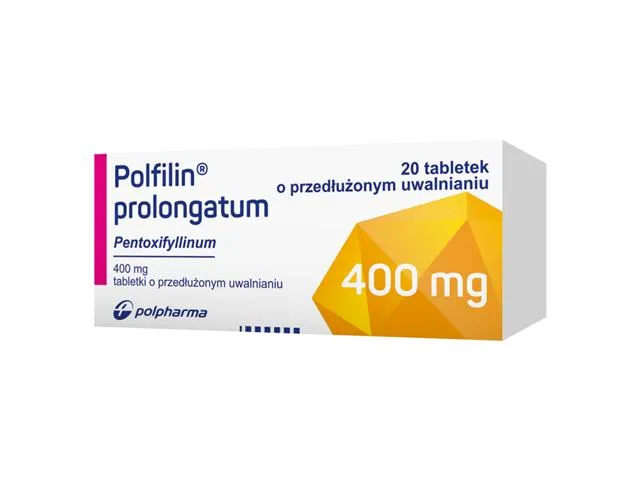
Table of Contents
- Package leaflet: information for the patient
- 1. What Polfilin prolongatum is and what it is used for
- 2. Important information before using Polfilin prolongatum
- 3. How to use Polfilin prolongatum
- 4. Possible adverse reactions
- 5. How to store Polfilin prolongatum
- 6. Contents of the pack and other information
Package leaflet: information for the patient
Polfilin prolongatum, 400 mg, prolonged-release tablets
Pentoxifylline
Please read the entire leaflet carefully before using the medicine, as it contains important information for the patient.
- Keep this leaflet, so that you can read it again if necessary.
- If you have any questions, please consult your doctor or pharmacist.
- This medicine has been prescribed for a specific individual. Do not pass it on to others. The medicine may harm another person, even if their symptoms are the same.
- If you experience any adverse reactions, including any not listed in this leaflet, inform your doctor or pharmacist. See section 4.
Table of contents of the leaflet
- What Polfilin prolongatum is and what it is used for
- Important information before taking Polfilin prolongatum
- How to take Polfilin prolongatum
- Possible side effects
- How to store Polfilin prolongatum
- Contents of the pack and other information
1. What Polfilin prolongatum is and what it is used for
Pentoxifylline, the active substance of the medicine, is a synthetic xanthine derivative. It improves blood flow in capillaries by reducing blood viscosity and increasing the flexibility of red blood cells. In this way, it may enhance perfusion of ischemic tissues, including those of the brain and lower limbs.
Indications for use of the medicine are as follows:
- Intermittent claudication;
- Circulatory disorders in the ocular bulb (acute and chronic circulatory disorders in the retina and choroid of the eye);
- Inner ear function disorders (e.g. hearing disturbances, sudden hearing loss, etc.) caused by circulatory changes;
- Cerebral ischemia (e.g. post-stroke conditions, vascular-origin brain function disorders with symptoms such as lack of concentration, dizziness, memory disturbances).
2. Important information before using Polfilin prolongatum
When not to use Polfilin prolongatum:
- if the patient is allergic to pentoxifylline or any of the other ingredients of this medicine (listed in section 6), or to methylxanthines (caffeine, theophylline, theobromine);
- if the patient has recently suffered a myocardial infarction or stroke;
- if the patient has severe bleeding or disorders associated with a high risk of haemorrhage;
- if the patient has experienced retinal haemorrhage.
Warnings and precautions
Before starting treatment with Polfilin prolongatum, discuss this with your doctor or
pharmacist.
If the patient experiences first signs of allergy—wheezing, difficulty breathing,
swelling of the face, eyelids, lips, tongue, throat or larynx, itchy rash, blisters or skin erythema—discontinue the medicine immediately and contact your doctor.
It is very important to inform your doctor about any health problems before taking this medicine, as some patients require close medical supervision, particularly:
- patients with hypotension or severe coronary artery disease, myocardial infarction, severe cardiac arrhythmias;
- patients with increased tendency to bleed, e.g. due to anticoagulant therapy or coagulation disorders;
- patients with impaired renal function (creatinine clearance less than 30 ml/min)—the doctor will reduce the daily dose of pentoxifylline to prevent drug accumulation (see section 3);
- patients with severe hepatic impairment—the doctor will reduce the dose (see section 3);
- patients receiving pentoxifylline concomitantly with antidiabetic agents.
Polfilin prolongatum and other medicines
Inform your doctor or pharmacist about all medicines currently taken or taken recently, as well as any medicines the patient plans to use.
The medicines listed below may be marketed under several different brand names. These brand names will not be listed here; only active substances or their groups are mentioned. Therefore, carefully check the packaging and the leaflet of the medicine being used for the name of its active ingredient.
- Pentoxifylline may enhance the effect of antihypertensive drugs and other agents that may lower arterial blood pressure.
- Concomitant use with theophylline may lead to increased blood levels and thus increased adverse effects of theophylline.
- Anticoagulants and other drugs affecting blood coagulation may interact with pentoxifylline. Concurrent use of pentoxifylline with these drugs increases the risk of bleeding.
- Pentoxifylline should not be used concomitantly with ketorolac due to increased risk of bleeding and/or prolonged prothrombin time.
- When used concomitantly with oral antidiabetic agents or insulin, the effect of antidiabetic drugs may be enhanced, leading to life-threatening reduction in blood glucose levels, manifested by: intense feeling of hunger, weakness, nausea, vomiting, restlessness, profuse sweating, rapid heartbeat, tremor, impaired motor coordination, convulsions, drowsiness.
Polfilin prolongatum with food and drink
See section 3.
Pregnancy and breastfeeding
If the patient is pregnant or breastfeeding, suspects she may be pregnant, or is planning to have a child, she should consult her doctor or pharmacist before using this medicine.
Due to insufficient data on the use of pentoxifylline in pregnant women, the use of this medicine during pregnancy is not recommended.
Pentoxifylline passes into breast milk. Consult your doctor before using this medicine.
Driving and operating machinery
In some patients, adverse effects such as dizziness have been observed, which may impair psychophysical performance. If such adverse effects occur, the patient should not drive or operate machinery.
3. How to use Polfilin prolongatum
This medicine should always be used as directed by a physician or pharmacist. If in doubt,
consult a physician or pharmacist.
- Tablets should be taken whole, after meals, with an adequate amount of fluid.
- Duration of treatment depends on the type of disease and is determined individually by the physician.
- In patients with low or fluctuating blood pressure, dosage adjustment may be necessary, as advised by the physician.
Recommended dose
Adults
1 prolonged-release tablet (corresponding to 400 mg pentoxifylline) 2 to 3 times daily.
In patients with severe circulatory disorders, the effect of the medicine may be enhanced by
concomitant intravenous administration of pentoxifylline.
In patients with impaired renal function (creatinine clearance less than 30 ml/min), the physician
will recommend reducing the dose to 50–70% of the standard dose—depending on individual tolerance,
e.g., taking two instead of three tablets per day.
Dose reduction is necessary in patients with severe hepatic impairment.
The treating physician will determine the dose based on severity of symptoms and tolerance to the medicine.
Use in children and adolescents
Safety and efficacy of this medicine in children have not been established.
Use of a higher than recommended dose of Polfilin prolongatum
If a higher than recommended dose is taken, seek immediate advice from a physician or
pharmacist.
Symptoms of overdose may include: dizziness, nausea, frothy vomiting, hypotension, tachycardia,
cardiac arrhythmias, sudden facial flushing, tonic-clonic seizures, loss of consciousness, fever,
agitation, and absence of reflexes. In case of poisoning, immediate medical consultation is required.
Missed dose of Polfilin prolongatum
If a dose is missed, take it as soon as possible. If it is almost time for the next dose, do not
take a double dose.
Stopping Polfilin prolongatum
If you have any further doubts regarding the use of this medicine, consult a physician or pharmacist.
4. Possible adverse reactions
Like all medicines, this medicine can cause adverse reactions, although not everyone experiences them.
The adverse reactions listed below are categorized according to their frequency of occurrence.
In rare cases, severe hypersensitivity reactions (angioedema, bronchospasm, anaphylactic shock) may develop within the first minutes after administration, manifesting as a drop in blood pressure, weakness, fainting, wheezing, breathing difficulties, swelling of the face, eyelids, lips, tongue, throat and larynx, itchy rash, skin blisters and redness. If such symptoms occur in a patient, the medicine must be discontinued and immediate contact with a physician is required.
Rare (may affect up to 1 to 10 in 10,000 people):
- hypersensitivity reactions (symptoms listed above);
- dizziness and headache;
- arrhythmia, increased heart rate (occurring primarily during administration of high doses of pentoxifylline).
Very rare (may affect fewer than 1 in 10,000 people):
- thrombocytopenia (reduced number of blood platelets);
- angina-like symptoms (chest tightness and pain) – occurring primarily during administration of high doses of pentoxifylline;
- restlessness and sleep disturbances;
- cases of bleeding (e.g. skin and mucosal petechiae, coffee-ground vomiting, blood in stool), especially in patients with increased bleeding tendency;
- intrahepatic cholestasis (impaired bile excretion from the liver – bile stasis);
- increased liver enzyme activity (aminotransferases, alkaline phosphatase).
Frequency not known (cannot be estimated from available data):
- aseptic meningitis (manifesting as headache, fever, neck stiffness) – mainly reported in patients with connective tissue disorders;
- hot flushes (facial redness, sensation of heat), hypotension (low blood pressure);
- gastrointestinal disturbances such as nausea, vomiting, bloating, feeling of fullness and diarrhea.
Reporting of adverse reactions
If any adverse reactions occur, including any not listed in this leaflet, inform your doctor, pharmacist, or nurse. Adverse reactions can be reported directly to the Department of Monitoring Adverse Drug Reactions of the Office for Registration of Medicinal Products, Medical Devices and Biocidal Products
Al. Jerozolimskie 181C
02-222 Warszawa
Tel.: + 48 22 49 21 301
Fax: + 48 22 49 21 309
Website: https://smz.ezdrowie.gov.pl
Adverse reactions can also be reported to the marketing authorization holder.
Reporting adverse reactions helps to provide more information on the safety of the medicine.
5. How to store Polfilin prolongatum
Keep the medicine out of the sight and reach of children.
Store below 25°C.
Do not use this medicine after the expiry date stated on the carton and blister pack. The expiry date refers to the last day of the stated month.
The marking on the packaging: EXP indicates the expiry date, and Lot/LOT indicates the batch number.
Medicines should not be disposed of via wastewater or household waste. Ask your pharmacist what to do with medicines no longer required. Proper disposal helps protect the environment.
6. Contents of the pack and other information
What Polfilin prolongatum contains
- The active substance is pentoxifylline. Each prolonged-release tablet contains 400 mg of pentoxifylline.
- The other ingredients are: hypromellose, ammonio methacrylate copolymer (type A), methacrylic acid and methyl methacrylate copolymer (1:1), magnesium stearate, talc – forming the tablet core; and hypromellose, polyethylene glycol 6000, titanium dioxide, talc – forming the tablet coating.
What Polfilin prolongatum looks like and contents of the pack
Polfilin prolongatum is white, round, biconvex tablets.
The pack contains 20 or 60 prolonged-release tablets.
Marketing Authorisation Holder and Manufacturer
Zakłady Farmaceutyczne POLPHARMA S.A.
ul. Pelplińska 19
83-200 Starogard Gdański
tel. + 48 22 364 61 01