Plofed 1%
Poland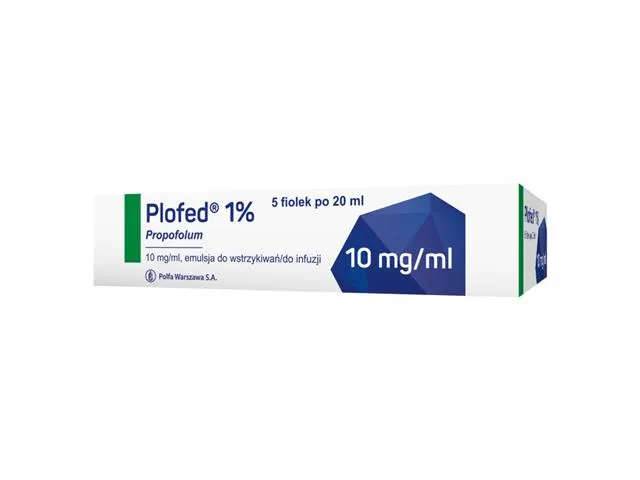
Table of Contents
Package leaflet: Information for the patient
PLOFED 1%, 10 mg/ml, emulsion for injection / for infusion
Propofolum
Please read the entire leaflet carefully before using the medicine, as it contains
important information for the patient.
- Keep this leaflet, as you may need to read it again.
- If you have any questions, please consult your doctor, pharmacist, or nurse.
- This medicine has been prescribed for a specific individual. Do not pass it on to others. The medicine may harm another person, even if their symptoms are the same.
- If you experience any adverse reactions, including any adverse reactions not listed in this leaflet, inform your doctor, pharmacist, or nurse. See section 4.
Table of contents
- What is Plofed 1% and what is it used for
- Important information before using Plofed 1%
- How to use Plofed 1%
- Possible side effects
- How to store Plofed 1%
- Contents of the pack and other information
1. What is Plofed 1% and what is it used for
Plofed 1% contains propofol – a substance belonging to the group of general anaesthetics.
Plofed 1% is administered intravenously by a doctor for the following purposes:
- to induce and maintain sedation or general anaesthesia in adults and children over one month of age during surgery or other procedures;
- to induce sedation in patients over 16 years of age during their stay in intensive care units;
- to induce sedation during surgery or other procedures in adults and children over one month of age; Plofed 1% may be administered as the sole agent or in combination with other medicines used in local and regional anaesthesia.
2. Information before using Plofed 1%
When not to use Plofed 1%:
- if the patient is allergic to propofol or any of the other ingredients of this medicine (listed in section 6);
- if the patient is allergic to peanuts or soya, because Plofed 1% contains soya oil;
- if the patient is pregnant (see section: "Pregnancy and breastfeeding");
- to induce sedation in intensive care patients aged 16 years and younger.
Tell your doctor or nurse if any of the above situations apply to you (even if you are not certain).
Warnings and precautions
Talk to your doctor, pharmacist, or nurse before using Plofed 1%.
Plofed 1% is administered by anaesthesiologists or doctors specialised in intensive care. During treatment, they will provide appropriate care and, if necessary, administer oxygen therapy and take other appropriate measures to support vital functions.
Therefore, it is very important that your doctor knows about all of the patient's medical conditions, especially if:
- the patient has ever had seizures or epileptic fits;
- the patient has suffered a head injury;
- the patient is receiving high doses of one or more of the following medicines: vasoconstrictors, steroids;
- the patient has been diagnosed with very high levels of blood fats or lipid metabolism disorders;
- the patient is dehydrated, i.e. has lost a lot of fluid from the body;
- the patient has or has had health problems with the heart, breathing, kidneys or liver (e.g. kidney or liver failure has been diagnosed);
- the patient is weak or has been feeling unwell recently;
- the patient has a mitochondrial disease.
Patients with severe heart or breathing problems, elderly patients, and weakened individuals should be under special medical supervision.
At the beginning of administration, the patient may experience a significant drop in blood pressure and transient breathing difficulties (apnoea). The doctor will prevent these by administering intravenous fluids and reducing the infusion rate.
The medicine may cause slowing of the heart rate, sometimes severe, even leading to cardiac arrest – in such a case, the doctor will administer another intravenous medicine to counteract these effects.
After surgery during which Plofed 1% was used, disinhibition of a sexual nature (feeling of sexual arousal) may occur.
Impaired consciousness caused by Plofed 1% usually does not last longer than 12 hours. The effect of Plofed 1%, the procedure, concomitant medicines, age and condition of the patient should all be taken into account.
The doctor will advise the patient on:
- the need for a companion when leaving the place where the medicine was administered;
- the time required before returning to perform complex or risky tasks, such as driving a vehicle;
- the use of other substances that may have a sedative effect (e.g. benzodiazepines, opioids, alcohol).
Children and adolescents
Plofed 1% is not recommended for use in newborns.
The doctor may use Plofed 1% in children who are at least one month old to induce general anaesthesia during surgery or a procedure.
See also the section "When not to use Plofed 1%" above.
Animal studies indicate that general anaesthetics may adversely affect brain development in children. The doctor will assess the benefit and risk of using this medicine.
Plofed 1% and other medicines
Tell your doctor or pharmacist about all medicines you are currently taking, have recently taken, or plan to take.
Strong painkillers (including opioids), alcohol, and medicines used for general anaesthesia may enhance the sedative effect of Plofed 1% and cause serious problems with the respiratory and circulatory systems.
Severe hypotension has been reported after anaesthesia with propofol in patients treated with rifampicin.
It has been observed that patients taking valproate require lower doses of propofol.
When both medicines are used concomitantly, a reduced dose of propofol may be considered.
Plofed 1% and alcohol
Do not consume alcohol before receiving the medicine or within 8 hours after administration.
Pregnancy and breastfeeding
If you are pregnant or breastfeeding, think you may be pregnant, or are planning to have a baby, consult your doctor or pharmacist before using this medicine.
Pregnancy
The safety of propofol use during pregnancy has not been established. Plofed 1% should not be used during pregnancy unless absolutely necessary.
Breastfeeding
Inform your doctor if you are breastfeeding. Studies in breastfeeding women have shown that small amounts of propofol pass into breast milk. Therefore, mothers should interrupt breastfeeding for 24 hours after receiving Plofed 1%. Milk collected during this period should be discarded.
Driving and operating machinery
After administration of Plofed 1%, drowsiness may persist for some time, making it unsafe to drive or operate machinery. Do not perform these activities until drowsiness has subsided. Ask your doctor when it is safe to drive or operate machinery after the procedure. Impaired consciousness caused by Plofed 1% usually does not last longer than 12 hours.
Plofed 1% contains soya oil and sodium
The medicine contains soya oil. Do not use if you are allergic to peanuts or soya.
The medicine contains less than 1 mmol of sodium (23 mg) per 100 ml of emulsion, meaning the medicine is considered "sodium-free".
The medicine may be diluted – see below "Information intended exclusively for healthcare professionals". The sodium content from the diluent should be taken into account when calculating the total sodium content of the prepared diluted solution. For accurate information on the sodium content of the solution used for dilution, refer to the Summary of Product Characteristics of the diluent used.
3. How to use Plofed 1%
Plofed 1% is administered intravenously by a doctor, usually an anaesthesiologist. The medicine may be injected into a vein or given slowly as an intravenous infusion (using appropriate equipment with controlled rate).
Intravenous infusion is used during long surgeries or in intensive care units.
The dose of Plofed 1% may vary between individual patients. The doctor will determine the dose depending on the patient's age, body weight, health status, duration of surgery, and the desired level of sedation or sleep required for the procedure, monitoring the patient's level of anaesthesia or sedation and vital functions (pulse, blood pressure, respiratory function, etc.). The doctor will provide detailed information regarding dosing.
Administration of a higher than recommended dose of Plofed 1%
Plofed 1% is administered by a doctor, so it is unlikely that a patient would receive more medicine than intended. If symptoms of overdose occur, the doctor will initiate appropriate treatment.
Administration of large doses exceeding the recommended doses, especially over several hours, may result in accumulation of acidic metabolites in the blood, such as carbohydrates (metabolic acidosis), increased potassium levels in the blood, and muscle pain (due to severe changes in muscle cells).
4. Possible adverse reactions
Like all medicines, this medicine can cause adverse reactions, although not everybody will experience them.
The type, severity and frequency of adverse reactions observed in patients receiving propofol may be related to the patient's condition and the surgical or therapeutic procedure being performed. While the medicine is being administered, the patient is under the supervision of medical personnel – if any adverse reactions occur, appropriate treatment will be provided.
Very common (in more than 1 in 10 people):
- pain at the injection site (occurring during injection of the medicine).
Common (in 1 to 10 in 100 people):
- headache during emergence from anaesthesia;
- slowed heart rate (in isolated cases, cardiac arrest);
- low blood pressure;
- changes in breathing rate, including transient breathing difficulties (apnoea) during induction of anaesthesia;
- nausea and vomiting during emergence from anaesthesia.
Uncommon (in 1 to 10 in 1,000 people):
- swelling and redness along the vein or thrombophlebitis.
Rare (in 1 to 10 in 10,000 people):
- tremors and body jerks or convulsive seizures (may occur during induction, maintenance or emergence from anaesthesia).
Very rare (in fewer than 1 in 10,000 people):
- allergic reactions (symptoms: wheezing, facial swelling, swelling of lips, tongue, urticaria, rash, flushing, low blood pressure);
- prolonged time to awakening;
- pulmonary oedema;
- pancreatitis, presenting as severe abdominal pain;
- unusual urine discoloration (after prolonged administration of the medicine);
- sensation of sexual excitation (sexual disinhibition);
- tissue necrosis following accidental extravasation of the medicine;
- postoperative fever.
Frequency not known (cannot be estimated from available data):
- presence in blood of acidic metabolic products (metabolic acidosis), elevated potassium levels in blood (hyperkalaemia), increased blood levels of fats known as lipids (hyperlipidaemia), liver enlargement (hepatomegaly), breakdown of muscle cells (rhabdomyolysis), kidney failure, cardiac arrhythmias, ECG changes, rapidly progressive heart failure in adults – these are symptoms of "propofol infusion syndrome", which may occur in critically ill patients at risk of developing these complications;
- euphoria, drug abuse, drug dependence – primarily among medical personnel;
- involuntary movements, uncoordinated and uncontrollable movements of limbs or the whole body; disturbances in voluntary (intentional) movements and/or muscle tone;
- respiratory depression (increased difficulty in breathing), dose-dependent;
- pain, swelling at the injection site, following accidental extravascular administration of the medicine;
- hepatitis, acute liver failure [symptoms may include yellowing of the skin and eyes (jaundice), itching, dark urine, abdominal pain and liver tenderness (referred to as pain under the front part of the rib cage on the right side of the body), sometimes with loss of appetite].
Reporting of adverse reactions
If any adverse effects occur, including any not listed in this leaflet, inform your doctor, pharmacist or nurse. Adverse reactions can be reported directly to the Department of Monitoring Adverse Drug Reactions of the Office for Registration of Medicinal Products, Medical Devices and Biocidal Products
Al. Jerozolimskie 181C
02-222 Warsaw
Tel.: +48 22 49 21 301
Fax: +48 22 49 21 309
Website: https://smz.ezdrowie.gov.pl
Adverse reactions can also be reported to the marketing authorization holder.
Reporting adverse reactions helps provide more information on the safety of the medicine.
5. How to store Plofed 1%
Keep the medicine out of sight and reach of children.
Store below 25°C. Protect from light. Do not freeze.
Shelf-life after first opening: the emulsion should be used immediately after opening the vial.
Shelf-life of diluted Plofed 1% product:
After dilution with 5% glucose solution (50 mg/ml), 0.9% sodium chloride solution (9 mg/ml),
or a mixture of 0.18% sodium chloride solution (1.8 mg/ml) and 4% glucose solution (40 mg/ml)
in polyethylene or glass containers, chemical and physical stability has been demonstrated for
12 hours at 25°C.
Dilutions should be prepared immediately before administration.
From a microbiological standpoint, the diluted medicine should be used immediately. If not
used immediately, the user is responsible for the conditions and duration of storage. If necessary,
the prepared mixture may be stored for up to 12 hours at a temperature not exceeding 25°C,
provided that dilution is carried out under controlled and validated aseptic conditions. Any unused
mixture after 12 hours must be discarded. The diluted product does not require protection from light during storage.
Do not use this medicine after the expiry date stated on the carton. The expiry date refers to the last day of the stated month.
The label on the packaging shows "EXP" followed by the expiry date, and "Lot" followed by the batch number.
Medicines must not be disposed of via wastewater or household waste. Ask your pharmacist what to do with medicines no longer in use. This will help protect the environment.
6. Contents of the pack and other information
What Plofed 1% contains
- The active substance is propofol. Each ml contains 10 mg of propofol. Each vial contains 200 mg of propofol.
- Other components are: glycerol, oleic acid, lecithin (purified from egg), purified soybean oil, 0.1 M sodium hydroxide (for pH adjustment), water for injections.
What Plofed 1% looks like and contents of the pack
Plofed 1% is an emulsion for injection/infusion. It is opaque, white or almost white.
The medicine is available in vials containing 20 ml of solution, packed in cardboard boxes of 5 or 10 vials.
Marketing Authorisation Holder and Manufacturer
Marketing Authorisation Holder
Zakłady Farmaceutyczne POLPHARMA S.A.
ul. Pelplińska 19, 83-200 Starogard Gdański
tel. +48 22 364 61 01
Manufacturer
Warszawskie Zakłady Farmaceutyczne Polfa S.A.
ul. Karolkowa 22/24; 01-207 Warszawa
Detailed information about this medicine is available on the website www.urpl.gov.pl
Information intended exclusively for healthcare professionals:
PLOFED 1%, 10 mg/ml, emulsion for injection / for infusion
Propofolum
Please refer to the current Summary of Product Characteristics.
Method of administration
Plofed 1% has no analgesic effect and therefore analgesics should be administered concomitantly.
Plofed 1% may be administered:
- as intravenous bolus injections – undiluted,
- by intravenous infusion – using diluted or undiluted solution.
The medicine may be administered in diluted form. It may be diluted with the following infusion solutions: 5% glucose solution (50 mg/ml); 0.9% sodium chloride solution (9 mg/ml); a mixture of 0.18% sodium chloride solution (1.8 mg/ml) and 4% glucose solution (40 mg/ml) in glass or polyethylene containers.
The dilution should be prepared as follows: 1 volume of propofol should be diluted with 4 volumes of the above-mentioned diluent. The resulting concentration of propofol in the diluted mixture is 2 mg per 1 ml. Aseptic conditions must be maintained during preparation.
Chemical and physical stability has been demonstrated for 12 hours at 25°C.
Diluted solutions should be prepared immediately before administration.
From a microbiological point of view, the diluted product should be used immediately. If not used immediately, the user is responsible for storage conditions and duration. If necessary, the prepared mixture may be stored for up to 12 hours at a temperature not exceeding 25°C, provided that the dilution is prepared under controlled and validated aseptic conditions. Any unused mixture after 12 hours must be discarded. The diluted product does not require protection from light during storage.
It is recommended that when diluting Plofed 1%, the volume of infusion solution removed from the container should be replaced with an equal volume of Plofed 1%.
The diluted medicine may be administered using one of several methods for regulating infusion rate. To prevent uncontrolled administration of a large volume of diluted medicine, the infusion set should include a burette, drip counter, or volumetric infusion pump. Even when the burette is completely filled with diluted medicine, there remains a risk of uncontrolled infusion.
If undiluted Plofed 1% is used to maintain anaesthesia, syringe or volumetric pumps are recommended to ensure accurate infusion rate.
The medicine may be administered via a Y-connector (placed as close as possible to the intravenous cannula) simultaneously with one of the following infusion fluids:
- 5% glucose solution (50 mg/ml);
- 0.9% sodium chloride solution (9 mg/ml);
- a mixture of 0.18% sodium chloride solution (1.8 mg/ml) and 4% glucose solution (40 mg/ml).
To reduce pain associated with the initial injection of propofol, lidocaine may be added by preparing immediately before administration a mixture containing 20 parts of propofol and 1 part of 0.5% or 1% lidocaine hydrochloride solution without preservatives.
Additional precautions
- Plofed 1% is an emulsion for injection/infusion. The emulsion should be opaque, white or almost white. Do not use if visible changes in colour occur.
- Vials should be shaken before use. Do not use if phase separation of the emulsion is observed.
- Do not use if the vial is damaged.
- Plofed 1% does not contain preservatives, which may promote microbial growth.
- All procedures involving withdrawal and administration of the medicine must be performed under aseptic conditions.
- Aseptic techniques must be maintained for both Plofed 1% and the equipment used during infusion.
- The emulsion should be drawn into a sterile syringe or infusion set immediately after opening the vial and administered without delay.
- All other medicines or fluids added to the line containing Plofed 1% should be administered as close as possible to the intravenous cannula.
- Plofed 1% must not be administered through microbiological filters.
- Plofed 1% vials and any syringe containing Plofed 1% are intended for single use only and for one patient only.
- In accordance with established guidelines for other lipid emulsions, a single propofol infusion must not last longer than 12 hours. At the end of the procedure or after 12 hours, whichever comes first, both the container with propofol and the infusion line must be replaced.
- After propofol, without prior flushing of the infusion set, neuromuscular blocking agents (atracurium, mivacurium) should not be administered.
- The medicine is intended for single use. Any unused portion of the medicine must be discarded.
Dosage
Induction of general anaesthesia
Adults
For patients with or without premedication, propofol may be administered as intravenous bolus injections or by intravenous infusion, dosed according to patient response until clinical signs of anaesthesia appear (approximately 40 mg, i.e. 4 ml of the medicine every 10 seconds, for an average healthy patient).
- For most adult patients under 55 years of age: the usual dose of propofol is 1.5 mg/kg to 2.5 mg/kg. The total dose required for anaesthesia induction may be reduced by prolonging the administration time and reducing the infusion rate to approximately 20–50 mg/min (2 to 5 ml/min).
- Patients over 55 years of age: propofol requirements are lower. For patients classified as ASA class 3 or 4 (American Society of Anesthesiologists), smaller doses should be used, i.e. approximately 20 mg (2 ml) every 10 seconds.
Elderly patients
In elderly patients, doses of propofol for induction of general anaesthesia are lower. Dose reduction should take into account the patient's clinical condition and age. Reduced doses should be administered at a slower rate and adjusted according to the patient's clinical response.
Children and adolescents
Propofol is not recommended for induction of general anaesthesia in children under one month of age (see section 1).
When propofol is used for induction of general anaesthesia in children over one month of age, it should be administered slowly until clinical signs of anaesthesia appear. The dose should be adjusted according to the child's age and/or body weight. In most children over 8 years of age, a dose of approximately 2.5 mg/kg of propofol is usually sufficient for induction. In younger children, especially between one month and 3 years of age, higher doses may be required (2.5 to 4 mg/kg).
In children and adolescents classified as ASA class 3 or 4, smaller doses are recommended.
Maintenance of general anaesthesia
Adults
To maintain the desired depth of anaesthesia with propofol, the medicine may be administered by continuous infusion or repeated bolus injections. Recovery from anaesthesia is rapid; therefore, it is important to continue administering propofol until the end of the procedure.
- Continuous intravenous infusion: the infusion rate required to maintain adequate anaesthesia depth varies significantly between individual patients and usually ranges from 4 mg/kg/h to 12 mg/kg/h.
- Repeated bolus injections: when using repeated bolus technique, doses of 25 mg to 50 mg (2.5 to 5 ml) may be administered, depending on clinical need.
Elderly patients
When propofol is used to maintain general anaesthesia, the infusion rate and target concentration should be reduced. Patients classified as ASA class 3 or 4 require reduced doses and slower administration rates. In elderly patients, propofol should not be administered as single or repeated bolus injections, as respiratory and circulatory depression may occur.
Children and adolescents
Propofol is not recommended for maintenance of general anaesthesia in children under one month of age (see section 1).
To maintain anaesthesia in children over one month of age, propofol may be administered by continuous intravenous infusion or repeated bolus injections.
The infusion rate may vary between patients and usually ranges from 9 mg/kg/h to 15 mg/kg/h. Younger children, especially between one month and 3 years of age, may require higher doses of propofol. In children and adolescents classified as ASA class 3 or 4, smaller doses are recommended.
Sedation during intensive care
Adults
If sedation of adult patients is required, propofol should be administered by continuous intravenous infusion. The infusion rate should be adjusted according to the desired level of sedation. In most patients, adequate sedation is achieved with doses of 0.3 mg/kg/h to 4.0 mg/kg/h of propofol. The use of Plofed 1% for sedation during intensive care in patients aged 16 years and younger is not indicated.
Plofed 1% may be diluted – see above "Method of administration".
Monitoring of blood lipid levels is recommended during administration in patients at risk of lipid overload. Administration of Plofed 1% should be adjusted appropriately if monitoring indicates inadequate lipid clearance. If the patient is simultaneously receiving other intravenous lipids, the total lipid load should be considered, including the amount delivered via Plofed 1% infusion.
1.0 ml of Plofed 1% contains approximately 0.1 g of fat.
If sedation lasts longer than 3 days, blood lipid levels should be monitored in all patients.
Elderly patients
When propofol is used for sedation, the infusion rate should be reduced. Patients classified as ASA class 3 or 4 require further dose reduction and slower administration rates. In elderly patients, propofol should not be administered as single or repeated bolus injections, as respiratory and circulatory depression may occur.
Children and adolescents
The use of propofol for sedation in children and adolescents aged 16 years and younger in intensive care units is contraindicated.
Sedation during diagnostic and surgical procedures
Adults
For sedation required during diagnostic or surgical procedures, the dose should be individually titrated according to the patient's clinical response.
For induction of sedation in most patients, a dose of 0.5 to 1.0 mg/kg administered over 1 to 5 minutes is required.
Maintenance of the desired depth of sedation is achieved by adjusting the propofol infusion rate – most patients will require 1.5 to 4.5 mg/kg/h. If rapid deepening of sedation is needed, an additional bolus injection of propofol (10 to 20 mg) may be administered.
In patients classified as ASA class 3 or 4, the administration rate and doses of propofol should be reduced.
Elderly patients
When propofol is used for sedation, the infusion rate or target concentration should be reduced. Patients classified as ASA class 3 or 4 require further dose reduction and slower administration rates. In elderly patients, propofol should not be administered as single or repeated bolus injections, as respiratory and circulatory depression may occur.
Children and adolescents
Propofol is not recommended for sedation during diagnostic and surgical procedures in children under one month of age (see section 1).
In children over one month of age, doses and administration rates should be adjusted according to the desired level of sedation and clinical response. In most children, a dose of 1 to 2 mg/kg of propofol is usually used to induce sedation. To maintain sedation, propofol should be administered by infusion, with the dose adjusted to the desired sedation level. In most patients, doses of 1.5 to 9 mg/kg/h of propofol are used.
If rapid deepening of sedation is required, an additional bolus injection of propofol up to 1 mg/kg may be administered.
In children and adolescents classified as ASA class 3 or 4, smaller doses may be required.