Phenylephrine aguettant
Poland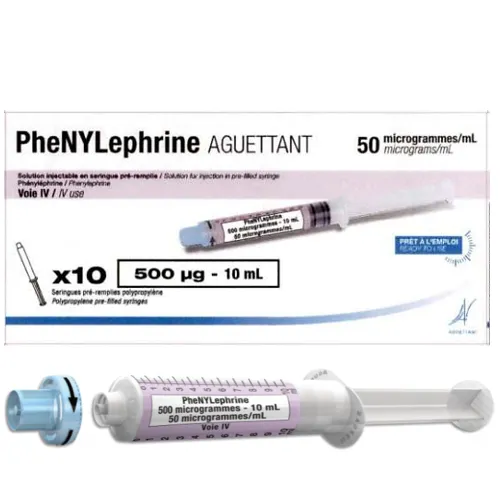
Table of Contents
Package leaflet: Information for the patient
Phenylephrine Aguettant, 100 micrograms/ml, solution for injection/infusion
Phenylephrinum
Please read carefully the entire leaflet before using this medicine, because it contains
important information for the patient.
- Keep this leaflet, as you may need to read it again.
- If you have any further questions, please consult your doctor, pharmacist, or nurse.
- If you experience any adverse reactions, including any not listed in this leaflet, inform your doctor, pharmacist, or nurse. See section 4.
Contents of the leaflet
- What Phenylephrine Aguettant is and what it is used for
- Important information before using Phenylephrine Aguettant
- How to use Phenylephrine Aguettant
- Possible side effects
- How to store Phenylephrine Aguettant
- Contents of the package and other information
1. What Phenylephrine Aguettant is and what it is used for
This medicine belongs to a group of agents acting as adrenergic and dopaminergic receptor agonists.
It is used in the treatment of low blood pressure during anesthesia.
2. Important information before using Phenylephrine Aguettant
Do not use Phenylephrine Aguettant:
- if the patient is allergic to phenylephrine hydrochloride or to any of the other ingredients of this medicine (listed in section 6);
- if the patient has severe hypertension or suffers from peripheral vascular disease (poor blood circulation);
- if the patient is taking monoamine oxidase inhibitors (MAO inhibitors) (or within 2 weeks after discontinuation), used in the treatment of depression (e.g. iproniazid, nialamide);
- if the patient has severe hyperthyroidism.
Warnings and precautions
Before starting treatment with Phenylephrine Aguettant, discuss the following with your doctor, pharmacist, or nurse:
- if the patient is elderly;
- if the patient has diabetes;
- if the patient has hypertension;
- if the patient has hyperthyroidism (uncontrolled hyperthyroidism);
- if the patient suffers from vascular diseases such as atherosclerosis (hardening and thickening of blood vessel walls);
- if the patient has a condition that may lead to poor cerebral blood circulation;
- if the patient has an aneurysm;
- if the patient has heart diseases, including chronic heart disease, peripheral vascular insufficiency (non-severe), cardiac arrhythmias, tachycardia (abnormally fast heart rate), bradycardia (abnormally slow heart rate), partial heart block, or angina pectoris;
- if the patient has closed-angle glaucoma (a rare eye condition).
In patients with severe heart failure, phenylephrine may worsen heart failure due to vasoconstriction.
During treatment, the patient's blood pressure will be monitored. Additional monitoring of vital functions will be performed in patients with heart disease.
Children
This medicine is not recommended for use in children due to insufficient data on efficacy, safety, and dosing.
Phenylephrine Aguettant and other medicines
Inform your doctor about all medicines currently used or recently used, as well as any medicines the patient plans to use, such as:
- certain antidepressants (iproniazid, nialamide, moclobemide, toloxatone, imipramine, mianserin, or venlafaxine);
- medicines used to treat infections (linezolid);
- certain medicines used to treat migraine (dihydroergotamine, ergotamine, methylergometrine, methysergide);
- certain medicines used to treat Parkinson's disease (bromocriptine, lisuride, pergolide);
- a medicine used to inhibit the secretion of the hormone responsible for lactation (cabergoline);
- inhaled anesthetics (desflurane, enflurane, halothane, isoflurane, methoxyflurane, sevoflurane);
- a medicine used to reduce appetite (sibutramine);
- a medicine used to treat high blood pressure (guanethidine);
- medicines used to treat heart failure and certain cardiac arrhythmias (cardiac glycosides);
- a medicine used to treat cardiac arrhythmia (quinidine);
- a medicine used during childbirth (oxytocin).
Pregnancy and breastfeeding
The safety of using this medicine during pregnancy and breastfeeding has not been established. However, if necessary, Phenylephrine Aguettant may be administered during pregnancy.
Use of this medicine is not recommended during breastfeeding. However, after a single dose administered during childbirth, breastfeeding is possible.
If the patient is pregnant or breastfeeding, suspects she may be pregnant, or plans to become pregnant, she should consult her doctor, pharmacist, or nurse before using this medicine.
Driving and operating machinery
Please consult your doctor if the patient plans to drive or operate machinery after receiving this medicine.
Phenylephrine Aguettant contains sodium
This medicine contains 78 mg of sodium (a main component of table salt) in each 20 ml vial. This corresponds to 4% of the recommended maximum daily dietary sodium intake for an adult.
3. How to use Phenylephrine Aguettant
The medicine is administered exclusively by medical personnel after appropriate training and with sufficient expertise to determine the appropriate dose for the patient, as well as the timing and method of injection administration.
Recommended doses are as follows:
Use in adults
The physician will determine the dose to be administered. The dose may be repeated or adjusted until the desired effect is achieved.
Use in patients with impaired kidney function (abnormal kidney function)
In patients with impaired kidney function, lower doses of phenylephrine may be required.
Use in patients with impaired liver function (abnormal liver function)
In patients with liver cirrhosis, higher doses of phenylephrine may be required.
Use in elderly patients
Caution should be exercised when treating elderly patients.
Use in children
The use of this medicine is not recommended in children due to insufficient data on efficacy, safety, and dosing recommendations.
Use of a higher than recommended dose of Phenylephrine Aguettant
The following symptoms may occur: palpitations, cardiac arrhythmias (tachycardia, heart rhythm disturbances), headache, nausea, vomiting, hallucinations, paranoid psychosis.
If you have any further doubts regarding the use of this medicine, consult your doctor, pharmacist, or nurse.
4. Possible adverse reactions
Like any medicine, this medicine may cause adverse reactions, although not everyone experiences them.
Some adverse reactions may be serious (frequency unknown). You should immediately contact a doctor if any of the following adverse reactions occur:
- chest pain or angina,
- irregular heartbeat,
- sensation of pounding in the chest,
- bleeding in the brain (speech disturbances, dizziness, paralysis on one side of the body),
- psychosis (loss of contact with reality).
Other possible adverse reactions (frequency unknown) include:
- hypersensitivity reaction (allergy),
- excessive pupil dilation,
- increased intraocular pressure (worsening of glaucoma),
- irritation (increased sensitivity of an organ or body part),
- excitation (restlessness),
- anxiety,
- disorientation,
- headache,
- nervousness,
- insomnia (difficulty falling or staying asleep),
- tremor,
- sensation of itching or tingling of the skin (paresthesia),
- slow or fast heartbeat,
- high blood pressure,
- breathing difficulties,
- presence of fluid in the lungs,
- nausea,
- vomiting,
- sweating,
- pale skin,
- goosebumps,
- tissue damage at injection site,
- muscle weakness,
- difficulty urinating or urinary retention.
Reporting of adverse reactions
If any adverse symptoms occur in a patient, including any possible adverse reactions not listed in this leaflet, inform a doctor, pharmacist, or nurse. Adverse reactions can be reported directly to:
Department for Monitoring of Adverse Drug Reactions
Office for Registration of Medicinal Products, Medical Devices and Biocidal Products
Al. Jerozolimskie 181C
PL-02 222 Warsaw
Tel.: +48 22 49 21 301
Fax: +48 22 49 21 309
Website: https://smz.ezdrowie.gov.pl
Adverse reactions may also be reported to the marketing authorization holder.
Reporting of adverse reactions helps to collect more information on the safety of the medicine.
5. How to store Phenylephrine Aguettant
Keep the medicine out of sight and reach of children.
Do not use this medicine after the expiry date stated on the label after EXP. The expiry date refers to the last day of the stated month. Your doctor or nurse will check the expiry date.
No special temperature requirements for storage.
Store the vial in the outer packaging to protect it from light.
Do not use this medicine if you notice any visible signs of deterioration.
Medicines must not be disposed of via wastewater or household waste. Ask your pharmacist how to dispose of medicines no longer in use. This will help protect the environment.
6. Contents of the packaging and other information
What Phenylephrine Aguettant contains
The active substance is phenylephrine hydrochloride.
- One ml of injection solution contains phenylephrine hydrochloride equivalent to 100 micrograms (0.1 mg) of phenylephrine.
- Each 20 ml vial contains phenylephrine hydrochloride equivalent to 2000 micrograms (2 mg) of phenylephrine.
- The other ingredients are sodium chloride, sodium citrate, citric acid monohydrate, sodium hydroxide, and water for injections.
What Phenylephrine Aguettant looks like and contents of the pack
Phenylephrine Aguettant is a clear, colourless injection solution, in a 20 ml transparent
vial made of type II glass, closed with a chlorobutyl rubber stopper and an aluminium cap.
Vials are available in packs containing 1 or 10 units.
Not all pack sizes may be marketed.
Marketing Authorisation Holder and Manufacturer
Laboratoire Aguettant
1 rue Alexander Fleming
69007 Lyon
France
Detailed information on this medicinal product is available on the website of the Office for Registration of Medicinal Products, Medical Devices and Biocidal Products.