Pevisone
Poland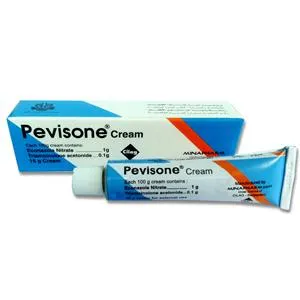
Table of Contents
Package leaflet: Information for the patient
PEVISONE, (10 mg + 1.1 mg)/g, cream
Econazole nitrate + Triamcinolone acetonide
Please read the following information carefully before using this medicine, as it contains
important information for the patient.
- Keep this leaflet for future reference.
- If you have any questions, please consult your doctor, pharmacist, or nurse.
- This medicine has been prescribed for a specific individual. Do not share it with others. This medicine may harm other people, even if their symptoms are the same.
- If you experience any adverse reactions, including any not listed in this leaflet, inform your doctor, pharmacist, or nurse. See section 4.
Table of contents:
- What Pevisone is and what it is used for
- Important information before using Pevisone
- How to use Pevisone
- Possible side effects
- How to store Pevisone
- Contents of the pack and other information
1. What Pevisone is and what it is used for
The active substances in Pevisone are econazole, in the form of econazole nitrate, and triamcinolone, in the form of triamcinolone acetonide.
Econazole nitrate is a topical antifungal agent, a triazole derivative.
Triamcinolone acetonide is a corticosteroid with moderately potent anti-inflammatory activity. When applied topically, it exerts anti-inflammatory, antipruritic, and vasoconstrictive effects.
Indications for Pevisone:
Treatment of fungal skin infections caused by dermatophytes and yeasts, associated with marked inflammatory symptoms.
2. Important information before using Pevisone
When not to use Pevisone
- if the patient is allergic to econazole or triamcinolone, or any of the other ingredients of this medicine (listed in section 6),
- if the patient has bacterial skin infections (e.g. tuberculosis),
- if the patient has viral skin infections (e.g. chickenpox, herpes),
- if the patient has post-vaccination reactions.
Warnings and precautions
Before starting treatment with Pevisone, discuss this with your doctor. Pevisone is intended for external use only. Do not apply Pevisone to the eyes, eyelids, or orally. If significant irritation or allergic reaction occurs, treatment should be discontinued.
Corticosteroids applied to the skin may be absorbed to a degree sufficient to cause systemic effects, including suppression of adrenal function. Systemic absorption may increase due to various factors such as application over a large skin surface, application to damaged skin, use under occlusive (sealed) dressings, and prolonged treatment duration.
Do not use this medicine in children under 16 years of age. In children, due to a higher body surface area to body weight ratio, suppression of the hypothalamic-pituitary-adrenal axis and adverse effects typical of corticosteroids, including growth and developmental disorders, may occur more easily than in adults.
Caution should be exercised when using Pevisone in adolescents over 16 years of age, and treatment should be discontinued if symptoms of hypothalamic-pituitary-adrenal axis suppression or Cushing's syndrome occur.
Repeated and/or prolonged local use of corticosteroids around the eyes may cause cataracts, increased intraocular pressure, or increase the risk of glaucoma.
The following have been reported during topical corticosteroid use: skin atrophy, striae, rosacea, perioral dermatitis, acne, telangiectasia, petechiae, excessive hair growth, and delayed wound healing.
Topically applied corticosteroids may increase the risk of recurrent skin infections and infections caused by microorganisms that normally do not cause disease in healthy individuals.
Overuse of the medicine, its application over large skin areas, or inappropriate long-term use may lead to withdrawal symptoms after stopping treatment.
If the condition recurs shortly after discontinuation of treatment, do not restart use of the cream without consulting a doctor, unless the doctor has previously advised otherwise.
If the condition has resolved, but upon recurrence redness spreads beyond the initial treatment area and burning occurs, consult a doctor before restarting treatment.
Children and adolescents
Do not use this medicine in children under 16 years of age.
Pevisone with other medicines
Tell your doctor or pharmacist about all medicines you are currently taking, have recently taken, or plan to take.
Although the systemic effect of econazole after topical application is limited, clinically significant interactions may occur, and such interactions have been observed during concomitant use of oral anticoagulants. If you are taking oral anticoagulants such as warfarin or acenocoumarol, inform your doctor, who should monitor your anticoagulant effect.
Pregnancy and breastfeeding
If you are pregnant, think you may be pregnant, or are planning to become pregnant, consult your doctor or pharmacist before using this medicine.
Pregnancy
Pevisone may be used during the first trimester of pregnancy only if the doctor considers it necessary. During the second and third trimesters of pregnancy, Pevisone may be used if, in the doctor's opinion, the potential benefits to the mother outweigh the possible risks to the fetus.
During pregnancy, avoid using the medicine in large doses, under occlusive dressings, or for prolonged periods.
Breastfeeding
If you are breastfeeding, consult your doctor or pharmacist before using this medicine.
Driving and operating machinery
No effects of Pevisone on the ability to drive or operate machinery have been observed.
Pevisone contains butylhydroxyanisole and benzoic acid
Due to the presence of butylhydroxyanisole (E 320), this medicine may cause local skin reactions (e.g. contact dermatitis) or irritation of the eyes and mucous membranes.
The medicine contains 2 mg of benzoic acid (E 210) per gram of cream, corresponding to 30 mg of benzoic acid in each 15 g tube. Benzoic acid may cause local irritation.
3. How to use Pevisone
This medicine should always be used as directed by a physician. If in doubt, consult your
doctor.
Pevisone should be rubbed into the infected areas of the skin no more than twice daily,
preferably in the morning and evening. The medicine should not be used under occlusive dressings or on
large areas of skin.
Treatment should continue until inflammatory symptoms have resolved, but not longer than 2 weeks. After 2
weeks of using Pevisone, your doctor may, if necessary, recommend continuing treatment with another medicine containing only econazole.
Excessive use of Pevisone, application over large skin areas, or prolonged improper use may lead to withdrawal symptoms, especially after abrupt discontinuation of treatment (see sections 2 and 4). Consult your doctor for advice.
Use in children and adolescents
Pevisone should not be used in children under 16 years of age.
Use of a higher than recommended dose of Pevisone
If a higher than recommended dose is used, contact your doctor.
Missed dose of Pevisone
Apply the medicine as soon as possible, then apply the next dose at the usual time.
Do not apply a double dose to make up for a missed dose.
If you have any further doubts regarding the use of this medicine, consult your doctor or pharmacist.
4. Possible adverse reactions
Like all medicines, this medicine can cause adverse reactions, although not everyone will experience them.
During clinical trials of Pevisone, skin burning sensation and skin irritation were observed in 1.6% of adult patients, and erythema was observed in 1.0% of children.
The following adverse reactions have been observed during the use of Pevisone, both in clinical trials and post-marketing:
Common adverse reactions (occurring in no more than 1 in 10 people):
Erythema, skin burning sensation, skin irritation.
Very rare adverse reactions (occurring in less than 1 in 10,000 people):
Angioedema (sudden swelling of the face or throat causing difficulty speaking, swallowing, or even breathing) – if such adverse reactions occur, contact a doctor immediately or go to the nearest hospital emergency department.
Additionally, the following very rare adverse reactions may occur:
Hypersensitivity (allergy), contact dermatitis, skin atrophy, pruritus, skin desquamation, striae (stretch marks), telangiectasia (dilation of small blood vessels), erythema (skin redness), pain at the application site, swelling at the application site.
Adverse reactions with unknown frequency (frequency cannot be estimated from available data):
Steroid withdrawal reaction:
With excessive use, application over large skin areas, or prolonged inappropriate use, a withdrawal reaction may occur after stopping treatment, characterized by some or all of the following symptoms: skin redness, which may spread beyond the initially treated area, burning or stinging, intense itching, skin peeling, oozing open lesions.
Reporting of adverse reactions
If any adverse reactions occur, including any adverse reactions not listed in this leaflet, inform your doctor, pharmacist, or nurse. Adverse reactions can be reported directly to the Department of Monitoring Adverse Drug Reactions at the Office for Registration of Medicinal Products, Medical Devices and Biocidal Products, Al. Jerozolimskie 181C, 02-222 Warsaw, Tel.: +48 22 49 21 301, Fax: +48 22 49 21 309, Website: https://smz.ezdrowie.gov.pl
Adverse reactions may also be reported to the responsible entity.
Reporting adverse reactions helps to provide more information on the safety of this medicine.
5. How to store Pevisone
Store below 25°C.
Keep the medicine out of sight and reach of children.
Do not use this medicine after the expiry date stated on the packaging after: EXP.
The expiry date refers to the last day of the stated month.
Medicines must not be disposed of via wastewater or household waste. Ask your pharmacist how to dispose of medicines no longer required. This will help protect the environment.
6. Contents of the pack and other information
What the medicine Pevisone contains
- The active substances are: econazole, in the form of econazole nitrate, and triamcinolone, in the form of triamcinolone acetonide. 1 g of cream contains 10 mg of econazole and 1.1 mg of triamcinolone.
- Other ingredients (excipients): butylhydroxyanisole (E320), benzoic acid (E210), disodium edetate, liquid paraffin, glyceryl monooleate polyethylene glycol, polyethylene glycol stearate (macrogol-6 and macrogol-32), purified water.
What Pevisone looks like and contents of the pack
Pevisone is a cream. The pack is a tube containing 15 g of cream, placed in a cardboard box.
Marketing Authorisation Holder and Manufacturer
Marketing Authorisation Holder
Karo Pharma AB
Box 16184, 103 24, Stockholm, Sweden
[email protected]
Manufacturer
Janssen Pharmaceutica NV
Turnhoutseweg 30, B-2340 Beerse, Belgium