Petinimid
Poland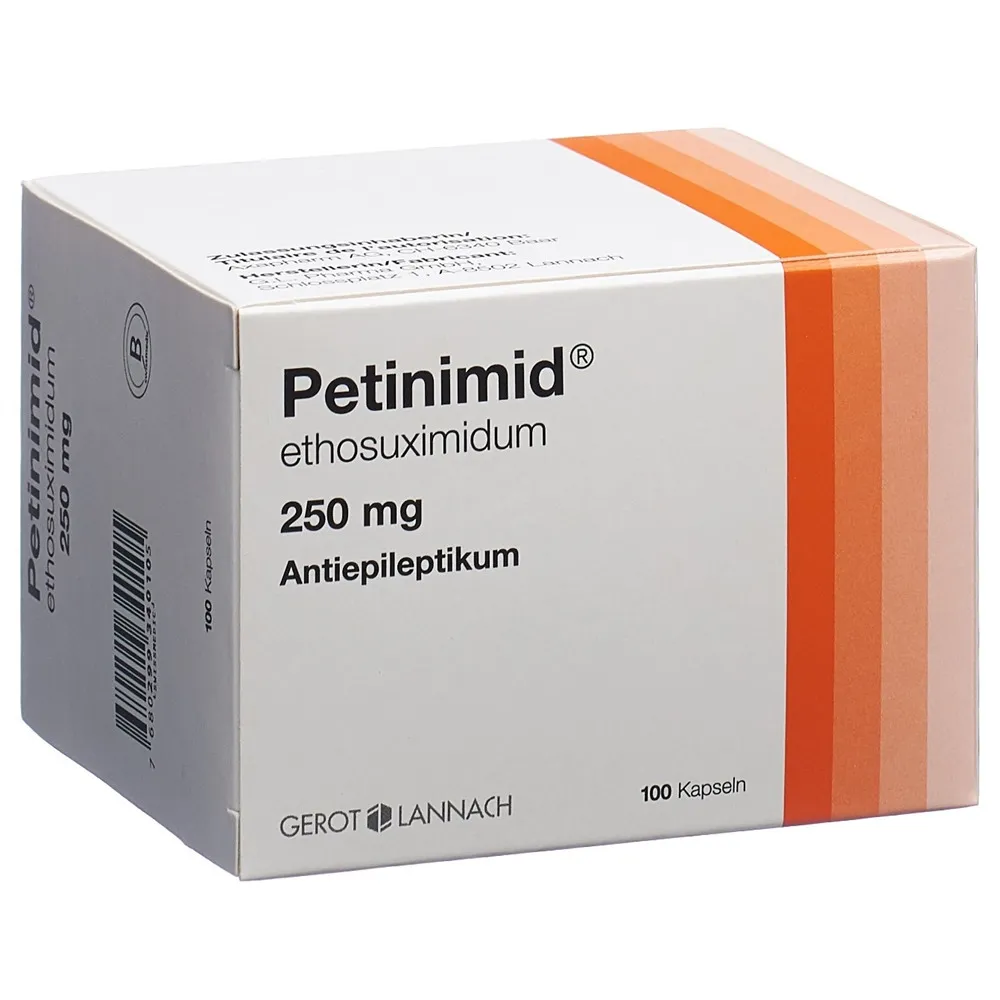
Table of Contents
Package leaflet: Information for the patient
Petinimid, 250 mg, capsules
Ethosuximidum
Please read carefully all of this leaflet before taking this medicine, because it contains
important information for the patient.
- Keep this leaflet, as you may need to read it again.
- If you have any doubts, please consult your doctor or pharmacist.
- This medicine has been prescribed for a specific individual. Do not pass it on to others. The medicine may harm another person, even if their symptoms are the same.
- If the patient experiences any adverse reactions, including any adverse reactions not listed in this leaflet, they should inform their doctor or pharmacist. See section 4.
Table of contents
- What Petinimid is and what it is used for
- Important information before taking Petinimid
- How to take Petinimid
- Possible side effects
- How to store Petinimid
- Contents of the package and other information
1. What Petinimid is and what it is used for
Ethosuximide, the active substance in Petinimid, is used in the treatment of primary generalized
epilepsy with typical and atypical absence seizures. If the patient suffers from mixed
types of epileptic seizures, the doctor may prescribe Petinimid together with another
antiepileptic medicine.
2. Important information before using Petinimid
When not to use Petinimid:
- if you are allergic to ethosuximide or other substances from the same group (succinimides), or to any of the excipients of this medicine listed in section 6.
Warnings and precautions:
Before starting treatment with Petinimid, you should discuss this with your doctor or pharmacist. In particular, you should inform your doctor if:
- the patient has impaired kidney or liver function, or suffers from porphyria (a rare metabolic disorder)
- the patient has a psychiatric disorder or has had one in the past; treatment with Petinimid may lead to undesirable effects such as irritability, agitation, anxiety, drowsiness, aggression, difficulty concentrating, or other mental changes
- the patient experiences symptoms resembling those of a cold (e.g. sore throat, fever), you should consult a doctor immediately. This may be a sign of serious, sometimes life-threatening, blood disorders – your doctor will recommend immediate blood tests
- blood test results show abnormalities (for early symptoms, see section "Undesirable effects"), you should immediately seek medical advice. Your doctor may switch treatment to another active substance
- a female patient plans to become pregnant, becomes pregnant, or suspects she may be pregnant while taking Petinimid, she should immediately consult her doctor (see also section "Pregnancy, breastfeeding and fertility")
Severe skin reactions, including Stevens-Johnson syndrome and drug reaction with eosinophilia and systemic symptoms (DRESS), have occurred during treatment with Petinimid. If the patient notices any of the symptoms described in section 4, treatment with Petinimid must be discontinued immediately and medical help should be sought urgently. The doctor may switch treatment to another active substance.
Petinimid used as monotherapy is not effective against tonic-clonic seizures and may even increase their frequency. Additional antiepileptic therapy may therefore be necessary. It is therefore very important to follow your doctor's instructions exactly.
During treatment, your doctor will recommend regular blood tests, urine tests, and liver function tests. Ensure that all clinical and laboratory tests are carried out strictly according to recommendations.
Antiepileptic treatment is usually long-term. Long-term use of antiepileptic drugs may lead, in some patients, to impairment of intellectual performance (e.g. learning difficulties in children and adolescents). Such an effect has not been demonstrated for Petinimid, but cannot be completely ruled out.
A small number of patients treated with antiepileptic drugs have shown tendencies toward suicidal thoughts and behavior. Such an effect has not been observed so far with Petinimid, but it cannot be entirely excluded. If the patient ever experiences such thoughts, medical advice should be sought immediately.
Petinimid and other medicines
Inform your doctor or pharmacist about all medicines currently taken or recently used, as well as any medicines you plan to take.
Medicines and other substances may interact with each other.
This also applies to other antiepileptic drugs taken together with Petinimid. In case of mixed seizure types, it may be necessary to use an additional antiepileptic drug simultaneously. Your doctor will closely monitor the treatment course and may recommend regular laboratory tests for certain drug combinations.
Valproic acid or sodium valproate may enhance or weaken the effect of Petinimid. Carbamazepine may reduce the effect of Petinimid. Treatment with Petinimid may enhance the effect of phenytoin.
Avoid using sedatives or sleeping pills during treatment with Petinimid, as this may intensify sedative effects.
For the same reason, alcohol consumption must be avoided during treatment with Petinimid.
Petinimid may reduce the effectiveness of hormonal contraception (e.g. oral contraceptives, transdermal patches). Therefore, alternative contraceptive methods should be used.
Taking Petinimid with food, drink, and alcohol
Petinimid should be taken during meals.
Alcohol must not be consumed during treatment with Petinimid.
Pregnancy, breastfeeding and fertility
If the patient is pregnant or breastfeeding, suspects she may be pregnant, or plans to have a child, she should consult her doctor or pharmacist before using this medicine.
Petinimid may be used during pregnancy and breastfeeding only on explicit medical advice.
Pregnancy
If the patient took Petinimid before becoming pregnant, she should not discontinue treatment without consulting her doctor, as sudden withdrawal may pose a risk to both mother and child. After careful risk assessment, the doctor may decide to continue Petinimid treatment during pregnancy, since epileptic seizures may pose a significant risk to both mother and child. On the other hand, if a mother takes an antiepileptic drug during pregnancy, especially when using a combination of several antiepileptic drugs, the risk of congenital malformations in the child increases. Therefore, the doctor will select the dose with special care (the lowest possible), recommend appropriate monitoring tests, and, if necessary, prescribe folic acid and vitamin K to minimize risks.
Breastfeeding
Petinimid passes into human milk and thereby into the infant's body. The doctor will decide whether the patient should continue taking Petinimid during breastfeeding.
Driving and operating machinery
Petinimid may impair the ability to drive and operate machinery.
At the beginning of treatment, you should therefore refrain from driving, operating machinery, or engaging in other potentially hazardous activities. Depending on the individual response to treatment, the doctor will decide whether the patient may drive or operate machinery.
The medicine contains sodium, sodium ethyl parahydroxybenzoate, and sodium propyl parahydroxybenzoate.
This medicine may cause allergic reactions (including delayed-type reactions).
The medicine contains less than 1 mmol (23 mg) of sodium per capsule; therefore, the medicine is considered "sodium-free".
3. How to use Petinimid
This medicine should always be taken according to the instructions given by your doctor or pharmacist. If in
doubt, consult your doctor or pharmacist.
Dosage is individual and depends on the individual response to treatment.
Treatment is initiated at a low dose, which is then gradually and slowly increased over
several weeks.
The dosing schedule given below is intended as a general guideline; the dose for
each patient will be determined individually by the doctor.
| Number of capsules per day | ||||
| Week 1 | Week 2 | Week 3 | Week 4 | |
| Adults | 2 capsules | 4 capsules | 6 capsules | 6-8 capsules |
After the initial treatment phase, the physician will determine the appropriate dose and duration of long-term treatment.
If the patient has severe renal function impairment, the physician may prescribe a lower dose.
Patients undergoing dialysis require an additional dose after each dialysis session or an adjustment in the dosing regimen.
Particular caution should be exercised in patients with severe hepatic impairment; dose reduction may be necessary.
Use in children
| Number of capsules per day | ||||
| Week 1 | Week 2 | Week 3 | Week 4 | |
| Younger children (from 3 years of age) | 1 capsule | 2 capsules | 3 capsules | 3 capsules |
| School-aged children | 1 capsule | 2 capsules | 4 capsules | 4-6 capsules |
Other forms of the medicine are available, e.g. syrup, containing the same active substance, which may be more suitable for children aged 3 years and older.
Petinimid must not be used in children under 3 years of age due to insufficient data in this age group.
Method of administration and duration of treatment
The daily dose prescribed by the doctor is usually divided into two doses taken during the day.
Capsules should be swallowed whole with sufficient fluid during a meal.
Epilepsy treatment is usually long-term and typically lasts several years. The doctor will decide on the appropriate dosage, dosage adjustments, duration of treatment, and the appropriate time and method of discontinuing treatment.
As with all antiepileptic drugs, Petinimid must be taken regularly. Any change in dosage or addition of another drug should be carried out gradually, never abruptly.
The doctor will inform the patient how to proceed.
Overdose of Petinimid
Overdose of Petinimid may manifest as follows: severe fatigue, drowsiness, mood changes or agitation, sometimes also irritability. Additionally, nausea, vomiting, and central nervous system disturbances may occur (sometimes leading to coma and shallow breathing or respiratory depression). In such a case, immediate medical assistance is required.
Missed dose of Petinimid
Do not take a double dose to make up for a missed dose. Take the next dose at the regular time.
Discontinuation of Petinimid
Do not stop taking Petinimid without consulting your doctor, even if seizures have not occurred for a prolonged period. Stopping treatment may lead to recurrence of seizures.
Any change in dosage, addition or discontinuation of another medicine, and especially ending treatment, should be carried out gradually over several weeks and always under medical supervision.
If you have any further questions or doubts regarding the use of this medicine, consult your doctor or pharmacist.
4. Possible adverse reactions
Like all medicines, this medicine may cause adverse reactions, although not everyone experiences them.
Serious adverse reactions
Stop taking Petinimid and seek immediate medical help if the patient notices any of the following symptoms:
-
Red rash on the trunk, which may appear as round, target-like spots or circular lesions, often with blisters in the center, peeling skin, and ulceration of the mouth, throat, nose, genital organs, and eyes. These severe skin reactions may be preceded by fever and flu-like symptoms (Stevens-Johnson syndrome);
-
Widespread rash, high body temperature, and swollen lymph nodes [drug reaction with eosinophilia and systemic symptoms (DRESS)].
Not common (may affect up to 1 in 100 patients):
- Drowsiness, headache, dizziness, hyperactivity, euphoria, irritability, movement or gait disturbances, drowsiness, or sleep disorders.
Frequency unknown (cannot be estimated from available data):
- Blood disorders (easier bruising or bleeding, fever, sore throat, mouth ulcers, fatigue, recurrent infections or infections that do not resolve) (Seek medical help if any of these symptoms occur. The doctor may regularly take blood samples to monitor for such effects).
- Allergic reactions, urticaria, and other skin reactions including rash, itching, and systemic lupus erythematosus.
- With high doses, decreased appetite and weight loss.
- Irritability, restlessness, agitation, motor restlessness, aggression, inability to concentrate, or other psychiatric changes (particularly in patients who have previously experienced similar symptoms).
- Increased libido, paranoid psychosis, and worsening of depression with possible suicidal behaviour.
- Parkinsonism-like symptoms and photosensitivity.
- Myopia.
- With high doses or in patients with sensitive stomach, symptoms such as stomach or abdominal pain, nausea, vomiting, hiccups, cramps, diarrhoea, swelling of the tongue and palate may occur. These symptoms are usually transient, rarely severe, and generally do not require discontinuation of treatment.
- Changes in liver enzyme activity, porphyria (a rare metabolic disorder which in severe cases may lead to liver damage).
- Skin discoloration, scleroderma (skin thickening), excessive facial or body hair growth.
- Kidney function disorders.
- Vaginal bleeding.
- Blood count abnormalities, liver and kidney function disturbances.
Reporting of adverse reactions
If any adverse reactions occur, including those not listed in this leaflet, inform a doctor or pharmacist. Adverse reactions can be reported directly to the Department of Monitoring Adverse Drug Reactions at the Office for Registration of Medicinal Products, Medical Devices and Biocidal Products
Al. Jerozolimskie 181 C
02-222 Warsaw
Tel.: +48 22 49 21 301
Fax: +48 22 49 21 309
Website: https://smz.ezdrowie.gov.pl
Adverse reactions can also be reported to the marketing authorization holder.
Reporting adverse reactions helps to provide more information on the safety of the medicine.
5. How to store Petinimid
Store in a place invisible and inaccessible to children.
Do not store at temperatures above 25°C.
Store in the original packaging to protect from light.
Do not use this medicine after the expiry date stated on the blister and carton after EXP.
The expiry date refers to the last day of the stated month.
Medicines must not be disposed of via wastewater or household waste. Ask your pharmacist how to dispose of medicines no longer in use. Such practices help protect the environment.
6. Contents of the package and other information
What Petinimid contains
The active substance is ethosuximide. One capsule contains 250 mg of ethosuximide.
Other components are:
Capsule core: Macrogol 400
Coating ingredients: Gelatin, glycerol 85%, sodium ethyl parahydroxybenzoate, sodium propyl
parahydroxybenzoate, titanium dioxide (E 171), yellow iron oxide (E172), ethylaniline.
What Petinimid looks like and contents of the pack
Elongated, soft gelatin capsules in an ivory colour.
Petinimid is available in blisters made of PVC/PVDC/Aluminium, containing 10 capsules per carton box.
Pack sizes: 100 capsules – 10 blisters with 10 capsules each
Marketing Authorisation Holder and Manufacturer
G.L. Pharma GmbH,
Schloßplatz 1,
A-8502 Lannach
Austria
For further information, please contact the local representative of the Marketing Authorisation Holder:
G.L. PHARMA POLAND Sp. z o.o.
Sienna 75; 00-833 Warsaw, Poland
Tel: 022/ 636 52 23; 636 53 02
[email protected]