Perlinganit
Poland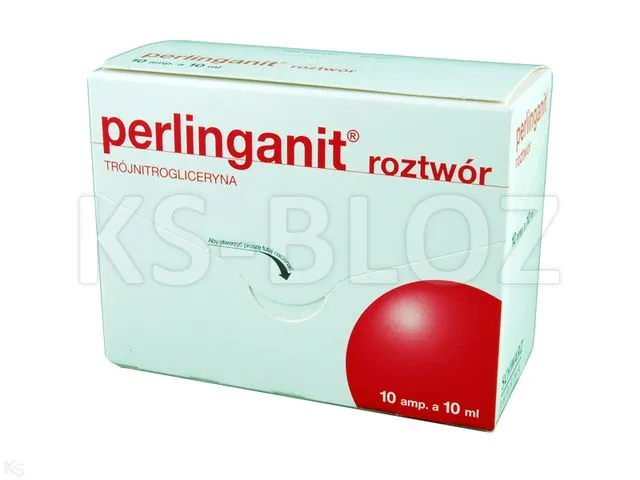
Table of Contents
Patient Information Leaflet
Perlinganit, 1 mg/ml, solution for infusion
Glyceroli trinitras
Please read all of this leaflet carefully before using this medicine, as it contains important information for you.
- Keep this leaflet, as you may need to read it again.
- If you have any further questions, ask your doctor, pharmacist, or nurse.
- This medicine has been prescribed for a specific individual. Do not pass it on to others. It may harm someone else, even if their symptoms are the same.
- If you experience any adverse reactions, including any not listed in this leaflet, inform your doctor, pharmacist, or nurse. See section 4.
Leaflet Contents
- What Perlinganit is and what it is used for
- What you need to know before using Perlinganit
- How to use Perlinganit
- Possible side effects
- How to store Perlinganit
- Contents of the pack and other information
1. What Perlinganit is and what it is used for
Perlinganit contains glyceryl trinitrate (1 ml of intravenous infusion solution contains 1 mg of glyceryl trinitrate). This medicine belongs to the group of organic nitrates. It exerts a direct relaxing effect on smooth muscles of blood vessel walls. As a result, blood vessels dilate. Perlinganit primarily dilates venous vessels, and at higher doses also arterial vessels. Consequently, the heart's workload and myocardial oxygen demand are reduced.
The drug also improves blood flow through the heart muscle, thereby reducing myocardial ischaemia. As a result, chest pain symptoms are alleviated and the extent of myocardial damage is reduced. Additionally, the drug prevents coronary vessel spasm.
Perlinganit is also beneficial in patients with chronic heart failure, reducing symptoms and improving exercise tolerance.
Other potential effects of the drug include relaxation of smooth muscles in the bronchi, gastrointestinal tract, biliary tract, urinary system, and uterus; however, these effects are not of major therapeutic significance.
Indications for use:
- Unstable angina pectoris, including vasospastic (Prinzmetal's) type
- Acute myocardial infarction
- Acute left ventricular failure
- Hypertensive crisis with congestive heart failure
- Controlled blood pressure reduction
2. Important information before using Perlinganit
When not to use Perlinganit:
- if the patient is allergic (hypersensitive) to the active substance or to any of the other ingredients of this medicine (listed in section 6),
- if the patient has acute circulatory failure (shock or vascular collapse),
- in cardiogenic shock (except in cases where sufficiently high end-diastolic pressure in the left ventricle is achieved with appropriate management),
- if the patient has significant arterial hypotension (systolic blood pressure less than 90 mm Hg),
- if the patient has cardiac tamponade,
- if the patient has left ventricular heart failure, including aortic or mitral valve stenosis, or obstruction of the outflow tract from the left ventricle (in hypertrophic cardiomyopathy or constrictive pericarditis),
- if the patient has severe hypovolemia (reduced circulating blood volume),
- if the patient has severe anemia,
- if the patient has conditions associated with increased intracranial pressure.
During treatment with Perlinganit, the following medicines must not be taken (see also
section “ Perlinganit and other medicines ” ):
- inhibitors of 5-phosphodiesterase (medicines used for erectile dysfunction), e.g. sildenafil, vardenafil, tadalafil,
- riociguat (a medicine used for chronic thromboembolic pulmonary hypertension and pulmonary arterial hypertension).
Warnings and precautions
Before starting treatment with Perlinganit, consult a doctor or pharmacist.
Exercise particular caution when using Perlinganit:
- in myocardial infarction with low filling pressure,
- if the patient has orthostatic hypotension (abnormally low blood pressure associated with rapid change to an upright position or prolonged standing),
- if the patient has severe liver or kidney impairment,
- if the patient has hypoxemia (reduced partial pressure of oxygen in blood, potentially leading to tissue hypoxia). Consult a doctor, even if the above warnings relate to conditions experienced in the past.
Even small doses of Perlinganit may cause a marked drop in blood pressure (especially in patients with hypovolemia or low arterial pressure prior to infusion), accompanied by excessive slowing of the heart rate, cerebral hypoxia, or worsening of symptoms of ischemic heart disease.
The medicine may also exacerbate symptoms of ischemic heart disease in hypertrophic cardiomyopathy with left ventricular outflow tract obstruction.
In some patients receiving Perlinganit as a 12-hour daily infusion, angina symptoms may occasionally occur during the treatment-free interval.
During administration, tolerance and cross-tolerance to other nitrates may develop.
To avoid this phenomenon, the lowest effective doses should be used, and glycerol trinitrate should be administered intermittently, alternating with other vasodilating agents.
Cases of methemoglobinemia (a red blood cell disorder characterized by cyanosis, dyspnea, headache, dizziness, somnolence, and coma; potentially fatal) have been reported following treatment with glycerol trinitrate. Treatment of methemoglobinemia with methylene blue is contraindicated in patients with glucose-6-phosphate dehydrogenase deficiency or methemoglobin reductase deficiency.
Perlinganit must not be used in individuals who have taken medicines containing a 5-phosphodiesterase inhibitor (e.g. sildenafil, vardenafil, tadalafil) within the previous 24 hours (48 hours in the case of tadalafil).
In patients being treated with Perlinganit, 5-phosphodiesterase inhibitors must not be used.
Alcohol consumption should be avoided during treatment with this medicine, as it may enhance the hypotensive and vasodilatory effects of glycerol trinitrate.
Children and adolescents
The safety and efficacy of the medicine in children have not been established.
Use of Perlinganit in patients with renal and/or hepatic impairment
The doctor will decide on appropriate dose adjustment in patients with severe liver or severe kidney impairment. See also section 3 “How to use Perlinganit”.
Use of Perlinganit in elderly patients
The doctor will decide on appropriate dose adjustment in elderly patients. See also section 3 “How to use Perlinganit”.
Pregnancy, breastfeeding, and fertility
If the patient is pregnant or breastfeeding, suspects she may be pregnant, or is planning to have a child, she should consult a doctor before using this medicine.
Perlinganit may be used in pregnant women only under medical supervision and only when, in the physician’s opinion, the benefit to the mother outweighs the potential risk to the fetus.
Data indicate that glycerol trinitrate may be excreted into human milk. Therefore, administration of Perlinganit should be avoided in breastfeeding women.
There are no data on the effect of glycerol trinitrate on human fertility.
Driving and operating machinery
Perlinganit may impair the ability to drive vehicles and operate machinery.
This effect is intensified by concomitant alcohol consumption.
Perlinganit and other medicines
Inform the doctor about all medicines currently or recently taken, as well as any medicines the patient plans to use.
Concomitant use of other antihypertensive medicines, e.g. beta-blockers, calcium antagonists, vasodilators, angiotensin-converting enzyme inhibitors, monoamine oxidase inhibitors, diuretics, and also alcohol, may enhance the hypotensive effect of glycerol trinitrate. A similar effect may also occur with neuroleptics and tricyclic antidepressants.
In addition, 5-phosphodiesterase inhibitors (e.g. sildenafil, vardenafil, tadalafil) may potentiate the hypotensive effect of glycerol trinitrate, potentially leading to life-threatening cardiovascular complications. Therefore, glycerol trinitrate must not be used in patients who have taken 5-phosphodiesterase inhibitors within the previous 24 hours (48 hours for tadalafil).
Concomitant intravenous infusion of tissue plasminogen activator (t-PA) and Perlinganit may increase the plasma clearance of t-PA due to enhanced hepatic blood flow.
Concomitant use of Perlinganit and dihydroergotamine may lead to increased plasma concentrations of dihydroergotamine and thus cause elevated arterial blood pressure. Particular caution is required in patients with ischemic heart disease, as dihydroergotamine may antagonize the effect of glycerol trinitrate, potentially leading to coronary vasoconstriction.
In patients previously treated with organic nitrates, e.g. isosorbide dinitrate or isosorbide mononitrate, higher doses of Perlinganit may be required to achieve the desired effect. Caution is advised when used concomitantly with products containing sapropterin.
Non-steroidal anti-inflammatory drugs (e.g. ibuprofen), except acetylsalicylic acid, may reduce the therapeutic effect of glycerol trinitrate.
Concomitant use of heparin and Perlinganit may reduce the effect of heparin.
Concomitant use of Perlinganit and acetylsalicylic acid may cause a reduction in arterial blood pressure.
Concomitant use of Perlinganit with riociguat is contraindicated, as it may cause hypotension (abnormally low blood pressure).
Perlinganit contains glucose
The 10 ml ampoule contains 480 mg glucose.
This should be taken into account in diabetic patients.
3. How to use Perlinganit
This medicine should always be used as directed by the physician. In case of doubt, consult the physician.
The physician will adjust the dosage according to the patient's needs.
Perlinganit is administered in hospital settings either in diluted form (as a continuous intravenous infusion using an automated device regulating the infusion rate) or undiluted (using a syringe infusion pump), with continuous monitoring of cardiovascular parameters. Depending on the type and severity of the disease, invasive hemodynamic monitoring may be indicated during treatment as a supplement to routine diagnostic tests (blood pressure measurement, heart rate, diuresis).
Dosage should be individually adjusted according to the patient's needs.
Perlinganit administration should begin at a dose of 0.75 to 1.0 mg/hour; the dose is then adjusted according to the patient's needs, usually not exceeding 8 mg/hour, and in rare cases up to 10 mg/hour.
It is advisable to start the infusion at the lowest possible rate (even 5 μg/min), increasing the rate by 5 to 10 μg/min every 3 to 5 minutes until the desired response is achieved.
In patients with severe angina symptoms, doses of 2 to 8 mg/hour (33 to 133 μg/min) should be used.
In acute left ventricular failure (pulmonary edema), the medicine should be administered at a dose of 2 to 8 mg/hour as a continuous infusion for 1 to 2 days.
In acute myocardial infarction, for relief of coronary pain (when opioid administration has proven insufficient), 2 to 8 mg/hour should be administered until pain subsides.
In hypertensive crisis with heart failure, Perlinganit should be administered as an intravenous infusion at a dose of 2 to 8 mg/hour (average 5 mg/hour), under continuous monitoring of arterial pressure and heart rate.
For controlled reduction of blood pressure: depending on the method of general anesthesia and the desired extent of arterial pressure reduction, administer 2 to 10 μg of Perlinganit/kg body weight/min, under continuous monitoring of arterial pressure (invasive measurement) and ECG.
Dilution of Perlinganit should be prepared under aseptic conditions immediately after opening the ampoule.
Perlinganit may be administered with commonly used intravenous infusion fluids in hospital practice, such as: physiological saline, 5% or 10% glucose solution, Ringer's solution.
When diluting Perlinganit solution with infusion fluid, follow the manufacturer's recommendations for the infusion fluid, especially regarding compatibility with other substances, contraindications, adverse effects, and interactions.
Dilution table
| Amount of active substance (glyceryl trinitrate) | 10 mg | 20 mg | 30 mg | 40 mg | 50 mg | |
| Perlinganit medicinal solution | 10 ml | 20 ml | 30 ml | 40 ml | 50 ml | |
| Volume of infusion fluid required to achieve the following dilutions (in millilitres): | 1+10 1+20 1+40 | 100 200 400 | 200 400 800 | 300 600 1200 | 400 800 1600 | 500 1000 2000 |
| Volume of ready-to-use infusion solution (in millilitres): | 1+10 1+20 1+40 | 110 210 410 | 220 420 820 | 330 630 1230 | 440 840 1640 | 550 1050 2050 |
Perlinganit dosage after dilution
| Dilution | 1 + 10 | 1 + 20 | 1 + 40 |
| Recommended dose of glyceryl trinitrate/hour | Infusion rate ml/hour | Infusion rate ml/hour | Infusion rate ml/hour |
| 0.50 mg 5.50 10.50 20.50 0.75 mg 8.25 15.75 30.75 1.00 mg 11.00 21.00 41.00 1.25 mg 13.75 26.25 51.25 1.50 mg 16.50 31.50 61.50 2.00 mg 22.00 42.00 82.00 2.50 mg 27.50 52.50 102.50 3.00 mg 33.00 63.00 123.00 3.50 mg 38.50 73.50 143.50 4.00 mg 44.00 84.00 164.00 4.50 mg 49.50 94.50 184.50 5.00 mg 55.00 105.00 205.00 5.50 mg 60.50 115.50 225.50 6.00 mg 66.00 126.00 246.00 7.00 mg 77.00 147.00 287.00 8.00 mg 88.00 168.00 328.00 9.00 mg 99.00 189.00 369.00 10.00 mg 110.00 210.00 410.00 | |||
The medicine does not contain ethanol or potassium ions.
The physician will determine the appropriate dosage of Perlinganit in patients with severe hepatic insufficiency, severe renal insufficiency, or in elderly patients.
Treatment is usually initiated at the lowest possible dose, which is then appropriately increased or decreased depending on the response to treatment. Glycerol trinitrate infusion should be started at a rate of 5 to 10 μg/min, increased every 5 minutes by 5 μg/min until a response is achieved. The dose may be increased up to a maximum of 167 μg/min. The physician will determine the appropriate monitoring of arterial blood pressure and maintaining its level ≥90 mmHg, adjusting the infusion rate of glycerol trinitrate accordingly.
There are no data indicating the need for dose adjustment in elderly patients.
Note
Infusion sets used for Perlinganit solution should be made of polyethylene (PE), polypropylene (PP), or polytetrafluoroethylene (PTFE). Other materials, such as polyvinyl chloride (PVC) or polyurethane (PU), cause adsorption of glyceryl trinitrate onto the infusion set walls, thereby reducing the drug concentration in the solution. When using materials made of PVC or PU, the dosage should be individually adjusted according to the patient's needs.
Development of tolerance and cross-tolerance to other nitrate compounds has been reported during Perlinganit treatment.
If you feel that the effect of Perlinganit is too strong or too weak, consult your doctor.
Use of a higher than recommended dose of Perlinganit
If more Perlinganit has been administered than recommended, seek immediate medical advice from a doctor or pharmacist.
Overdose may result in excessive reduction of arterial blood pressure (systolic pressure below 90 mmHg), pallor, increased sweating, diminished pulse, tachycardia, dizziness upon changing body position, headache, weakness, dizziness, nausea, vomiting, and diarrhea.
Following administration of organic nitrates, including Perlinganit, cases of methemoglobinemia have been reported, presenting with cyanosis, increased respiratory rate, anxiety, loss of consciousness, and cardiac arrest.
Very high doses may lead to increased intracranial pressure and neurological symptoms.
Therapeutic management should primarily aim at increasing arterial blood pressure. In mild overdose, placing the patient with legs elevated may be sufficient. In more severe intoxications, management should follow standard recommendations for treating poisoning and shock; therefore, immediate medical assistance is essential.
4. Possible adverse reactions
Like all medicines, this medicine can cause adverse reactions, although not everyone will experience them.
The following adverse reactions have been observed during treatment with this medicine:
Very common (occurs in more than 1 in 10 patients): headache,
Common (occurs in more than 1 in 100 patients): increased heart rate, weakness, dizziness (including related to change in body position), drowsiness, hypotension related to change in body position,
Uncommon (occurs in less than 1 in 100 patients): worsening of angina symptoms, circulatory collapse (sometimes with bradycardia, arrhythmias, and loss of consciousness), nausea, vomiting, allergic skin reactions (e.g. rash), contact allergy, itching, sensation of warmth (burning), erythema, and skin irritation.
Rare (occurs in less than 1 in 10,000 patients): heartburn.
Frequency not known (frequency cannot be estimated from available data): hypotension (reduction in arterial blood pressure), sudden facial flushing with sensation of warmth, palpitations, generalized rash, tachycardia.
Single cases: exfoliative dermatitis.
During treatment with organic nitrates, cases of significant reduction in arterial blood pressure accompanied by nausea, vomiting, restlessness, pallor, and excessive sweating have been reported.
Note: During therapy with Perlinganit, a temporary decrease in arterial oxygen tension may occur due to relative redistribution of blood flow to less ventilated areas of the lungs. This may lead, especially in patients with coronary artery disease, to myocardial ischemia.
Perlinganit may cause dose-dependent headaches due to cerebral vasodilation. These symptoms usually subside despite continuation of treatment. If headaches persist during treatment, mild analgesics should be used.
In case of headaches unresponsive to treatment, the physician will decide whether to reduce the dose of Perlinganit or discontinue administration.
If necessary, the physician may decide to administer beta-blockers to prevent slight tachycardia.
Reporting of adverse reactions
If any adverse reactions occur, including any not listed in this leaflet, inform your doctor, pharmacist, or nurse. Adverse reactions can be reported directly to the Department of Monitoring Adverse Drug Reactions, Office for Registration of Medicinal Products, Medical Devices and Biocidal Products:
Al. Jerozolimskie 181C, 02-222 Warsaw, tel.: 22 49-21-301, fax: 22 49-21-309,
Website: https://smz.ezdrowie.gov.pl
Adverse reactions can also be reported to the marketing authorization holder.
Reporting of adverse reactions helps to provide more information on the safety of the medicine.
5. How to store Perlinganit
Do not store above 25 °C.
Keep the medicine in a place invisible and inaccessible to children.
Do not use this medicine after the expiry date stated on the carton. The expiry date refers to the last day of the stated month.
Medicines must not be disposed of via wastewater or household waste. Ask your pharmacist how to dispose of medicines no longer required. This will help protect the environment.
6. Contents of the packaging and other information
What Perlinganit contains
- The active substance is glyceryl trinitrate. One ampoule (10 ml) contains 10 mg of glyceryl trinitrate in 10 ml of isotonic solution.
- The other ingredients are: propylene glycol, glucose, hydrochloric acid, water for injections.
What Perlinganit looks like and contents of the pack
Perlinganit 1 mg/ml, solution for infusion is a clear, colourless and odourless solution.
Perlinganit is available in the following pack sizes:
10 ampoules of 10 ml in a cardboard box.
Perlinganit solution is sterile and contains no preservatives.
The ampoule is not intended for multiple use.
Marketing Authorisation Holder and Manufacturer
Marketing Authorisation Holder:
Merus Labs Luxco II S.à.R.L.
208, Val des Bons Malades
L-2121 Luxembourg
Luxembourg
Manufacturer:
Aesica Pharmaceuticals GmbH
Alfred-Nobel-Str. 10
40789 Monheim
Germany
For further information, please contact the representative of the Marketing Authorisation Holder.
Merus Labs Luxco II S.à.R.L.
208, Val des Bons Malades
L-2121 Luxembourg
Luxembourg