Peritol
Poland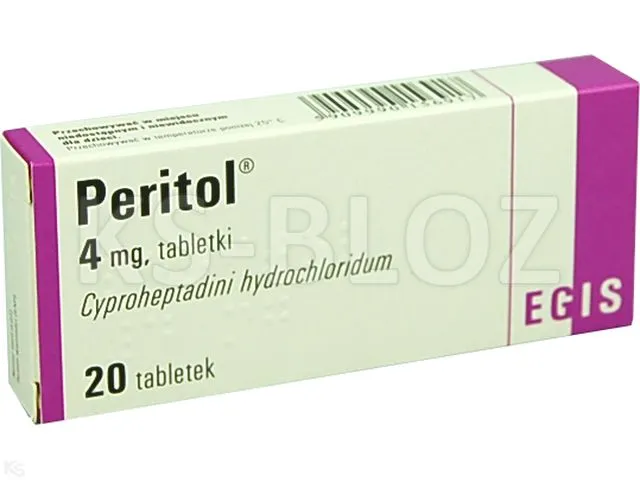
Table of Contents
Patient Information Leaflet
Peritol, 4 mg, tablets
Cyproheptadini hydrochloridum
Please read the entire leaflet carefully before using the medicine, as it contains
important information for the patient.
- Keep this leaflet for future reference.
- If you have any doubts, consult your doctor or pharmacist.
- This medicine has been prescribed for a specific individual. Do not pass it on to others. The medicine may harm others, even if their symptoms are identical.
- If you experience any adverse reactions, including those not listed in this leaflet, inform your doctor or pharmacist. See section 4.
Table of Contents
- What Peritol is and what it is used for
- Important information before taking Peritol
- How to take Peritol
- Possible side effects
- How to store Peritol
- Contents of the pack and other information
1. What Peritol is and what it is used for
Cyproheptadine, the active substance in Peritol, belongs to a group of medicines called
antihistamines. It blocks the action of histamine and other substances produced by the body that cause allergy or itching. It is a serotonin and histamine antagonist.
Peritol is used in the treatment of allergic conditions, especially those accompanied by itching, e.g.
acute and chronic urticaria, angioedema, drug eruption, rash, dermatitis, eczematous dermatitis, contact dermatitis, neurodermatitis, allergic rhinitis (hay fever), vasomotor rhinitis, serum sickness, local allergic reactions following insect bites, vascular headaches (migraine, histamine-dependent headaches), and in patients with psychogenic anorexia (anorexia nervosa).
2. Important information before using Peritol
When not to use Peritol
- if the patient is allergic to cyproheptadine or any of the other ingredients of this medicine (listed in section 6),
- if the patient is experiencing an acute asthma attack,
- if the patient has glaucoma,
- if the patient has a narrowing between the stomach and the small intestine causing vomiting of undigested food, as occurs with gastric ulcers in specific locations,
- if the patient has symptomatic benign prostatic hyperplasia or narrowing of the urethra associated with urinary retention,
- if the patient is concurrently taking medicines belonging to a group called monoamine oxidase inhibitors (MAOIs),
- if the patient is pregnant, trying to become pregnant, or breastfeeding,
- in newborns and infants,
- in debilitated patients, including elderly individuals (over 65 years of age).
Warnings and precautions
If the patient has any of the following conditions, discuss them with a doctor before starting treatment with Peritol:
- history of bronchial asthma,
- increased intraocular pressure,
- hyperthyroidism,
- heart or circulatory disease,
- arterial hypertension.
When taking Peritol for the first time, it should be taken after dinner, as it may cause drowsiness.
Always inform the doctor if any of the following symptoms occur during treatment with Peritol: fever, sore throat, mouth ulcers, pallor, yellowing of the skin or whites of the eyes, bruising, or unusual or uncontrollable bleeding. In such cases, the doctor may order certain laboratory tests. If test results indicate that the observed disturbances are caused by the medicine, the doctor may consider discontinuing treatment with Peritol. Always follow the doctor's advice.
Children and adolescents
Peritol should not be used in children under 2 years of age. Do not give any medication to children without consulting a doctor.
If a doctor has prescribed Peritol for a child, ensure that the medicine is being used exactly as directed. Some children may experience restlessness during treatment. Inform the doctor if the child's behavior appears to be related to the medicine.
Peritol and other medicines
Inform the doctor about all medicines currently or recently taken, as well as any medicines planned for use.
Antidepressants (e.g. phenelzine, selegiline, moclobemide) may intensify and prolong the effects of Peritol.
Sedatives, tranquilizers, and anxiolytics may enhance the sedative effect of Peritol.
Peritol may interfere with the action of serotonergic antidepressants, potentially leading to recurrence of depression and associated symptoms.
Cyproheptadine may cause false-positive results in screening urine tests for tricyclic antidepressants. If such a test is planned, it is essential to inform the doctor that Peritol is being taken.
Therefore, particular caution is required when using any of these medicines concurrently with Peritol.
If in doubt about concomitant medicines, consult a doctor.
Peritol and alcohol
Do not consume alcoholic beverages while taking this medicine.
Pregnancy, breastfeeding, and fertility
If the patient is pregnant, breastfeeding, suspects she might be pregnant, or is planning to have a child, she should consult a doctor before using this medicine.
Use of this medicine is contraindicated during pregnancy and breastfeeding.
Driving and operating machinery
Especially at the beginning of treatment, Peritol may cause dizziness, drowsiness, and psychomotor slowing. Therefore, during the initial phase of treatment – for a period to be determined individually – patients should not drive or operate machinery. Later in the course of treatment, restrictions and prohibitions regarding driving and operating machinery will be determined individually by the doctor for each patient.
Peritol contains lactose
Each tablet of Peritol contains 128 mg of lactose. If the patient has previously been diagnosed with intolerance to certain sugars, the patient should consult a doctor before taking this medicine.
3. How to use Peritol
This medicine should always be taken exactly as directed by your doctor or pharmacist. If you are unsure,
you should consult your doctor.
Adults
The recommended initial dose is 12 mg (1 tablet three times daily).
In chronic urticaria, the medicine may be used at a total daily dose of 6 mg (half a tablet three times daily).
For acute migraine attacks, the recommended dose is 4 mg (1 tablet) once daily. If migraine headache persists after half an hour, the dose may be repeated. However, the dose of 8 mg (2 tablets) must not be exceeded within 4 to 6 hours.
In psychogenic anorexia, the recommended dose is 4 mg (1 tablet) three times daily.
Maintenance dose: a total daily dose of 12 mg (1 tablet three times daily) is generally sufficient.
Maximum daily dose: 20 mg (5 tablets).
The use of Peritol in elderly and/or debilitated patients is contraindicated, as this patient group may be particularly susceptible to certain adverse effects typical of antihistamines (e.g. dizziness, drowsiness, hypotension).
Use in children and adolescents
Peritol is not recommended for children under 2 years of age.
The recommended dose for children over 2 years of age is 0.25 mg/kg body weight per day, i.e. 8 mg/m^2 body surface area.
Children aged 2 to 6 years: the recommended initial daily dose is 2 mg two or three times daily (half a tablet two or three times daily), adjusted according to body weight and clinical response. If an additional dose is required, it should be administered before bedtime. The maximum daily dose in this age group is 8 mg (2 tablets).
Children aged 7 to 14 years: the recommended daily dose is 8 to 12 mg (2 or 3 times 1 tablet).
If an additional dose is required, it should be administered before bedtime. The maximum daily dose in this age group is 16 mg (4 tablets).
Children aged 15 to 18 years: there are no data available on the use of cyproheptadine in children aged 15–18 years.
Patients with hepatic function disorders: due to the possibility of reduced metabolism of the active substance, your doctor may recommend a reduced dose.
Patients with renal function disorders: the medicine is primarily eliminated via the kidneys; therefore, your doctor may recommend a reduced dose.
Your doctor will inform you how long treatment with Peritol should last.
Peritol should be taken at approximately the same time each day. This is optimal and will also help you remember to take the tablets.
If you feel that the effect of Peritol is too strong or too weak, you should consult your doctor.
Use of a higher than recommended dose of Peritol
If you take more Peritol than recommended, or if someone else accidentally takes the medicine, you should go immediately to the nearest hospital emergency department. You should bring this leaflet and any remaining tablets with you to show the doctor.
Symptoms of overdose: excessive sedation, drowsiness, coma, states of excitation and convulsions, dryness of the mouth, rigid pupil dilation, skin flushing, as well as gastrointestinal symptoms.
Treatment: in case of suspected overdose of Peritol, induction of vomiting, gastric lavage, administration of activated charcoal, and supportive treatment are recommended. Administration of osmotic laxatives, which draw water into the intestines and dilute their contents, may be helpful. Stimulants of the central nervous system (CNS) should be avoided. Hypotension should be treated with vasopressor agents.
Missed dose of Peritol
Do not take a double dose to make up for a missed dose.
If you have any further questions about the use of this medicine, consult your doctor or pharmacist.
4. Possible adverse reactions
Like any medicine, this medicine may cause adverse reactions, although not everybody will experience them.
If any of the symptoms listed below occur, stop taking Peritol immediately
and contact a doctor or call an ambulance, or go to the nearest hospital emergency department:
- allergic reaction (due to hypersensitivity), skin rash, urticaria, swelling of hands, feet or face,
- severe hypersensitivity reaction with accompanying breathing difficulties, dizziness. In rare cases, long-term treatment with Peritol may cause hematological disorders (significant decrease in white blood cells leading to reduced resistance to infectious diseases, reduced platelet count, anemia caused by destruction of red blood cells). Medical advice should be sought immediately if, during prolonged treatment, fever, sore throat, mouth ulcers, pallor, jaundice, fainting, breathing difficulties, petechiae or unexplained bruising on the skin, or unusual or persistent bleeding of unknown cause occur.
Additionally, the following symptoms may occur during treatment with Peritol:
- loss of appetite or increased appetite.
- disorientation, visual hallucinations, psychomotor agitation, irritability, nervousness, aggressive behaviour, insomnia, euphoria, hysteria.
- drowsiness; this is usually a transient adverse effect which often resolves after the first 3–4 days of treatment.
- excessive sedation, dizziness, coordination disturbances, tremor, numbness, neuritis (manifested by increased sensitivity to pain, inability to perform movements, twitching), seizures, headache, weakness.
- blurred vision, disturbances of ocular accommodation (pupil dilation), double vision.
- acute inner ear inflammation, dizziness with a spinning sensation, tinnitus.
- rapid or irregular heartbeat, palpitations.
- hypotension.
- dryness of the nose and throat, presence of thick bronchial secretions, breathing difficulties, nasal congestion, nosebleeds.
- dry mouth, nausea, vomiting, epigastric pain, diarrhoea and constipation.
- yellowing of the skin and eyes, sometimes accompanied by fever, pale stools and dark urine. These symptoms suggest liver disease, obstruction of liver ducts, hepatitis or liver failure.
- skin rash, excessive sweating, photosensitivity.
- frequent urge to urinate, difficulty in passing urine, urinary retention.
- early menstruation.
- chest tightness, fatigue, chills.
- weight gain.
Reporting of adverse reactions
If any adverse reactions occur, including any adverse reactions not listed
in this leaflet, inform a doctor or pharmacist. Adverse reactions can be reported
directly to the Department of Monitoring of Adverse Drug Reactions of the Office for Registration of Medicinal Products, Medical Devices and Biocidal Products:
Al. Jerozolimskie 181C
02-222 Warszawa
Tel: +48 22 49 21 301
Fax: +48 22 49 21 309
Website: https://smz.ezdrowie.gov.pl.
Adverse reactions can also be reported to the marketing authorisation holder.
Reporting adverse reactions helps to provide more information on the safety of the medicine.
5. How to store Peritol
Store below 25°C.
Keep the medicine out of the sight and reach of children.
Do not use this medicine after the expiry date stated on the packaging.
Expiry date (EXP)
Batch number (Lot)
Medicines must not be disposed of via wastewater or household waste. Ask your pharmacist how to dispose of medicines no longer required. Such measures help protect the environment.
6. Contents of the pack and other information
What Peritol contains
- The active substance is cyproheptadine hydrochloride. Each tablet contains 4 mg of cyproheptadine hydrochloride (equivalent to 4.3 mg of cyproheptadine hydrochloride hemihydrate).
- Other ingredients are: gelatine (type B), lactose monohydrate, magnesium stearate, potato starch, talc.
What Peritol looks like and contents of the pack
White or greyish-white, round, flat, bevel-edged tablets, completely or almost completely odourless, with a breakline on one side and the inscription "PERITOL" on the other side.
The tablet can be divided into equal doses.
PVC/PVdC/Al foils in a cardboard box, with an enclosed patient information leaflet.
The pack contains 20 tablets (2 blisters of 10 tablets each).
Marketing Authorisation Holder:
Egis Pharmaceuticals PLC.
1106 Budapest, Keresztúri út 30-38
Hungary
Manufacturer:
Egis Pharmaceuticals PLC.
Mátyás király u. 65
9900 Körmend
Hungary
For more detailed information, please contact the representative of the marketing authorisation holder in Poland.
EGIS Polska Sp. z o.o.
ul. Komitetu Obrony Robotników 45D
02-146 Warsaw
Telephone: +48 22 417 92 00