Pemetrexed sandoz
Poland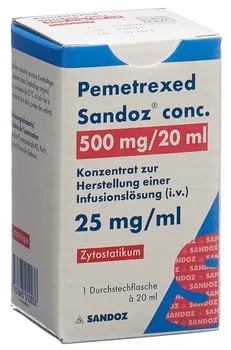
Table of Contents
- Package leaflet: Information for the user
- 1. What Pemetrexed Sandoz is and what it is used for
- 2. Important information before using Pemetrexed Sandoz
- 3. How to use Pemetrexed Sandoz
- 4. Possible side effects
- 5. How to store Pemetrexed Sandoz
- 6. Contents of the pack and other information
- The following information is intended solely for medical professionals:
Package leaflet: Information for the user
Pemetrexed Sandoz, 25 mg/ml, concentrate for solution for infusion
Pemetrexedum
Please read all of this leaflet carefully before using this medicine, because it contains
important information for the patient.
- Keep this leaflet, as you may need to read it again.
- If you have any further questions, please ask your doctor or pharmacist.
- If you experience any side effects, including any not listed in this leaflet, please tell your doctor or pharmacist. See section 4.
Contents of the leaflet
- What Pemetrexed Sandoz is and what it is used for
- What you need to know before using Pemetrexed Sandoz
- How to use Pemetrexed Sandoz
- Possible side effects
- How to store Pemetrexed Sandoz
- Contents of the pack and other information
1. What Pemetrexed Sandoz is and what it is used for
Pemetrexed Sandoz is a medicine used to treat malignant tumours.
Pemetrexed Sandoz, in combination with another anticancer medicine, cisplatin, is used to treat malignant pleural mesothelioma, a type of cancer affecting the membrane covering the lungs, in patients who have not previously received chemotherapy.
Pemetrexed Sandoz in combination with cisplatin is used as initial treatment in patients with advanced-stage lung cancer.
Pemetrexed Sandoz may be prescribed to patients with advanced-stage lung cancer who have responded to initial chemotherapy or whose condition has largely remained stable after initial chemotherapy.
Pemetrexed Sandoz is also used to treat patients with advanced-stage lung cancer in whom the disease has progressed after initial chemotherapy with other medicines.
This medicine is intended for use in adults only.
2. Important information before using Pemetrexed Sandoz
When not to use Pemetrexed Sandoz
- if the patient is allergic to pemetrexed or any of the other ingredients of this medicine (listed in section 6).
- if the patient is breastfeeding. Breastfeeding must be discontinued during treatment with Pemetrexed Sandoz.
- in patients who have recently been vaccinated or are scheduled to be vaccinated against yellow fever.
Warnings and precautions
Before receiving Pemetrexed Sandoz, discuss this with your doctor or hospital pharmacist.
Patients who currently have or have previously had kidney function disorders should inform their doctor or hospital pharmacist, as this may mean that Pemetrexed Sandoz cannot be administered.
Before each infusion, medical personnel will take blood samples from the patient to assess whether liver and kidney function are adequate and whether blood cell counts are sufficient for treatment with Pemetrexed Sandoz. Depending on the patient's general condition and if blood cell counts are too low, the doctor may decide to adjust the dose or delay treatment. If the patient is being treated concurrently with cisplatin, the doctor will ensure that the patient is adequately hydrated and receives appropriate antiemetic treatment before and after cisplatin administration.
Patients who have undergone or will undergo radiotherapy should inform their doctor, as early or delayed radiation reactions may occur after administration of Pemetrexed Sandoz.
Patients who have recently been vaccinated should inform their doctor, as administration of Pemetrexed Sandoz may cause adverse reactions.
Patients with current or past heart disease should inform their doctor.
If fluid has accumulated around the patient's lung, the doctor may decide to perform a procedure to drain the fluid before administering Pemetrexed Sandoz.
Children and adolescents
Pemetrexed Sandoz must not be used in children and adolescents, as there is no experience with the use of this medicine in patients under 18 years of age.
Pemetrexed Sandoz and other medicines
Inform your doctor about any pain-relieving and anti-inflammatory medicines (e.g. those that reduce swelling), such as non-steroidal anti-inflammatory drugs (NSAIDs), including those available without a prescription (such as ibuprofen). There are many types of non-steroidal anti-inflammatory drugs (NSAIDs) with different durations of action. Depending on the planned date of Pemetrexed Sandoz infusion and (or) the patient's kidney function, the doctor will advise which medicines can be taken and when. If in doubt whether a medicine belongs to the group of non-steroidal anti-inflammatory drugs (NSAIDs), ask your doctor or pharmacist.
Inform your doctor if the patient is taking medicines known as proton pump inhibitors (omeprazole, esomeprazole, lansoprazole, pantoprazole and rabeprazole) used to treat heartburn and acid reflux.
Tell your doctor or hospital pharmacist about all medicines currently or recently taken, including those available without a prescription.
Pregnancy, breastfeeding and fertility
Pregnancy
If the patient is pregnant, suspects she may be pregnant, or is planning to have a child, she must inform her doctor. Use of Pemetrexed Sandoz during pregnancy should be avoided. The doctor will inform the patient about the potential risks associated with using Pemetrexed Sandoz during pregnancy. Women must use an effective method of contraception during treatment with Pemetrexed Sandoz and for 6 months after the last dose.
Breastfeeding
Women who are breastfeeding should inform their doctor.
Breastfeeding must be discontinued during treatment with Pemetrexed Sandoz.
Fertility
Men are advised not to attempt to father a child during treatment and for 3 months after completion of treatment with Pemetrexed Sandoz, and to use effective contraception during this time. If a man wishes to father a child during treatment with Pemetrexed Sandoz or within 3 months after completion of treatment, he should consult his doctor or pharmacist. Pemetrexed Sandoz may affect the ability to have children. Before starting treatment, patients should consult their doctor about sperm storage.
Driving and using machines
Pemetrexed Sandoz may cause fatigue. Caution should be exercised when driving or operating machinery.
Pemetrexed Sandoz contains sodium and propylene glycol
Pemetrexed Sandoz, 100 mg (4 ml vial):
This medicine contains less than 1 mmol (23 mg) of sodium per vial, meaning the medicine is considered "sodium-free".
This medicine contains 200 mg of propylene glycol in each vial.
Pemetrexed Sandoz, 500 mg (20 ml vial):
This medicine contains 55.6 mg of sodium (the main component of table salt) per vial. This corresponds to 3% of the maximum recommended daily dietary intake of sodium in adults.
This medicine contains 1000 mg of propylene glycol in each vial.
Pemetrexed Sandoz, 1000 mg (40 ml vial):
This medicine contains 111.2 mg of sodium (the main component of table salt) per vial. This corresponds to 6% of the maximum recommended daily dietary intake of sodium in adults.
This medicine contains 2000 mg of propylene glycol in each vial.
3. How to use Pemetrexed Sandoz
Pemetrexed Sandoz must only be administered under the supervision of an oncologist experienced in the use of chemotherapy.
The dose of Pemetrexed Sandoz is 500 milligrams per square meter of the patient's body surface area. Body surface area is calculated based on the patient's height and body weight. The physician will determine the appropriate dose based on the calculated body surface area. The dose may be adjusted or treatment delayed depending on blood count test results and the patient's overall condition.
Prior to administration, hospital pharmacy staff, a nurse or physician will reconstitute the concentrate with either 9 mg/ml (0.9%) sodium chloride solution for injection or 50 mg/ml (5%) glucose solution for injection.
Pemetrexed Sandoz is always administered as an intravenous infusion lasting approximately 10 minutes.
Administration of Pemetrexed Sandoz in combination with cisplatin
The physician or hospital pharmacist will calculate the dose based on the patient's height and body weight. Cisplatin is also administered as an intravenous infusion. The cisplatin infusion begins approximately 30 minutes after completion of the Pemetrexed Sandoz infusion and lasts about two hours.
Infusions are usually given every 3 weeks.
Additional medications
Corticosteroids: Your doctor will prescribe oral corticosteroids (in a dose equivalent to 4 mg dexamethasone twice daily) to be taken on the day before, the day of, and the day after Pemetrexed Sandoz infusion. These medications are used to reduce the frequency and severity of skin reactions that may occur during anticancer therapy.
Vitamin supplementation: Your doctor will prescribe folic acid (vitamin B9) or a multivitamin product containing folic acid (350 to 1000 micrograms), to be taken orally once daily throughout the duration of Pemetrexed Sandoz treatment. At least five doses of folic acid must be taken during the seven days preceding the first dose of Pemetrexed Sandoz. Folic acid supplementation should continue for 21 days after the last dose of Pemetrexed Sandoz is administered.
During the week before the first administration of Pemetrexed Sandoz, and then every approximately 9 weeks (corresponding to three chemotherapy cycles with Pemetrexed Sandoz), patients will also receive vitamin B({12}) (1000 micrograms) via injection. Administration of vitamin B({12}) and folic acid is intended to reduce the potential adverse effects of anticancer therapy.
If you have any further questions about the use of this medicine, please consult your doctor or pharmacist.
4. Possible side effects
Like all medicines, this medicine can cause side effects, although not everybody will experience them.
If any of the following symptoms occur, contact your doctor immediately:
- Fever or infection (common or very common): if you have a temperature of 38°C or higher, sweats or other signs of infection (due to the possibility of a marked decrease in white blood cells, which is a very common effect). Infection (sepsis) may be severe and may lead to death.
- Chest pain (common) or rapid heartbeat (uncommon).
- Pain, redness, swelling or ulcers in the mouth (very common).
- Allergic reaction: skin rash (very common) and/or burning or tingling sensation (common) or fever (common). In rare cases, skin reactions may be severe and lead to death. Inform your doctor if you develop severe rash, itching or blisters (symptoms of Stevens-Johnson syndrome or toxic epidermal necrolysis).
- Feeling of fatigue, fainting, sudden shortness of breath or pale skin (due to the possibility of a marked decrease in haemoglobin, which is a very common effect).
- Bleeding from gums, nose or mouth or other bleeding that cannot be stopped, red or pink discolouration of urine, unexpected bruising of the skin (due to the possibility of a marked decrease in platelets, which is a common effect).
- Sudden breathlessness, severe chest pain or cough with blood-stained sputum (uncommon) (may indicate presence of blood clots in the blood vessels of the lungs).
Possible side effects after administration of Pemetrexed Sandoz
Very common (may affect more than 1 in 10 people)
- Infection
- Sore throat (pharyngitis)
- Decrease in neutrophil count (a type of white blood cells)
- Decrease in white blood cell count
- Decrease in haemoglobin concentration
- Pain, redness, swelling or ulcers in the mouth
- Loss of appetite
- Vomiting
- Diarrhoea
- Nausea
- Skin rash
- Skin peeling
- Abnormal blood test results indicating worsening kidney function
- Fatigue
Common (may affect less than 1 in 10 people)
- Blood infection (sepsis)
- Fever with low neutrophil count (a type of white blood cells)
- Decrease in platelet count
- Allergic reaction
- Fluid loss (dehydration)
- Taste disturbances
- Damage to motor nerves, which may lead to muscle weakness and wasting, especially in arms and legs
- Damage to sensory nerves, which may lead to loss of sensation, burning pain and unsteady gait
- Dizziness
- Inflammation or swelling of the conjunctiva (the membrane lining the eyelids and covering the white part of the eye)
- Dry eyes
- Watery eyes
- Dryness of the conjunctiva (the membrane lining the eyelids and covering the white part of the eye) and cornea (the transparent layer covering the front of the iris and pupil)
- Swelling of the eyelids
- Eye disorders with associated dryness, watering, irritation and/or pain
- Heart failure (a condition causing weakened pumping function of the heart muscle)
- Irregular heartbeat
- Indigestion
- Constipation
- Abdominal pain
- Liver: increased blood levels of chemicals produced in the liver
- Increased skin pigmentation
- Itching of the skin
- Rash on the body with lesions resembling a target (bull's eye)
- Hair loss
- Urticaria (hives)
- Kidney shutdown
- Worsening kidney function
- Fever
- Pain
- Excess fluid in body tissues causing swelling (oedema)
- Chest pain
- Inflammation and ulceration of the mucous membranes lining the gastrointestinal tract
Uncommon (may affect less than 1 in 100 people)
- Decrease in red blood cells, white blood cells and platelets
- Stroke
- A type of stroke caused by blockage of an artery supplying blood to the brain
- Intracranial haemorrhage
- Angina (pain in the chest caused by reduced blood flow to the heart)
- Heart attack
- Narrowing or blockage of the coronary arteries
- Rapid heartbeat
- Inadequate blood supply to the limbs
- Blockage of one of the pulmonary arteries
- Inflammation and scarring of the membrane lining the lungs, with associated breathing problems
- Bright red blood from the anus
- Gastrointestinal bleeding
- Rupture of the intestinal wall
- Inflammation of the membrane lining the oesophagus
- Inflammation of the membrane lining the large intestine, which may be accompanied by intestinal or rectal bleeding (observed only when used in combination with cisplatin)
- Inflammation, swelling, redness and erosions of the oesophageal mucosa caused by radiotherapy
- Inflammation of the lungs caused by radiotherapy
Rare (may affect less than 1 in 1000 people)
- Breakdown of red blood cells (haemolysis)
- Anaphylactic shock (severe allergic reaction)
- Inflammation of the liver (hepatitis)
- Redness of the skin
- Skin rash appearing in previously irradiated skin areas
Very rare (may affect less than 1 in 10,000 people)
- Skin and soft tissue infections
- Stevens-Johnson syndrome (a type of severe skin and mucous membrane reaction which may be life-threatening)
- Toxic epidermal necrolysis (a type of severe skin reaction which may be life-threatening)
- Autoimmune disorders causing rash and blistering on the skin of the feet, arms and abdomen
- Skin inflammation characterised by fluid-filled blisters
- Fragile skin, presence of blisters and erosions, and skin scarring
- Redness, pain and swelling, mainly in the lower limbs
- Inflammation of the skin and subcutaneous fat tissue (resembling cellulitis)
- Dermatitis (skin inflammation)
- Inflammatory condition with itching, redness, cracking and roughness of the skin
- Intensely itchy skin lesions
Frequency not known: cannot be estimated from the available data
- A type of diabetes caused mainly by abnormal changes in the kidneys
- Kidney disorders leading to death of tubular epithelial cells in the kidneys
- Increased volume of urine output
- Thirst and increased water intake
- Hypernatraemia – increased sodium concentration in the blood
Any of these symptoms and/or conditions may occur. If the first signs of these adverse effects appear, inform your doctor as quickly as possible.
Inform your doctor if you are concerned about any of these symptoms.
Reporting of side effects
If you experience any side effects, including any not listed in this leaflet, tell your doctor, pharmacist or nurse. Side effects can also be reported directly to the Department of Monitoring Adverse Drug Reactions at the Office for Registration of Medicinal Products, Medical Devices and Biocidal Products: Al. Jerozolimskie 181C, 02-222 Warsaw
Tel: +48 22 49 21 301, Fax: +48 22 49 21 309, Website: https://smz.ezdrowie.gov.pl
Side effects can also be reported to the responsible entity.
Reporting side effects helps provide more information on the safety of this medicine.
5. How to store Pemetrexed Sandoz
Keep this medicine out of the sight and reach of children.
Do not use this medicine after the expiry date stated on the cardboard box and
label under Exp. The expiry date refers to the last day of the stated month.
Unopened vial
Do not store above 25°C. Store in the original packaging to protect from light.
After first opening
The medicine should be used immediately. Any unused portions must be discarded.
After dilution
100 mg vial
It has been demonstrated that the prepared infusion solution of Pemetrexed Sandoz remains stable for 3 days at 2°C to 8°C protected from light.
500 mg and 1000 mg vials
It has been demonstrated that the prepared infusion solution of Pemetrexed Sandoz remains stable for 7 days at room temperature protected from light and for 14 days at 2°C to 8°C protected from light.
From a microbiological point of view, the medicine should be used immediately after preparation. If the medicine is not used immediately, the responsibility for the storage duration and conditions prior to use lies with the user. The solution should not be stored for longer than 24 hours at 2°C to 8°C, unless dilution has been carried out under controlled and validated aseptic conditions.
Medicines should not be disposed of via wastewater or household waste. Ask your pharmacist how to dispose of medicines no longer required. These measures will help protect the environment.
6. Contents of the pack and other information
What Pemetrexed Sandoz contains
The active substance is pemetrexed.
Each 1 ml of concentrate for solution for infusion contains 25 mg of pemetrexed (as pemetrexed
disodium dihydrate and a half).
Each 4 ml vial contains 100 mg of pemetrexed (as pemetrexed disodium dihydrate and a half).
Each 20 ml vial contains 500 mg of pemetrexed (as pemetrexed disodium dihydrate and a half).
Each 40 ml vial contains 1000 mg of pemetrexed (as pemetrexed disodium dihydrate and a half).
The other ingredients are sodium thiosulfate (E 539), propylene glycol (E1520), hydrochloric acid
10% (for pH adjustment), sodium hydroxide (for pH adjustment), water for injections.
What Pemetrexed Sandoz looks like and contents of the pack
Pemetrexed Sandoz is a concentrate for solution for infusion. Pemetrexed Sandoz is a clear,
colourless to yellow or greenish-yellow solution, practically free from particulate matter.
Pemetrexed Sandoz is supplied in clear type I glass vials, closed with a bromobutyl rubber stopper,
aluminium overseal and a light blue flip-off cap.
Each vial contains 4 ml, 20 ml or 40 ml of concentrate for solution for infusion.
Each pack of Pemetrexed Sandoz contains one vial of the medicinal product (with or without a
protective cap).
Marketing Authorisation Holder
Sandoz GmbH
Biochemiestrasse 10
6250 Kundl
Austria
Manufacturer
Ebewe Pharma Ges.m.b.H Nfg.KG
Mondseestrasse 11, Unterach
4866 Austria
Fareva Unterach GmbH
Mondseestraße 11
4866 Unterach, Austria
This product is authorised in the European Economic Area (EEA) Member States under the
following names:
Netherlands Pemetrexed Sandoz 25 mg/ml, concentraat voor oplossing voor infusie
Austria Pemetrexed Sandoz 25 mg/ml – Konzentrat zur Herstellung einer Infusionslösung
Belgium Pemetrexed Sandoz 25 mg/ml concentraat voor oplossing voor infusie
Bulgaria Pemetrexed Sandoz 25 mg/ml concentrate for infusion solution
Denmark Pemetrexed Hexal
Greece Pemetrexed/EBEWE 25mg/ml πυκνό διάλυμα για παρασκευή διαλύματος προς
έγχυση
Spain Pemetrexed Ebewe 25mg/ml concentrado para solución para perfusión
Finland Pemetrexed Hexal 25 mg/ml Infuusiokonsentraatti, liuosta varten
France Pemetrexed GNR 25 mg/ml, solution à diluer pour perfusion
Ireland Pemetrexed Rowex 25 mg/ml concentrate for solution for infusion
Iceland Pemetrexed Hexal 25 mg/ml Koncentrat til infusionsvæske, opløsning
Italy Pemetrexed Sandoz BV
Lithuania Pemetrexed Ebewe 25mg/ml koncentratas infuziniam tirpalui
Norway Pemetrexed Hexal
Poland Pemetrexed Sandoz
Portugal Pemetrexedo Sandoz
Romania Pemetrexed Sandoz 25mg/ml concentratpentru soluţie perfuzabilă
Sweden Pemetrexed Hexal 25 mg/ml Koncentrat till infusionsvätska, lösning
Slovenia Pemetreksed Sandoz 25 mg/ml koncentrat za raztopino za infundiranje
For more detailed information about this medicinal product, please contact:
Sandoz Polska Sp. z o.o.
ul. Domaniewska 50 C
02-672 Warszawa
tel. 22 209 70 00
(logo of the marketing authorisation holder)
The following information is intended solely for medical professionals:
Special precautions for handling, preparing, administering the medicinal product, and
disposing of its residues
Pemetrexed solutions are intended for single use only. Any unused portions or waste
material must be disposed of in accordance with local regulations for cytotoxic drugs.
- Dilution of the pemetrexed concentrate to prepare an infusion solution must be carried out under aseptic conditions.
- Calculate the required dose and the number of vials of Pemetrexed Sandoz needed. Each vial contains slightly more pemetrexed concentrate than indicated on the label, which facilitates withdrawal of the desired volume.
- The appropriate volume of pemetrexed concentrate should be diluted to a final volume of 100 ml with sodium chloride solution for injection 9 mg/ml (0.9%) without preservatives or glucose solution for injection 50 mg/ml (5%) without preservatives. The solution should be administered as an intravenous infusion over 10 minutes.
- Pemetrexed infusion solutions prepared as described above have shown no incompatibility with infusion bags and administration sets whose inner layer is made of polyolefin.
- Before parenteral administration, the medicinal product should be visually inspected for particulate matter and discoloration. The medicinal product should not be administered if visible particulates are present in the solution.
Precautions during preparation and administration of the medicinal product: As with other potentially toxic antineoplastic agents, caution should be exercised when handling the medicinal product and preparing pemetrexed infusion solutions. The use of gloves is recommended. If the pemetrexed solution comes into contact with the skin, the affected area should be washed immediately and thoroughly with soap and water. In case of contact with mucous membranes, the area should be thoroughly rinsed with water. Pemetrexed does not cause blistering. There is no specific antidote known in the event of extravasation. There have been rare reports of pemetrexed extravasation, which were not considered serious by investigators. In the event of extravasation, management should follow established guidelines, as for other non-vesicant substances.