Pediaven nn1
Poland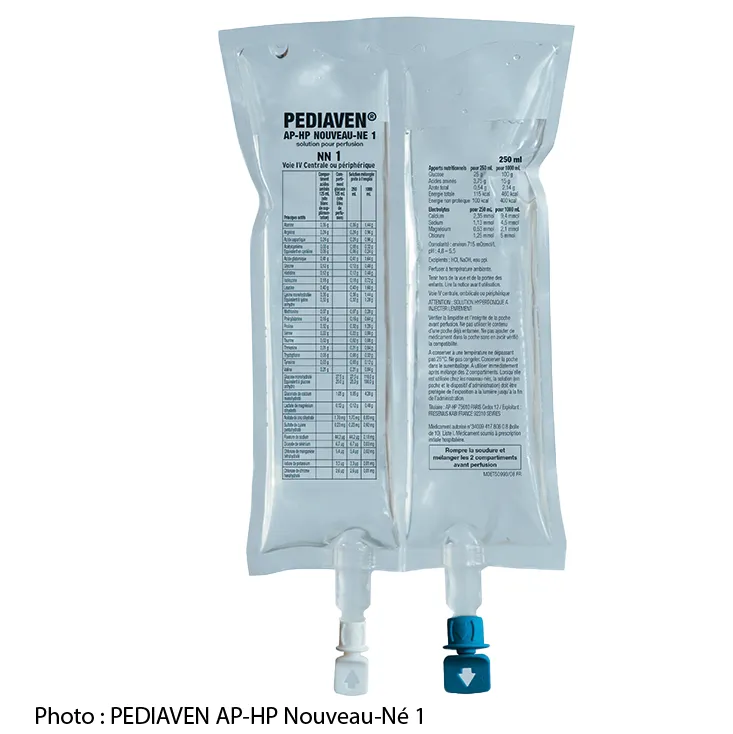
Table of Contents
- Package leaflet: Information for the user
- 1. What Pediaven NN1 is and what it is used for
- 2. Important information before using Pediaven NN1
- 3. How to use Pediaven NN1
- 4. Possible adverse effects
- 5. How to store Pediaven NN1
- 6. Contents of the package and other information
- Information intended exclusively for medical professionals:
Package leaflet: Information for the user
Pediaven NN1, solution for infusion
composite product
Please read all of this leaflet carefully before the medicine is administered, because it contains
important information for the patient.
Keep this leaflet, so that you can read it again if necessary.
If you have any further questions, please consult your doctor or nurse.
If any side effects occur in the patient, including any side effects not listed in this leaflet, inform your doctor or nurse. See section 4.
Contents of the leaflet
- What Pediaven NN1 is and what it is used for
- Important information before administration of Pediaven NN1
- How to use Pediaven NN1
- Possible side effects
- How to store Pediaven NN1
- Contents of the pack and other information
1. What Pediaven NN1 is and what it is used for
Pediaven NN1 is a nutritional mixture containing an amino acid solution (components necessary for protein synthesis) and glucose (carbohydrate) with salts (electrolytes and trace elements), supplied in a plastic bag with two compartments, each with a capacity of 125 ml.
This medicine is a solution intended for intravenous infusion (intravenous infusion) via an infusion drip.
It may be used in neonates who cannot receive oral feeding.
Pediaven NN1 is particularly indicated to provide nutritional support in premature and full-term newborns during the first 24 to 48 hours of life.
2. Important information before using Pediaven NN1
When not to use Pediaven NN1:
if the patient is allergic to the active substances or any of the other ingredients of this medicine
(listed in section 6);
if the patient has inherited amino acid metabolism disorders (when the body uses certain amino acids
in an abnormal way);
if the patient has severe hyperglycemia (high blood sugar level) and this condition is uncontrolled;
if the blood concentration (in serum) of one of the salts (electrolytes) present in this medicine is
elevated;
if the patient is in an unstable general condition, for example after a serious injury or in case of
uncontrolled diabetes, metabolic acidosis (a problem caused by a very high amount of acidic substances in the blood), severe infection (severe sepsis), acute shock, or coma.
Other general situations when not to use Pediaven NN1:
if the patient has fluid in the lungs (acute pulmonary edema);
if the patient has excess fluid in the body (overhydration);
if the patient has untreated heart failure;
if the patient has insufficient fluid in the body (hypotonic dehydration).
Pediaven NN1 should not be administered if any of the above-mentioned conditions apply to the patient.
If in doubt, consult a doctor or nurse before administering Pediaven NN1 to the patient.
Warnings and precautions
Important information before starting Pediaven NN1 in a child:
Pediaven NN1 must be used with great caution when fluid intake must be restricted, for example in certain heart, lung or kidney diseases.
Inform the doctor if any adverse reactions occur during treatment in the child, such as chills, sweating, fever, rash or breathing difficulties. In such cases, the infusion should be stopped.
When used in newborns, the solution (in the bag and infusion set) must be protected from light until the end of administration. Exposure of Pediaven NN1 to light, particularly after addition of trace elements and (or) vitamins, may lead to the formation of peroxides and other degradation products. This can be minimized by protecting the solution from light.
Elevated magnesium levels in blood
The amount of magnesium contained in Pediaven NN1 may cause increased magnesium concentration in blood. This may manifest as: weakness, reduced reflexes, vomiting, decreased blood calcium levels, breathing difficulties, low blood pressure, and irregular heartbeat. These symptoms may be difficult to detect; therefore, the doctor may monitor the child's blood parameters, especially if there is a risk of elevated magnesium levels in blood, particularly in case of kidney function disorders. If blood magnesium concentration is elevated, the infusion will be stopped or reduced.
The doctor will monitor the child's condition throughout the treatment period and may adjust the administered dose or recommend additional medications if necessary (mainly vitamins, fats, amino acids or electrolytes).
Pediaven NN1 and other medicines
Inform the doctor about all medicines currently or recently taken by the child, including medicines obtained without a prescription.
3. How to use Pediaven NN1
Dosage
Pediaven NN1 should always be used as directed by the physician. The physician will determine the dose
and duration of treatment based on the child's age, body weight, metabolic and energy requirements,
clinical condition, and ability to tolerate oral or enteral nutrition (delivery of nutrients via a tube placed
in the gastrointestinal tract).
If nutrition is administered exclusively by intravenous route (into the vein), the physician may recommend
the simultaneous administration of vitamins and fats. If vitamins have been added to the solution,
the bag must be protected from light.
Route of administration
Pediaven NN1 is administered exclusively by medical personnel and only by intravenous route.
When used in newborns, the solution (in the bag and infusion set) must be protected from light until
the end of administration (see section 2).
Administration of a higher than recommended dose of Pediaven NN1
Pediaven NN1 should always be used as directed by the physician. If there is any suspicion that the child
has received more than the recommended dose, inform the physician immediately.
Missed administration of Pediaven NN1
Pediaven NN1 should always be used as directed by the physician. If an infusion of Pediaven NN1 has
been missed, inform the physician immediately. Do not administer a double dose to make up for the
missed dose, and do not exceed the recommended infusion rate.
If you have any further questions regarding the use of this medicine, consult your physician.
4. Possible adverse effects
Like all medicines, this medicine can cause adverse effects, although not everyone will experience them.
You must contact the doctor immediately, who will stop the infusion, if the child develops any of the
following symptoms:
Unusual signs or symptoms of an allergic reaction, such as sweating, chills, headache, rash, or
breathing difficulties.
Adverse effects associated with parenteral nutrition (nutrition administered intravenously) may occur, especially at the beginning of treatment, including:
Leakage of the solution outside the vein (extravasation), causing local inflammation or tissue necrosis;
Increased blood glucose concentration (hyperglycaemia);
Gastrointestinal disturbances (nausea, vomiting);
Disturbances in fluid and electrolyte balance, such as changes in blood levels of the following electrolytes: sodium, potassium, chloride, magnesium, phosphorus;
Metabolic acidosis (disturbance in the balance between acidic and alkaline substances in the body) caused by excessive intake of amino acids. Hyperazotaemia (excess nitrogen-containing compounds in the blood) may also occur, particularly in patients with kidney or respiratory problems;
Increased blood phenylalanine (amino acid) concentration in critically ill premature infants;
Thrombophlebitis (blood clots in veins), which may occur especially if the infusion line is inserted into the arm or foot (peripheral venous administration);
Transient liver function disturbances;
Allergic reactions to specific amino acids.
Improper use (overdose or infusion too rapid) may lead to symptoms of hyperglycaemia, hypercalcaemia (increased calcium concentration in blood), and hypervolaemia (increased blood volume in vessels).
Reporting of adverse effects
If any adverse effects occur, including any not listed in this leaflet, inform your doctor or pharmacist. Adverse effects can be reported directly to the Department of Monitoring Adverse Drug Reactions of the Office for Registration of Medicinal Products, Medical Devices and Biocidal Products
Al. Jerozolimskie 181C
02-222 Warsaw
tel.: +48 22 49 21 301
fax: +48 22 49 21 309
e-mail: [email protected]
Adverse effects may also be reported to the responsible entity.
By reporting adverse effects, additional information on the safety of the medicine can be collected.
5. How to store Pediaven NN1
Keep this medicine out of sight and reach of children.
Do not use this medicine after the expiry date stated on the label following: EXP. The expiry date refers to the last day of the stated month.
Store below 25°C. Do not freeze. Store in the outer bag. Use immediately after mixing the contents of the two chambers.
When used in newborns, the solution (in the bag and administration set) must be protected from light until administration is completed (see section 2).
Shelf-life after mixing with additional substances
After mixing the two chambers, other components may be added via the port designated for administration of additional substances. The medicine must be used immediately after addition of other components.
Do not use this medicine if the packaging is damaged or if there are signs of deterioration.
Medicines must not be disposed of via wastewater or household waste. Ask your pharmacist how to dispose of medicines no longer required. These measures will help protect the environment.
6. Contents of the package and other information
What Pediaven NN1 contains
The active substances in the medicine are:
| Active substances | Amino acid solution 125 ml | Glucose solution 125 ml | Solution after mixing, ready for use 250 ml 1000 ml | |
| alanine | 0.36 g | 0.36 g | 1.44 g | |
| arginine | 0.24 g | 0.24 g | 0.96 g | |
| aspartic acid | 0.24 g | 0.24 g | 0.96 g | |
| acetylcysteine (equivalent to cysteine) | 0.08 g (0.06 g) | 0.08 g (0.06 g) | 0.32 g (0.24 g) | |
| glutamic acid | 0.41 g | 0.41 g | 1.64 g | |
| glycine | 0.12 g | 0.12 g | 0.48 g | |
| histidine | 0.12 g | 0.12 g | 0.48 g | |
| isoleucine | 0.18 g | 0.18 g | 0.72 g | |
| leucine | 0.40 g | 0.40 g | 1.60 g | |
| lysine monohydrate (equivalent to anhydrous lysine) | 0.36 g (0.32 g) | 0.36 g (0.32 g) | 1.44 g (1.28 g) | |
| methionine | 0.07 g | 0.07 g | 0.28 g | |
| phenylalanine | 0.16 g | 0.16 g | 0.64 g | |
| proline | 0.32 g | 0.32 g | 1.28 g | |
| serine | 0.22 g | 0.22 g | 0.88 g | |
| taurine | 0.02 g | 0.02 g | 0.08 g | |
| threonine | 0.21 g | 0.21 g | 0.84 g | |
| tryptophan | 0.08 g | 0.08 g | 0.32 g | |
| tyrosine | 0.03 g | 0.03 g | 0.12 g | |
| valine | 0.21 g | 0.21 g | 0.84 g | |
| glucose monohydrate (equivalent to anhydrous glucose) | 27.5 g (25.0 g) | 27.5 g (25.0 g) | 110.0 g (100.0 g) | |
| calcium gluconate | 1.05 g | 1.05 g | 4.20 g | |
| magnesium lactate dihydrate | 0.12 g | 0.12 g | 0.48 g | |
| zinc acetate dihydrate | 1.70 mg | 1.70 mg | 6.80 mg | |
| copper sulfate pentahydrate | 0.23 mg | 0.23 mg | 0.92 mg | |
| sodium fluoride | 44.2 µg | 44.2 µg | 0.18 mg | |
| selenium dioxide | 6.7 µg | 6.7 µg | 0.03 mg | |
| manganese chloride tetrahydrate | 5.4 µg | 5.4 µg | 0.02 mg | |
| potassium iodide | 3.3 µg | 3.3 µg | 0.01 mg | |
| chromium chloride hexahydrate | 2.6 µg | 2.6 µg | 0.01 mg | |
Remaining ingredients (excipients) are: hydrochloric acid (for pH adjustment), sodium hydroxide (for
pH adjustment), water for injections.
Osmolarity of the solution: 715 mOsmol/l
pH of the solution: 4.8 – 5.5
Nutritional value in 250 ml in 1000 ml
glucose 25.00 g 100 g
amino acids 3.75 g 15 g
total nitrogen 0.54 g 2.14 g
total energy 115 kcal 460 kcal
non-protein energy 100 kcal 400 kcal
What Pediaven NN1 looks like and contents of the pack
This medicinal product is an infusion solution, transparent, colourless to slightly yellowish, free from solid particles. It
is available in a dual-chamber bag (each chamber contains 125 ml of solution).
Pack size: 10 bags × 250 ml.
Marketing Authorisation Holder and Manufacturer
Marketing Authorisation Holder
Fresenius Kabi Polska Sp. z o.o.
Al. Jerozolimskie 134
02-305 Warsaw
Manufacturer
Fresenius Kabi Austria GmbH
Hafnerstrasse 36
8055 Graz
Austria
For further information, please contact the Marketing Authorisation Holder's representative:
Fresenius Kabi Polska Sp. z o.o.
Al. Jerozolimskie 134
02-305 Warsaw
tel.: +48 22 345 67 89
This medicinal product is authorised for marketing in the European Economic Area member states under the following names:
Austria Pediaven Start-Up Potassium Free
Belgium Kidiamix Neo 1
Estonia Pediaven NN1
France Kidiaven Nouveau-Né 1
Spain Pediaven NN1
Netherlands Kidiamix Neo 1
Lithuania Pediaven Start-Up Potassium Free
Latvia Pediaven Start-Up Potassium Free
Poland Pediaven NN1
Portugal Pediaven NN1
Italy Kidiamix G10% senza potassio
Information intended exclusively for medical professionals:
Warnings and precautions for use
Pediaven NN1, solution for infusion, is a hypertonic solution. It contains a low concentration of sodium (4.5 mmol/l) and chloride (5 mmol/l). It does not contain potassium or phosphorus. Therefore, the undiluted product should not be administered for longer than 48 hours, and serum calcium, phosphate, and potassium levels should be monitored.
Since the use of a central vein for infusion is associated with the risk of infection, strict adherence to aseptic procedures is essential to prevent any infection, particularly during catheter insertion.
To avoid risks associated with infusion rates exceeding the recommended rate, it is important to administer the infusion at a regular and controlled rate.
Serum osmolarity and glucose concentration, fluid and electrolyte balance, acid-base balance, and liver function should be monitored.
If any signs or symptoms of an anaphylactic reaction occur (especially fever, chills, sweating, rash, or dyspnea), the infusion must be stopped immediately.
Clinical and laboratory monitoring is required during the infusion, particularly at the beginning. Monitoring should be intensified in the following cases:
- severe liver insufficiency,
- severe renal insufficiency,
- metabolic acidosis (a disorder caused by a very high concentration of acidic substances in the blood),
- diabetes or glucose intolerance in preterm infants.
Extravasation
As with all intravenously administered medicinal products, extravasation may occur during infusion of this product (see section 4. Undesirable effects).
The catheter insertion site should be regularly checked for signs of extravasation.
If extravasation occurs, the infusion must be stopped immediately, but the catheter or cannula should remain in place to allow immediate treatment of the patient. Any fluid that has extravasated should be aspirated before removing the catheter or cannula, and the affected limb should be elevated (if applicable).
Management following extravasation may include non-pharmacological treatment, pharmacological treatment, and/or surgical intervention. In cases of extensive extravasation, consultation with a surgeon is recommended.
Infusion should not be restarted through the same central vein.
Method of administration
Infusion into a central, peripheral, or umbilical vein. The infusion duration should be 24 hours.
To ensure complete parenteral nutrition, concomitant administration of vitamins and lipids is recommended. However, Pediaven NN1 already contains trace elements. In certain cases, depending on patient needs, Pediaven NN1 may be supplemented with amino acids and electrolytes (see section "Pharmaceutical compatibility").
When used in neonates, the solution (in bag and administration set) must be protected from light until administration is completed.
Infusion rate
The dose should be individually adjusted according to patient age, body weight, metabolic and energy requirements, and clinical condition.
Pediaven NN1 does not contain potassium or phosphorus and is therefore not indicated for parenteral nutrition lasting longer than the first 48 hours of neonatal life.
Special precautions for preparation of the medicinal product for use
Before use, remove the outer bag and inspect the inner bag for damage (integrity). Do not use if the packaging is damaged.
Use only if amino acid and glucose solutions are clear, colorless to slightly yellow, and free from particulate matter. The contents of the two separate chambers must be mixed before use, as well as before adding any other substances via the designated port.
Exposure to light of parenteral nutrition solutions, particularly after addition of trace elements and/or vitamins, may have adverse effects on clinical response in neonates due to the formation of peroxides and other degradation products. When used in neonates, Pediaven NN1 must be protected from light until administration is completed.
Mixing the two chambers before use
- Remove the outer bag and place the bag on a hard surface.
- Gently roll the bag from the top (handle side), applying pressure until the vertical seal breaks. Invert the bag several times to ensure thorough mixing of the solution components.
For single use only. Any unused portion of the mixture must be discarded.
Validated aseptic procedures must be strictly followed regarding handling of the medicinal product, catheter, and infusion.
Stability after mixing
Chemical and physical stability of the dual-chamber bag has been demonstrated for 24 hours at 25°C after mixing. From a microbiological point of view, the product should be used immediately. If not used immediately, the responsibility for the in-use storage duration and conditions prior to use lies with the user.
Pharmaceutical compatibility
Only medicinal products or parenteral nutrition solutions with established compatibility may be added to Pediaven NN1 or administered through the same infusion line. Information on the volume of additional substances and their compatibility with Pediaven NN1 is provided in the Summary of Product Characteristics, section 6.6 Special precautions for disposal and preparation of the medicinal product for use. There is a risk of precipitation of calcium salts.
All additions must be made under aseptic conditions.
Special precautions for disposal and preparation of the medicinal product for use
When used in neonates, protect from light until administration is completed. Exposure of Pediaven NN1 to light, particularly after addition of trace elements and/or vitamins, leads to the formation of peroxides and other degradation products, which can be minimized by providing protection from light.