Paramax rapid 500 mg
Poland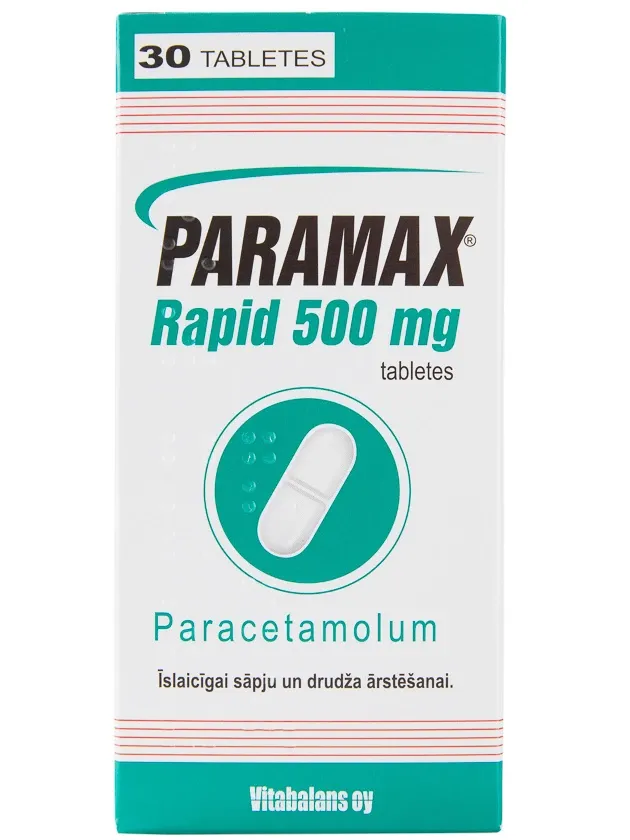
Table of Contents
PARAMAX Rapid, 500 mg, tablets
Paracetamolum
Please read the entire leaflet carefully before taking the medicine, as it contains important information for the patient.
This medicine should always be used exactly as described in the patient leaflet or as advised by a doctor or pharmacist.
- Keep this leaflet, as you may need to read it again.
- If you need advice or further information, please consult your pharmacist.
- If you experience any side effects, including any not listed in this leaflet, tell your doctor, pharmacist or nurse. See section 4.
- If there is no improvement after 3–4 days, or if you feel worse, contact your doctor.
Contents of the leaflet
- What Paramax Rapid is and what it is used for
- Important information before taking Paramax Rapid
- How to take Paramax Rapid
- Possible side effects
- How to store Paramax Rapid
- Contents of the package and other information
1. What Paramax Rapid is and what it is used for
Paramax Rapid contains paracetamol, which has analgesic and antipyretic effects.
The medicine is used for reducing elevated body temperature and for symptomatic treatment of mild to moderate pain, such as headache, toothache, joint and muscle pain, menstrual pain, and neuralgia.
If there is no improvement after 3–4 days, or if you feel worse, contact your doctor.
2. Important information before taking Paramax Rapid
When not to take Paramax Rapid
- if you are allergic to paracetamol or to any of the other ingredients of this medicine (listed in section 6);
- if you have severe kidney failure;
- if you have severe liver failure;
- if you have alcohol-related liver disease;
- do not take this medicine concurrently with MAO inhibitors (medicines used, among others, in the treatment of depression), or within 2 weeks after stopping treatment with such medicines;
- do not use in children under 12 years of age.
Warnings and precautions
Before starting treatment with Paramax Rapid, consult your doctor:
- if you have kidney disease;
- if you have liver disease;
- if you have glucose-6-phosphate dehydrogenase (G-6-PD) deficiency.
During treatment with Paramax Rapid, contact your doctor immediately:
- if you have serious underlying conditions, including severe kidney dysfunction or sepsis (when bacteria and their toxins circulate in the blood, leading to organ damage), or
- malnutrition, chronic alcoholism, or if you are also taking flucloxacillin (an antibiotic). In such cases, severe metabolic acidosis (a blood and body fluid disorder) has been reported in patients taking paracetamol regularly over a long period or when paracetamol is taken together with flucloxacillin. Symptoms of metabolic acidosis may include: severe breathing difficulties, including rapid deep breathing, drowsiness, nausea, and vomiting.
This medicine contains paracetamol. Do not take other medicines containing paracetamol (e.g. some cold and flu remedies) due to the risk of overdose and potentially life-threatening liver damage. Prolonged or frequent use of this medicine is not recommended.
Do not exceed the recommended daily dose. In case of overdose, contact your doctor immediately, even if you feel well. See also section 3, "Taking more than the recommended dose of Paramax Rapid".
Patients who are fasting or regularly consume alcohol are at particular risk of liver damage.
Do not drink alcohol during treatment.
Prolonged use of high doses of paracetamol (>4 g in adults) may cause liver damage, even in individuals with no prior history of liver disease, if used for longer than 3 weeks.
Patients with moderate or severe liver or kidney impairment should be closely monitored by a doctor.
Long-term use of paracetamol increases the risk of kidney damage.
Paramax Rapid and other medicines
Inform your doctor about all medicines you are currently taking, have recently taken, or plan to take.
- Flucloxacillin (an antibiotic) – due to a serious risk of blood and body fluid disorders (metabolic acidosis), which require urgent treatment (see section 2).
To avoid overdose, check whether other medicines you are taking contain paracetamol.
Concurrent use of this medicine with MAO inhibitors is contraindicated, as well as within 2 weeks after stopping treatment with such medicines, due to the risk of agitation and high fever.
Do not drink alcohol while taking paracetamol, due to the risk of hepatotoxicity.
Medicines such as isoniazid or rifampicin (antituberculosis drugs), carbamazepine, phenytoin, and phenobarbital (used, among others, in epilepsy) accelerate the metabolism of paracetamol. This may lead to liver damage even when recommended doses of paracetamol are used.
Probenecid (used, among others, in gout) delays the elimination of paracetamol metabolites and may increase the hepatotoxicity of paracetamol.
Concurrent use of paracetamol with zidovudine (AZT, an antiviral drug used in HIV infection) may enhance the bone marrow toxicity of zidovudine.
Paracetamol may enhance the effect of anticoagulant medicines (coumarin derivatives).
Concurrent use of paracetamol and non-steroidal anti-inflammatory drugs increases the risk of kidney dysfunction.
The absorption rate of paracetamol may be increased by metoclopramide or domperidone (medicines used for nausea and vomiting), and decreased by cholestyramine (used to reduce high cholesterol levels in blood).
Salicylamide (a medicine with analgesic and antipyretic properties) prolongs the elimination time of paracetamol.
Paramax Rapid with food and drink
This medicine may be taken during or independently of meals.
Pregnancy and breastfeeding
If you are pregnant or breastfeeding, think you may be pregnant, or are planning to have a baby, consult your doctor or pharmacist before taking this medicine.
Paramax Rapid may be used in pregnant women if clinically justified.
Use the lowest effective dose needed to relieve pain or fever, and take the medicine for the shortest possible time. If pain is not relieved or fever does not subside, or if you need to take the medicine more frequently, consult your doctor.
Driving and operating machinery
At recommended doses, paracetamol does not affect the ability to drive motor vehicles or operate mechanical equipment.
3. How to take Paramax Rapid
This medicine should always be taken exactly as described in this patient leaflet or as advised by your doctor. If in doubt, consult your doctor or pharmacist.
Recommended doses of Paramax Rapid:
Adults and children over 12 years of age (weighing over 40 kg):
1 or 2 tablets 1 to 3 times daily, no more frequently than every 4 hours.
Do not take more than 4 doses per day.
Do not use Paramax Rapid for longer than 3 days without consulting a doctor.
Patients with liver or kidney impairment:
In patients with kidney or liver impairment or Gilbert's syndrome, the dose should be reduced or the intervals between doses extended.
Taking more than the recommended dose of Paramax Rapid
In case of overdose, seek immediate medical advice, even if you feel well. If less than 1 hour has passed since the overdose, induce vomiting. Contact a doctor immediately, as specialized hospital treatment may be necessary.
Accidental or intentional overdose of paracetamol may cause symptoms within a few to several hours, such as nausea, vomiting, excessive sweating, drowsiness, and general weakness. These symptoms may resolve the next day, despite the onset of potentially life-threatening liver damage, which may later manifest as upper abdominal discomfort, recurrence of nausea, and jaundice.
If you miss a dose of Paramax Rapid
Do not take a double dose to make up for a missed tablet. Take the missed dose as soon as possible, then continue treatment as directed.
If you have any further questions about the use of this medicine, consult your doctor or pharmacist.
4. Possible adverse reactions
Like all medicines, this medicine can cause adverse reactions, although not everybody will experience them.
The frequency of the possible adverse reactions listed below is defined as follows:
Common (occur in 1 to 10 out of 100 people): nausea, vomiting;
Uncommon (occur in 1 to 10 out of 1,000 people): constipation;
Very rare (occur in less than 1 out of 10,000 people): anaphylactic reactions, hypersensitivity reactions, skin redness, rash, erythema or urticaria, angioedema (distinct, localized swelling involving deeper skin layers including subcutaneous tissue), dyspnea, bronchospasm, decreased granulocyte (a type of white blood cells) or platelet count, and agranulocytosis. Renal colic, necrosis of renal papillae, acute renal failure.
Very rare cases of severe skin reactions have been reported.
Frequency not known (cannot be estimated from the available data): a serious condition which may cause acidification of the blood (so-called metabolic acidosis) in patients with severe disease taking paracetamol (see section 2).
Reporting of adverse reactions
If any adverse reactions occur, including any adverse reactions not listed in this leaflet, inform a doctor or pharmacist. Adverse reactions can be reported directly to the Department of Monitoring Adverse Drug Reactions of the Office for Registration of Medicinal Products, Medical Devices and Biocidal Products
Al. Jerozolimskie 181C
02 222 Warsaw
Phone: +48 22 49 21 301
Fax: +48 22 49 21 309
Website: https://smz.ezdrowie.gov.pl
Adverse reactions may also be reported to the Marketing Authorisation Holder.
Reporting adverse reactions helps to provide more information on the safety of the medicine.
5. How to store Paramax Rapid
No special storage instructions are required.
Keep the medicine in a place out of sight and reach of children.
Do not use this medicine after the expiry date stated on the carton and blister pack after:
Expiry date. The expiry date refers to the last day of the stated month.
Medicines must not be disposed of via wastewater or household waste. Ask your pharmacist
what to do with medicines no longer required. This will help protect the environment.
6. Contents of the pack and other information
What Paramax Rapid contains
- The active substance is paracetamol. Each tablet contains 500 mg of paracetamol.
- The other ingredients are: povidone, microcrystalline cellulose, sodium carboxymethylstarch, stearic acid, magnesium stearate.
What Paramax Rapid looks like and contents of the pack
White, capsule-shaped tablets, 18 mm in length and 7.5 mm in width, packed in blisters
or in HDPE containers with a cardboard box.
10 tablets (1 blister containing 10 tablets)
30 tablets (3 blisters containing 10 tablets each)
100 tablets (1 container containing 100 tablets)
Marketing Authorisation Holder and Manufacturer
Vitabalans Oy
Varastokatu 8
13500 Hämeenlinna
Finland
Tel.: +358 (3) 615600
For further information, please contact the representative of the Marketing Authorisation Holder:
Vitabalans Sp. z o.o., ul. Narbutta 5, lok. 1, 02-564 Warsaw, Poland
Telephone: (0-48) 22 646 6035