Paracod
Poland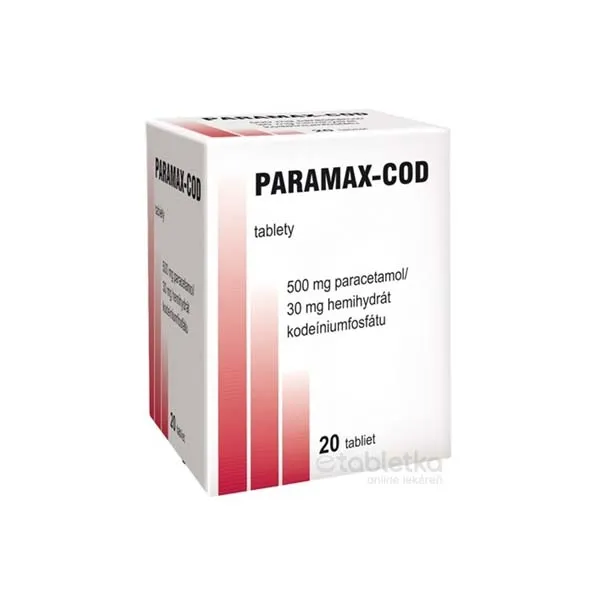
Table of Contents
Patient Information Leaflet
Paramax-Cod, 500 mg + 30 mg, tablets
Paracetamolum + Codeini phosphas hemihydricus
Please read this leaflet carefully before taking this medicine, as it contains important information for you.
- Keep this leaflet, as you may need to read it again.
- If you have any further questions, please ask your doctor or pharmacist.
- This medicine has been prescribed for a specific individual. Do not pass it on to others. It may harm someone else, even if their symptoms are the same.
- If you experience any adverse reactions, including any not listed in this leaflet, inform your doctor or pharmacist. See section 4.
- If there is no improvement after 3 days, or if you feel worse, you should contact your doctor.
Leaflet Contents
- What Paramax-Cod is and what it is used for
- Important information before taking Paramax-Cod
- How to take Paramax-Cod
- Possible side effects
- How to store Paramax-Cod
- Contents of the pack and other information
1. What Paramax-Cod is and what it is used for
Paramax-Cod contains paracetamol and codeine. Paracetamol has analgesic and antipyretic properties. The combination of paracetamol and codeine provides a longer-lasting and stronger analgesic effect than either component alone.
Paramax-Cod is indicated for the short-term treatment of moderate pain.
This medicine contains codeine. Codeine belongs to a group of medicines called opioid analgesics, which relieve pain. It may be used alone (as monotherapy) or in combination with other analgesics such as paracetamol.
Codeine may be used in children aged 12 years and older for the short-term relief of moderate pain not relieved by other analgesics such as paracetamol or ibuprofen used as monotherapy.
2. Important information before taking the medicine
When not to take Paramax-Cod
- if the patient has hypersensitivity (allergy) to paracetamol, codeine, or any of the other ingredients of Paramax-Cod;
- if the patient has severe renal impairment;
- if the patient has hepatic insufficiency;
- if the patient suffers from alcoholic liver disease;
- if the patient has bronchial asthma or respiratory insufficiency;
- during the first three months of pregnancy;
- if the patient is breastfeeding;
- if the patient has glucose-6-phosphate dehydrogenase deficiency;
- if the patient is currently taking MAO inhibitors (medicines used, among others, in the treatment of depression), or within 14 days after discontinuation of treatment with these drugs;
- for pain relief in children and adolescents (aged 0 to 18 years) following tonsillectomy due to obstructive sleep apnoea syndrome;
- if the patient is known to be a rapid metabolizer of codeine to morphine.
The medicine should not be used in children under 12 years of age.
Warnings and precautions
The medicine contains paracetamol. Do not take other medicines containing paracetamol (e.g.,
some cold and flu remedies) due to the risk of overdose and potentially life-threatening liver damage.
Prolonged or frequent use of the medicine is not recommended.
Do not exceed the recommended daily dose. In case of overdose, contact a doctor immediately, even if the patient feels well.
See also section 3, "Taking more than the recommended dose of Paramax-Cod."
- Do not drink alcohol or use medicines containing alcohol while taking this medicine, due to increased risk of hepatotoxic liver damage and enhanced effects of codeine. The risk of hepatotoxic liver damage is particularly high in undernourished individuals and those who regularly consume alcohol.
- Exercise caution in patients with impaired lung, liver, or kidney function.
- Exercise caution in patients taking medicines that cause central nervous system depression, such as benzodiazepines, antipsychotics, or anaesthetics.
- Long-term use of high doses of codeine may lead to dependence. When high doses of codeine are used, tolerance, psychological dependence, and constipation may occur.
- Codeine may trigger hepatic colic in patients with gallstones.
- Codeine may trigger renal colic in patients with kidney stones.
- Codeine may cause urinary retention in patients with benign prostatic hyperplasia.
- Codeine may increase intracranial pressure; therefore, caution is advised in patients with head injuries.
- In patients with renal impairment, the interval between doses should be at least 8 hours.
- Codeine is metabolized to morphine by liver enzymes. Morphine is the substance responsible for pain relief. Some individuals have altered enzyme activity, which may affect the drug’s action differently. In some people, morphine is not produced or is produced in very small amounts, resulting in inadequate pain relief. Others are at higher risk of severe adverse effects due to the production of very large amounts of morphine. If any of the following adverse effects occur, discontinue taking the medicine and contact a doctor immediately: slow or shallow breathing, confusion, drowsiness, pinpoint pupils, nausea or vomiting, constipation, loss of appetite.
During treatment with Paramax-Cod, inform your doctor immediately
- if the patient has serious medical conditions, including severe kidney dysfunction or sepsis (when bacteria and their toxins circulate in the blood, leading to organ damage), malnutrition, chronic alcoholism, or if the patient is also taking flucloxacillin (an antibiotic). In these situations, severe metabolic acidosis (a blood and body fluid disorder) has been reported in patients who took paracetamol regularly over a long period or who took paracetamol together with flucloxacillin. Symptoms of metabolic acidosis may include: severe breathing difficulties, including rapid deep breathing, drowsiness, nausea, and vomiting.
Children and adolescents
This medicine must not be given to children under 12 years of age.
Use in children and adolescents after surgery
Codeine must not be used for pain relief in children and adolescents after surgical removal of the palatine or pharyngeal tonsils due to obstructive sleep apnoea syndrome.
Use in children with breathing disorders
Codeine is not recommended in children with respiratory disorders, as symptoms of morphine toxicity may be intensified.
Paramax-Cod and other medicines
Inform your doctor about all medicines you are currently taking, including those available without a prescription.
Due to the risk of overdose, check whether other medicines you are taking contain paracetamol or codeine.
Paracetamol
Concomitant use of this medicine with MAO inhibitors is contraindicated, as well as within 2 weeks after discontinuation of treatment with these drugs, due to the risk of excitation and high fever.
Do not drink alcohol while taking paracetamol, due to the risk of hepatotoxic liver damage.
Medicines such as isoniazid or rifampicin (antituberculosis drugs), carbamazepine, phenytoin, and phenobarbital (medicines used, among others, in epilepsy) accelerate paracetamol metabolism. This may lead to liver damage even when recommended doses of paracetamol are used.
Probenecid (a medicine used, among others, in gout) delays elimination of paracetamol metabolites and may increase paracetamol hepatotoxicity.
Concomitant use of paracetamol with zidovudine (AZT, an antiviral drug used in HIV infection) may enhance zidovudine’s toxic effects on bone marrow.
Paracetamol may enhance the effects of anticoagulant medicines (coumarin derivatives).
Concomitant use of paracetamol and non-steroidal anti-inflammatory drugs increases the risk of kidney function disorders.
The absorption rate of paracetamol may be increased by metoclopramide or domperidone (medicines used for nausea and vomiting), or decreased by cholestyramine (a medicine used to lower elevated blood cholesterol levels).
Salicylamide (a medicine with analgesic and antipyretic effects) prolongs paracetamol elimination time.
Flucloxacillin (an antibiotic) carries a serious risk of blood and body fluid disorders (called metabolic acidosis), which require urgent treatment (see section 2).
Codeine
Concomitant use of this medicine with other analgesics containing buprenorphine, pentazocine, or nalbuphine is contraindicated, as codeine’s effect may be reduced and the risk of withdrawal syndrome upon discontinuation increased.
Alcohol intensifies the effects of codeine.
Barbiturates, benzodiazepines, morphine derivatives (analgesic and antitussive medicines), and methadone (an opioid analgesic) taken together with codeine increase the risk of respiratory depression, which may lead to death in case of overdose.
Other medicines with central nervous system depressant effects (sedative antidepressants, barbiturates, clonidine and its derivatives, sleeping pills, neuroleptics, anxiolytics) enhance codeine’s depressant effects on the central nervous system.
Concomitant use of codeine and anticholinergic medicines may cause paralytic ileus.
Food and drink
The medicine may be taken during or independently of meals.
Pregnancy and breastfeeding
If the patient is pregnant or breastfeeding, suspects she may be pregnant, or plans to become pregnant, she should consult a doctor before using this medicine.
Pregnancy
The medicine is contraindicated during the first trimester of pregnancy.
During the second and third trimesters of pregnancy, the medicine should only be used after consultation with a doctor.
Breastfeeding
Paracetamol and codeine pass into breast milk. Codeine should not be taken during breastfeeding.
Driving and operating machinery
Due to the presence of codeine, Paramax-Cod may impair the ability to drive or operate machinery.
3. How to take Paramax-Cod
This medicine should always be taken according to the doctor's instructions. In case of doubt, consult
your doctor.
The usual dose of PARAMAX-COD is:
Adults: 1 to 2 tablets every 6 hours.
The maximum daily dose is 6 tablets.
Children aged 12 to 18 years:
the recommended dose of codeine in children aged 12 years and older is 1 to 2 tablets every 6 hours, if
necessary, up to a maximum daily dose of 180 mg.
Paramax-Cod should not be used in children under 12 years of age due to the risk of
severe respiratory depression.
Patients with renal impairment: in patients with renal impairment, the interval between doses
should be at least 8 hours.
The duration of treatment should be limited to 3 days, and if effective pain relief has not been achieved,
the patient or caregiver should seek medical advice.
Method of administration
Tablets should be swallowed with a glass of water.
Taking more than the recommended dose of Paramax-Cod
If more than the recommended dose is taken, seek medical advice immediately, even
if the patient feels well.
Symptoms
Paracetamol: accidental or intentional paracetamol overdose may cause symptoms within
a few to several hours, such as nausea, vomiting, excessive sweating, drowsiness, and general
weakness. These symptoms may subside the next day, despite the onset of liver damage, which
subsequently manifests as upper abdominal discomfort, recurrence of nausea, and
jaundice. Death may occur.
Codeine: accidental or intentional codeine overdose in adults may cause
respiratory depression (cyanosis, depressed respiratory function, shallow breathing),
hypotension, bradycardia, drowsiness, vomiting, skin rash, itching, motor incoordination,
pulmonary edema (rarely), and pinpoint pupils.
Symptoms of overdose in children: respiratory depression, pinpoint pupils, seizures,
histamine release symptoms – sudden facial flushing and swelling, urticaria, urinary retention.
Management
In any case where a patient has taken more than the recommended dose, or if a child
accidentally swallows even one tablet, induce vomiting if no more than 1 hour has passed since ingestion,
and immediately contact the emergency department of the nearest hospital.
Missed dose of Paramax-Cod
Do not take a double dose to make up for a missed tablet. Take the tablet as soon as possible,
then continue taking the medicine as directed.
In case of any doubts regarding the use of the medicine, consult your doctor or pharmacist.
4. Possible adverse reactions
Like all medicines, Paramax-Cod may cause adverse reactions, although not everyone experiences them.
If hypersensitivity reactions or other serious adverse reactions occur, discontinue use of the medicine immediately and urgently contact a doctor or the nearest hospital emergency department.
Common (may affect up to 1 in 10 people): constipation, nausea, vomiting, renal colic, necrosis, renal papillary necrosis, acute renal failure
Uncommon (may affect up to 1 in 1,000 people):
- cases of hypersensitivity reactions, such as skin redness, rash, erythema or urticaria, excessive sweating, hypotension up to shock symptoms,
- drowsiness, dizziness
Rare (may affect up to 1 in 10,000 people):
- cases of hypersensitivity reactions, such as angioedema (distinct, localized swelling involving deeper skin layers including subcutaneous tissue), dyspnea, bronchospasm,
- decreased number of granulocytes (a type of white blood cells) or platelets,
- granulocyte aplasia,
- respiratory centre depression, apnoea,
- cases of severe skin reactions.
Frequency not known (cannot be estimated from available data): a serious condition which may lead to blood acidification (so-called metabolic acidosis) in patients with severe disease taking paracetamol (see section 2).
Prolonged use of the medicine carries a risk of dependence and withdrawal syndrome in patients who suddenly stop taking the medicine, as well as in newborns whose mothers took the medicine during the third trimester of pregnancy.
Reporting of adverse reactions
If any adverse reactions occur, including any adverse reactions not listed in this leaflet, inform your doctor, pharmacist or nurse. Adverse reactions can be reported directly to the Department of Monitoring Adverse Drug Reactions at the Office for Registration of Medicinal Products, Medical Devices and Biocidal Products:
Al. Jerozolimskie 181C
02-222 Warsaw
Tel.: +48 22 49 21 301
Fax: +48 22 49 21 309
Website: https://smz.ezdrowie.gov.pl
Adverse reactions can also be reported to the marketing authorization holder.
Reporting adverse reactions helps to provide more information on the safety of the medicine.
5. How to store Paramax-Cod
Keep this medicine out of sight and reach of children.
Do not use this medicine after the expiry date stated on the packaging. The expiry date refers to the last day of the specified month.
Medicines must not be disposed of via wastewater or household waste. Ask your pharmacist how to dispose of medicines no longer required. This will help protect the environment.
6. Contents of the pack and other information
What Paramax-Cod contains
- The active substances are paracetamol and codeine. Each tablet contains 500 mg of paracetamol and 30 mg of codeine phosphate hemihydrate.
- Other ingredients: microcrystalline cellulose, povidone, stearic acid, magnesium stearate.
What Paramax-Cod looks like and contents of the pack
White, capsule-shaped tablets, 18 mm long and 7.5 mm wide, with a central groove.
The container is made of HDPE plastic with an LDPE closure, placed in a cardboard box containing
10, 20, 30, 50 or 100 tablets.
Marketing Authorisation Holder
Vitabalans Oy, Varastokatu 8, 13500 Hämeenlinna, Finland
Manufacturer
Vitabalans Oy, Varastokatu 8, FI-13500 Hämeenlinna, Finland
For further information, please contact the Marketing Authorisation Holder's representative:
Vitabalans Sp. z o.o., Narbutta Street 5, loc. 1, 02-564 Warsaw, Poland
Telephone: (0-48) 22 646 6035