Paracetamol hasco forte
Poland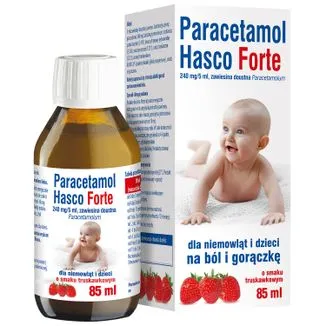
Table of Contents
- Patient Information Leaflet
- 1. What Paracetamol Hasco Forte is and what it is used for
- 2. Important information before using Paracetamol Hasco Forte
- 3. How to use Paracetamol Hasco Forte
- 4. Possible adverse effects
- 5. How to store Paracetamol Hasco Forte
- 6. Contents of the pack and other information
Patient Information Leaflet
Paracetamol Hasco Forte
240 mg/5 ml, oral suspension
Paracetamolum
for infants and children
Please read this leaflet carefully before using the medicine, as it contains
important information for the patient.
This medicine should always be used exactly as described in this patient leaflet or as directed by a
physician or pharmacist.
- Keep this leaflet, as you may need to read it again.
- If you need advice or further information, please consult your pharmacist.
- If any adverse reactions occur, including any not listed in this leaflet, inform your doctor or pharmacist. See section 4.
- If there is no improvement after 3 days or the patient feels worse, consult a doctor.
Table of Contents
- What Paracetamol Hasco Forte is and what it is used for
- Important information before using Paracetamol Hasco Forte
- How to use Paracetamol Hasco Forte
- Possible side effects
- How to store Paracetamol Hasco Forte
- Contents of the pack and other information
1. What Paracetamol Hasco Forte is and what it is used for
Paracetamol Hasco Forte oral suspension is an antipyretic and analgesic medicine intended for use in infants and children. When used at recommended doses, it is well tolerated.
Indications
Fever and pain of various origins (e.g. following surgical procedures, teething pain, mild to moderate headache), as well as symptoms associated with the body's reaction to vaccination (pain, fever, local reaction).
Additionally, this medicine is used in infants from 0 to 3 months of age (with body weight up to 4 kg) for symptomatic treatment of fever lasting no longer than 3 days and mild to moderate pain.
If there is no improvement after 3 days or the patient feels worse, consult a doctor.
2. Important information before using Paracetamol Hasco Forte
When not to use Paracetamol Hasco Forte
- if the patient is allergic to paracetamol or any of the other ingredients of this medicine (listed in section 6),
- in patients with severe liver failure or viral hepatitis,
- in patients with severe renal failure,
- in alcoholic liver disease.
Warnings and precautions
Before starting treatment with Paracetamol Hasco Forte, discuss this with your doctor or
pharmacist.
Do not use together with other medicines containing paracetamol due to the risk of overdose. In case
of overdose, consult a doctor immediately, even if the patient feels well.
Do not use for longer than 3 days without medical advice. Do not exceed the recommended doses.
The medicine should be used with caution in patients with liver or kidney impairment. There is an increased risk of liver damage in malnourished individuals. Caution is advised when using in patients with conditions associated with reduced glutathione levels (such as sepsis).
The use of paracetamol may increase the risk of metabolic acidosis. Caution is advised when using paracetamol in patients with glucose-6-phosphate dehydrogenase deficiency or methemoglobin reductase deficiency.
During treatment with Paracetamol Hasco Forte, inform your doctor immediately if the patient develops severe illnesses, including severe kidney disorders or sepsis (when bacteria and their toxins circulate in the blood, leading to organ damage) or malnutrition, chronic alcoholism, or if the patient is also taking flucloxacillin (an antibiotic). In these situations, cases of a serious condition called metabolic acidosis (an abnormality in blood and body fluids) have been reported in patients who took paracetamol regularly over a prolonged period or who took paracetamol together with flucloxacillin. Symptoms of metabolic acidosis may include severe breathing difficulties, including rapid deep breathing, drowsiness, nausea, and vomiting.
In patients with asthma who are allergic to salicylates (e.g. acetylsalicylic acid), hypersensitivity to paracetamol may occur.
Available research data suggest that administration of paracetamol may be a risk factor for the development of asthma and allergic diseases in children.
Paracetamol Hasco Forte and other medicines
Tell your doctor or pharmacist about all medicines the patient is currently taking or has recently taken, as well as any medicines the patient plans to take.
This medicine should not be taken together with centrally acting analgesics or alcohol, as it enhances their effects. When used concomitantly with barbiturates, antiepileptic drugs (e.g. gluthetimide, phenobarbital, phenytoin, carbamazepine), or rifampicin, the hepatotoxic effect of paracetamol is enhanced. Paracetamol increases the toxicity of chloramphenicol.
Long-term use of paracetamol in high doses enhances the effect of oral anticoagulants of the coumarin group.
Concomitant use of paracetamol with non-steroidal anti-inflammatory drugs (NSAIDs) increases the risk of kidney function disorders. Paracetamol used simultaneously with monoamine oxidase (MAO) inhibitors may cause agitation and high fever.
The absorption of paracetamol is accelerated by drugs that speed up gastric emptying (e.g. metoclopramide, domperidone) and delayed by drugs that slow gastric emptying (e.g. cholestyramine).
Concomitant use of paracetamol with zidovudine may cause neutropenia. Salicylamide prolongs the elimination time of paracetamol.
Paracetamol use may lead to false results in certain laboratory tests (e.g. blood glucose measurement).
Inform your doctor or pharmacist if the patient is taking flucloxacillin (an antibiotic) due to the serious risk of blood and body fluid disorders (called metabolic acidosis), which require urgent treatment (see section 2).
Paracetamol Hasco Forte and alcohol
Do not drink alcohol while taking Paracetamol Hasco Forte, as this may cause liver damage.
Pregnancy and breastfeeding
If the patient is pregnant or breastfeeding, suspects she may be pregnant, or is planning to have a child, she should consult a doctor or pharmacist before using this medicine.
Like other medicines, this product should be used during pregnancy and breastfeeding only if clearly needed.
Driving and operating machinery
Paracetamol Hasco Forte has no effect on the ability to drive or operate machinery.
Paracetamol Hasco Forte contains 3.7 g of sucrose in 5 ml of suspension
This should be taken into account in patients with diabetes. If a patient has previously been diagnosed with intolerance to certain sugars, the patient should consult a doctor before taking this medicine.
Paracetamol Hasco Forte contains sodium metabisulphite (E 223)
Sodium metabisulphite may in rare cases cause severe hypersensitivity reactions and bronchospasm.
Paracetamol Hasco Forte contains 7.059 mg of sodium benzoate (E 211) in 5 ml of suspension
Sodium benzoate may increase the risk of jaundice (yellowing of the skin and whites of the eyes) in newborns (up to 4 weeks of age).
Paracetamol Hasco Forte contains less than 1 mmol (23 mg) of sodium per 5 ml of suspension, meaning the medicine is considered "sodium-free".
Paracetamol Hasco Forte contains d-limonene
Paracetamol Hasco Forte contains 11.579 mg of propylene glycol (E 1520) in 5 ml of suspension
Before administering this medicinal product to a child under 4 weeks of age, consult a doctor or pharmacist, especially if the child is taking other medicinal products containing propylene glycol or alcohol.
3. How to use Paracetamol Hasco Forte
This medicine should always be taken exactly as described in this patient information leaflet or as directed by a doctor or pharmacist. If in doubt, consult a doctor or pharmacist.
This medicine is for oral use.
Shake the bottle vigorously before use to obtain a uniform suspension.
Paracetamol Hasco Forte suspension contains twice the concentration of paracetamol compared to
Paracetamol Hasco suspension.
Recommended dose:
Unless otherwise advised by a doctor, the average single dose of paracetamol is 10 mg to 15 mg per kilogram of body weight.
If necessary, the dose may be repeated no more frequently than every 4 to 6 hours, up to 4 times daily, i.e., a maximum of 60 mg/kg body weight/day.
The table below provides an example of the dosage calculation:
| Age (child's body weight) | Recommended single dose | Maximum daily dose |
| from 0 to 3 months of age (up to 4 kg) | 1.25 ml (60 mg) | 5 ml (240 mg) |
| from 4 to 8 months of age (up to 7 kg) | 2 ml (96 mg) | 8 ml (384 mg) |
| from 9 to 11 months of age (up to 8 kg) | 2.5 ml (120 mg) | 10 ml (480 mg) |
| from 1 to 2 years (up to 10.5 kg) | 3.25 ml (156 mg) | 13 ml (624 mg) |
| from 2 to 3 years (up to 13 kg) | 4 ml (192 mg) | 16 ml (768 mg) |
| from 4 to 5 years (up to 18.5 kg) | 6 ml (288 mg) | 24 ml (1152 mg) |
| from 6 to 8 years (up to 24 kg) | 7.5 ml (360 mg) | 30 ml (1440 mg) |
| from 9 to 10 years (up to 32 kg) | 10 ml (480 mg) | 40 ml (1920 mg) |
| from 11 to 12 years (up to 45.6 kg) | 14.25 ml (684 mg) | 57 ml (2736 mg) |
Do not use for longer than 3 days without consulting a doctor. Use in children under 2 years of age should be prescribed by a physician. An oral syringe is included with the package.
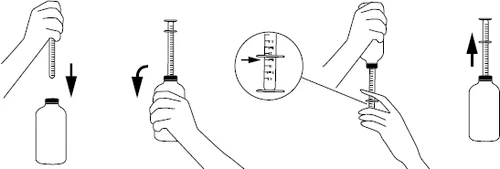
Instructions for dosing using the oral syringe:
- after unscrewing the cap, place the syringe onto the stopper located in the bottle neck,
- to fill the syringe, shake the bottle vigorously, turn it upside down, and then slowly push the plunger down, drawing the suspension into the syringe to the desired volume indicated on the scale,
- return the bottle to its upright position and carefully remove the syringe from the stopper,
- place the tip of the syringe into the child's mouth, then slowly depress the plunger to carefully empty the syringe's contents,
- after use, close the bottle and wash and dry the syringe.
No special recommendations regarding administration with food.
If you feel that the effect of Paracetamol Hasco Forte is too strong or too weak, consult your doctor.
Use of a higher than recommended dose of Paracetamol Hasco Forte
If a higher than recommended dose of the medicine is taken, seek immediate advice from a doctor or pharmacist, even if the patient feels well.
Severe poisoning may occur in children after ingestion of 200 mg of paracetamol/kg body weight.
Accidental or intentional overdose of paracetamol may cause symptoms within several to several hours, such as nausea, vomiting, excessive sweating, drowsiness, and general weakness. These symptoms may subside the next day, despite the gradual development of severe liver damage, manifested by a feeling of fullness in the upper abdomen, nausea, and jaundice.
Treatment of paracetamol poisoning must be carried out in hospital under intensive medical care. If less than one hour has passed since paracetamol ingestion, induce vomiting and administer activated charcoal.
Missed dose of Paracetamol Hasco Forte
Paracetamol Hasco Forte is used on an as-needed basis when symptoms occur. It should be taken according to the recommendations given in section 3. However, if your doctor recommends regular use of the medicine, do not take a double dose to make up for a missed dose.
If you have any further doubts regarding the use of this medicine, consult your doctor or pharmacist.
4. Possible adverse effects
Like all medicines, this medicine can cause adverse effects, although not everyone will experience them.
Rare (in 1 to 10 patients out of 10,000):
skin allergic reactions: urticaria, erythema, dermatitis.
Very rare (occurring in less than 1 patient out of 10,000):
decreased platelet count (thrombocytopenia)
decreased white blood cell count (leukopenia, agranulocytosis)
nausea, vomiting, diarrhoea
liver function disorders.
Frequency unknown (cannot be estimated from available data):
serious condition that may cause blood acidification (so-called metabolic acidosis) in
patients with severe illness taking paracetamol (see section 2).
Long-term use or overdose of the medicine may cause liver and kidney damage, as well as
methemoglobinemia with symptoms of cyanosis (bluish skin discoloration).
There have been reports of very rare cases of severe skin reactions (acute generalized exanthematous pustulosis, Stevens-Johnson syndrome, toxic epidermal necrolysis).
Reporting of adverse effects
If any adverse effects occur, including any adverse effects not listed in this leaflet, inform your doctor or pharmacist. Adverse effects can be reported directly to the Department of Monitoring Adverse Drug Reactions of the Office for Registration of Medicinal Products, Medical Devices and Biocidal Products
Al. Jerozolimskie 181 C, 02-222 Warsaw,
tel.: 22 49 21 301, fax: 22 49 21 309,
Website: https://smz.ezdrowie.gov.pl
Adverse effects can also be reported to the marketing authorization holder.
By reporting adverse effects, additional information on the safety of the medicine can be collected.
5. How to store Paracetamol Hasco Forte
Store below 25°C. The product should not be stored in an inverted position.
Keep the medicine out of the sight and reach of children.
Do not use this medicine after the expiry date stated on the packaging. The expiry date refers to the last day of the stated month.
Shelf-life after first opening: 12 months.
Medicines must not be disposed of via wastewater or household waste. Ask your pharmacist how to dispose of medicines no longer required. This will help protect the environment.
6. Contents of the pack and other information
What Paracetamol Hasco Forte contains
- The active substance is paracetamol. 5 ml of oral suspension contains 240 mg of paracetamol.
- The other ingredients (excipients) are: sucrose, xanthan gum (E 415), monohydrate citric acid (E 330), sodium benzoate (E 211), sodium metabisulfite (E 223), natural strawberry flavour AR 2143 (containing natural flavouring substances, including d-limonene and propylene glycol), purified water.
What Paracetamol Hasco Forte looks like and contents of the pack
Milk-coloured to pale yellow suspension with a strawberry odour. The pack contains 150 ml,
100 ml or 85 ml of oral suspension.
Orange type III glass bottle with HDPE screw cap, with tamper-evident ring and LDPE adapter for oral syringe, and an oral syringe made of LDPE/PS with a capacity of 5 ml, marked in 0.25 ml graduations, in a cardboard box.
Marketing Authorisation Holder and Manufacturer
"PRZEDSIĘBIORSTWO PRODUKCJI FARMACEUTYCZNEJ HASCO-LEK" S.A.
51-131 Wrocław, ul. Żmigrodzka 242 E
Pharmaceutical Information
tel.: 22 742 00 22
e-mail: [email protected]