Paracetamol galena
Poland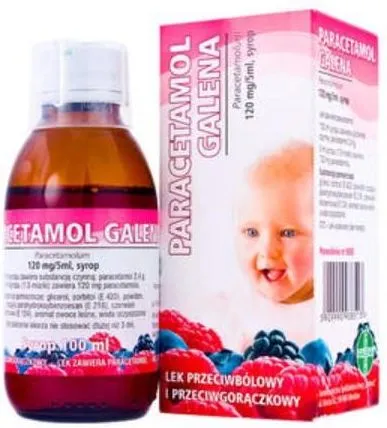
Table of Contents
- Package leaflet: Information for the user
- 1. What Paracetamol Galena is and what it is used for
- 2. Important Information Before Using Paracetamol Galena
- 3. How to use Paracetamol Galena
- 4. Possible adverse reactions
- 5. How to store Paracetamol Galena
- 6. Contents of the packaging and other information
Package leaflet: Information for the user
PARACETAMOL GALENA
120 mg/5 ml, syrup
Paracetamolum
Please read all of this leaflet carefully before taking this medicine, because it contains
important information for you.
This medicine should always be taken exactly as described in this patient leaflet or as directed by
your doctor or pharmacist.
- Keep this leaflet, as you may need to read it again.
- If you need advice or further information, please consult your pharmacist.
- If you experience any adverse reactions, including any not listed in this leaflet, inform your doctor or pharmacist. See section 4.
- If there is no improvement in children after 3 days, or in adults after 3 days in case of fever and 5 days in case of pain, or if the patient feels worse, consult a doctor.
Table of contents
- What Paracetamol Galena is and what it is used for
- Important information before taking Paracetamol Galena
- How to take Paracetamol Galena
- Possible side effects
- How to store Paracetamol Galena
- Contents of the pack and other information
1. What Paracetamol Galena is and what it is used for
Paracetamol Galena syrup is an analgesic and antipyretic medicine particularly intended for children.
Paracetamol Galena is used in mild to moderate pain of various origins (headache, toothache, muscle and joint pain, menstrual pain, neuralgia and others), as well as during fever associated with colds and flu-like conditions.
2. Important Information Before Using Paracetamol Galena
When not to use Paracetamol Galena
- if the patient is allergic to paracetamol or to any of the other ingredients of this medicine (listed in section 6),
- in case of severe liver or kidney failure,
- during treatment with MAO inhibitors and for up to 2 weeks after their discontinuation,
- in case of congenital deficiency of glucose-6-phosphate dehydrogenase or methemoglobin reductase.
Warnings and precautions
Overdose of Paracetamol Galena may be life-threatening. During treatment,
ensure that other medicines being taken concurrently do not contain paracetamol.
Exercise particular caution in patients with liver or kidney impairment and in those with bronchial asthma.
The risk of liver damage is especially high in fasting individuals and in those who regularly consume alcohol,
as alcohol enhances the toxic effects of paracetamol.
Paracetamol Galena and other medicines
Consult a doctor if using:
- oral anticoagulants of the coumarin group, because paracetamol may enhance their effect,
- drugs that inhibit paracetamol metabolism (rifampicin, antiepileptic drugs, some sedatives), due to increased risk of liver damage,
- drugs belonging to the MAO inhibitor group (medicines used in depression), because concomitant use with paracetamol may cause agitation and high fever,
- zidovudine (an antiviral drug), because combination with paracetamol may lead to changes in blood parameters (reduction in neutrophil granulocytes) and increased risk of liver damage,
- non-steroidal anti-inflammatory drugs (NSAIDs), because concomitant use with paracetamol increases the risk of kidney function disorders.
Caffeine enhances the analgesic effect of paracetamol.
Pregnancy, breastfeeding, and effects on fertility
If the patient is pregnant or breastfeeding, suspects she may be pregnant, or is planning to have a child,
she should consult a doctor or pharmacist before using this medicine.
Pregnancy
Paracetamol Galena may be used during pregnancy if necessary. The lowest effective dose that reduces pain and/or fever should be taken for the shortest possible duration and as infrequently as possible. Consult a doctor if pain and/or fever do not subside or if the patient needs to take the medicine more frequently.
Breastfeeding
Paracetamol passes into breast milk in clinically insignificant amounts.
Paracetamol may be used during pregnancy and breastfeeding when absolutely necessary.
Fertility
There is no data available on the effect of paracetamol on fertility.
Driving and operating machinery
When used as directed, this medicine does not affect psychophysical performance and does not impair the ability to drive or operate machinery.
Paracetamol Galena contains glycerol
This medicine may cause headache, gastrointestinal disturbances, and diarrhea.
Paracetamol Galena contains sorbitol (E 420)
This medicine contains 357 mg of sorbitol in each 1 ml. Sorbitol is a source of fructose. If the patient (or their child) has previously been diagnosed with intolerance to certain sugars or hereditary fructose intolerance—a rare genetic disorder in which the body cannot break down fructose—the patient should consult a doctor before taking the medicine or giving it to a child. Sorbitol may cause gastrointestinal discomfort and may have a mild laxative effect.
Paracetamol Galena contains propyl parahydroxybenzoate (E 216)
This medicine may cause allergic reactions (including delayed-type reactions).
Paracetamol Galena contains carmine red (E 124)
This medicine may cause allergic reactions.
Paracetamol Galena contains propylene glycol (component of forest fruit flavor)
This medicine contains 0.6973 mg of propylene glycol in each milliliter of syrup. Before administering this medicine to a child under 4 weeks of age, consult a doctor or pharmacist, especially if the child is taking other medicines containing propylene glycol or alcohol.
Paracetamol Galena contains ethanol (component of forest fruit flavor)
This medicine contains 0.1426 mg of alcohol (ethanol) in each 1 ml of syrup. The amount of alcohol in 1 ml of this medicine is equivalent to less than 0.148 ml of beer or 0.059 ml of wine. The small amount of alcohol in this medicine will not cause noticeable effects.
3. How to use Paracetamol Galena
This medicine should always be taken exactly as described in this patient information leaflet or as directed by a doctor, pharmacist, or nurse. If in doubt, consult a doctor, pharmacist, or nurse.
Recommended dose
Children
The recommended single dose is 10 to 15 mg of paracetamol per kilogram of the child's body weight, administered no more frequently than every 4 hours, up to 4 times daily.
The maximum daily dose for children is 60 mg of paracetamol per kilogram of body weight.
Dosing is based on the child's body weight.
Below is an example dosing guide according to body weight and approximate age:
| Body weight* (approximate age of child) | Single dose (amount of syrup in ml) |
| 6 kg (3 months) | 2.5 ml |
| 8 - 10 kg (6 - 12 months) | 5.0 ml |
| 12.5 - 17 kg (2 - 4 years) | 7.5 ml |
| 19 - 21 kg (5 - 6 years) | 10.0 ml |
| 30 kg (9 years) | 12.5 ml |
| 36 kg (11 years) | 15.0 ml |
| 42 kg (12 years) | 17.5 ml |
* According to the percentile grid developed by I. Palczewska, Z. Niedźwiecka, 1999.
Paracetamol Galena should not be used in children under 3 months of age without consultation with a
physician.
Without a physician's recommendation, do not administer for longer than 3 days.
Adults
The recommended single dose is 0.3 g to 1.0 g of paracetamol (12.5 ml to 41.6 ml of syrup),
no more frequently than every 4 hours, up to 4 times daily.
The maximum daily dose is 4 g of paracetamol (166.7 ml of syrup) per day. Higher doses are
toxic.
Without a physician's recommendation, do not administer for longer than 3 days in case of fever and 5 days in case of pain.
Method of administration
Oral administration. A dosing device is attached to the package, facilitating accurate measurement of the appropriate dose.
Use of a higher than recommended dose of Paracetamol Galena
Nausea, vomiting, excessive sweating, drowsiness, and general weakness may occur.
In case of ingestion of a higher than recommended dose, seek immediate advice from a physician
or pharmacist, even if the patient feels well.
Treatment of paracetamol overdose involves induced vomiting. If less than 1 hour has passed since ingestion, administer 60–100 g of activated charcoal orally, preferably mixed with water. In cases of ingestion of very large doses of the drug, antidotes such as methionine should be administered, followed by continued treatment with acetylcysteine.
Treatment of paracetamol poisoning should be conducted in a hospital under intensive care conditions.
Missed dose of Paracetamol Galena
Do not use a double dose to make up for a missed dose.
Discontinuation of Paracetamol Galena
If you have any further doubts regarding the use of this medicine, consult your physician or pharmacist.
4. Possible adverse reactions
Like all medicines, this medicine can cause adverse reactions, although not everybody will experience them.
You should contact a doctor immediately if any of the following adverse reactions occur
- fainting or dizziness and disorientation, which may be symptoms of life-threatening anaphylactic shock (inadequate blood flow to organs due to circulatory failure); the frequency of these adverse reactions is unknown,
- sudden onset of wheezing, breathing difficulties, swelling of the eyelids, face or lips,
- rash, urticaria, erythema, pigmented purpura or itching (especially if affecting the entire body); the frequency of these adverse reactions is unknown,
- severe skin reactions such as: acute generalized pustular rash, Stevens-Johnson syndrome and toxic epidermal necrolysis, characterized by skin redness, rash, blisters and erosions on the skin, in the mouth, eyes and genital organs, rupturing subcutaneous bullae, extensive skin erosions, large-scale peeling of the epidermis, and fever. These adverse reactions occur very rarely;
- thrombocytopenia – reduced number of blood platelets, manifesting as bleeding, hemorrhages, easy bruising and petechiae; occurs very rarely (isolated cases),
- methemoglobinemia – reduced ability of hemoglobin to carry oxygen, manifesting as cyanosis, fatigue, dyspnea on exertion, tachycardia, chest pain and dizziness, somnolence or coma; occurs very rarely (isolated cases).
Other possible adverse reactions of Paracetamol Galena
Very rare (less than 1 in 10,000 patients – isolated cases):
- agranulocytosis – absence of granulocytes in the blood, manifesting as increased susceptibility to infections.
Frequency unknown (cannot be estimated from available data):
- liver damage, occurring mainly after overdose, manifesting as nausea, vomiting, upper abdominal discomfort, jaundice (yellowing of the skin and eyes), liver tenderness with increased liver enzyme activity,
- gastrointestinal disturbances in hypersensitive individuals (nausea, vomiting, digestive disturbances).
Reporting of adverse reactions
If any adverse symptoms occur, including any adverse symptoms not listed in this leaflet, inform your doctor or pharmacist. Adverse reactions can be reported directly to the Department of Monitoring of Adverse Drug Reactions of the Office for Registration of Medicinal Products, Medical Devices and Biocidal Products
Al. Jerozolimskie 181C
02-222 Warsaw
Tel.: +48 22 49 21 301
Fax: +48 22 49 21 309
Website: https://smz.ezdrowie.gov.pl
Adverse reactions can also be reported to the marketing authorization holder.
Reporting adverse reactions helps to provide more information on the safety of the medicine.
5. How to store Paracetamol Galena
No special storage instructions are required. Store in the original
packaging.
Keep the medicine out of the sight and reach of children.
Do not use this medicine after the expiry date stated on the packaging. The expiry date refers to the last day of the stated month.
Medicines must not be disposed of via wastewater or household waste. Ask your pharmacist how to dispose of medicines no longer in use. This will help protect the environment.
6. Contents of the packaging and other information
What Paracetamol Galena contains
- The active substance is paracetamol. 5 ml of syrup contains 120 mg of paracetamol.
- Other ingredients are: glycerol, liquid sorbitol, non-crystallising (E 420), povidone, propyl parahydroxybenzoate (E 216), carmine red (E 124), forest fruit flavour (containing: natural and synthetic flavouring substances and compounds (including d-limonene, eugenol, farnesol, geraniol and linalool), propylene glycol, ethanol, lactic acid, water, acetic acid, glyceryl triacetate, maltol, ascorbic acid), purified water.
What Paracetamol Galena looks like and contents of the pack
Paracetamol Galena syrup is a clear, red liquid with a forest fruit odour.
The packaging consists of an amber glass bottle closed with a metal screw cap with a tamper-evident seal.
The bottle is supplied with a measuring device.
The single pack contains 100 ml of syrup.
Marketing Authorisation Holder:
Zakład Farmaceutyczny ,,Amara” sp. z o. o.
ul. Stacyjna 5
30-851 Kraków
Tel. +48 12 657 40 40
[email protected]
Manufacturer:
Farmaceutyczna Spółdzielnia Pracy „GALENA”
ul. Krucza 62
53-411 Wrocław
Poland