Paracetamol forte apteo med
Poland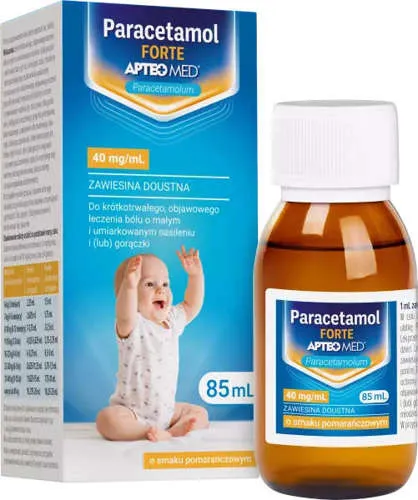
Table of Contents
Package leaflet: Information for the patient
Paracetamol, 40 mg/ml, oral suspension
Paracetamolum
Please read the entire leaflet carefully before use, as it contains important information for the patient.
This medicine should always be used exactly as described in this patient leaflet or as directed by a doctor or pharmacist.
- Keep this leaflet for future reference.
- If you need advice or further information, consult your pharmacist.
- If you experience any adverse reactions, including any not listed in this leaflet, inform your doctor or pharmacist. See section 4.
- If there is no improvement after 2 days of treatment, or if you feel worse, consult your doctor.
Table of contents
- What Paracetamol is and what it is used for
- Important information before taking Paracetamol
- How to take Paracetamol
- Possible side effects
- How to store Paracetamol
- Contents of the pack and other information
1. What Paracetamol is and what it is used for
Paracetamol contains the active substance paracetamol. Paracetamol is a medicine with analgesic and antipyretic properties used to treat mild to moderate pain and (or) fever.
Paracetamol is indicated for short-term symptomatic treatment of fever (high temperature) and (or) mild to moderate pain (e.g. headache, pain and (or) fever associated with influenza or the common cold, pain due to otitis media, toothache, painful teething, menstrual pain, muscle and bone pain, pain and (or) fever following vaccination, as an analgesic before and after surgical procedures (e.g. pain after tonsillectomy).
Paracetamol is used to treat mild to moderate pain and (or) fever in infants (older than 3 months), children, adolescents, and adults (including elderly individuals).
In children under 3 months of age, this medicine should be used only on medical advice.
If there is no improvement after 2 days of treatment, or if you feel worse, consult your doctor.
2. Important information before using Paracetamol
When not to use Paracetamol
- if the patient is allergic (hypersensitive) to paracetamol or any of the other ingredients of this medicine (listed in section 6),
- if the patient suffers from severe liver disease.
Warnings and precautions
The medicine contains paracetamol.
Due to the risk of overdose, do not take Paracetamol simultaneously with other medicines containing paracetamol, or in doses higher than recommended. In case of overdose, consult a doctor immediately, even if the patient feels well. Taking a multiple daily dose of paracetamol at once may lead to severe, life-threatening liver damage; unconsciousness does not occur in such cases. However, immediate medical advice must be sought. See also section 3 "Taking more Paracetamol than recommended".
Before starting treatment with Paracetamol, discuss this with your doctor or pharmacist.
Consult your doctor or pharmacist before using Paracetamol:
- if the patient has kidney function disorders,
- if the patient has liver diseases (including Gilbert's syndrome, which causes yellowing of the skin and/or eyes),
- if the patient is taking other medicines affecting liver function,
- if the patient has glucose-6-phosphate dehydrogenase deficiency,
- if the patient has haemolytic anaemia (abnormal breakdown of red blood cells),
- if the patient suffers from alcoholism,
- if the patient is dehydrated or chronically undernourished.
During treatment with Paracetamol, inform the doctor immediately if the patient develops severe conditions, including severe kidney disorders or sepsis (when bacteria and their toxins circulate in the blood, leading to organ damage), malnutrition, chronic alcoholism, or if the patient is also taking flucloxacillin (an antibiotic). In these situations, patients have been reported to develop a serious condition called metabolic acidosis (abnormality in blood and body fluids) when taking paracetamol regularly for a prolonged period or when taking paracetamol together with flucloxacillin. Symptoms of metabolic acidosis may include: severe breathing difficulties, including rapid deep breathing, drowsiness, nausea and vomiting.
Prolonged inappropriate use of large amounts of painkillers may cause headaches. Do not treat these headaches with higher doses of Paracetamol.
Long-term use may cause kidney damage, including tissue destruction (necrosis of renal papillae).
Do not take or give Paracetamol to a child without consulting a doctor or pharmacist in the following cases:
- high fever (above 39°C),
- fever lasting longer than 3 days,
- fever that disappears and then reappears (recurrent fever).
The above-mentioned situations may require evaluation and treatment determined by a doctor or pharmacist.
Paracetamol with other medicines
Tell your doctor or pharmacist about all medicines the patient is currently taking or has recently taken, as well as any medicines the patient plans to take. This is especially important when using:
- warfarin (anticoagulant),
- probenecid (a medicine used in the treatment of gout),
- glycopyrronium and propantheline (anticholinergic medicines that may reduce absorption of paracetamol),
- antiepileptic medicines such as carbamazepine, phenobarbital and phenytoin,
- sedatives,
- rifampicin (a medicine used in the treatment of tuberculosis),
- chloramphenicol (antibiotic),
- zidovudine (antiviral medicine used in the treatment of AIDS),
- flucloxacillin (antibiotic), due to the serious risk of blood and body fluid disorders (called metabolic acidosis), which must be urgently treated (see section 2).
Paracetamol is a common ingredient in many combination medicines with other active substances. This fact should be taken into account to avoid exceeding the maximum daily dose.
Do not take or give Paracetamol simultaneously with medicines that delay gastric emptying (e.g. propantheline) or accelerate it (e.g. metoclopramide and domperidone).
If taking colestyramine (a medicine that lowers blood cholesterol levels), it is recommended to take Paracetamol one hour before or 4 hours after taking colestyramine.
Taking Paracetamol with food, drink and alcohol
Paracetamol is a ready-to-use medicine and may be taken with food and drink. Do not drink alcohol during treatment with Paracetamol. Alcohol may increase the hepatotoxicity of paracetamol.
Pregnancy and breastfeeding
If the patient is pregnant or breastfeeding, suspects she may be pregnant, or plans to have a baby, she should consult her doctor or pharmacist before using this medicine.
During pregnancy, consult a doctor or pharmacist before taking any medicine.
Pregnancy
Paracetamol may be used during pregnancy if clinically justified. Take the lowest recommended dose for the shortest possible duration and as infrequently as possible. Consult a doctor if pain and (or) fever do not subside or if the patient needs to take the medicine more frequently. During pregnancy, paracetamol should not be taken in combination with other medicines.
Breastfeeding
After oral administration, paracetamol passes into breast milk. However, generally there is no need to interrupt breastfeeding during treatment with Paracetamol, as no adverse effects on breastfed infants have been observed so far.
Driving and operating machinery
Paracetamol does not affect the ability to drive or operate machinery. However, if the patient experiences mild drowsiness or dizziness as side effects, he or she should not drive or operate machinery.
Paracetamol contains sucrose, methyl parahydroxybenzoate (E218), propyl parahydroxybenzoate (E216), ethanol and sodium
This medicine contains sucrose (500 mg/ml). If the patient has previously been diagnosed with intolerance to certain sugars, he or she should consult a doctor before using this medicine.
A dose exceeding 10 ml of oral suspension contains more than 5 g of sucrose per dose, which should be considered in patients with diabetes. Sucrose may be harmful to teeth.
This medicine contains 0.68 mg/ml of methyl parahydroxybenzoate (E218) and 0.12 mg/ml of propyl parahydroxybenzoate (E216), which may cause allergic reactions (possible delayed-type reactions).
This medicine contains 2.25 mg of alcohol (ethanol) in each 1 ml of suspension, equivalent to 191.25 mg/85 ml (0.225% w/v). The amount of alcohol in 85 ml of this medicine is equivalent to less than 4.78 ml of beer or 1.91 ml of wine. The small amount of alcohol in this medicine will not cause noticeable effects.
This medicine contains less than 1 mmol (23 mg) of sodium per ml, meaning the medicine is considered "sodium-free".
3. How to take Paracetamol
This medicine should always be taken exactly as described in the patient leaflet or as directed by a doctor or pharmacist. If in doubt, consult a doctor or pharmacist.
The dose administered depends on the patient's age and body weight. The usual single dose is 10–20 mg/kg body weight, up to a maximum of 60 mg/kg body weight per day.
Paracetamol may be administered at intervals of 6 to 8 hours, up to a maximum of 3–4 times daily, provided the maximum daily dose is not exceeded.
Do not use with other medicines containing paracetamol due to the risk of overdose.
Dosing guidelines for reference:
Volume of single dose (single dose of
paracetamol) Maximum daily dose is 60 mg/kg body weight
Body weight
Medicine volume (paracetamol
15 mg/kg every 6 hours 20 mg/kg every 8 hours
dose in mg)
(maximum 4 times daily) (maximum 3 times daily)
1.0 ml 1.5 ml 4.5 ml
3 kg
(40 mg) (60 mg) (180 mg)
1.5 ml 2.0 ml 6.0 ml
4 kg
(60 mg) (80 mg) (240 mg)
1.75 ml 2.5 ml 7.5 ml
5 kg
(70 mg) (100 mg) (300 mg)
2.25 ml 3.0 ml 9.0 ml
6 kg
(90 mg) (120 mg) (360 mg)
| 7 kg | 2.5 ml (100 mg) | 3.5 ml (140 mg) | 10.5 ml (420 mg) |
| 8 kg | 3.0 ml (120 mg) | 4.0 ml (160 mg) | 12.0 ml (480 mg) |
| 9 kg | 3.25 ml (130 mg) | 4.5 ml (180 mg) | 13.5 ml (540 mg) |
| 10 kg | 3.75 ml (150 mg) | 5.0 ml (200 mg) | 15.0 ml (600 mg) |
| 11–12 kg | 4.0 to 4.5 ml (160 to 180 mg) | 5.5 to 6.0 ml (220 to 240 mg) | 16.5 to 18 ml (660 to 720 mg) |
| 13–15 kg | 4.75 to 5.5 ml (190 to 220 mg) | 6.5 to 7.5 ml (260 to 300 mg) | 19.5 to 22.5 ml (780 to 900 mg) |
| 16–18 kg | 6.0 to 6.75 ml (240 to 270 mg) | 8.0 to 9.0 ml (320 to 360 mg) | 24.0 to 27.0 ml (960 to 1080 mg) |
| 19–21 kg | 7.0 to 7.75 ml (280 to 310 mg) | 9.5 to 10.5 ml (380 to 420 mg) | 28.5 to 31.5 ml (1140 to 1260 mg) |
| 22–25 kg | 8.25 to 9.25 ml (330 to 370 mg) | 11.0 to 12.5 ml (440 to 500 mg) | 33.0 to 37.5 ml (1320 to 1500 mg) |
| 26–29 kg | 9.75 to 10.75 ml (390 to 430 mg) | 13.0 to 14.5 ml (520 to 580 mg) | 39.0 to 43.5 ml (1560 to 1740 mg) |
| 30–32 kg | 11.25 to 12.0 ml (450 to 480 mg) | 15.0 to 16.0 ml (600 to 640 mg) | 45.0 to 48.0 ml (1800 to 1920 mg) |
5 ml (full oral syringe) of oral suspension = 200 mg paracetamol
6 ml (full oral syringe) of oral suspension = 240 mg paracetamol
When taking other medicines containing paracetamol, care must be taken not to exceed the maximum daily dose of paracetamol.
The dosing instructions described above are for guidance only, and it is essential to follow the recommendations of the doctor or pharmacist. The medicine should be used in children under 3 months of age only on medical advice. If there is no improvement or the patient feels worse after 2 days of using the medicine, consult a doctor.
Duration of treatment
If there is no improvement or the patient feels worse after 2 days of using the medicine, consult a doctor.
Method and route of administration
Oral administration.
Shake the bottle before use. A dosing syringe with a graduated scale for accurate dosing is provided inside the packaging.
The dosing syringe should be used as follows:
Bottle with syringe adapter
- Unscrew the child-resistant cap by pressing down (a) and turning counterclockwise (b).
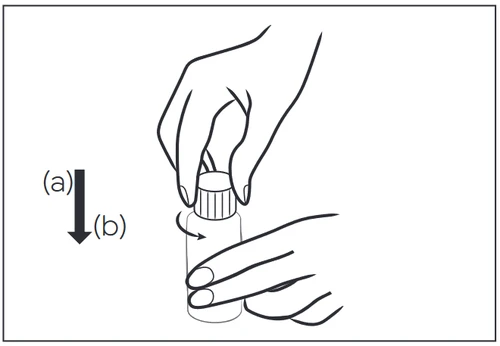
- Insert a clean, dry syringe into the bottle until it is securely attached to the lower part of the adapter.
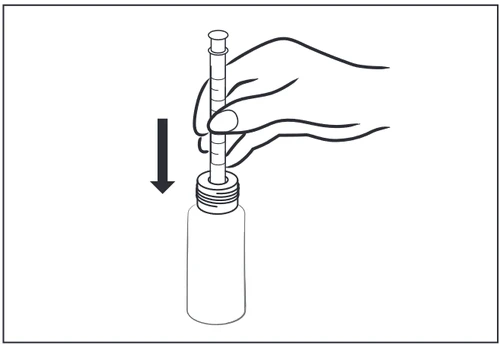
- To fill the syringe without air bubbles, carefully invert the bottle. Hold the dosing syringe and slowly pull the plunger down until the desired dose in millilitres (ml) is reached. If air bubbles appear or the required dose is exceeded, the syrup can be returned completely or partially to the bottle by pulling the syringe plunger upwards and redosing. If more than 5 ml needs to be administered, fill the syringe multiple times as required.
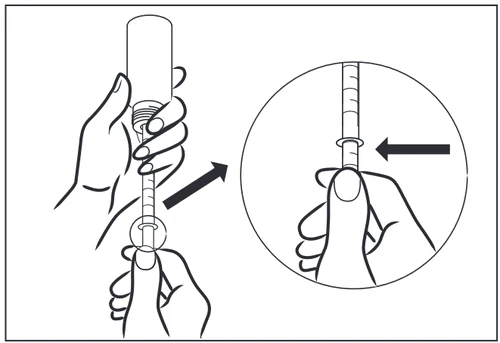
- Upright the bottle with the syringe inserted and remove the syringe by simultaneously twisting and pulling it out of the bottle.
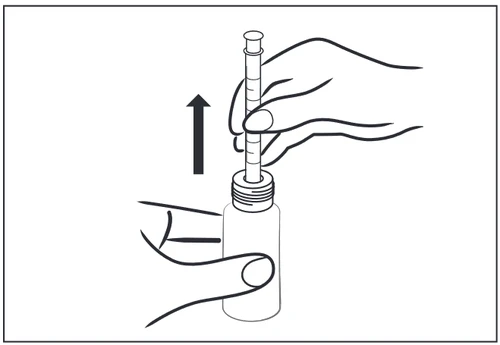
Bottle without syringe adapter
- Unscrew the child-resistant cap by pressing down (a) and turning counterclockwise (b).
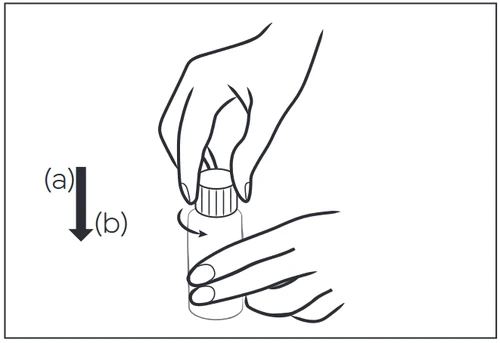
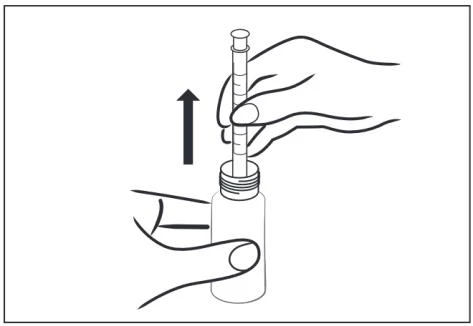
- Insert a clean, dry syringe into the bottle. Submerge it into the suspension.
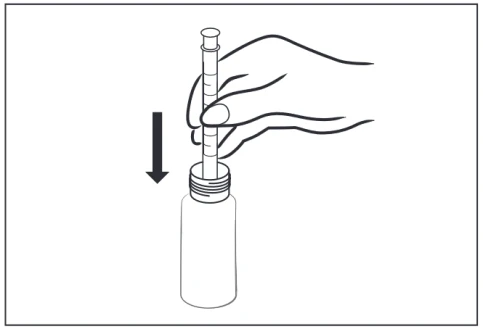
- Hold the dosing syringe and slowly pull the plunger upwards until the desired dose in millilitres (ml) is reached. If air bubbles appear or the required dose is exceeded, the syrup can be returned completely or partially to the bottle. If more than 5 ml needs to be administered, fill the syringe multiple times as required.
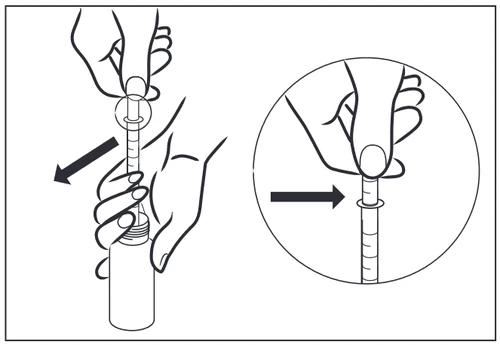
- Remove the syringe from the bottle.
The syrup can be administered directly into the child's mouth using the syringe or with a spoon. When administering directly into the mouth, the child must be properly positioned. It is best to slowly empty the syringe into the inside of the cheek. To prevent choking, the speed of emptying the syringe should be adjusted to the child's swallowing rate.
After administration, the syringe should be cleaned. To do this, completely disassemble the syringe. Both parts should be thoroughly rinsed with hot water and then dried.
Special patient groups
Patients with diagnosed liver or kidney problems or Gilbert's syndrome should consult a doctor to determine the appropriate dose and dosing intervals.
Use of a higher than recommended dose of Paracetamol
In case of ingestion of a higher than recommended dose of the medicine, seek immediate medical advice, even if the patient feels well. If less than 1 hour has passed since the overdose, induce vomiting. Immediate contact with a doctor is necessary, as specialized hospital treatment may be required.
Symptoms may include: nausea, vomiting, excessive sweating, drowsiness, and general weakness. These symptoms may resolve the next day, despite the onset of liver damage, which subsequently manifests as abdominal discomfort, recurrence of nausea, and jaundice. Other possible symptoms include tremor, restlessness, insomnia, increased blood pressure, marked tachycardia, pallor, and urinary retention. Death may occur.
Missed dose of Paracetamol
Do not take a double dose to make up for a missed dose. Instead, take the next dose of Paracetamol at the usual time.
If you have any further doubts regarding the use of this medicine, consult your doctor or pharmacist.
4. Possible adverse reactions
Like all medicines, Paracetamol may cause adverse reactions,
although not everyone experiences them.
You must immediately stop using the medicine and contact your doctor if you develop swelling
of the face, particularly around the mouth (tongue and (or) throat), difficulty breathing, sweating, nausea,
or a sudden drop in blood pressure. These symptoms may indicate a severe, life-threatening
allergic reaction, which however occurs very rarely (affects less than 1 person in 10,000).
The following adverse reactions may occur:
Common (may affect 1 in 10 people):
- mild drowsiness,
- nausea,
- vomiting.
Uncommon (may affect 1 in 100 people):
- dizziness,
- drowsiness,
- nervousness,
- burning sensation in the throat,
- diarrhoea,
- abdominal pain (including cramps and heartburn),
- constipation,
- headache,
- increased sweating,
- excessive drop in body temperature.
Rare (may affect 1 in 1,000 people):
- skin redness.
Very rare (may affect 1 in 10,000 people):
- blood disorders (reduced platelet count, reduced white blood cell count, sometimes severe; general reduction in all blood components),
- breathing difficulties (analgesic-induced asthma) in more sensitive individuals,
- allergic reactions. Very rare cases of severe skin reactions have been reported.
Frequency not known (cannot be estimated from available data):
- Increased liver function test values, particularly transaminases.
- Serious condition which may cause blood acidification (so-called metabolic acidosis) in patients with severe disease taking paracetamol (see section 2).
Reporting of adverse reactions
If any adverse reactions occur, including any adverse reactions not listed
in this leaflet, inform your doctor, pharmacist, or nurse. Adverse reactions
can be reported directly to the Department of Monitoring Adverse Drug Reactions of the Office for Registration of Medicinal Products, Medical Devices and Biocidal Products: Al. Jerozolimskie 181C, 02-222 Warsaw, tel. +48 22 49 21 301, fax +48 22 49 21 309, website: https://smz.ezdrowie.gov.pl.
Adverse reactions can also be reported to the marketing authorisation holder.
Reporting adverse reactions helps provide more information on the safety of the medicine.
5. How to store Paracetamol Forte Apteo Med
Keep the medicine out of sight and reach of children.
Store below 30°C.
Keep in the original packaging to protect from light.
Do not use this medicine after the expiry date stated on the carton and on the label of the bottle after "EXP". The expiry date refers to the last day of the stated month.
Expiry after first opening: 6 months.
Do not use this medicine if signs of deterioration are observed.
Medicines must not be disposed of via wastewater or household waste. Ask your pharmacist how to dispose of medicines no longer required. These measures will help protect the environment.
6. Contents of the package and other information
What Paracetamol contains
- The active substance is paracetamol. 1 ml of oral suspension contains 40 mg of paracetamol.
- The other ingredients are: citric acid monohydrate, sodium citrate, sucrose, methyl parahydroxybenzoate (E218), propyl parahydroxybenzoate (E216), xanthan gum, purified water, orange flavour (natural flavours, artificial flavours, ethanol, butylhydroxyanisole (E320)).
What Paracetamol looks like and contents of the pack
Paracetamol is a viscous liquid, white to almost white, homogeneous in appearance, with a characteristic odour and orange taste.
Paracetamol is supplied in an amber glass bottle (type III) containing 85 ml of oral suspension, with a child-resistant closure made of HDPE/PP/LDPE, an oral syringe with a capacity of 5 ml graduated in 0.25 ml increments, and an opening instruction leaflet, all contained in a cardboard box.
Paracetamol is supplied in an amber glass bottle (type III) containing 85 ml of oral suspension, with a child-resistant closure made of PP, an oral syringe with a capacity of 6 ml graduated in 0.25 ml increments, a connector for the oral syringe, and an opening instruction leaflet, all contained in a cardboard box.
Marketing Authorisation Holder
Synoptis Pharma Sp. z o.o.
ul. Krakowiaków 65
02-255 Warszawa
tel. +48 607 696 231
Manufacturer
Laboratórios Basi – Indústria Farmacêutica, S.A.
Parque Industrial Manuel Lourenço Ferreira
Lotes 8, 15 e 16
3450-232 Mortágua
Portugal