Paracetamol filofarm
Poland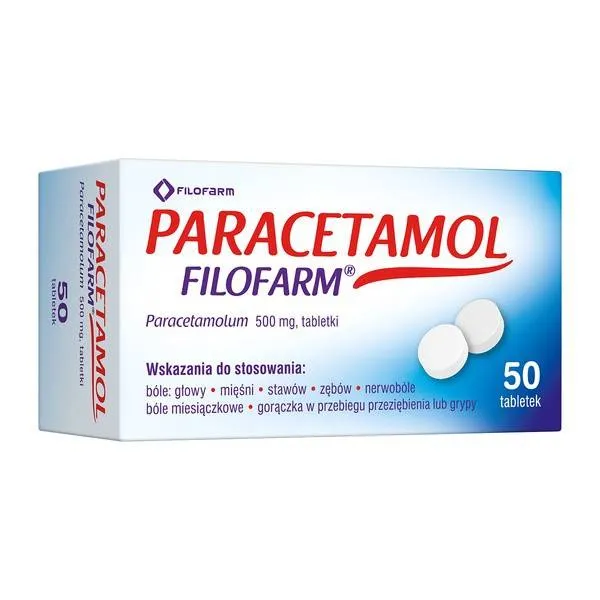
Table of Contents
- Package leaflet: Information for the user
- 1. What Paracetamol Filofarm is and what it is used for
- 2. Important information before using Paracetamol Filofarm
- 3. How to use Paracetamol Filofarm
- 4. Possible adverse reactions
- 5. How to store Paracetamol Filofarm
- 6. Contents of the package and other information
Package leaflet: Information for the user
Paracetamol Filofarm
500 mg, tablets
Paracetamolum
Please read the entire leaflet carefully before using the medicine, as it contains
important information for the patient.
This medicine should always be used exactly as described in the patient leaflet or as directed by a
physician or pharmacist.
- Keep this leaflet for future reference.
- If advice or additional information is needed, consult a pharmacist.
- If any adverse reactions occur, including any possible adverse reactions not listed in this leaflet, inform a doctor or pharmacist. See section 4.
- If there is no improvement or if the patient feels worse after 3 days, consult a doctor.
Table of contents
- What Paracetamol Filofarm is and what it is used for
- Important information before taking Paracetamol Filofarm
- How to take Paracetamol Filofarm
- Possible side effects
- How to store Paracetamol Filofarm
- Contents of the pack and other information
1. What Paracetamol Filofarm is and what it is used for
Paracetamol Filofarm contains paracetamol as the active substance, which has analgesic and antipyretic properties. By inhibiting cyclooxygenase of arachidonic acid, it prevents the formation of prostaglandins in the central nervous system. Reduced prostaglandin concentration in the hypothalamus results in antipyretic action. Its analgesic effect is similar to that of non-steroidal anti-inflammatory drugs (NSAIDs); however, unlike NSAIDs, paracetamol does not inhibit peripheral prostaglandin synthesis. Therefore, it lacks anti-inflammatory activity and does not cause the typical adverse effects associated with NSAIDs. Paracetamol does not affect platelet aggregation. It is the drug of choice in the treatment of pain and fever.
Paracetamol Filofarm is indicated:
- for various types of pain: headaches, muscle pain, toothache, joint pain, neuralgia, menstrual pain;
- for fever, e.g., associated with colds or influenza.
This medicine is intended for patients over 12 years of age.
2. Important information before using Paracetamol Filofarm
When not to use Paracetamol Filofarm
- if the patient is allergic (hypersensitive) to paracetamol or any of the other ingredients of this medicine (listed in section 6). Due to the risk of overdose, check whether other medicines being taken contain paracetamol;
- if the patient has severe liver or kidney failure;
- if the patient has congenital glucose-6-phosphate dehydrogenase deficiency or haemolytic anaemia;
- if the patient has congenital methemoglobin reductase deficiency;
- if the patient is taking monoamine oxidase inhibitors (MAO inhibitors) (e.g. selegiline – a medicine used to treat depression and hypotension), and for up to 2 weeks after stopping these medicines.
Warnings and precautions
While taking Paracetamol Filofarm, immediately inform your doctor if:
- the patient has mild to moderate liver impairment (including Gilbert's syndrome), acute hepatitis, is taking other medicines affecting liver function, abuses alcohol, or is undernourished, as there is a risk of liver damage;
- the patient has kidney failure;
- the patient has bronchial asthma;
- the patient has severe illnesses, including severe kidney dysfunction or sepsis (when bacteria and their toxins circulate in the blood, leading to organ damage), malnutrition, chronic alcoholism, or is also taking flucloxacillin (an antibiotic). Cases of a serious condition called metabolic acidosis (an abnormality in blood and body fluids) have been reported in patients who take paracetamol regularly for a prolonged period or who take paracetamol together with flucloxacillin. Symptoms of metabolic acidosis may include severe breathing difficulties, including rapid deep breathing, drowsiness, nausea and vomiting.
Consult a doctor, even if the above warnings relate to conditions that occurred in the past.
This medicine contains paracetamol. Due to the risk of overdose, do not take it together with other medicines containing paracetamol; therefore, check whether other medicines being taken contain paracetamol.
Children and adolescents
This medicine is not intended for use in children under 12 years of age and should not be used in this age group.
Paracetamol Filofarm and other medicines
Tell your doctor about all medicines you are currently taking or have recently taken, as well as any medicines you plan to take.
Do not take this medicine simultaneously with other medicines containing paracetamol.
Paracetamol may enhance the effect of anticoagulant medicines (warfarin, coumarins).
Concomitant administration with rifampicin (an antibiotic), isoniazid (an antituberculosis medicine), barbiturates (sleeping medicine), antiepileptic medicines, diflunisal (a non-steroidal anti-inflammatory drug), sulfinpyrazone (a medicine used in the treatment of gout), or other medicines with similar effects on the liver (microsomal enzyme inducers) increases the risk of liver damage.
Concomitant use with monoamine oxidase inhibitors (e.g. selegiline – a medicine used to treat depression and hypotension) may cause agitation and high fever.
Concomitant use with zidovudine (an antiviral medicine) may cause neutropenia (a life-threatening deficiency of neutrophils – a type of white blood cells) and increase the risk of liver damage.
Caffeine enhances the analgesic effect of paracetamol.
Inform your doctor or pharmacist if the patient is taking:
- flucloxacillin (an antibiotic) due to a serious blood and fluid disorder (called metabolic acidosis) requiring urgent treatment (see section 2).
Paracetamol Filofarm with food, drink and alcohol
See section 3. Do not drink alcohol while taking this product.
Do not consume alcohol during treatment with Paracetamol Filofarm.
Pregnancy, breastfeeding and fertility
If you are pregnant or breastfeeding, think you may be pregnant or are planning to become pregnant, consult your doctor or pharmacist before taking Paracetamol Filofarm.
Paracetamol Filofarm may be given to pregnant women if necessary. Use the lowest effective dose needed to relieve pain or reduce fever, and take the medicine for the shortest possible time.
If pain is not relieved or fever does not subside, or if it becomes necessary to increase the frequency of dosing, consult your doctor.
After oral administration, paracetamol passes into breast milk in small amounts. Paracetamol at therapeutic doses may be used in breastfeeding women.
Driving and operating machinery
Paracetamol Filofarm, when used as directed, does not affect the ability to drive or operate machinery or psychomotor performance.
3. How to use Paracetamol Filofarm
This medicine should always be used exactly as described in the patient information leaflet or as directed by a doctor or pharmacist. If in doubt, consult your doctor or pharmacist.
Recommended dose
Adults:
Oral administration of 1 or 2 tablets (corresponding to 500 mg to 1000 mg of paracetamol) is usually recommended, if necessary, up to 3 or 4 times daily (maximum daily dose: 8 tablets, corresponding to 4000 mg of paracetamol).
A minimum interval of 4 hours must be maintained between consecutive doses.
This medicine should be taken after a meal. Swallow the tablet with water.
Maximum duration of use without medical advice – 3 days.
Children over 12 years of age:
Oral administration of 1 tablet (corresponding to 500 mg of paracetamol) is usually recommended, if necessary, up to 3 or 4 times daily (maximum daily dose: 4 tablets, corresponding to 2000 mg of paracetamol).
A minimum interval of 4 hours must be maintained between consecutive doses.
Swallow the tablet with water.
Maximum duration of use without medical advice – 3 days.
Patients with renal or hepatic impairment
Use of Paracetamol Filofarm is contraindicated in patients with renal or hepatic insufficiency.
In patients with hepatic dysfunction or Gilbert's syndrome, the dose should be reduced or the intervals between doses extended.
The effective daily dose should not exceed 60 mg/kg body weight (maximum daily dose is 2 g).
Extreme caution is required, as the medicine may exert hepatotoxic effects.
If you feel that the effect of Paracetamol Filofarm is too strong or too weak, consult your doctor.
Use of a higher than recommended dose of Paracetamol Filofarm
In case of ingestion of more than the recommended dose, seek immediate medical advice from a doctor or pharmacist, even if no symptoms are present, as life-threatening liver damage may occur.
Paracetamol overdose may cause symptoms within several to several hours, such as nausea, vomiting, excessive sweating, drowsiness, and general weakness. These symptoms may subside the following day, despite the onset of liver damage, which may later manifest as upper abdominal discomfort, recurrence of nausea, and jaundice.
In any case of single ingestion of 5 g or more of paracetamol, vomiting should be induced if less than one hour has passed since ingestion, and immediate contact with a doctor must be established. Administration of 60–100 g of activated charcoal orally, preferably mixed with water, is recommended.
Reliable assessment of poisoning severity is provided by measuring blood paracetamol concentration. The relationship between paracetamol concentration and the time elapsed since ingestion is an important indicator of whether and how intensive antidotal treatment is required. Treatment of paracetamol poisoning must be carried out in a hospital under intensive care conditions.
Missed dose of Paracetamol Filofarm
Do not take a double dose to make up for a missed dose.
Stopping Paracetamol Filofarm
If you have any further questions about the use of this medicine, consult your doctor or pharmacist.
4. Possible adverse reactions
Like all medicines, Paracetamol Filofarm can cause adverse reactions, although they do not occur in everyone.
Uncommon adverse reactions (occur in 1 to 10 out of 10,000 treated patients):
nausea, vomiting, gastrointestinal disturbances, allergic reactions: urticaria, erythema, pruritus, rash,
pigmentary purpura, anaphylactic shock (life-threatening inadequate organ perfusion due to a sudden drop in blood pressure caused by a severe allergic reaction).
Very rare adverse reactions (occur in fewer than 1 out of 10,000 treated patients):
hematological disorders, i.e. thrombocytopenia (low platelet count) and agranulocytosis (complete or near-complete absence of granulocytes – a type of white blood cells).
Very rare cases of severe skin reactions have also been reported.
Frequency not known for occurrence of adverse reactions (“frequency not known” – cannot be estimated based on available data): serious condition causing the blood to become more acidic (so-called metabolic acidosis) in patients with severe illness taking paracetamol (see section 2).
Paracetamol Filofarm used for a long time at high doses or overdosed may cause liver and kidney damage.
Reporting of adverse reactions
If any adverse reactions occur, including any adverse reactions not listed in this leaflet, inform your doctor, pharmacist or nurse. Adverse reactions can be reported directly to the Department of Monitoring Adverse Drug Reactions at the Office for Registration of Medicinal Products, Medical Devices and Biocidal Products:
Al. Jerozolimskie 181C
02-222 Warsaw
tel: +48 22 49 21 301
fax: +48 22 49 21 309
website: https://smz.ezdrowie.gov.pl
Adverse reactions can also be reported to the marketing authorization holder. Reporting adverse reactions helps provide more information on the safety of the medicine.
5. How to store Paracetamol Filofarm
Keep this medicine out of sight and reach of children.
Do not use this medicine after the expiry date stated on the packaging.
The expiry date refers to the last day of the stated month.
Store below 25°C.
Store in the original packaging to protect from moisture.
Medicines must not be disposed of via wastewater or household waste. Ask your pharmacist how to dispose of medicines no longer required. Such measures help protect the environment.
6. Contents of the package and other information
What Paracetamol Filofarm contains
The active substance is paracetamol.
Each tablet contains 500 mg of paracetamol.
Excipients: maize starch, povidone, stearic acid.
What Paracetamol Filofarm looks like and contents of the pack
Paracetamol Filofarm is in the form of white, round, biconvex tablets for oral administration.
Pack sizes:
Tablets in blister packs, in a cardboard box:
6 tablets – 1 blister with 6 tablets
10 tablets – 1 blister with 10 tablets
20 tablets – 2 blisters with 10 tablets each
50 tablets – 5 blisters with 10 tablets each
60 tablets – 6 blisters with 10 tablets each
100 tablets – 10 blisters with 10 tablets each
120 tablets – 12 blisters with 10 tablets each
Not all pack sizes may be marketed.
Marketing Authorisation Holder and Manufacturer
Farmaceutyczna Spółdzielnia Pracy FILOFARM
ul. Pułaskiego 39
85-619 Bydgoszcz, Poland
Tel.: 52 342 67 88
Fax: 52 342 49 81
Information for the blind and visually impaired: The package leaflet for Paracetamol Filofarm is available in the Audio Leaflet system via the national free-phone number 800 706 848.