Paracetamol + diphenhydramine hasco night
Poland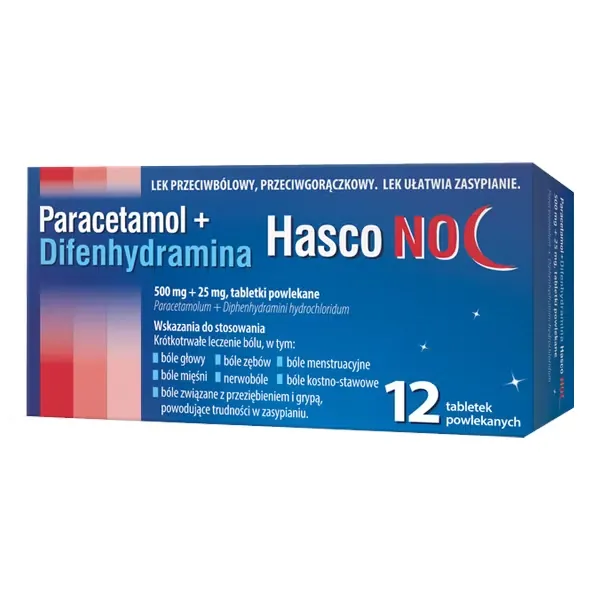
Table of Contents
- Package leaflet: Information for the patient
- 1. What is Paracetamol + Difenhydramine Hasco Noc and what is it used for
- 2. Important information before using Paracetamol + Difenhydramina Hasco Noc
- 3. How to use Paracetamol + Difenhydramina Hasco Noc
- 4. Possible adverse effects
- 5. How to store Paracetamol + Difenhydramina Hasco Noc
- 6. Contents of the packaging and other information
Package leaflet: Information for the patient
PARACETAMOL + DIPHENHYDRAMINE HASCO NOC
500 mg + 25 mg, coated tablets
Paracetamolum + Diphenhydramini hydrochloridum
Please read the entire leaflet carefully before using the medicine, as it contains
important information for the patient.
This medicine should always be used exactly as described in this patient leaflet or as directed by a
physician or pharmacist.
- Keep this leaflet so that you can read it again if necessary.
- If you need advice or further information, please consult your pharmacist.
- If you experience any adverse reactions, including any not listed in this leaflet, inform your doctor or pharmacist. See section 4.
- If there is no improvement after 5 days, or if your condition worsens, you should contact your doctor.
Table of contents
- What is Paracetamol + Difenhydramine Hasco Noc and what is it used for
- Important information before taking Paracetamol + Difenhydramine Hasco Noc
- How to take Paracetamol + Difenhydramine Hasco Noc
- Possible side effects
- How to store Paracetamol + Difenhydramine Hasco Noc
- Contents of the pack and other information
1. What is Paracetamol + Difenhydramine Hasco Noc and what is it used for
Paracetamol + Difenhydramine Hasco Noc is an analgesic and antipyretic medicine that utilizes the combined action of two active substances.
The paracetamol contained in the medicine relieves pain (analgesic effect), while diphenhydramine facilitates falling asleep and prevents nighttime awakenings caused by pain.
Indications for use
Short-term treatment of pain, including: headache, musculoskeletal pain, muscle pain, toothache, menstrual pain, neuralgia, and pain associated with colds and flu, when such pain causes difficulty in falling asleep.
If there is no improvement after 5 days, or if the patient feels worse, medical advice should be sought.
2. Important information before using Paracetamol + Difenhydramina Hasco Noc
When not to use Paracetamol + Difenhydramina Hasco Noc
- if the patient is allergic to the active substances (paracetamol or diphenhydramine) or to any of the other ingredients of this medicine listed in section 6;
- if the patient has any of the following conditions: severe liver or kidney failure, viral hepatitis, glaucoma, prostate enlargement, porphyria, bronchial asthma in an acute exacerbation phase;
- during treatment with so-called MAO inhibitors (medicines used in depression) and within 2 weeks after discontinuation of these medicines. Do not use in children under 12 years of age. Do not use during pregnancy and breastfeeding. 1/5
Warnings and precautions
The product contains paracetamol. Due to the risk of overdose, patients should be informed not to take this product together with other medicines containing paracetamol.
Before starting treatment with Paracetamol + Difenhydramina Hasco Noc, discuss with a doctor or pharmacist if the patient:
- has liver impairment, alcohol abuse, is malnourished, has anorexia, or low body weight;
- has kidney impairment, glucose-6-phosphate dehydrogenase deficiency, haemolytic anaemia, cardiac arrhythmia, hypertension, epilepsy, myasthenia gravis, hyperthyroidism, pyloric stenosis, or is elderly;
- has a severe infection, which may increase the risk of metabolic acidosis, manifested by deep, rapid, and laboured breathing, nausea, vomiting, loss of appetite, and general malaise; if these occur, inform the doctor immediately.
During treatment with Paracetamol + Difenhydramina Hasco Noc, inform the doctor immediately if the patient develops severe illness, including severe kidney dysfunction or sepsis (when bacteria and their toxins circulate in the blood, leading to organ damage), malnutrition, chronic alcoholism, or if the patient is also taking flucloxacillin (an antibiotic). In these situations, patients have experienced a serious condition called metabolic acidosis (an abnormality in blood and body fluids) when paracetamol was taken at regular doses over a prolonged period or when paracetamol was taken together with flucloxacillin. Symptoms of metabolic acidosis may include: severe breathing difficulties, including rapid deep breathing, drowsiness, nausea, and vomiting.
This medicine should be used only before bedtime.
Effect of paracetamol on laboratory tests: results of tests assessing blood uric acid and blood glucose levels may be altered.
Children
Do not use in children under 12 years of age.
Paracetamol + Difenhydramina Hasco Noc and other medicines
Tell your doctor or pharmacist about all medicines the patient is currently taking or has recently taken, as well as any medicines the patient plans to take.
Do not take Paracetamol + Difenhydramina Hasco Noc together with other medicines containing paracetamol.
Consult a doctor before taking this medicine if the patient is also taking:
- antiemetics (e.g. metoclopramide, domperidone);
- medicines used to treat high blood cholesterol (cholestyramine);
- probenecid (a medicine used to treat high blood uric acid levels – gout);
- analgesic or antipyretic medicines (aspirin, salicylamide);
- isoniazid (used in the treatment of tuberculosis);
- anticoagulants (warfarin and other coumarin derivatives);
- medicines with central nervous system depressant effects (such as sedatives, tranquilizers, and opioid analgesics);
- neuroleptics (haloperidol and other butyrophenone derivatives, used in psychiatric disorders with excessive excitement);
- antidepressants (fluoxetine, paroxetine, tricyclic antidepressants), 2/5
- anticonvulsants (phenytoin, carbamazepine, phenobarbital);
- rifampicin (an antibiotic used, among others, in the treatment of tuberculosis);
- inhibitors of cytochrome P450 CYP2D6 activity, i.e. amiodarone (used in the treatment of cardiac arrhythmias), ranitidine (used in peptic ulcer disease).
Inform the doctor or pharmacist if the patient is taking flucloxacillin (an antibiotic) due to the serious risk of disturbances in blood and body fluids (called metabolic acidosis), which must be urgently treated (see section 2).
Paracetamol + Difenhydramina Hasco Noc with food, drink or alcohol
Do not drink alcohol while taking this medicine due to increased risk of liver damage.
Pregnancy and breastfeeding
Do not use Paracetamol + Difenhydramina Hasco Noc during pregnancy or if the patient suspects she may be pregnant, or during breastfeeding.
If the patient plans to become pregnant, she should consult a doctor or pharmacist before using this medicine.
Driving and operating machinery
Do not drive or operate machinery while taking this medicine.
3. How to use Paracetamol + Difenhydramina Hasco Noc
This medicine should always be taken exactly as described in this patient leaflet or as advised by your
doctor or pharmacist. If in doubt, consult your doctor or pharmacist.
This medicine is for oral use.
Use only before bedtime.
Recommended dose:
Adults and adolescents aged 16 years and older: 1 or 2 tablets taken 30 minutes before bedtime.
Do not take more than 2 tablets before bedtime.
Adolescents aged 12–15 years: 1 tablet taken 30 minutes before bedtime.
Do not exceed the recommended dose.
Prolonged use without medical supervision may be harmful.
Do not use this medicine for longer than 5 days without consulting a doctor.
If symptoms persist, consult your doctor.
Do not give this medicine to children under 12 years of age.
Taking more Paracetamol + Difenhydramina Hasco Noc than recommended
Overdosing may cause severe nausea, vomiting, excessive sweating, drowsiness, and general weakness.
These symptoms may resolve the next day, even though liver damage may have started developing,
manifesting later as a feeling of fullness in the upper abdomen, recurrence of nausea, and jaundice.
Due to the risk of irreversible liver damage in case of overdose, seek immediate medical attention.
Missed dose of Paracetamol + Difenhydramina Hasco Noc
Do not take a double dose to make up for a missed dose.
If you have any further questions about the use of this medicine, consult your doctor or pharmacist.
3/5
4. Possible adverse effects
Like all medicines, this medicine can cause adverse effects, although not everyone will experience them.
Treatment should be discontinued and a doctor should be consulted immediately if the patient experiences any of the following adverse effects:
Rare (occurring in 1 to 10 out of 10,000 patients taking the medicine):
- Allergic reactions such as urticaria, erythema, rash (including generalized), swelling;
Very rare (occurring in fewer than 1 out of 10,000 patients taking the medicine):
- Anaphylactic shock (manifesting, among others, as disturbances in consciousness, reduced urine output, increased respiratory rate—hyperventilation, and significant weakness);
- Bleeding;
- Bronchospasm causing breathing difficulties in patients allergic to acetylsalicylic acid and other non-steroidal anti-inflammatory drugs;
- Laryngeal edema, angioedema manifesting as swelling of the lips, tongue, throat, or face, and difficulty breathing;
- Severe skin reactions such as acute generalized exanthematous pustulosis, Stevens-Johnson syndrome (erythema multiforme bullous), toxic epidermal necrolysis, manifesting as follows: initially as red spots on the trunk, often with blisters in the center, pustular rash over the entire body or erosions in the oral cavity, eyes, genital organs, and on the skin, or bursting giant blisters, peeling off large sheets of epidermis, accompanied by weakness, fever, and joint pain;
- Acute liver damage due to paracetamol overdose, liver failure, hepatic necrosis, jaundice manifesting as yellowing of the eyes and skin, abdominal pain, loss of appetite;
- Necrosis of renal papillae during prolonged use, kidney damage (nephropathy or tubulopathy) manifesting as fever, lumbar pain, skin rash, red discoloration of urine (hematuria), renal colic, urinary retention.
Other adverse effects:
Common (occurring in more than 1 out of 100 patients taking the medicine):
- Drowsiness, attention disturbances, dizziness;
- Dryness of mucous membranes of the mouth, throat, and nose;
Rare (occurring in 1 to 10 out of 10,000 patients taking the medicine):
- Disorientation, restlessness;
- Blurred vision;
- Rapid heartbeat (tachycardia), heart rhythm disturbances (arrhythmia);
- Gastrointestinal disturbances, nausea, vomiting, diarrhea, abdominal pain, indigestion;
- Itching, sweating;
- Urinary retention;
Very rare (occurring in fewer than 1 out of 10,000 patients taking the medicine):
- Anaemia, bone marrow suppression, thrombocytopenia (reduced platelet count leading to tendency for petechiae and bruising), agranulocytosis (severe reduction or absence of white blood cells), leukopenia (reduced white blood cell count), neutropenia (reduced number of neutrophil granulocytes, leading to increased susceptibility to infections);
- Dizziness;
- Acute or chronic pancreatitis;
- Pigmented purpura.
Frequency not known (cannot be estimated from available data):
- Serious condition that may cause blood acidification (so-called metabolic acidosis) in patients with severe disease taking paracetamol (see section 2).
Reporting of adverse effects
If any adverse effects occur, including any not listed in this leaflet, inform your doctor or pharmacist. Adverse effects can be reported directly to the Department of Monitoring Adverse Drug Reactions of the Office for Registration of Medicinal Products, Medical Devices and Biocidal Products:
Aleje Jerozolimskie 181C, 02-222 Warsaw
Phone: +48 22 49 21 301, Fax: +48 22 49 21 309
Website: https://smz.ezdrowie.gov.pl
Adverse effects can also be reported to the marketing authorization holder.
Reporting adverse effects helps to provide more information on the safety of the medicine.
5. How to store Paracetamol + Difenhydramina Hasco Noc
Keep the medicine in its original packaging at a temperature below 25°C.
Keep the medicine out of the sight and reach of children.
Do not use this medicine after the expiry date stated on the packaging. The expiry date refers to the last day of the stated month.
Medicines must not be disposed of via wastewater or household waste. Ask your pharmacist how to dispose of medicines no longer in use. This will help protect the environment.
6. Contents of the packaging and other information
What Paracetamol + Difenhydramine Hasco Noc contains
- The active substances are paracetamol and difenhydramine (in the form of hydrochloride). Each tablet contains 500 mg of paracetamol and 25 mg of difenhydramine hydrochloride.
- Other components (excipients) are: pregelatinized corn starch, povidone K-30, magnesium stearate, and Opadry II Blue 85F205046 coating, which consists of: polyvinyl alcohol, titanium dioxide (E 171), polyethylene glycol, talc, aluminium lake of brilliant blue FCF (E 133), aluminium lake of indigo carmine (E 132).
What Paracetamol + Difenhydramine Hasco Noc looks like and contents of the packaging
Paracetamol + Difenhydramine Hasco Noc are film-coated tablets, oval, biconvex,
blue in colour, with "NOC" embossed on one side, packed in blisters.
The cardboard box contains 6, 12 or 24 film-coated tablets.
Marketing Authorisation Holder and Manufacturer
"PRZEDSIĘBIORSTWO PRODUKCJI FARMACEUTYCZNEJ HASCO-LEK" S.A.
51-131 Wrocław, ul. Żmigrodzka 242 E
Medicinal product information
tel.: 22 742 00 22
e-mail: [email protected]
5/5