Paracetamol accord
Poland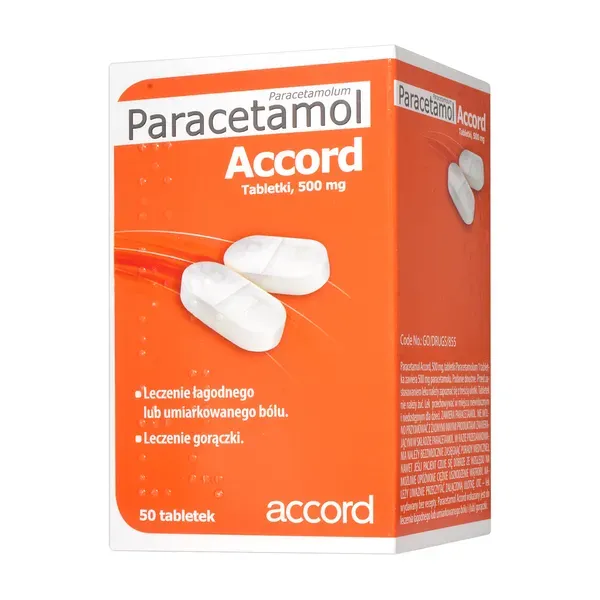
Table of Contents
Patient Information Leaflet
Paracetamol Accord, 500 mg, tablets
Paracetamolum
Please read all of this leaflet carefully before you start taking this medicine, because it contains
important information for you.
Always use this medicine exactly as described in this leaflet or as your doctor, pharmacist or nurse has told you.
- Keep this leaflet. You may need to read it again.
- If you need advice or more information, please consult your pharmacist.
- If you experience any side effects, including any not listed in this leaflet, tell your doctor or pharmacist. See section 4.
- If there is no improvement after 3 days or if you feel worse, you should contact your doctor.
Leaflet Contents:
- What Paracetamol Accord is and what it is used for
- Important information before taking Paracetamol Accord
- How to take Paracetamol Accord
- Possible side effects
- How to store Paracetamol Accord
- Contents of the pack and other information
1. What Paracetamol Accord is and what it is used for
The active substance in Paracetamol Accord is paracetamol, which belongs to a group of medicines called analgesics (painkillers).
Paracetamol Accord is used to relieve pain and reduce fever. The tablets may be used in the treatment of mild to moderate pain and/or fever.
Paracetamol Accord can be used in adults and adolescents, but is not suitable for children under 6 years of age.
2. Important information before taking Paracetamol Accord
When not to take Paracetamol Accord
- if you are allergic to paracetamol or any of the other ingredients of this medicine listed in section 6,
- if you are under 6 years of age.
Warnings and precautions
Before taking Paracetamol Accord, talk to your doctor, pharmacist or nurse if:
- you are taking other medicines containing paracetamol, as this may lead to serious liver damage,
- you have kidney or liver disease (including Gilbert's syndrome or acute hepatitis),
- you have glucose-6-phosphate dehydrogenase deficiency,
- you have haemolytic anaemia (abnormal breakdown of red blood cells),
- you regularly consume large amounts of alcohol. Never take more than 4 tablets in 24 hours.
- you have asthma and are sensitive to acetylsalicylic acid,
- you are dehydrated or chronically undernourished.
While taking Paracetamol Accord, contact your doctor immediately if:
- you have serious health conditions, including severe kidney impairment, sepsis (when bacteria and their toxins circulate in the blood causing organ damage), malnutrition, chronic alcoholism, or if you are also taking flucloxacillin (an antibiotic). Cases of a serious condition called metabolic acidosis (an imbalance in blood and body fluids) have been reported in patients taking paracetamol regularly over a long period or when paracetamol is taken together with flucloxacillin. Symptoms of metabolic acidosis may include: severe breathing difficulties, including rapid deep breathing, drowsiness, nausea and vomiting.
If you have high fever, signs of secondary infection, or symptoms persist for longer than three days, consult your doctor or pharmacist.
- Headaches caused by overuse of painkillers should not be treated by increasing the dose. In such cases, consult your doctor before taking any painkillers.
Children and adolescents
Paracetamol Accord must not be used in children under 6 years of age.
Paracetamol Accord and other medicines
Tell your doctor or pharmacist if you are taking, have recently taken or might take any other medicines, including those obtained without a prescription.
Do not take Paracetamol Accord together with other medicines containing paracetamol.
Talk to your doctor before starting paracetamol if you are taking any of the following medicines:
- metoclopramide or domperidone (used to treat nausea and vomiting),
- cholestyramine (used to lower cholesterol levels),
- warfarin and other coumarin derivatives (used as blood thinners), especially if paracetamol needs to be taken daily over a long period,
- phenacetin (a painkiller),
- probenecid (used to treat gout),
- isoniazid and rifampicin (used to treat tuberculosis),
- lamotrigine or phenytoin (used to treat epilepsy),
- barbiturates or carbamazepine (medicines that cause drowsiness and sedation),
- St John's wort (used to treat depression),
- chloramphenicol (an antibiotic),
- zidovudine (used to treat AIDS),
- flucloxacillin (an antibiotic), due to a serious imbalance in blood and body fluids (called metabolic acidosis) which requires urgent treatment (see section 2).
If you are scheduled for any laboratory tests (blood tests, urine analysis, skin tests, etc.), inform your doctor that you are taking this medicine, as it may affect test results.
Paracetamol Accord with food and drink
Do not consume large amounts of alcohol while taking Paracetamol Accord.
Pregnancy, breastfeeding and fertility
Pregnancy
Paracetamol Accord may be used during pregnancy if necessary. Use the lowest effective dose for pain relief or fever reduction, and take the medicine for the shortest possible time. If pain persists or fever does not subside, or if you need to take the medicine more frequently, consult your doctor.
Before taking any medicine, consult your doctor or pharmacist.
Breastfeeding
Although paracetamol passes into breast milk in small amounts, it has not been associated with any adverse effects in breastfed infants. Women who are breastfeeding may take paracetamol, but only at recommended doses. Caution is advised with prolonged use.
Fertility
There is no known harmful effect of paracetamol on fertility with normal use.
Before taking any medicine, consult your doctor or pharmacist.
Driving and using machines
Paracetamol has no effect on the ability to drive or operate machinery.
3. How to use Paracetamol Accord
This medicine should always be taken exactly as described in the patient leaflet or as directed by a doctor, pharmacist, or nurse. If in doubt, consult a doctor, pharmacist, or nurse.
Recommended dosage:
Adults and adolescents aged above 15 years (> 55 kg body weight):
1 or 2 tablets (500–1000 mg paracetamol). If necessary, repeat every 4 to 6 hours, up to a maximum of 6 tablets (3000 mg paracetamol) in 24 hours.
Children aged 6 to 9 years (body weight 22–30 kg):
Half a tablet (250 mg paracetamol), up to a maximum of 4 to 6 times in 24 hours.
The tablet can be divided into equal doses.
Children aged 9 to 12 years (body weight 30–40 kg):
One tablet (500 mg paracetamol), up to a maximum of 3 to 4 times in 24 hours.
Children aged 12 to 15 years (body weight 40–55 kg):
One tablet (500 mg paracetamol), up to a maximum of 4 to 6 times in 24 hours.
The lowest number of daily doses is intended for younger children within each age group.
The tablet should be swallowed whole with a large amount of water. Alternatively, dissolve the tablet in a large amount of water, mix well, and drink.
- Paracetamol Accord is not suitable for children under 6 years of age.
- A minimum interval of 4 hours must be maintained between two consecutive doses.
- Do not use in combination with other preparations containing paracetamol.
- Do not exceed the recommended dose.
- If pain and/or fever return, treatment with Paracetamol Accord may be repeated.
- Paracetamol Accord tablets have a score line to facilitate breaking the tablet when used in children.
- If pain persists for more than 5 days, or if fever persists for more than 3 days, or if symptoms worsen or new symptoms appear, discontinue treatment and consult a doctor.
The effective daily dose should not exceed 60 mg paracetamol/kg body weight/day (up to 2 g paracetamol/day) in the following cases:
- adults with body weight less than 50 kg,
- mild or moderate hepatic impairment, Gilbert's syndrome (familial non-haemolytic jaundice),
- dehydration,
- chronic malnutrition.
Follow these instructions unless otherwise advised by a doctor.
If you feel that the effect of Paracetamol Accord is too strong or too weak, consult your doctor or pharmacist.
Method of administration:
The tablet should be swallowed whole with a large amount of water. Alternatively, dissolve the tablet in a glass of water and mix well before drinking.
Taking more Paracetamol Accord than recommended
In case of overdose, seek immediate medical help, due to the risk of delayed, severe liver damage.
Missed dose of Paracetamol Accord
Do not take a double dose to make up for a missed tablet. Instead, take the next dose at the scheduled time.
Stopping Paracetamol Accord
If you have any further questions about the use of this medicine, consult your doctor or pharmacist.
4. Possible adverse reactions
Like all medicines, this medicine can cause adverse reactions, although not everyone will experience them.
The possible adverse reactions are listed below:
Uncommon adverse reactions: occur in 1 to 10 patients in 10,000
- Certain blood disorders, including: agranulocytosis, thrombocytopenia, thrombocytopenic purpura, haemolytic anaemia, leukopenia, platelet disorders (coagulation disorders), and stem cell disorders (disorders of blood cell formation in the bone marrow).
- Allergic reactions.
- Depression, disorientation, hallucinations.
- Tremor, headache.
- Visual disturbances.
- Oedema (abnormal accumulation of fluid under the skin).
- Abdominal pain, gastrointestinal or stomach bleeding, diarrhoea, nausea, vomiting.
- Liver function disorders, liver failure, jaundice (with symptoms such as yellowing of the skin and eyes), liver necrosis (death of liver cells).
- Rash, itching, excessive sweating, urticaria, red skin spots, angioedema with symptoms such as swelling of the face, lips, throat or tongue.
- Dizziness, malaise, fever, excessive sedation, drug interactions.
- Overdose and poisoning.
Very rare adverse reactions: occur in less than 1 patient in 10,000
- Pancytopenia (reduced blood cell counts).
- Allergic reactions requiring discontinuation of treatment, including angioedema, breathing difficulties, sweating, nausea, hypotension, shock, and anaphylaxis.
- Low blood glucose levels.
- Hepatotoxicity (liver damage caused by chemical substances).
- Cloudy urine and kidney disorders.
- Bronchospasm (breathing difficulties) in patients with hypersensitivity to acetylsalicylic acid and other anti-inflammatory drugs.
- Haematuria (blood in urine).
- Anuria (inability to pass urine).
Frequency not known (cannot be estimated from available data)
- Acute generalised exanthematous pustulosis (a rash characterised by numerous small, mainly non-vesicular, sterile pustules).
- Severe rash or skin peeling.
- Stevens-Johnson syndrome (a severe, life-threatening skin disease).
- Skin redness, blisters or rash caused by taking paracetamol.
- A serious condition that may cause the blood to become more acidic (so-called metabolic acidosis) in patients with severe illness taking paracetamol (see section 2).
These symptoms should resolve after discontinuation of the medicine. If any of the adverse
reactions worsen, consult a doctor or pharmacist.
Reporting of adverse reactions
If any adverse reactions occur, including any adverse reactions not listed in this leaflet, inform your doctor or pharmacist. Adverse reactions can be reported directly to the Department of Monitoring Adverse Drug Reactions of the Office for Registration of Medicinal Products, Medical Devices and Biocidal Products
Al. Jerozolimskie 181C
02-222 Warsaw
Phone: +48 22 49 21 301
Fax: +48 22 49 21 309
Website: https://smz.ezdrowie.gov.pl
Adverse reactions may also be reported to the marketing authorisation holder.
Reporting adverse reactions helps provide more information on the safety of this medicine.
5. How to store Paracetamol Accord
Keep out of the sight and reach of children.
Do not use Paracetamol Accord after the expiry date stated on the label after EXP. The expiry date refers to the last day of the stated month.
Store below 30⁰C.
Medicines should not be disposed of via wastewater or household waste. Ask your pharmacist how to dispose of medicines no longer required. This will help protect the environment.
6. Contents of the pack and other information
What Paracetamol Accord contains
- The active substance is paracetamol. Each tablet contains 500 mg of paracetamol.
- Other ingredients are: maize starch, gelatin, colloidal anhydrous silica, talc, sodium carboxymethyl starch (type A), magnesium stearate.
What Paracetamol Accord looks like and contents of the pack
Paracetamol Accord is a white, film-coated tablet in capsule shape, with a break line and
marked with "B" and "T" on one side and smooth on the other side.
The length, width and thickness of the tablet are 16.50 ± 0.20 mm, 8.20 ± 0.20 mm and
5.10 ± 0.30 mm, respectively.
Paracetamol Accord 500 mg tablets are packed in PVC/Aluminum blisters in a cardboard
box.
Pack sizes: 8, 10, 12, 16, 20, 24, 30, 32, 50, 56, 60, 100 tablets.
Not all pack sizes may be marketed.
Marketing Authorisation Holder
Accord Healthcare Polska Sp. z o.o.
Taśmowa Street 7
02-677 Warsaw
Tel: +48 22 577 28 00
Manufacturer/Importer:
Accord Healthcare Polska Sp. z o.o.
Lutomierska Street 50
95-200 Pabianice
Accord Healthcare Single Member S.A.
64th Km National Road Athens
Lamia, Schimatari, 32009
Greece
This medicinal product is authorised in the European Economic Area countries under the following names:
| Member State | Medicinal product name |
| Austria | Paracetamol Accord 500 mg tabletten |
| Cyprus | Paracetamol Accord 500 mg tablets |
| Denmark | Paracetamol Accord 500 mg tabletter |
| Estonia | Paracetamol Accord |
| Finland | Paracetamol Accord 500 mg tabletti |
| France | Paracetamol Accord 500 mg comprimé |
| Netherlands | Paracetamol Accord 500 mg tabletten |
| Ireland | Paracetamol 500 mg tablets |
| Latvia | Paracetamol Accord 500 mg tabletės |
| Poland | Paracetamol Accord |