Pangrol 10 000
Poland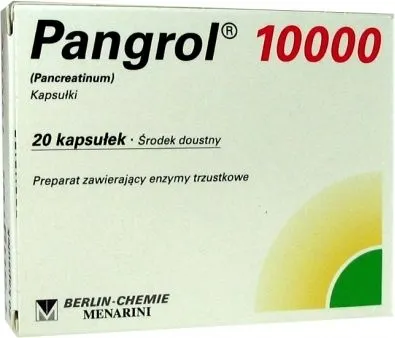
Table of Contents
Package leaflet: Information for the user
Warning! Keep this leaflet. The information on the immediate packaging is in a foreign language.
Pangrol 10 000 (Pangrol 10000 V)
10 000 Ph.Eur. units of lipase, enteric-coated hard capsules
Pancreatinum
Pangrol 10 000 and Pangrol 10000 V are different trade names for the same medicine.
Please read this leaflet carefully before using the medicine, as it contains
important information for the patient.
This medicine should always be taken exactly as described in this patient leaflet or as directed by the
physician or pharmacist.
- Keep this leaflet, so that you can read it again if necessary.
- If you need advice or further information, please consult your pharmacist.
- If you experience any adverse reactions, including any possible side effects not listed in this leaflet, inform your doctor, pharmacist, or nurse. See section 4.
- If there is no improvement or if your condition worsens after 7–14 days, consult your doctor.
Table of contents of the leaflet:
- What Pangrol 10 000 is and what it is used for
- Important information before taking Pangrol 10 000
- How to take Pangrol 10 000
- Possible side effects
- How to store Pangrol 10 000
- Contents of the pack and other information
1. What Pangrol 10 000 is and what it is used for
What is Pangrol 10 000?
Pangrol 10 000 contains digestive enzymes derived from porcine sources (powdered pancreas, also known as pancreatin).
What Pangrol 10 000 is used for:
Pangrol 10 000 is used as a replacement therapy for pancreatic enzymes in patients with digestive disorders due to deficiency or insufficient secretion and/or activity of pancreatic enzymes in the duodenum. Such disorders may occur, for example, under the following conditions:
- Chronic pancreatitis of any cause (alcohol-related, traumatic, autoimmune, drug-induced, tropical calcifying, or idiopathic);
- Specific pancreatic dysfunction (cystic fibrosis);
- Pancreatic duct obstruction caused, for example, by neoplastic disease or gallstones;
- Liver and biliary tract disorders;
- Previous pancreatic or pancreaticoduodenal surgery;
- Accelerated intestinal transit following gastric or intestinal surgery, due to stress, or inflammatory bowel diseases;
- Consumption of hard-to-digest plant foods, fats, or foods to which the digestive system is unaccustomed, leading to impaired nutrient absorption and digestive disturbances accompanied by loss of appetite, belching, nausea, and diarrhea (indigestion);
- Celiac disease;
- Inflammatory bowel disease (particularly Crohn's disease);
- Diabetes;
- Acquired immunodeficiency syndrome (AIDS);
- Shwachman syndrome;
- Sjögren's syndrome.
This medicine may be used in adults (including elderly patients) and children.
If there is no improvement or if your condition worsens after 7–14 days, consult your doctor.
Page 1 of 6
2. Important information before using Pangrol 10 000
When not to use Pangrol 10 000
- if the patient is hypersensitive to pancreatin, pork meat, or any of the other ingredients of this medicine (listed in section 6).
- in patients with acute pancreatitis and acute attacks in the course of chronic pancreatitis, during the exacerbation phase.
However, occasional administration of the medicine is appropriate during the remission phase, while gradually expanding the oral diet (mild diet), if symptoms indicating persistent pancreatic dysfunction are present.
Warnings and precautions
Before starting treatment with Pangrol 10 000, discuss this with your doctor or pharmacist:
- if symptoms indicating intestinal obstruction occur (e.g. abdominal pain, absence of bowel movements, nausea, vomiting). Intestinal obstruction is a common complication in patients with cystic fibrosis.
- as a precaution, any unusual gastrointestinal or abdominal symptoms, or changes in existing symptoms, should be evaluated by a physician to rule out intestinal damage. This particularly applies to patients receiving more than 10,000 Ph. Eur. units of lipase per kg body weight per day.
- This medicine contains active enzymes which, if released in the oral cavity (e.g. by chewing), may cause damage (ulceration) of the oral mucosa. Therefore, caution is required and the medicine must be taken whole.
Pangrol 10 000 and other medicines
Inform your doctor or pharmacist about all medicines currently used or recently taken, as well as any medicines planned for future use.
Concomitant use of pancreatic enzyme preparations may reduce the absorption of folic acid, which may necessitate additional folic acid supplementation.
Concomitant use of Pangrol 10 000 may reduce the effectiveness of oral antidiabetic drugs: acarbose and miglitol.
Pregnancy and breastfeeding
If the patient is pregnant or breastfeeding, suspects she may be pregnant, or is planning to become pregnant, she should consult her doctor or pharmacist before using this medicine.
There is no clinical experience with the use of Pangrol 10 000 in pregnant women. Only incomplete animal data are available regarding the effects on pregnancy, fetal development, delivery, and postnatal development. The potential risk in humans is unknown.
If the patient is pregnant or breastfeeding, she should not take Pangrol 10 000 unless, in the opinion of the physician, it is absolutely necessary.
Driving and operating machinery
Pangrol 10 000 has no effect or negligible effect on the ability to drive vehicles and operate machinery.
3. How to take Pangrol 10 000
Page 2 of 6
This medicine should always be taken exactly as described in this leaflet or as prescribed by your doctor or pharmacist. If in doubt, consult your doctor or pharmacist.
Dosage
The recommended dose is 2–4 capsules of Pangrol 10 000 per meal (corresponding to 20,000–40,000 IU Ph.Eur. of lipase).
The dosage depends on the severity of digestive disturbances. Higher doses may be necessary. Any increase in dosage must be discussed with your doctor beforehand, with the aim of improving symptoms (e.g. fatty stools, stomach pain).
Do not exceed a daily dose of 15,000–20,000 units of lipase per kilogram of body weight.
In cystic fibrosis, Pangrol 10 000 may be used in adults and children weighing at least 10 kg.
Unless otherwise directed by a physician, patients with cystic fibrosis weighing 10 kg or more should take 1–2 capsules of Pangrol 10 000 per meal (equivalent to 10,000–20,000 IU Ph.Eur. of lipase per meal). The physician may decide to increase the dose depending on body weight and severity of symptoms. Do not exceed the maximum dose of 15,000–20,000 units of lipase per kilogram of body weight per day.
Children and adolescents
Dosage for children should be determined by a doctor.
Method of administration
Pangrol 10 000 capsules should be swallowed whole during a meal, with a large amount of water.
Patients who prefer not to swallow the capsule whole may open it over a suitable container (e.g. a glass) and swallow only the contents with a small amount of liquid.
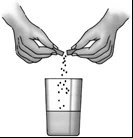
Care should be taken to swallow the contents whole, as chewing may reduce the effectiveness of the medicine and release enzymes into the oral cavity, potentially causing damage to the oral mucosa. The dose should be followed with a large amount of fluid (water or juice).
Duration of treatment
There is no fixed limit on the duration of treatment with Pangrol 10 000. The length of treatment depends on the course of the disease and should be determined by the doctor.
If the patient does not feel better or feels worse, medical advice should be sought.
If you feel the effect of Pangrol 10 000 is too strong or too weak, consult your doctor or pharmacist.
Taking more Pangrol 10 000 than recommended
If you take more Pangrol 10 000 than recommended, drink plenty of water and contact your doctor.
Taking very high doses of pancreatin, especially in patients with cystic fibrosis, may lead to increased levels of uric acid in the blood (hyperuricaemia) and in the urine (hyperuricosuria).
Missed dose of Pangrol 10 000
Do not take a double dose to make up for a missed dose. Take the next dose as scheduled.
Stopping Pangrol 10 000
Page 3 of 6
If treatment with Pangrol 10 000 is stopped prematurely or interrupted, symptoms may return. Consult your doctor.
If you have any further questions about the use of this medicine, consult your doctor or pharmacist.
4. Possible adverse reactions
Like all medicines, this medicine can cause adverse reactions, although not everyone will experience them.
Important adverse reactions and symptoms to be aware of
If any of the symptoms listed below occur, stop taking
the medicine Pangrol 10 000 immediately and seek medical advice without delay. The doctor will decide on further management.
Very rare adverse reactions (may affect up to 1 in 10,000 people)
- Diarrhea, abdominal discomfort, abdominal pain, nausea, vomiting
- Immediate-type allergic reactions, such as: skin rash, urticaria, sneezing, lacrimation, breathlessness due to airway narrowing (bronchospasm), dyspnea
- Gastrointestinal allergic reactions
- In patients with cystic fibrosis, following high doses of pancreatin, cases of distal intestinal strictures (in the ileocaecal and ascending colon regions) have been reported. This may lead to intestinal obstruction (see section 2 "Warnings and precautions").
Frequency not known (cannot be estimated from available data)
In patients with cystic fibrosis, mainly in those receiving high doses of pancreatin, increased urinary excretion of uric acid may occur. Therefore, urinary uric acid levels in these patients should be monitored to prevent the formation of uric acid stones.
Reporting of adverse reactions
If any adverse reactions occur, including any adverse reactions not listed in this leaflet, inform your doctor, pharmacist or nurse.
Adverse reactions can be reported directly to the Department of Monitoring Adverse Drug Reactions at the Office for Registration of Medicinal Products, Medical Devices and Biocidal Products:
Al. Jerozolimskie 181C, 02-222 Warsaw
Phone: (22) 49-21-301
Fax: (22) 49-21-309
Website: https://smz.ezdrowie.gov.pl
Reporting adverse reactions helps to provide more information on the safety of the medicine.
5. How to store Pangrol 10 000
Keep out of the sight and reach of children.
Do not use this medicine after the expiry date stated on the packaging. The expiry date refers to the last day of the stated month.
The container should be kept closed.
Storage conditions
Store below 25°C.
After first opening the bottle, the medicine remains stable for 6 months.
Page 4 of 6
Medicines should not be disposed of down the toilet or in household waste. Ask your pharmacist how to dispose of medicines no longer in use. This will help protect the environment.
6. Contents of the pack and other information
What Pangrol 10 000 contains
The active substance is pancreatin. One enteric hard capsule (containing enteric-coated minitablets resistant to
gastric juice) contains pancreatin with enzymatic activity of:
- lipase 10 000 IU Ph.Eur.
- amylase 9 000 IU Ph.Eur.
- protease 500 IU Ph.Eur.
Excipients
minitablets:
Sodium croscarmellose
Microcrystalline cellulose
Hydrogenated castor oil
Anhydrous colloidal silica
Magnesium stearate
Methacrylic acid and ethyl acrylate copolymer (1:1), 30% dispersion
Triethyl citrate
Simeticone emulsion 30%
Talc
Capsule shell:
Gelatin
Iron oxide red (E 172)
Quinoline yellow (E 104)
Iron oxide yellow (E 172)
Indigo carmine (E 132)
Titanium dioxide (E 171)
What Pangrol 10 000 looks like and contents of the pack
Pangrol 10 000 is an enteric hard capsule. The size 2 capsule has a light orange, opaque body and a yellow-green, opaque cap, containing light brown, shiny, homogeneous minitablets.
Pack: a polypropylene bottle closed with a polyethylene screw cap, containing a desiccant, and holding 50 capsules.
For further detailed information, please contact the marketing authorisation holder or the parallel importer.
Marketing Authorisation Holder in Latvia, country of export:
Berlin-Chemie AG (Menarini Group), Glienicker Weg 125, 12489 Berlin, Germany
Manufacturer:
Berlin-Chemie AG (Menarini Group), Glienicker Weg 125, 12489 Berlin, Germany
Parallel Importer:
Delfarma Sp. z o.o., ul. Św. Teresy od Dzieciątka Jezus 111, 91-222 Łódź
Repackaged in:
Delfarma Sp. z o.o., ul. Św. Teresy od Dzieciątka Jezus 111, 91-222 Łódź
Marketing Authorisation Number in Latvia, country of export: 98-0159
Parallel Import Authorisation Number: 187/24
Page 5 of 6
Page 6 of 6