Paclitaxel accord
Poland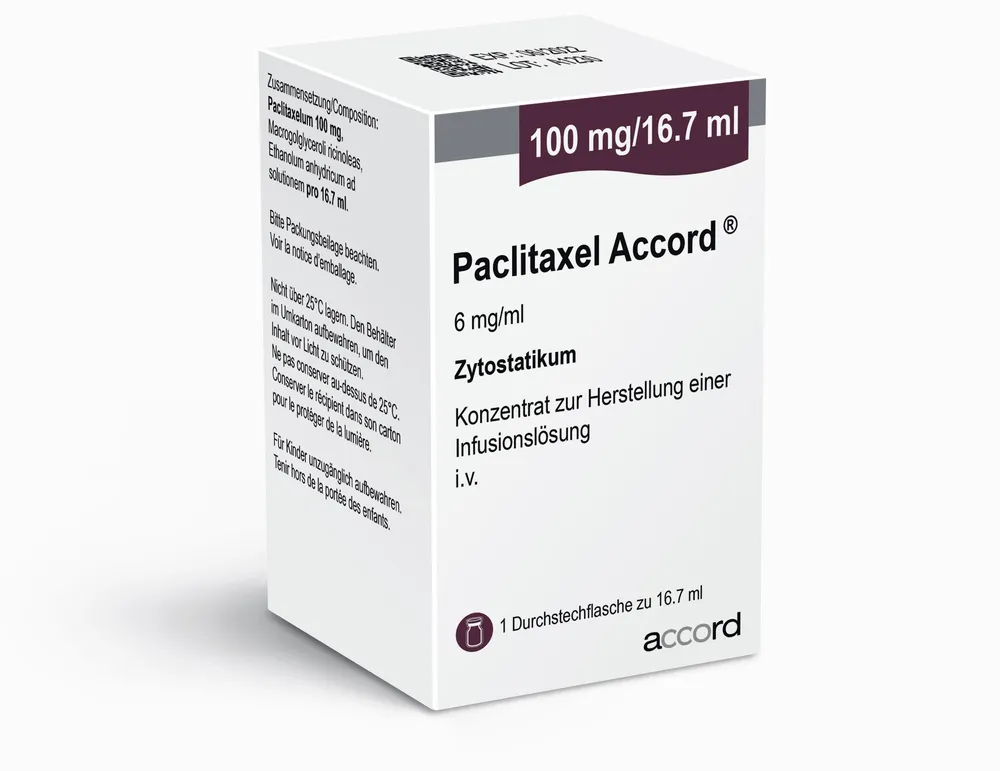
Table of Contents
- Package leaflet: Information for the patient
- 1. What Paclitaxelum Accord is and what it is used for
- 2. Important information before using Paclitaxelum Accord
- 3. How to use Paclitaxelum Accord
- 4. Possible adverse reactions
- 5. How to store Paclitaxelum Accord
- 6. Contents of the pack and other information
- Information intended exclusively for medical or healthcare personnel:
Package leaflet: Information for the patient
Paclitaxelum Accord, 6 mg/ml, concentrate for solution for infusion
Paclitaxelum
Please read carefully the entire leaflet before using this medicine, as it contains
important information for the patient.
- Keep this leaflet, as you may need to read it again.
- If you have any questions, please consult your doctor, pharmacist, or nurse.
- If you experience any adverse reactions, including any possible adverse reactions not listed in this leaflet, inform your doctor, pharmacist, or nurse. See section 4.
The medicine is named "Paclitaxelum Accord, 6 mg/ml, concentrate for solution for infusion",
but in the remainder of this leaflet it will be referred to as "Paclitaxelum Accord".
Leaflet contents:
- What Paclitaxelum Accord is and what it is used for
- What you must know before receiving Paclitaxelum Accord
- How to use Paclitaxelum Accord
- Possible side effects
- How to store Paclitaxelum Accord
- Contents of the pack and other information
1. What Paclitaxelum Accord is and what it is used for
Paclitaxel belongs to a group of anticancer medicines known as "taxanes".
These medicines inhibit the growth of cancer cells.
Paclitaxelum Accord is used in the treatment of the following cancers:
Ovarian cancer:
- as first-line treatment (after prior surgery, in combination with a platinum-containing medicine, cisplatin).
- when other treatments using conventional platinum-containing medicines have failed.
Breast cancer:
- as first-line treatment for advanced disease or disease that has spread to other parts of the body (metastases). Paclitaxelum Accord is used in combination with an anthracycline (e.g. doxorubicin) or with a medicine called trastuzumab (in patients who cannot be treated with anthracyclines and who have HER2 receptor proteins present on the surface of their cancer cells; see the patient leaflet for trastuzumab).
- after prior surgery, as adjuvant therapy following anthracycline and cyclophosphamide (AC) treatment.
- as second-line treatment in patients in whom standard anthracycline-based therapy has failed or in patients for whom anthracycline treatment is not appropriate.
Advanced non-small cell lung cancer:
- in combination with cisplatin in patients who are not candidates for surgery and (or) radiotherapy.
Kaposi's sarcoma associated with AIDS:
- in patients in whom other treatments (e.g. treatment with liposomal formulations of anthracyclines) have been ineffective.
2. Important information before using Paclitaxelum Accord
When not to use Paclitaxelum Accord
if the patient is allergic (hypersensitive) to paclitaxel or any of the other
components of this medicine, especially polyoxyethylated castor oil (listed in section
6.1);
during breastfeeding;
in patients with reduced white blood cell count. The doctor will perform a blood test to
check whether the patient has an adequate number of blood cells;
in cases of severe and uncontrolled infection in patients receiving Paclitaxelum Accord for the treatment of Kaposi's sarcoma.
If any of the above conditions apply to the patient, the doctor must be informed before starting
treatment with Paclitaxelum Accord.
Use of Paclitaxelum Accord is not recommended in children (under 18 years of age).
Warnings and precautions
Before starting treatment with Paclitaxelum Accord, discuss this with your doctor.
To prevent allergic reactions, the patient will receive other medications before starting therapy with Paclitaxelum Accord.
If the patient experiences severe allergic reactions (e.g. difficulty breathing, shortness of breath, chest tightness, low blood pressure, dizziness, confusion, skin reactions such as rash or swelling);
if the patient experiences fever, severe chills, sore throat or mouth ulcers
(symptoms of bone marrow suppression);
if the patient experiences numbness or weakness in hands and feet
(symptoms of peripheral neuropathy);
a dose reduction of Paclitaxelum Accord may be necessary;
if the patient has severe liver function impairment; in such cases, use of Paclitaxelum Accord is not recommended;
if the patient has cardiac conduction disorders;
if the patient develops severe or chronic diarrhoea accompanied by fever and abdominal pain during or shortly after treatment with Paclitaxelum Accord. Pseudomembranous colitis may occur;
in patients who have previously undergone chest radiotherapy (as this may increase the risk of developing pneumonitis);
in patients with pain or redness in the mouth (symptoms of mucositis) being treated for Kaposi's sarcoma. A lower dose may be required.
The doctor must be informed immediately if any of the above conditions occur.
Paclitaxelum Accord must be administered intravenously only.
Administration of Paclitaxelum Accord via arterial route may cause arterial inflammation, leading to pain, swelling, redness, and burning sensation.
Paclitaxelum Accord and other medicines
Inform the doctor about all medicines currently taken or recently used, as well as any medicines the patient plans to use, including over-the-counter medicines. This is because Paclitaxelum Accord or another medicine may not work as expected, or the risk of adverse reactions may increase.
An interaction means that different medicines may affect each other.
Exercise caution and inform the doctor if paclitaxel is used concomitantly with the following medicines:
- Medicines used to treat infections (e.g. antibiotics such as erythromycin, rifampicin, etc.; if uncertain whether a medicine is an antibiotic, consult the doctor, nurse, or pharmacist)
- Medicines used to improve mood, sometimes also called antidepressants (e.g. fluoxetine)
- Medicines used to treat seizures (epilepsy) (e.g. carbamazepine, phenytoin)
- Medicines used to lower blood lipid levels (e.g. gemfibrozil)
- Medicines used to treat heartburn or stomach ulcers (e.g. cimetidine)
- Medicines used to treat HIV infection and AIDS (e.g. ritonavir, saquinavir, indinavir, nelfinavir, efavirenz, nevirapine)
- An anticoagulant medicine called clopidogrel
- An antibiotic used to treat tuberculosis called rifampicin. An increase in the dose of Paclitaxelum Accord may be necessary
- Vaccines: if the patient has recently been vaccinated or plans to be vaccinated, they should inform their doctor. Using paclitaxel together with certain vaccines may lead to serious complications.
- Cisplatin (used in cancer treatment): Paclitaxelum Accord should be administered before cisplatin. Kidney function may need to be monitored more frequently.
- Doxorubicin (used in cancer treatment): Paclitaxelum Accord should be administered 24 hours after doxorubicin to avoid high levels of doxorubicin in the body.
Pregnancy, breastfeeding and effects on fertility
If the patient is pregnant, suspects she may be pregnant, she should consult her doctor before using this medicine. If there is a risk of becoming pregnant, an effective and safe method of contraception should be used during treatment.
Use of Paclitaxelum Accord during pregnancy is not recommended unless absolutely necessary. Patients (women and men) of reproductive age and/or their partners should use contraception for at least 6 months after completion of paclitaxel treatment.
Men undergoing treatment should seek advice regarding sperm storage prior to starting paclitaxel treatment due to the risk of irreversible infertility.
Breastfeeding women should inform their doctor. Breastfeeding must be discontinued during treatment with Paclitaxelum Accord. Breastfeeding should not be resumed unless otherwise advised by the doctor.
Driving and operating machinery
This medicine contains alcohol. Therefore, driving or operating machinery is not recommended immediately after a treatment cycle. Under no circumstances should the patient drive if they experience dizziness or feel unsteady.
Important information about certain ingredients of Paclitaxelum Accord
Paclitaxelum Accord contains castor oil (50% polyethoxylated castor oil 35), which may cause severe hypersensitivity reactions. If the patient is allergic to castor oil, the doctor must be informed before starting treatment with Paclitaxelum Accord.
Paclitaxelum Accord contains alcohol
This medicine contains 391 mg of alcohol (ethanol) per ml. The amount of alcohol in the medicine (at the maximum dose of 220 mg/m² BSA) is equivalent to 646 ml of beer or 258 ml of wine.
The alcohol in this medicine may affect the action of other medicines. If the patient is taking other medicines, they should consult their doctor or pharmacist.
If the patient is pregnant or breastfeeding, they should consult their doctor or pharmacist before using this medicine.
If the patient is alcohol-dependent, they should consult their doctor or pharmacist before using this medicine.
3. How to use Paclitaxelum Accord
- To minimize hypersensitivity reactions, the patient will receive other medications before starting treatment with Paclitaxelum Accord. These medications may be given as tablets, intravenous infusion, or both.
- Paclitaxelum Accord is administered as an intravenous infusion into a vein using an in-line filter. Paclitaxelum Accord is given by a healthcare professional, who will prepare the infusion solution prior to administration. The dose of the medicine will also depend on the patient's blood test results. Depending on the type and severity of the tumour, Paclitaxelum Accord may be used as monotherapy or in combination with another antineoplastic agent.
- Paclitaxelum Accord should always be administered intravenously over 3 or 24 hours. The medicine is usually given every 2 or 3 weeks, unless otherwise indicated by the physician. The physician will inform the patient about the number of treatment cycles with Paclitaxelum Accord required.
If you have any further doubts regarding the use of this medicine, consult your doctor.
Overdose of Paclitaxelum Accord
There is no known antidote in case of overdose with Paclitaxelum Accord. The patient will be treated symptomatically.
4. Possible adverse reactions
Like all medicines, this medicine can cause adverse reactions, although not everybody will get them.
You should inform your doctor immediately if any symptoms of an allergic reaction occur, including one or more of the following:
- hot flushes,
- skin reactions,
- itching,
- chest tightness,
- shortness of breath or breathing difficulties,
- swelling. All of these reactions may be signs of serious adverse reactions.
You should inform your doctor immediately:
- if the patient has fever, severe chills, sore throat or mouth ulcers (symptoms of bone marrow suppression);
- if the patient has numbness or weakness in the hands and feet (symptoms of peripheral neuropathy); Neuropathy symptoms may persist for longer than 6 months after completion of paclitaxel treatment;
- if the patient has severe or prolonged diarrhoea accompanied by fever and stomach pain.
Very common adverse reactions (may affect more than 1 in 10 patients):
- Mild allergic reactions such as hot flushes, rash, itching.
- Infections: mainly upper respiratory tract infections, urinary tract infections.
- Shortness of breath.
- Sore throat or mouth ulcers, pain or redness in the mouth, diarrhoea, nausea, vomiting.
- Hair loss (most cases of hair loss occurred within less than one month after starting paclitaxel treatment. In most patients, hair loss is significant (more than 50%)).
- Muscle pain, cramps, joint pain.
- Fever, severe chills, headache, dizziness, fatigue, pale skin, bleeding, increased tendency to bruising.
- Numbness, tingling or weakness in the hands and feet (all are symptoms of peripheral neuropathy).
- Blood tests may show: reduced number of platelets, white or red blood cells, and low blood pressure.
Common adverse reactions (may affect up to 1 in 10 patients):
- Transient, mild changes in nails and skin disorders, reactions at the injection site (local swelling, pain, redness of the skin).
- Blood tests may show: reduced heart rate, significant increase in liver enzyme activity (alkaline phosphatase and aspartate aminotransferase).
Uncommon adverse reactions (may affect up to 1 in 100 patients):
- Infection-induced shock (known as "septic shock").
- Palpitations, heart dysfunction (atrioventricular block), rapid heartbeat, myocardial infarction, respiratory failure.
- Fatigue, sweating, fainting, severe allergic reactions, vein inflammation due to blood clot (thrombophlebitis), swelling of the face, lips, mouth, tongue or throat.
- Back pain, chest pain, pain in hands and feet, chills, abdominal pain.
- Blood tests may show: significant increase in bilirubin levels (jaundice), high blood pressure, blood clots.
Rare adverse reactions (may affect up to 1 in 1,000 patients):
- Decreased number of white blood cells with fever and increased risk of infection (febrile neutropenia).
- Nerve disorders, including muscle weakness in arms and legs (motor neuropathy).
- Shortness of breath, pulmonary embolism, pulmonary fibrosis, interstitial lung disease, dyspnoea, pleural effusion.
- Intestinal obstruction, intestinal perforation, ischaemic colitis, pancreatitis.
- Itching, rash, skin redness (erythema).
- Blood infection (sepsis), peritonitis.
- Fever, dehydration, weakness, oedema and malaise.
- Severe, life-threatening allergic reactions (anaphylactic reactions).
- Blood tests may show: increased blood creatinine levels, indicating kidney function impairment.
- Heart failure.
Very rare adverse reactions (may affect up to 1 in 10,000 patients):
- Irregular, rapid heart rhythm (atrial fibrillation, supraventricular tachycardia).
- Sudden disorders of blood-forming cells (acute myeloid leukaemia, myelodysplastic syndrome).
- Optic nerve and/or vision disorders (sparkling scotoma).
- Hearing loss or hearing disturbances (ototoxicity), tinnitus, labyrinthine vertigo.
- Cough.
- Blood clots in blood vessels of the abdominal cavity and intestines (mesenteric thrombosis), colitis, sometimes with persistent severe diarrhoea (pseudomembranous colitis, neutropenic colitis), ascites, oesophagitis, constipation.
- Severe hypersensitivity reactions, including fever, skin redness, joint pain and/or eye inflammation (Stevens-Johnson syndrome), local skin peeling (epidermal necrolysis), erythema with irregular red patches (exudates) (erythema multiforme), skin inflammation with blistering and peeling (exfoliative dermatitis), urticaria, nail separation from the nail bed (patients undergoing treatment should use a protective sunscreen on hands and feet).
- Loss of appetite (anorexia).
- Severe hypersensitivity reactions with shock, which are life-threatening (anaphylactic shock).
- Liver function disorders (liver necrosis, hepatic encephalopathy [fatal cases have been reported in both]).
- Confusion.
Adverse reactions with unknown frequency (frequency cannot be estimated from the available data):
- Cases of disseminated intravascular coagulation (DIC, disseminated intravascular coagulation) have been reported; this is a serious disorder causing a tendency to bleed or form blood clots, or both simultaneously.
- Skin thickening (scleroderma).
- Metabolic complications following tumour treatment (tumour lysis syndrome).
- Eye disorders such as thickening and swelling of the macula (macular oedema), flashes of light (photopsia), and floaters, spots, specks and "cobwebs" drifting in the visual field (vitreous opacity), excessive tearing.
- Vein inflammation.
- Autoimmune disease with multiple symptoms such as red, scaly skin patches, joint pain or fatigue (systemic lupus erythematosus) or red, thick and often scaly rashes and sores which may burn or itch (cutaneous lupus erythematosus).
- Acute inflammatory reaction limited to previously irradiated areas, triggered by systemic drugs causing a recall reaction after radiotherapy ("recall" phenomenon).
- Excessive sweating (hyperhidrosis).
You should inform your doctor if any of the adverse reactions worsen or if any adverse reactions not listed in this leaflet occur.
Reporting of adverse reactions
If you experience any adverse reactions, including those not listed in this leaflet, you should inform your doctor or pharmacist. Adverse reactions can be reported directly to the Department of Monitoring Adverse Drug Reactions at the Office for Registration of Medicinal Products, Medical Devices and Biocidal Products
Al. Jerozolimskie 181C
02-222 Warsaw
Tel: +48 22 49 21 301
Fax: +48 22 49 21 309
Website: https://smz.ezdrowie.gov.pl
Adverse reactions can also be reported to the marketing authorisation holder.
Reporting adverse reactions helps to provide more information on the safety of the medicine.
5. How to store Paclitaxelum Accord
Keep out of the sight and reach of children.
Do not use this medicinal product after the expiry date stated on the carton after "EXP". The expiry date refers to the last day of the stated month.
Before opening
Do not store above 25°C. Store the vial in its outer packaging to protect from light.
Freezing does not affect the quality of the product.
After opening, prior to dilution (description of storage conditions)
From a microbiological standpoint, the product may be stored for up to 28 days at a temperature of 25°C after opening. The user is responsible for other storage conditions and duration.
After dilution (description of storage conditions)
From a microbiological standpoint, the diluted product should be used immediately. If the product is not used immediately, it should be stored in a refrigerator (2 to 8°C). The storage period should not exceed 24 hours, provided dilution was carried out under controlled and validated aseptic conditions. For detailed information on stability after dilution, see the section intended for healthcare professionals.
Do not use Paclitaxelum Accord if cloudiness or insoluble precipitate is visible.
Medicinal products must not be disposed of via wastewater or household waste. Ask your pharmacist how to dispose of medicines no longer required. These measures will help protect the environment.
6. Contents of the pack and other information
What Paclitaxelum Accord contains
The active substance is paclitaxel.
Each millilitre of concentrate for solution for infusion contains 6 mg of paclitaxel.
Each vial contains 5, 16.7, 25, 50 ml or 100 ml (corresponding to 30, 100, 150, 300 mg and 600 mg
of paclitaxel).
The other ingredients are macrogolglycerol ricinoleate 35 and ethanol anhydrous.
What Paclitaxelum Accord looks like and contents of the pack
Paclitaxelum Accord is a clear, colourless or slightly yellow solution without visible solid particles.
The medicine is available in vials containing 5 ml, 16.7 ml, 25 ml, 50 ml and 100 ml of concentrate for solution for infusion.
Not all pack sizes may be marketed.
Marketing Authorisation Holder and Manufacturer
Marketing Authorisation Holder
Accord Healthcare Polska Sp. z o.o.
ul. Taśmowa 7
02-677 Warszawa
Tel: +48 22 577 28 00
Manufacturer/Importer
Accord Healthcare Polska Sp. z o.o.
ul. Lutomierska 50
95-200 Pabianice
Accord Healthcare Single Member S.A.
64th Km National Road Athens
32009 Lamia
Greece
This medicinal product is authorised in the Member States of the European Economic Area under the following names:
| Member State Name | Medicinal Product Name |
| Austria | Paclitaxel Accord 6 mg/ml, Konzentrat zur Herstellung einer Infusionslösung |
| Belgium | Paclitaxel Accord Healthcare 6 mg/ml, solution à diluer pour perfusion / concentraat voor oplossing voor infusie / Konzentrat zur Herstellung einer Infusionslösung |
| Bulgaria | Paclitaxel Accord 6 mg/ml, concentrate for infusion solution |
| Cyprus | Paclitaxel Accord 6 mg/ml, concentrate for solution for infusion |
| Czech Republic | Paclitaxel Accord 6 mg/ml, concentrate for preparation of infusion solution |
| Denmark | Paclitaxel Accord 6 mg/ml, concentrate for infusion solution, solution |
| Estonia | Paclitaxel Accord |
| Finland | Paclitaxel Accord 6 mg/ml, infuusiokonsentraatti, liuosta varten / koncentrat till infusionsvätska, lösning |
| France | Paclitaxel Accord 6 mg/ml, solution à diluer pour perfusion |
| Spain | Paclitaxel Accord 6 mg/ml, concentrado para solución para perfusión EFG |
| Netherlands | Paclitaxel Accord 6 mg/ml, concentraat voor oplossing voor intraveneuze infusie |
| Ireland | Paclitaxel 6 mg/ml, Concentrate for Solution for Infusion |
| Lithuania | Paclitaxel Accord 6 mg/ml, koncentratas infuziniam tirpalui |
| Latvia | Paclitaxel Accord |
| Germany | Paclitaxel Accord 6 mg/ml, Konzentrat zur Herstellung einer Infusionslösung |
| Norway | Paclitaxel Accord 6 mg/ml, konsentrat til infusjonsvæske |
| Poland | Paclitaxelum Accord |
| Portugal | Paclitaxel Accord |
| Romania | Paclitaxel Accord 6 mg/ml, concentrat pentru soluţie perfuzabilǎ |
| Slovakia | Paclitaxel Accord 6 mg/ml, infúzny koncentrát |
| Slovenia | Paclitaxel Accord 6 mg/ml, koncentrat za raztopino za infundiranje |
| Sweden | Paclitaxel Accord 6 mg/ml, koncentrat till infusionsvätska, lösning |
| Hungary | Paclitaxel Accord 6 mg/ml, koncentrátum oldatos infúzióhoz |
| United Kingdom | Paclitaxel 6 mg/ml, Concentrate for Solution for Infusion |
| Italy | Paclitaxel Accord Healthcare 6 mg/ml, concentrato per soluzione per infusione |
Information intended exclusively for medical or healthcare personnel:
Preparation of infusion solutions:
- Containers and infusion sets used with Paclitaxel Accord must not contain DEHP. This will reduce patient exposure to DEHP [di-(2-ethylhexyl) phthalate], which may leach from containers or infusion sets made of PVC. The use of filtration devices (e.g., IVEX-2) equipped with short inlet and/or outlet segments made of PVC did not have a significant impact on DEHP leaching.
- As with other antineoplastic agents, caution should be exercised when handling Paclitaxelum Accord. Appropriate protective gloves should always be worn when handling vials containing paclitaxel. Dilution must be performed under sterile conditions by trained personnel in a designated area. In case of contact with skin, wash the affected area thoroughly with soap and water. In case of contact with mucous membranes, rinse thoroughly with water.
- The use of a "Chemo-Dispensing Pin" device or similar devices to withdraw doses from the vial is not recommended, as they may cause the vial stopper to be ejected, resulting in loss of sterility.
Step 1: Dilution of concentrate
Prior to administration, Paclitaxelum Accord must be diluted in:
- 0.9% sodium chloride injection, or
- 5% glucose injection, or
- 5% glucose and 0.9% sodium chloride injection, or
- 5% glucose in Ringer's injection
The final concentration of the paclitaxel solution must be between 0.3 and 1.2 mg/mL.
Containers and infusion sets used must be DEHP-free.
After dilution, the solution may appear cloudy, which is due to the vehicle contained in the
medicinal product and is not removed by filtration. No significant loss of potency has been
observed during simulated administration of the solution through an infusion line with a filter.
Step 2: Infusion administration
Prior to administration, patients should receive corticosteroids, antihistamines,
and H-receptor antagonists.
Paclitaxelum Accord must not be re-administered until neutrophil count reaches ≥ 1500/mm³ (≥ 1000/mm³ in patients with Kaposi's sarcoma) and platelet count reaches ≥ 100,000/mm³ (≥ 75,000/mm³ in patients with Kaposi's sarcoma).
To minimize the risk of precipitation of the infusion solution:
- administer the solution as soon as possible after dilution,
- avoid excessive shaking, vibration, or agitation,
- flush infusion sets thoroughly before use,
- regularly inspect the appearance of the solution and discontinue infusion if precipitation occurs.
The diluted solution remains chemically and physically stable at 5°C and 25°C for 7 days when diluted in 5% glucose injection, and for 14 days when diluted in 0.9% sodium chloride injection. From a microbiological standpoint, the diluted product should be used immediately or stored at 2 to 8°C for no longer than 24 hours.
Paclitaxelum Accord must be administered through an appropriate in-line filter with a microporous membrane having a pore size of ≤ 0.2 micrometers. Containers and infusion sets must not contain DEHP. The use of filtration devices equipped with short inlet and/or outlet segments made of plasticized materials did not have a significant effect on DEHP leaching.
Step 3: Disposal
Any unused product or waste material must be disposed of in accordance with local regulations governing cytotoxic drugs.
Dosage:
Recommended intravenous infusion doses of Paclitaxelum Accord are as follows:
| Indications | Dose | Interval between treatment courses with Paclitaxel Accord |
| First-line treatment of ovarian cancer patients | 135 mg/m2 over 24 hours, followed by cisplatin 75 mg/m2 or 175 mg/m2 over 3 hours, followed by cisplatin 75 mg/m2 | 3 weeks |
| Second-line treatment of ovarian cancer patients | 175 mg/m2 over 3 hours | 3 weeks |
| Adjuvant treatment of breast cancer | 175 mg/m2 over 3 hours; after anthracycline and cyclophosphamide (AC) therapy. | 3 weeks |
| First-line treatment of breast cancer patients (in combination with doxorubicin) | 220 mg/m2 over 3 hours, 24 hours after administration of doxorubicin (50 mg/m2) | 3 weeks |
| First-line treatment of breast cancer patients (in combination with trastuzumab) | 175 mg/m2 over 3 hours, after administration of trastuzumab (see trastuzumab SmPC) | 3 weeks |
| Second-line treatment of breast cancer patients | 175 mg/m2 over 3 hours | 3 weeks |
| Advanced non-small cell lung cancer | 175 mg/m2 over 3 hours, followed by cisplatin 80 mg/m2 | 3 weeks |
| Kaposi's sarcoma in AIDS | 100 mg/m2 over 3 hours | 2 weeks |
Paclitaxelum Accord must not be re-administered until the absolute neutrophil count reaches ≥ 1500/mm³ (≥ 1000/mm³ in patients with Kaposi's sarcoma) and platelet count reaches ≥ 100,000/mm³ (≥ 75,000/mm³ in patients with Kaposi's sarcoma).
In patients who experience severe neutropenia (absolute neutrophil count < 500/mm³ for one week or longer) or severe peripheral neuropathy, the dose should be reduced by 20% (by 25% in patients with Kaposi's sarcoma) in subsequent treatment cycles (see Summary of Product Characteristics).
Available data are insufficient to recommend dose adjustments in patients with mild or moderate hepatic impairment. Paclitaxelum Accord therapy is not recommended in patients with severe hepatic impairment (see Summary of Product Characteristics).
Paclitaxelum Accord is not recommended for use in children under 18 years of age due to lack of data on safety and efficacy.