Oxytocin-grindex
Poland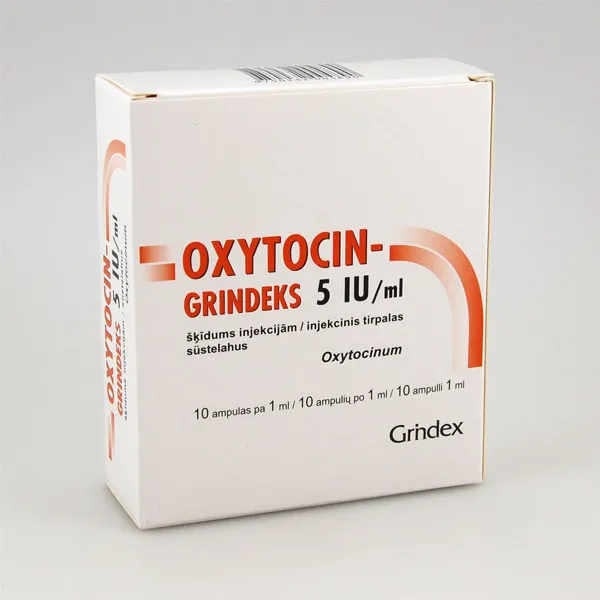
Table of Contents
Package leaflet: Information for the patient
OXYTOCIN-GRINDEX, 5 IU/ml, solution for injection and infusion
Oxytocinum
Please read carefully the entire leaflet before using this medicine, as it contains
important information for the patient.
- Keep this leaflet, as you may need to read it again.
- Consult your doctor, pharmacist, or nurse if you have any further questions.
- This medicine has been prescribed for a specific individual. Do not pass it on to others.
- This medicine may harm another person, even if their symptoms are the same.
- If any of the side effects worsens, or if you experience any side effects not listed in this leaflet, inform your doctor, pharmacist, or nurse. See section 4.
Table of contents of the leaflet:
- What Oxytocin-Grindex is and what it is used for
- Important information before using Oxytocin-Grindex
- How to use Oxytocin-Grindex
- Possible side effects
- How to store Oxytocin-Grindex
- Contents of the pack and other information
1. What Oxytocin-Grindex is and what it is used for
Oxytocin-Grindex contains oxytocin, a synthetic cyclic 9-amino acid peptide with the same structure as the hormone produced by the posterior pituitary gland. Oxytocin causes contractions of the smooth muscle of the uterus and of the myoepithelial cells in the mammary gland.
Oxytocin-Grindex is used in hospital settings for the following purposes:
- Induction and stimulation of labor in cases of weak uterine contractile activity, and in patients with the following medical indications for termination of pregnancy: pregnancy-induced hypertension and/or pre-eclampsia, chronic hypertension, diabetes, chronic maternal diseases (non-advanced, stabilized), intrauterine infection, serological incompatibility, fetal hypotrophy, abnormal test results suggesting threatening intrauterine hypoxia, history of intrauterine death of a full-term fetus, fetal malformations, premature rupture of membranes;
- Acceleration of labor: oxytocin induction may be indicated in pregnancies lasting longer than 42 weeks, in cases of intrauterine fetal death or fetal growth delay, as well as in prolonged labor or occurrence of uterine atony;
- Control of postpartum hemorrhage and uterine atony;
- As supportive treatment following incomplete or missed abortion;
- Diagnostic use: to assess fetal-placental respiratory function in high-risk pregnancies (stress test).
2. Important information before using Oxytocin-Grindex
When not to use Oxytocin-Grindex:
- if the patient is allergic to oxytocin or any of the other ingredients of this medicine (listed in section 6);
- if the patient has excessive (hypertonic) uterine contractile activity, fetal distress (fetal hypoxia);
- if there is disproportion between the size of the fetus and the birth canal, transverse or oblique fetal presentation, placenta praevia, vasa praevia, placental abruption,
prolapse or protrusion of the umbilical cord, predisposition to uterine rupture such as in multiple pregnancy, polyhydramnios (excess amniotic fluid), multiparity, and presence of uterine scars following major surgical procedures including caesarean section.
Prolonged use should be avoided in cases of oxytocin-resistant uterine inertia, severe pre-eclampsia with eclampsia (presence of protein in urine), and severe cardiovascular disease.
Warnings and precautions
Before starting treatment with Oxytocin-Grindex, consult a doctor, pharmacist, or nurse.
Oxytocin used to induce or augment labour must be administered only as an intravenous infusion under strict medical supervision in a hospital setting.
The infusion rate must be carefully controlled. In addition, close monitoring of uterine activity, fetal heart rate, fetal position, maternal blood pressure, and the patient's general condition is essential.
Special precautions should be taken in the following cases:
- borderline disproportion between fetal head and maternal pelvis (oxytocin administration should be avoided in cases of significant disproportion);
- secondary uterine inertia (decrease in contraction frequency following a wave of intense contractions);
- mild to moderate pregnancy-induced hypertension or heart disease;
- women over 35 years of age;
- women who had a lower uterine segment incision during caesarean section;
- intrauterine fetal death;
- presence of meconium-stained amniotic fluid (may increase the risk of amniotic fluid embolism). Pharmacologically induced labour with oxytocin is considered to increase the risk of a very rare condition: postpartum disseminated intravascular coagulation (DIC). The risk is increased in women over 35 years of age, women who experienced complications during pregnancy, and women whose pregnancy has lasted beyond 40 weeks. In these patients, oxytocin should be used with caution and the physician should monitor for symptoms of DIC (i.e. assess fibrinolysis). If large doses of oxytocin are administered too rapidly, water intoxication or hyponatremia may occur.
- avoid administering the drug in large-volume infusions and restrict oral fluid intake. The therapeutic effect of oxytocin may be enhanced by concomitant prostaglandins (careful monitoring is required). Oxytocin administered 3-4 hours after prophylactic vasoconstrictor agents together with spinal anaesthesia may cause severe hypertension. The risk of water intoxication should be considered, especially when high doses of oxytocin are used for prolonged periods. Small-volume infusions should be used, and in such cases, oxytocin is recommended to be administered in an electrolyte solution rather than in glucose solution. In case of suspected electrolyte imbalance, serum electrolyte concentrations should be monitored. Oxytocin infusions should not be administered using the same equipment used for blood or plasma, as this may lead to oxytocin inactivation. Oxytocin is incompatible with solutions containing sodium metabisulfite used as a stabilizing agent.
Latex allergy
The active substance in Oxytocin-Grindex may cause a severe allergic reaction (anaphylactic shock) in patients allergic to latex. If the patient knows she is allergic to latex, she should inform her doctor.
Children
Oxytocin-Grindex is not intended for use in children.
Oxytocin-Grindex and other medicines
Inform your doctor or pharmacist about any medicines you are currently taking, have recently taken, or plan to take.
Oxytocin should not be administered earlier than 6 hours after vaginal administration of prostaglandins.
Some inhalational anaesthetics (cyclopropane, halothane) may enhance the hypotensive effect of oxytocin and reduce its labour-inducing action. Concurrent use with oxytocin may lead to cardiac arrhythmias.
Concomitant administration of oxytocin with vasoconstrictive sympathomimetics may enhance their effect.
Oxytocin administered during or after spinal anaesthesia may potentiate the hypertensive effect of vasoconstrictive sympathomimetics.
Oxytocin-Grindex with food and drink
The patient may be advised to limit fluid intake to a minimum.
Pregnancy, breastfeeding and fertility
If the patient is pregnant, breastfeeding, suspects she may be pregnant, or is planning to become pregnant, she should consult her doctor or pharmacist before using this medicine.
Oxytocin-Grindex should be used to induce labour only when strictly indicated for medical reasons.
Only small amounts of oxytocin pass into breast milk, and it is not expected to have harmful effects on infants, as it undergoes rapid inactivation in the gastrointestinal tract.
Driving and operating machinery
Not applicable.
3. How to use Oxytocin-Grindex
This medicine should always be used exactly as directed by the physician. The physician will decide when and how to administer Oxytocin-Grindex. If in doubt, consult the doctor or pharmacist.
Induction and stimulation of labour
5-10 IU of oxytocin, dissolved in 500 ml of Ringer's solution or multi-electrolyte fluid, should be administered intravenously via an infusion pump at a rate of 1-6 mIU/minute, increasing the infusion rate as needed.
After delivery of the newborn, prophylactic administration of oxytocin to the mother is recommended at a dose of 3 to 5 IU intravenously as a bolus or intramuscularly.
Cesarean section
5 IU by slow intravenous injection (5 IU should be diluted in physiological electrolyte solution and administered either as a slow intravenous infusion or preferably via a variable-rate rotary pump over 5 minutes), administered immediately after delivery to stimulate uterine contraction and reduce blood loss.
Management of postpartum haemorrhage
Initially, 5 IU of oxytocin administered by slow intravenous infusion (5 IU should be diluted in physiological electrolyte solution and administered as a slow intravenous drip or preferably via a variable-rate rotary pump over 5 minutes); the dose may be repeated. This may be followed by a continuous infusion (40 IU in 500 ml of Ringer's solution at a rate of 125 ml/hour), provided fluid restriction is not required.
Supportive treatment of incomplete or inevitable abortion (abortion in progress)
10 IU of oxytocin dissolved in 500 ml of physiological saline solution or 5% glucose solution is administered by intravenous drip infusion at a rate of 20-40 drops/minute.
Stress test
Intravenous drip infusion – initially at 0.5 mIU/minute, then doubling the dose every 20 minutes if necessary, until an effective dose is achieved (usually 5-6 mIU/minute, maximum 20 mIU/minute). Once three moderate uterine contractions (lasting 40-60 seconds) occur within a 10-minute period, the infusion should be discontinued and the subsequent decrease in fetal heart rate should be monitored.
Patients with renal and/or hepatic impairment
There are no data regarding the use of oxytocin in patients with renal and/or hepatic impairment.
Elderly patients
Oxytocin is not indicated for use in elderly patients.
Use of a higher than recommended dose of Oxytocin-Grindex
Since this medicine is administered in a hospital setting, it is unlikely that a patient would receive a dose higher than recommended.
No antidote is known.
Overdose may lead to placental abruption, amniotic fluid embolism, excessive uterine activity, strong (hypertonic) and/or prolonged (tetanic) contractions, and consequently to uterine rupture, cervical and vaginal lacerations, severe postpartum haemorrhage, fetal arrhythmia (irregular heartbeat), hypoxia (lack of oxygen in tissues), and even death.
In case of overdose, the infusion should be stopped immediately and normal diuresis maintained. Symptomatic treatment is required; hypertonic electrolyte-containing fluids are recommended.
Missed administration of Oxytocin-Grindex
Since the medicine is administered by a physician, it is unlikely that a recommended dose would be missed.
If the patient has any doubts, she should inform the physician.
Do not use a double dose to make up for a missed dose.
Discontinuation of Oxytocin-Grindex
Once labour has progressed adequately, oxytocin may be gradually discontinued.
There are no data on adverse effects following discontinuation.
If you have any further questions about the use of this medicine, consult your doctor, pharmacist, or nurse.
4. Possible adverse effects
Like all medicines, this medicine can cause adverse effects, although not everybody will experience them.
Uterine contractions (may occur when low doses are administered).
The medicine Oxytocin-Grindex, when administered in excessively high doses or to women who are hypersensitive, may cause increased uterine tone with strong (hypertonic) and/or prolonged (tetanic) contractions, leading to uterine rupture and soft tissue damage, and consequently, the following may occur in the fetus: bradycardia (slowed heart rate), arrhythmias, asphyxia (suffocation), acute hypoxia, and possibly fetal demise or maternal death.
Administration of large volumes of electrolyte-free fluids may lead to water intoxication with pulmonary edema, seizures, coma, hyponatremia (low serum sodium levels), and even death. Nausea, vomiting, rashes, and anaphylactic reactions (with respiratory distress, hypotension, or shock) may occur.
Severe hypertension and subarachnoid hemorrhage (bleeding into the space between the brain and surrounding tissues) may result in maternal death. Postpartum hemorrhage and afibrinogenemia leading to death (lack of fibrinogen in plasma) may be obstetric complications. Rare postpartum disseminated intravascular coagulation may also occur (see section 4.4).
Very rapid intravenous injection may cause acute, transient hypotension accompanied by flushing and reflex tachycardia.
There have been reports of neonatal jaundice and retinal hemorrhages associated with the use of oxytocin during labor.
Common (may affect more than 1 in 100 people):
- headache,
- bradycardia, tachycardia,
- nausea,
- vomiting.
Uncommon (may affect more than 1 in 1,000 people):
- arrhythmia (irregular heartbeat).
Rare (may affect more than 1 in 10,000 people):
- severe allergic reactions associated with breathing difficulties, hypotension, or shock,
- rash.
Reporting of adverse effects
If any adverse effects occur, including any adverse effects not listed in this leaflet, inform your doctor or pharmacist. Adverse effects can be reported directly to the Department for Monitoring Adverse Drug Reactions of the Office for Registration of Medicinal Products, Medical Devices and Biocidal Products
Al. Jerozolimskie 181C
02-222 Warsaw
Tel: +48 22 49 21 301
Fax: +48 22 49 21 309
e-mail: [email protected]
Adverse effects can also be reported to the marketing authorization holder.
Reporting adverse effects helps provide more information on the safety of this medicine.
5. How to store Oxytocin-Grindex
Store below 25°C.
Keep out of the sight and reach of children.
Do not use this medicine after the expiry date stated on the label. The expiry date refers to the last day of the stated month.
Medicines should not be disposed of via wastewater or household waste. Ask your pharmacist how to dispose of medicines no longer required. Proper disposal helps protect the environment.
6. Contents of the pack and other information
What Oxytocin-Grindex contains
- The active substance is oxytocin (Oxytocinum)
- 1 ml of solution contains 5 IU of oxytocin. The other ingredients are chlorobutanol hemihydrate, glacial acetic acid, and water for injections.
What Oxytocin-Grindex looks like and contents of the pack
A colourless, clear solution.
The pack contains 10 ampoules made of colourless borosilicate glass.
Marketing Authorisation Holder and Manufacturer
AS GRINDEKS
Krustpils iela 53,
Rīga, LV-1057,
Latvia
Tel.: +371 67083205
Fax: +371 67083505
e-mail: [email protected]