Oxsoralen
Poland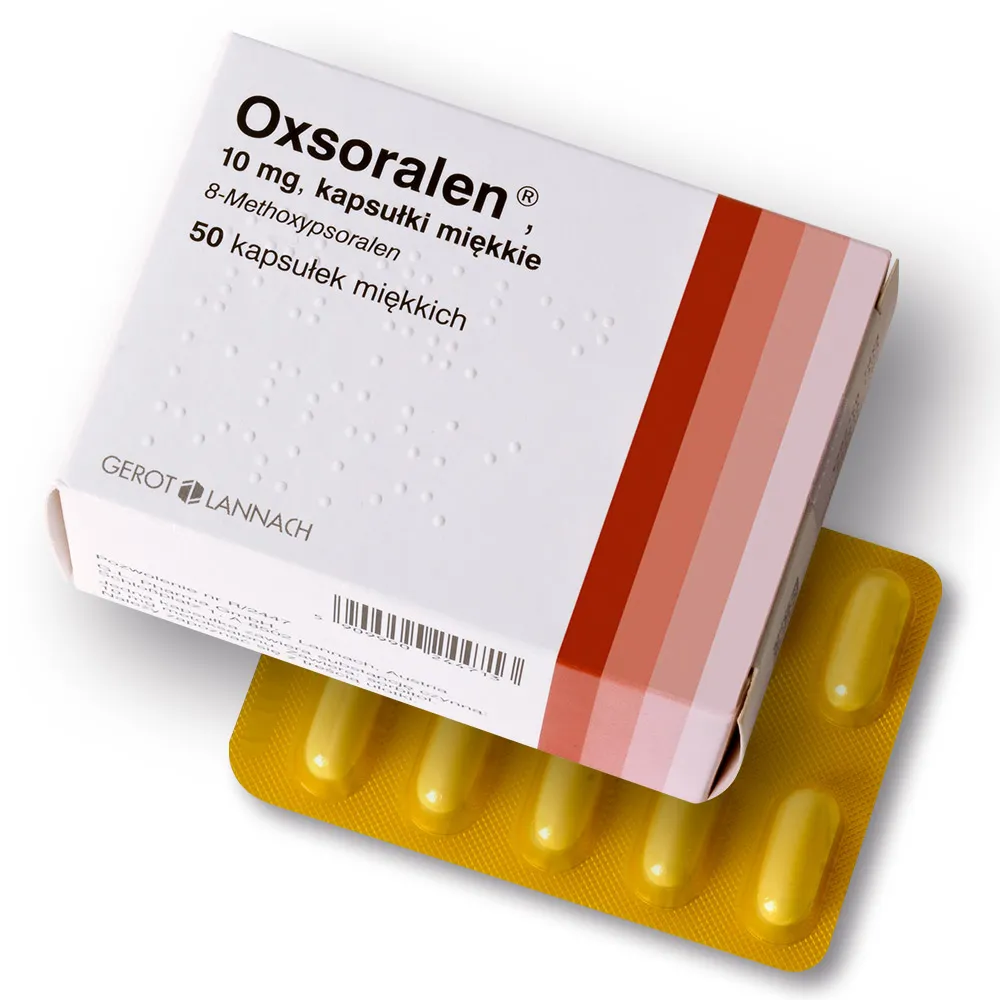
Table of Contents
Package leaflet: Information for the patient
Oxsoralen, 10 mg, soft capsules
(8-Methoxypsoralen)
Please read all of this leaflet carefully before taking this medicine, because it contains important information for you.
- Keep this leaflet. You may need to read it again.
- If you have any further questions, please ask your doctor or pharmacist.
- This medicine has been prescribed for a specific individual. Do not pass it on to others. It may harm someone else, even if their symptoms are the same.
- If you experience any side effects, including any not listed in this leaflet, tell your doctor or pharmacist. See section 4.
Contents of this leaflet:
- What Oxsoralen is and what it is used for
- What you need to know before taking Oxsoralen
- How to take Oxsoralen
- Possible side effects
- How to store Oxsoralen
- Contents of the pack and other information
1. What Oxsoralen is and what it is used for
Oxsoralen is a soft capsule containing the active substance methoxypsoralen, which inhibits excessive proliferation of epidermal cells. Methoxypsoralen does not act alone – it is activated by long-wave ultraviolet radiation (UV-A) emitted by special lamps or by sunlight.
Indications
Oxsoralen is indicated in the treatment of severe psoriasis vulgaris (as part of so-called PUVA therapy).
PUVA photochemotherapy (PUVA = Psoralen + UV-A) involves oral administration of capsules prescribed by a doctor, followed by exposure to UV-A radiation emitted by special lamps (see also section 3. How to take Oxsoralen).
2. What you need to know before taking Oxsoralen
Do not take Oxsoralen:
- if you are allergic to methoxypsoralen, other psoralens, or any of the other ingredients of this medicine (listed in section 6)
- if you have severe impairment of kidney or liver function
- if you suffer from diseases associated with photosensitivity, such as: late cutaneous porphyria, mixed porphyria, erythropoietic porphyria, xeroderma pigmentosum, or polymorphic photodermatoses
- if you have systemic lupus erythematosus
- if you have albinism
- if you have malignant melanoma, squamous cell carcinoma of the skin, or a history of skin cancer
- if you are currently undergoing anticancer therapy (chemotherapy, irradiation)
- if you have aphakia (absence of the eye lens)
- in children under 12 years of age
- during pregnancy or breastfeeding
Warnings and precautions
Before starting treatment with Oxsoralen, discuss it with your doctor or pharmacist.
You must inform your doctor before taking Oxsoralen:
- if you have previously undergone any of the following treatments, as in such cases your doctor should exclude, if possible, the use of PUVA therapy:
- coal tar therapy,
- treatment with arsenic-containing preparations,
- treatment with UV-B or X-ray radiation.
PUVA therapy may be used only in the following cases, and exclusively if the doctor decides it is absolutely necessary:
- in young patients,
- in patients with fair skin (skin types I and II),
- if the patient has or has had skin cancers, herpes, or eye disorders (especially cataracts and glaucoma, uveitis, or retinitis),
- in patients with cardiovascular disorders, who should be irradiated in a lying position.
PUVA therapy may only be performed in specialized centers equipped with trained personnel and appropriate equipment.
During treatment with Oxsoralen, sexually active men and women of childbearing age should use effective contraceptive methods.
You must strictly follow your doctor's instructions, including all required examinations (eyes, blood count, liver and kidney function).
There is a suspicion that in patients with epilepsy, the flickering light from fluorescent UV-A lamps may trigger seizures.
How to avoid skin and eye damage
Oxsoralen makes the skin of the entire body more sensitive to sunlight (UV-A radiation) or artificial light with similar properties to sunlight.
A mild skin reaction (redness) is a desired effect and indicates that the treatment is effective.
Itching after irradiation may be relieved by using emollient creams or anti-itch ointments.
Daylight also contains some long-wave UV radiation; therefore, you must take precautions during Oxsoralen treatment to minimize the risk of adverse effects, especially to the eyes and skin. You should avoid prolonged exposure to outdoor air and sunlight, even through window glass. If uncovered skin is exposed to sunlight (even in the shade) after taking Oxsoralen, it may cause severe burns.
You must avoid prolonged exposure to outdoor air and sunlight, even through glass, for 24 hours before and at least 8 hours after taking Oxsoralen. You must not sunbathe at any time during the course of therapy.
Oxsoralen must not be used as a tanning aid.
Improper use of the medicine may lead to life-threatening burns, skin damage, and increased risk of developing skin cancer.
Men must completely cover external genital organs during irradiation due to the risk of squamous cell carcinoma in these areas. Women should cover genital organs if irradiation is performed in the supine position.
To protect the eyes from potential damage, you must wear well-fitting UV-A protective sunglasses for at least the first 8 hours after taking Oxsoralen.
Inform your doctor about any liver function disorders, as this may require a longer period of sun protection than specified for all patients.
Children and adolescents
Oxsoralen is contraindicated in children under 12 years of age (see section "When not to take Oxsoralen").
Oxsoralen with other medicines
Tell your doctor or pharmacist if you are taking, have recently taken, or might take any other medicines.
Pregnancy, breastfeeding, and fertility
If you are pregnant or breastfeeding, think you may be pregnant, or are planning to have a baby, consult your doctor or pharmacist before taking this medicine.
Do not take Oxsoralen during pregnancy or breastfeeding.
If you become pregnant, treatment with Oxsoralen must be discontinued. It may be resumed only after the breastfeeding period ends.
Driving and using machines
Oxsoralen has no effect or has a negligible effect on the ability to drive and operate machinery.
Oxsoralen contains sorbitol.
Anidrisorb, one of the capsule shell components, contains sorbitol. If you have been previously diagnosed with intolerance to certain sugars, you should consult your doctor before taking this medicine.
3. How to use Oxsoralen
This medicine should always be taken according to the instructions given by your doctor or pharmacist. If you have any doubts,
you should consult your doctor or pharmacist.
Treatment with Oxsoralen and UV-A radiation exposure must be performed only by medical personnel
specifically trained for this purpose and having access to appropriate equipment.
Dosage
If your doctor has not instructed otherwise, the recommended dose is:
Body weight Dose of Oxsoralen
up to 40 kg 1 capsule (10 mg)
40 – 50 kg 2 capsules (20 mg)
50 – 60 kg 3 capsules (30 mg)
above 60 kg 4 to a maximum of 5 capsules (40 mg, up to a maximum of 50 mg)
In patients showing low sensitivity to UV radiation, your doctor may decide to increase the dose to avoid excessively prolonged irradiation.
Use in children and adolescents
Oxsoralen is contraindicated in children under 12 years of age.
Method of administration
Description of PUVA procedures:
Before starting treatment, an appropriate phototoxicity test must be performed to determine the correct radiation dose and exposure time.
Before the test, you must take the dose of Oxsoralen prescribed by your doctor at the exact time specified by them.
One hour after taking the capsule, irradiation begins with a small dose of UV-A radiation. The patient is then exposed to gradually increasing doses of UV-A radiation until mild redness of the skin appears, indicating that the treatment has started to take effect.
The radiation dose determined in this way will be used during treatment unless your doctor decides that adjustment is necessary.
Oxsoralen capsules should be taken with a glass of milk or food. Irradiation begins approximately 1 hour after taking the capsule.
During UV-A irradiation, the eyes must be completely covered with light-proof protective shields that block all light (see also How to avoid skin and eye damage in section 2).
Duration of treatment
At the beginning, treatment should be performed once daily, no more than four times per week.
First, take the prescribed dose of Oxsoralen. Then, one hour later, UV-A irradiation is administered. After two consecutive days of irradiation, a one-day break in treatment must be observed—one day without treatment is required.
If a change in irradiation dose is necessary, your doctor may recommend repeating the phototoxicity tests.
Your doctor will individually determine treatment breaks and the total duration of therapy.
Taking more Oxsoralen than recommended
Acute overdose causes nausea, severe vomiting, and dizziness. Induce vomiting and keep the patient in a darkened room for at least 24 hours.
Cardiovascular function should be monitored.
Missed dose of Oxsoralen
Since Oxsoralen capsules are part of PUVA therapy, you must inform your doctor before starting irradiation that the prescribed dose of the medicine was missed.
Do not take a double dose of the medicine.
If you have any questions about the medicine, consult your doctor or pharmacist.
4. Possible adverse reactions
Like all medicines, Oxsoralen may cause adverse reactions, although not everyone experiences them.
Uncommon (may occur in less than 1 in 100 people):
- headache, nervousness, insomnia
- nausea and vomiting immediately after taking Oxsoralen; this effect may be reduced by taking the medicine with milk or food
- photosensitivity reactions, such as redness, rash and itching after exposure to light. If redness is severe or blisters appear, inform your doctor before the next phototherapy session. Overexposure to UV-A radiation may cause sunburn, which in severe cases may be associated with blistering and erythema.
Rare (may occur in less than 1 in 1,000 people):
- hair discoloration, which is completely reversible after discontinuation of treatment
Very rare (may occur in less than 1 in 10,000 people):
- changes in blood parameters (particularly during long-term treatment)
- liver damage (particularly during long-term treatment)
- kidney damage (particularly during long-term treatment)
Frequency unknown (cannot be estimated from available data):
- During long-term therapy, excessive keratosis, premature skin aging, and skin pigmentation spots may occur.
The risk of developing skin cancers is increased. This particularly affects the external genital organs in males, but cannot be excluded in females (see also How to avoid skin and eye damage in section 2).
Reporting of adverse reactions
If any adverse reactions occur, including any not listed in this leaflet, inform your doctor or pharmacist. Adverse reactions can be reported directly to the Department of Monitoring Adverse Reactions of Medicinal Products, Office for Registration of Medicinal Products, Medical Devices and Biocidal Products
Al. Jerozolimskie 181 C
02-222 Warsaw
Phone: +48 22 4921301
Fax: +48 22 4921309
e-mail: [email protected]
Reporting adverse reactions helps to provide more information on the safety of this medicine.
5. How to store Oxsoralen
Store below 30°C.
Do not use this medicine after the expiry date stated on the packaging after EXP.
The expiry date refers to the last day of the stated month.
Medicines should not be disposed of via wastewater or household waste. Ask your pharmacist how to dispose of medicines no longer in use. This will help protect the environment.
6. Contents of the pack and other information
What Oxsoralen contains
- The active substance is methoxsalen. One soft capsule contains 10 mg of methoxsalen.
- Other components of the medicine are: Macrogol 400, Propylene glycol, Gelatin, Glycerol 85%, Titanium dioxide (E171), Anidrisorb 85/70: sorbitol, sorbitan, mannitol, superior Polyols.
What Oxsoralen looks like and contents of the pack:
The medicine is in the form of soft capsules.
The pack contains 50 soft capsules (5 blisters Al/PVC/PVDC containing 10 capsules each),
placed in a cardboard box.
Marketing Authorisation Holder and Manufacturer
G.L. Pharma GmbH
Schloßplatz 1
A-8502 Lannach
Austria
G.L. Pharma GmbH Sp. z o.o. Branch in Poland
Al. Jana Pawła II 61
01-031 Warsaw
Poland
Tel: 022/ 636 52 23; 636 53 02
Fax: 022/ 636 50 76