Oxodil combo
Poland
Table of Contents
Package leaflet: Information for the user
Oxodil Combo, (160 micrograms + 4.5 micrograms)/delivered dose,
inhalation powder, pre-dispensed
Budesonide + Formoterol fumarate dihydrate
Please read this leaflet carefully before using this medicine because it contains important
information for you.
- Keep this leaflet as you may need to read it again.
- If you have any further questions, please ask your doctor or pharmacist.
- This medicine has been prescribed for you personally. Do not pass it on to others. It may harm them even if their symptoms are the same as yours.
- If you experience any side effects, including any not listed in this leaflet, please inform your doctor or pharmacist. See section 4.
Leaflet contents
- What Oxodil Combo is and what it is used for
- Important information before using Oxodil Combo
- How to use Oxodil Combo
- Possible side effects
- How to store Oxodil Combo
- Contents of the pack and other information
1. What Oxodil Combo is and what it is used for
Oxodil Combo is a medicine delivered via an inhaler used to treat:
- Asthma in adults and adolescents aged 12 to 17 years.
- Symptoms of chronic obstructive pulmonary disease (COPD) in adults aged 18 years and older.
Oxodil Combo contains two medicines: budesonide and formoterol fumarate dihydrate.
- Budesonide belongs to a group of medicines called corticosteroids. It works by reducing and preventing swelling and inflammation in the lungs.
- Formoterol fumarate dihydrate belongs to a group of medicines called long-acting beta_2-adrenergic agonists or bronchodilators. It works by relaxing the muscles in the airways. The medicine makes breathing easier.
Asthma
Oxodil Combo may be prescribed for asthma treatment in two different ways:
a) Some people are prescribed two inhaler medicines for asthma treatment: Oxodil Combo
and a separate reliever medicine.
- Oxodil Combo is taken daily. It helps prevent asthma symptoms from occurring.
- The reliever inhaler is used when asthma symptoms occur, to help ease breathing.
b) Some people are prescribed Oxodil Combo as the only inhaler medicine for asthma treatment.
- Oxodil Combo is taken daily. It helps prevent asthma symptoms from occurring.
- Oxodil Combo is also used when additional doses are needed to relieve asthma symptoms and ease breathing. These individuals do not require a separate reliever inhaler.
Chronic obstructive pulmonary disease (COPD)
Oxodil Combo may also be used in adults to treat symptoms of COPD. COPD is a chronic disease characterized by persistent breathing difficulties caused by narrowed airways in the lungs, often accompanied by cough and sputum production. It is often caused by smoking.
2. Important information before using Oxodil Combo
When not to use Oxodil Combo
- if the patient is allergic to budesonide, formoterol, or any other ingredient of this medicine, which is lactose (containing small amounts of milk proteins).
Warnings and precautions
Before starting to use Oxodil Combo, discuss this with your doctor or pharmacist if the patient:
- has diabetes,
- has a lung infection,
- has high blood pressure or has ever had heart disease (including heart rhythm disorders, very fast heartbeat (high pulse), narrowed arteries, or heart failure),
- has thyroid or adrenal gland disease,
- has low blood potassium levels,
- has severe liver function impairment.
If the patient experiences blurred vision or other vision disturbances, they should contact their doctor.
Oxodil Combo and other medicines
Tell your doctor or pharmacist about all medicines the patient is currently taking or has recently taken, as well as any medicines the patient plans to use.
Inform your doctor or pharmacist if the patient is using any of the following medicines:
- β-blockers (such as atenolol or propranolol used to treat high blood pressure), including eye drops (such as timolol used in glaucoma treatment);
- medicines used to treat rapid or irregular heart rhythm (such as quinidine, disopyramide, procainamide);
- medicines used to treat allergies, so-called antihistamines (such as terfenadine);
- oxytocin, a medicine used to induce labor;
- procarbazine, a medicine used to treat cancer;
- medicines such as digoxin, often used in heart failure treatment;
- diuretics, so-called water tablets (such as furosemide) used to treat high blood pressure;
- corticosteroids (such as prednisolone) used to treat inflammatory conditions or to prevent rejection of transplanted organs;
- xanthine derivatives (such as theophylline or aminophylline) commonly used in asthma treatment;
- other medicines used to dilate the airways (such as salbutamol);
- medicines used to treat depression, so-called tricyclic antidepressants (such as amitriptyline) and the antidepressant nefazodone;
- medicines used to treat psychiatric disorders, nausea, or vomiting, so-called phenothiazines (such as chlorpromazine and prochlorperazine);
- medicines used to treat fungal infections (such as ketoconazole, itraconazole, voriconazole, posaconazole) and bacterial infections (such as clarithromycin, telithromycin, and furazolidone);
- medicines used to treat Parkinson's disease (such as levodopa);
- medicines used to treat thyroid disorders (such as levothyroxine);
- ritonavir, cobicistat (used in HIV infection treatment). The effect of Oxodil Combo may be enhanced, and the doctor may closely monitor the patient's condition.
If any of these situations apply to the patient, or if the patient is unsure whether they are taking any of the listed medicines, they should consult their doctor or pharmacist before using Oxodil Combo.
Also inform your doctor or pharmacist if general anesthesia is planned due to surgery or a dental procedure.
Pregnancy, breastfeeding, and fertility
- If the patient is pregnant or planning to become pregnant, she should consult her doctor before using Oxodil Combo – do not use Oxodil Combo unless advised by a doctor.
- If the patient becomes pregnant while being treated with Oxodil Combo, she should not stop taking Oxodil Combo but should contact her doctor immediately.
- If the patient is breastfeeding, she should consult her doctor before using Oxodil Combo.
Driving and operating machinery
Oxodil Combo has no effect or has a negligible effect on the ability to drive or operate tools or machinery.
Oxodil Combo contains lactose
Oxodil Combo contains lactose, a type of sugar. If the patient has previously been diagnosed with intolerance to certain sugars, they should contact their doctor before taking this medicine. The amount of lactose in this medicine should generally not pose a problem for people with lactose intolerance.
Lactose, an excipient of this medicine, contains small amounts of milk proteins, which may cause allergic reactions.
3. How to use Oxodil Combo
This medicine should always be used exactly as prescribed by your doctor or pharmacist. If you have any doubts,
you should consult your doctor or pharmacist.
- It is important to use Oxodil Combo every day, even if you do not have asthma or COPD symptoms at the time.
- If you are using Oxodil Combo for asthma treatment, your doctor will regularly monitor your symptoms.
If you are taking oral corticosteroid tablets for asthma or COPD, your doctor may reduce their dosage after you start using Oxodil Combo. If you have been taking oral corticosteroids for a prolonged period, your doctor may occasionally recommend blood tests. After reducing the dose of oral corticosteroids, you may feel unwell, even if your respiratory symptoms improve. Symptoms may include nasal congestion or runny nose, fatigue or joint or muscle pain, and rash (skin eruption). If any of these symptoms occur, or if you experience headache, tiredness, nausea, or vomiting, contact your doctor immediately. If allergic reactions or joint inflammation occur, additional medications may be necessary. If you are unsure whether to continue using Oxodil Combo, consult your doctor.
During periods of stress (e.g., chest infection or prior to surgery), your doctor may consider adding oral corticosteroid tablets to your usual treatment regimen.
Important information about asthma or COPD symptoms
If you experience shortness of breath or wheezing while using Oxodil Combo, continue using the medicine and contact your doctor as soon as possible, as additional treatment may be required.
Contact your doctor immediately if:
- your breathing problems worsen or asthma symptoms frequently wake you at night;
- you begin to feel chest tightness in the morning or chest tightness lasts longer than usual. These symptoms may indicate inadequate control of asthma or COPD, and immediate adjustment or additional treatment may be necessary.
Asthma
For asthma treatment, your doctor may prescribe Oxodil Combo in two different ways. The dose and timing depend on the prescribed regimen.
a) If your doctor has prescribed Oxodil Combo and a separate reliever inhaler, read the instructions below under “a) Using Oxodil Combo and a separate reliever inhaler”.
b) If your doctor has prescribed Oxodil Combo as the only inhaled medicine, read the instructions below under “b) Using Oxodil Combo as the sole inhaler in asthma treatment”.
a) Using Oxodil Combo and a separate reliever inhaler
Oxodil Combo must be used daily. This helps prevent asthma symptoms.
Adults (aged 18 years and above)
- The usual dose is 1 or 2 inhalations twice daily.
- Your doctor may increase this dose to 4 inhalations twice daily.
- Once symptoms are under control, your doctor may recommend using the medicine once daily.
Adolescents (aged 12 to 17 years)
- The usual dose is 1 or 2 inhalations twice daily.
- Once symptoms are under control, your doctor may recommend using the medicine once daily.
Oxodil Combo is not recommended for children under 12 years of age.
Your doctor will help you properly manage your asthma symptoms and determine the lowest effective dose. Do not change the dose without first consulting your doctor.
For treating asthma symptoms as they occur, use a separate “reliever inhaler”. Always carry your reliever inhaler with you so you can use it when needed. Do not use Oxodil Combo to treat asthma attacks—use the separate reliever inhaler instead.
b) Using Oxodil Combo as the sole inhaler in asthma treatment
Oxodil Combo should only be used as directed by your doctor and only in individuals aged 12 years and above.
Oxodil Combo must be used daily. This helps prevent asthma symptoms. You may use:
- 1 inhalation in the morning and 1 in the evening, or
- 2 inhalations in the morning, or
- 2 inhalations in the evening.
Your doctor may increase the dose to 2 inhalations twice daily.
Oxodil Combo should also be used as a “reliever inhaler” to treat asthma symptoms.
- If asthma symptoms occur, take 1 inhalation and wait a few minutes.
- If there is no improvement, take another inhalation.
- Do not use more than 6 inhalations at one time.
Always carry your Oxodil Combo inhaler so you can use it when needed. Usually, a total daily dose exceeding 8 inhalations is not required. However, your doctor may allow up to 12 inhalations per day for a limited period.
If you regularly need 8 or more inhalations per day, contact your doctor or nurse, as your treatment may need to be adjusted.
Do not exceed 12 inhalations per day.
If asthma symptoms occur during physical exertion, use Oxodil Combo as described above. However, do not use this medicine before exercise to prevent asthma symptoms.
Chronic obstructive pulmonary disease (COPD)
This medicine should only be used in adults (aged 18 years and above).
- The usual dose is 2 inhalations twice daily.
For COPD treatment, your doctor may also prescribe other bronchodilators, such as anticholinergics (e.g., tiotropium bromide or ipratropium).
Instructions for use
Your doctor, nurse, or pharmacist should demonstrate how to use the inhaler and regularly check that you are using it correctly.
The inhaler contains 60 doses of medicine in powder form within a foil strip. It has a dose counter that shows the number of doses remaining, counting down from 60 to 0. The last 10 doses are indicated against a red background.
The inhaler is not refillable—once empty, it should be discarded and replaced with a new one.
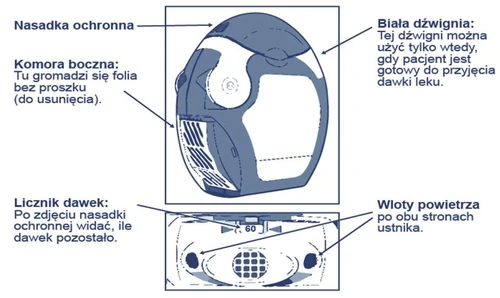
Before using the inhaler
- Open the transparent side chamber cover.
- Remove the foil strip from the side chamber by gently peeling it off along its entire length using the serrated edge, as shown in the figure below. Do not pull or jerk the strip.
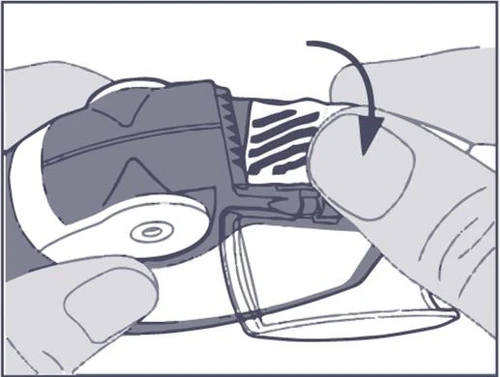
- Close the side chamber cover and dispose of the removed foil strip.
Note: As the inhaler is used, the side chamber gradually fills with used foil strips. Foil strips with black marks do not contain medicine. Numbered segments of the strip will appear at the end. Do not allow more than 2 foil strips to accumulate in the side chamber, as this may block the inhaler. Gently peel off the foil strip as shown above and dispose of it safely.
Using the inhaler
Hold the inhaler as shown in the illustrations.
1. Opening
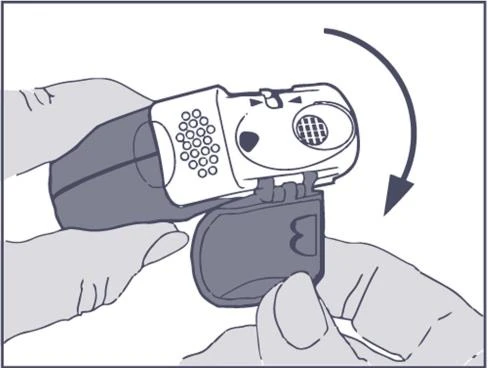
- Uncover the mouthpiece by pulling down the protective cap.
- Check the dose counter window to see how many doses remain.
2. Preparing a dose
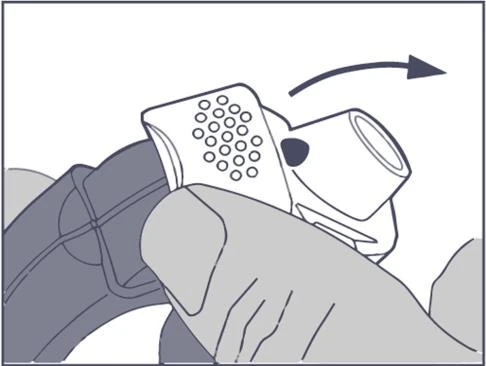
- Lift the edge of the white lever. Ensure the side chamber is closed. Note: Use the white lever only when you are ready to take a dose. Playing with the white lever may waste doses.
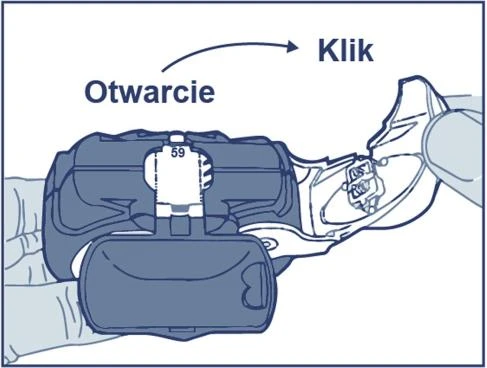
- Opening: Pull the white lever fully until you hear a click, which loads the dose and displays its number in the dose counter.
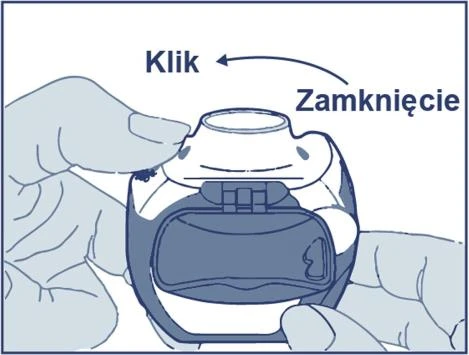
- Closing: Then fully close the white lever until you hear a click and it returns to its original position. The inhaler is now ready for immediate use.
3. Inhaling the dose
- Breathe out deeply away from the mouthpiece. Never exhale directly into the inhaler, as this may alter the dose.
- Hold the inhaler with the protective cap pointing downward.
- Close your lips tightly around the mouthpiece.
- Breathe in as deeply and forcefully as possible through your mouth (not your nose).
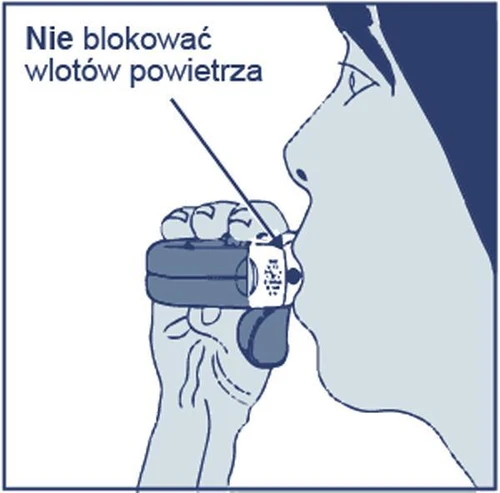
- Remove the inhaler from your mouth and hold your breath for 5–10 seconds, or as long as comfortable without discomfort.
- Then breathe out slowly, but not toward the inhaler.
- Close the protective cap over the mouthpiece.
- Rinse your mouth with water and spit it out. This helps prevent fungal infection in the mouth and hoarseness.
Cleaning
- If necessary, wipe the outer part of the mouthpiece with a clean, dry cloth.
- Do not disassemble the inhaler for cleaning or any other purpose!
- Do not clean any parts with water or wet wipes, as moisture may alter the dose!
- Never insert needles or other sharp objects into the mouthpiece or any other part of the inhaler, as this may damage it.
Using more than the recommended dose of Oxodil Combo
It is important to use this medicine exactly as prescribed. Do not increase the prescribed dose without consulting your doctor.
The most common symptoms after taking more than the recommended dose of Oxodil Combo are: tremors, headache, rapid or irregular heartbeat.
If you miss a dose of Oxodil Combo
- If you forget a dose, take it as soon as you remember. However, if it is almost time for your next dose, skip the missed dose.
- Do not take a double dose to make up for a missed dose.
If you have any further questions about the use of this medicine, consult your doctor or pharmacist.
4. Possible adverse reactions
Like all medicines, this medicine can cause adverse reactions, although not everyone will experience them.
If any of the following symptoms occur, stop using the medicine Oxodil Combo immediately
and consult a doctor:
- swelling of the face, particularly around the mouth (swelling of the tongue and/or throat and/or difficulty swallowing) or urticaria with breathing difficulties (angioedema) and/or sudden feeling of fainting. These symptoms may indicate a rare allergic reaction (may occur in less than 1 in 1,000 people).
- sudden onset of wheezing or breathlessness immediately after inhalation. If any of these symptoms occur, stop using the medicine Oxodil Combo immediately and use a rescue inhaler. Contact a doctor immediately, as a change in treatment may be necessary. This situation is very rare (may occur in less than 1 in 10,000 people).
Other possible adverse reactions:
Common (may occur in less than 1 in 10 people)
- palpitations (awareness of heartbeat), muscle tremor or shaking. If these symptoms occur, they are usually mild and diminish during continued use of Oxodil Combo.
- oral candidiasis (fungal infection of the mouth). The risk of developing this is reduced if the patient rinses the mouth with water after inhalation.
- mild sore throat, cough, and hoarseness
- headache
- pneumonia (lung infection) in patients with COPD
If any of the following symptoms occur during treatment with Oxodil Combo, consult a doctor – these may be signs of lung infection:
- fever or chills
- increased production of bronchial secretions, change in their color
- worsening cough or increased difficulty breathing.
Uncommon (may occur in less than 1 in 100 people)
- feeling of anxiety, nervousness, or restlessness
- sleep disturbances
- dizziness
- blurred vision
- nausea
- rapid heartbeat
- presence of bruises on the skin
- muscle cramps
- aggression
- anxiety
Rare (may occur in less than 1 in 1,000 people)
- rash, itching
- bronchospasm (constriction of the muscles in the airways causing wheezing). If wheezing occurs suddenly after using Oxodil Combo, discontinue use of Oxodil Combo and contact a doctor immediately.
- low blood potassium levels
- irregular heartbeat
Very rare (may occur in less than 1 in 10,000 people)
- depression
- behavioral changes, especially in children
- chest pain or tightness (angina pectoris)
- increased blood glucose (sugar) levels
- taste disturbances, such as unpleasant taste in the mouth
- changes in blood pressure
- weight gain, moon face, weakness, abdominal obesity (Cushing's syndrome).
Inhaled corticosteroids, especially when used long-term in high doses, may affect the body's normal production of steroid hormones. Symptoms include:
- changes in bone mineral density (bone thinning)
- cataract (clouding of the lens in the eye)
- glaucoma (increased pressure in the eye)
- slowed growth rate in children and adolescents
- effects on the adrenal glands (small glands located near the kidneys)
- cushingoid features (including weight gain, development of moon face, poor wound healing, and thinning of the skin)
- increased susceptibility to infections and reduced ability to cope with stressful situations. The likelihood of these symptoms is significantly lower with inhaled corticosteroids than with oral corticosteroid tablets.
Reporting of adverse reactions
If any adverse reactions occur, including any not listed in this leaflet, inform your doctor or pharmacist. Adverse reactions can be reported directly to the Department of Monitoring Adverse Drug Reactions of the Office for Registration of Medicinal Products, Medical Devices and Biocidal Products
Al. Jerozolimskie 181C
02-222 Warsaw
Phone: +48 22 49 21 301
Fax: +48 22 49 21 309
Website: https://smz.ezdrowie.gov.pl
Adverse reactions can also be reported to the marketing authorization holder.
Reporting adverse reactions helps to provide more information on the safety of the medicine.
5. How to store Oxodil Combo
Keep the medicine out of sight and reach of children.
Do not store above 30°C.
Do not use this medicine after the expiry date stated on the carton or inhaler label after EXP. The expiry date refers to the last day of the stated month.
The marking on the packaging after EXP indicates the expiry date, and after Lot indicates the batch number.
Medicines must not be disposed of via wastewater or household waste. Ask your pharmacist how to dispose of medicines no longer in use. This will help protect the environment.
6. Contents of the pack and other information
What Oxodil Combo contains
- The active substances are budesonide and formoterol fumarate dihydrate. Each delivered dose (inhaled dose) contains 160 micrograms of budesonide and 4.5 micrograms of formoterol fumarate dihydrate. Each metered dose (drug dose in the blister before administration) contains 194.7 micrograms of budesonide and 6.1 micrograms of formoterol fumarate dihydrate.
- The other ingredient is lactose monohydrate (contains milk proteins).
What Oxodil Combo looks like and contents of the pack
Oxodil Combo is a red and white plastic inhaler containing the medicine, in a cardboard box.
Each inhaler contains an OPA/Aluminum/PVC/Aluminum blister with 60 divided doses of powder for inhalation. The powder for inhalation is uniform, white, almost white or light yellow.
Pack sizes: 1 or 2 inhalers (each containing 60 doses).
Not all pack sizes may be marketed.
Marketing Authorisation Holder and Manufacturer
Marketing Authorisation Holder
Zakłady Farmaceutyczne POLPHARMA S.A.
ul. Pelplińska 19
83-200 Starogard Gdański
tel. +48 22 364 61 01
Manufacturer
Lek Pharmaceuticals d.d.
Verovškova 57
1526 Ljubljana
Slovenia
Salutas Pharma GmbH
Otto-Von-Guericke-Allee 1
39179 Barleben, Sachsen-Anhalt
Germany
Aeropharm GmbH
Francois-Mitterand-Allee 1
07407 Rudolstadt, Thuringen
Germany