Oxazepam espefa
Poland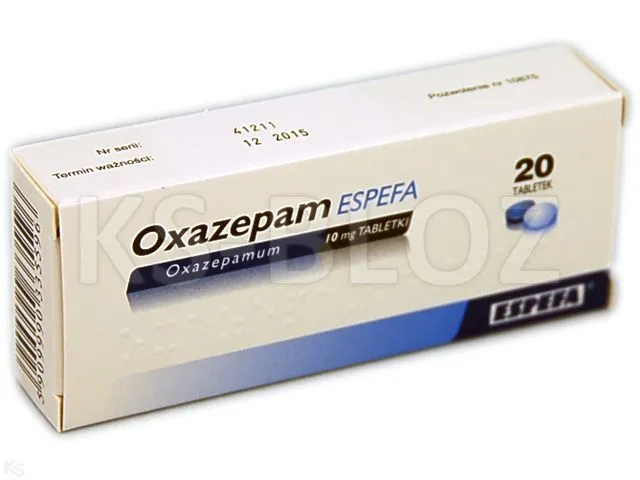
Table of Contents
Package leaflet: Information for the patient
OXAZEPAM ESPEFA, 10 mg, tablets
Oxazepamum
Please read carefully the entire leaflet before taking the medicine, as it contains
important information for the patient.
- Keep this leaflet, so that you can read it again if necessary.
- If you have any doubts, please consult your doctor or pharmacist.
- This medicine has been prescribed for a specific individual. Do not pass it on to others. The medicine may harm another person, even if their symptoms are the same.
- If any adverse reactions occur in the patient, including any adverse reactions not listed in this leaflet, inform your doctor or pharmacist. See section 4.
Table of contents
- What Oxazepam Espefa is and what it is used for
- Important information before taking Oxazepam Espefa
- How to take Oxazepam Espefa
- Possible side effects
- How to store Oxazepam Espefa
- Contents of the pack and other information
1. What Oxazepam Espefa is and what it is used for
Oxazepam Espefa is a short-acting benzodiazepine derivative with anxiolytic,
sedative, hypnotic, and anticonvulsant properties. It acts on the limbic system, thalamus, and hypothalamus.
Indications for use:
- anxiety states;
- anxiety associated with depression;
- agitation associated with acute alcoholic withdrawal syndrome.
States of tension and anxiety related to everyday problems are not indications for the use of
this medicine.
2. Important information before using Oxazepam Espefa
When not to use Oxazepam Espefa:
- if the patient is allergic to the active substance, other benzodiazepines, or any of the other ingredients of this medicine (listed in section 6);
- if the patient has severe liver failure;
- in case of addiction to drugs, narcotics, or alcohol;
- if the patient has severe respiratory insufficiency or sleep apnoea syndrome;
- in case of acute alcohol intoxication, intoxication with hypnotics, opiates, antipsychotics (neuroleptics, antidepressants, lithium salts);
- if the patient has been diagnosed with myasthenia gravis (muscle weakness);
- in women during pregnancy and breastfeeding, and in children under 6 years of age.
Warnings and precautions
Before starting treatment with Oxazepam Espefa, discuss this with your doctor.
- This medicine is not intended for the primary treatment of psychotic disorders and depression; it should not be used as monotherapy in patients with depression or psychotic disorders.
- The medicine should be used with particular caution in patients with respiratory disorders or porphyria.
- In elderly and debilitated patients, the dose should be reduced.
- Prolonged use and abrupt discontinuation of therapy should be avoided.
- Oxazepam Espefa administered in therapeutic doses may cause anterograde amnesia; the risk increases with higher doses.
- Paradoxical reactions may also occur, such as acute agitation, hallucinations, psychosis, and euphoric states.
- Oxazepam Espefa should be used with caution in patients in whom lowering of blood pressure could lead to cardiovascular complications.
- The medicine should be used cautiously in patients with impaired liver or kidney function. Liver function and blood morphology should be monitored during treatment.
- Regular use may lead to the development of tolerance, i.e. reduced effectiveness of the drug.
- In patients with a history of alcohol or drug dependence, oxazepam should be used with great caution.
- Treatment with Oxazepam Espefa may lead to physical and psychological dependence. If the drug is abruptly discontinued, withdrawal symptoms may occur, such as irritability, nervous overexcitability, difficulty falling asleep, restlessness, anxiety, less frequently muscle spasms and abdominal pain, loss of reality, and excessive sweating.
Oxazepam Espefa and other medicines
Tell your doctor about all medicines currently taken or recently taken, as well as any medicines the patient plans to take.
Concomitant administration of oxazepam with other drugs that depress the central nervous system (e.g. anaesthetics, antidepressants, antipsychotics, hypnotics, antihistamines, antihypertensives) increases both the sedative effect of oxazepam and the effects of these other drugs.
When oxazepam is used concomitantly with opioid analgesics, intense euphoria may occur, increasing the risk of psychological dependence.
Muscle relaxants (myorelaxants) may also enhance the sedative effect of oxazepam.
Theophylline and caffeine may reduce the hypnotic effect of benzodiazepines (including oxazepam).
Oxazepam administered simultaneously with drugs used in the treatment of parkinsonism (e.g. levodopa) may reduce their effectiveness.
During treatment with oxazepam, alcohol consumption should be avoided, as individual cases of paradoxical reactions have been reported.
Oxazepam Espefa with food and drink
Taking Oxazepam Espefa with food and drink does not affect the extent of drug absorption.
Pregnancy and breastfeeding
If the patient is pregnant or breastfeeding, suspects she may be pregnant, or is planning to become pregnant, she should consult a doctor before using this medicine.
The safety of oxazepam use in pregnant women has not been established.
Oxazepam Espefa is contraindicated during pregnancy, especially in the first and third trimesters.
Administration of benzodiazepines during pregnancy may cause fetal harm.
Long-term use of oxazepam in pregnant women may lead to withdrawal syndrome in the newborn. Administration of the drug in the late stages of pregnancy or during delivery may cause in the newborn reduced body temperature, low blood pressure, breathing disorders, apnoea, and weakened sucking reflex.
Oxazepam and its metabolites pass into breast milk; therefore, the medicine should not be used during breastfeeding.
Driving and operating machinery
While taking Oxazepam Espefa, patients should not drive motor vehicles or operate machinery, as the drug may impair psycho-physical performance. The ability to drive motor vehicles and operate mechanical equipment may be impaired due to drowsiness, concentration disturbances, or other possible adverse effects that reduce concentration (see section 4 "Possible side effects").
Oxazepam Espefa contains lactose and sucrose
If the patient has previously been diagnosed with intolerance to certain sugars, the patient should consult a doctor before taking this medicine.
3. How to use Oxazepam Espefa
This medicine should always be taken exactly as directed by your doctor. If you have any doubts, consult your doctor.
The medicine should be taken orally, regardless of meals.
Recommended dose:
The dose should be individually adjusted. The lowest possible dose should be used (especially in elderly patients, debilitated patients, and patients with low serum albumin concentration) in order to avoid excessive sedation.
Adults: The dosage and dosing schedule depend on individual sensitivity and clinical symptoms.
- Mild to moderate anxiety: 10 mg to 20 mg, 3 to 4 times daily.
- Severe anxiety: 20 mg to 30 mg, 3 to 4 times daily, with the higher dose taken at bedtime.
In elderly or debilitated patients, those with low body weight, low blood pressure, circulatory or respiratory insufficiency, or muscle weakness, the lowest effective dose should be administered (usually 10 mg three times daily).
The tablet should not be taken in the evening immediately after a meal, due to delayed onset of action and the possibility of fatigue and concentration disturbances the following morning.
- Agitation associated with acute alcoholic withdrawal syndrome: 20 mg to 30 mg, administered 3 or 4 times daily.
In acute cases, a single dose or several doses over a few days may be used.
Duration of treatment:
Your doctor will keep the duration of oxazepam treatment as short as possible. It usually lasts from a few days up to 2 weeks. After two weeks of oxazepam treatment, your doctor will reassess the need for continued use. The total duration of treatment, including the tapering period, should not exceed 4 weeks. Prolonged use of the medicine may lead to dependence.
Use in children and adolescents:
Oxazepam Espefa should not be used in children under 6 years of age. In children and adolescents aged 6 to 18 years, the use of oxazepam is not recommended due to lack of dosing recommendations in this age group.
Taking more than the recommended dose of Oxazepam Espefa:
If you take more than the recommended dose, seek immediate medical advice from your doctor or pharmacist.
Symptoms of mild poisoning include: drowsiness, confusion, lethargy, ataxia (impaired body movement coordination), dysarthria (slurred speech), hypotonia, dyskinesia (involuntary, sometimes stereotyped movements affecting proximal and distal limb muscles and trunk); occasionally shallow and short-lived loss of consciousness.
Symptoms of severe poisoning (especially when alcohol is consumed simultaneously) include: depression of respiratory and circulatory centers, coma, and even death.
Missed dose of Oxazepam Espefa:
Do not take a double dose to make up for a missed tablet.
Stopping Oxazepam Espefa:
Do not stop taking this medicine on your own. Your doctor will decide on gradually reducing the dose.
If you have any further doubts about using this medicine, consult your doctor or pharmacist.
4. Possible adverse reactions
Like all medicines, this medicine can cause adverse reactions, although not everyone experiences them.
The frequency and severity of adverse reactions depend on the individual patient's sensitivity
and the dose administered. Discontinuation of the medicine due to adverse reactions occurs rarely.
The frequency of the possible adverse reactions listed below is defined as follows:
- very common: (occurs in more than 1 in 10 people);
- common: (occurs in 1 to 10 in 100 people);
- uncommon: (occurs in 1 to 10 in 1,000 people);
- rare: (occurs in 1 to 10 in 10,000 people);
- very rare: (occurs in less than 1 in 10,000 people);
- unknown: (frequency cannot be estimated from the available data).
Central and peripheral nervous system disorders
Common: drowsiness, slowed reactions, dizziness, confusion and disorientation, muscle weakness,
disturbances in body motor coordination.
Rare: headache.
These effects occur most frequently at the beginning of treatment and in elderly patients,
and usually diminish during continued therapy. If these reactions intensify, appropriate dose reduction
usually reduces their severity and frequency.
Frequency unknown: dysarthria (slurred speech) with blurred and incorrect pronunciation,
memory disturbances (retrograde amnesia), libido disorders. The risk of these adverse reactions
is greater at higher doses of the medicine.
Eye disorders
Common: blurred double vision.
Skin and subcutaneous tissue disorders
Frequency unknown: allergic reactions.
Gastrointestinal disorders
Frequency unknown: dyspepsia (indigestion).
If dyspepsia occurs, the dose should be reduced or the medicine discontinued.
Renal and urinary disorders
Frequency unknown: urinary retention, urinary incontinence.
Musculoskeletal and connective tissue disorders
Frequency unknown: muscle tremor, muscle flaccidity.
Blood and lymphatic system disorders
Frequency unknown: leukopenia, thrombocytopenia, and agranulocytosis.
Immune system disorders
Frequency unknown: anaphylactic reactions.
Hepatobiliary disorders
Frequency unknown: liver function disturbances, jaundice.
Reproductive system and breast disorders
Frequency unknown: menstrual disorders.
Metabolism and nutrition disorders
Frequency unknown: loss of appetite.
Vascular disorders
Frequency unknown: slight decrease in blood pressure.
General disorders and administration site conditions
Frequency unknown: general weakness, fainting.
Psychiatric disorders
Frequency unknown: paradoxical reactions – psychomotor agitation, excitement and aggression,
confusion, hallucinations, nightmares, delusions, psychoses, irritability, inappropriate behavior.
Paradoxical reactions most commonly occur after alcohol consumption, in elderly patients,
and in patients with psychiatric disorders.
Physical and psychological dependence may develop during treatment with oxazepam at therapeutic doses.
Sudden discontinuation of treatment may cause withdrawal symptoms such as: seizures, tremors,
intestinal colic and muscle cramps, insomnia, vomiting, excessive sweating, and insomnia with rebound.
Patients who abuse alcohol or drugs are more susceptible to developing dependence.
During treatment with oxazepam, previously existing undiagnosed depression with suicidal tendencies may emerge.
In addition, the following may occur: stupor, disorientation, fever, and euphoria.
Reporting of adverse reactions
If any adverse reactions occur, including any possible adverse reactions not listed in this leaflet,
inform your doctor or pharmacist. Adverse reactions can be reported directly to the Department of Monitoring Adverse Drug Reactions of the Office for Registration of Medicinal Products, Medical Devices and Biocidal Products
Al. Jerozolimskie 181C
02-222 Warsaw
Phone: +48 22 49 21 301
Fax: +48 22 49 21 309
Website: https://smz.ezdrowie.gov.pl
Adverse reactions can also be reported to the marketing authorization holder.
Reporting adverse reactions helps to provide more information on the safety of the medicine.
5. How to store Oxazepam Espefa
Keep the medicine out of the sight and reach of children.
Do not use this medicine after the expiry date stated on the carton. The expiry date refers to the last day of the specified month.
Store below 25°C. Keep in the original packaging to protect from light and moisture.
Medicines must not be disposed of via wastewater or household waste. Ask your pharmacist how to dispose of medicines no longer required. This will help protect the environment.
6. Contents of the packaging and other information
What Oxazepam Espefa contains
- The active substance is oxazepam. One tablet contains 10 mg of oxazepam.
- The other ingredients (excipients) are: lactose monohydrate, potato starch, sucrose, povidone, calcium stearate.
What Oxazepam Espefa looks like and contents of the pack
The pack contains 1 blister with 10 tablets or 2 blisters with 10 tablets each.
Marketing Authorisation Holder and Manufacturer
Marketing Authorisation Holder
Chemico-Pharmaceutical Workers' Cooperative ESPEFA
J. Lea 208
30 - 133 Kraków, Poland
tel. 12 639 27 27
Manufacturer
Joint-Stock Company "Olainfarm"
5 Rupnicu Str., Olaine
LV - 2114 Latvia
Information for the blind and visually impaired: 800-007-777