Otrivin allergy
Poland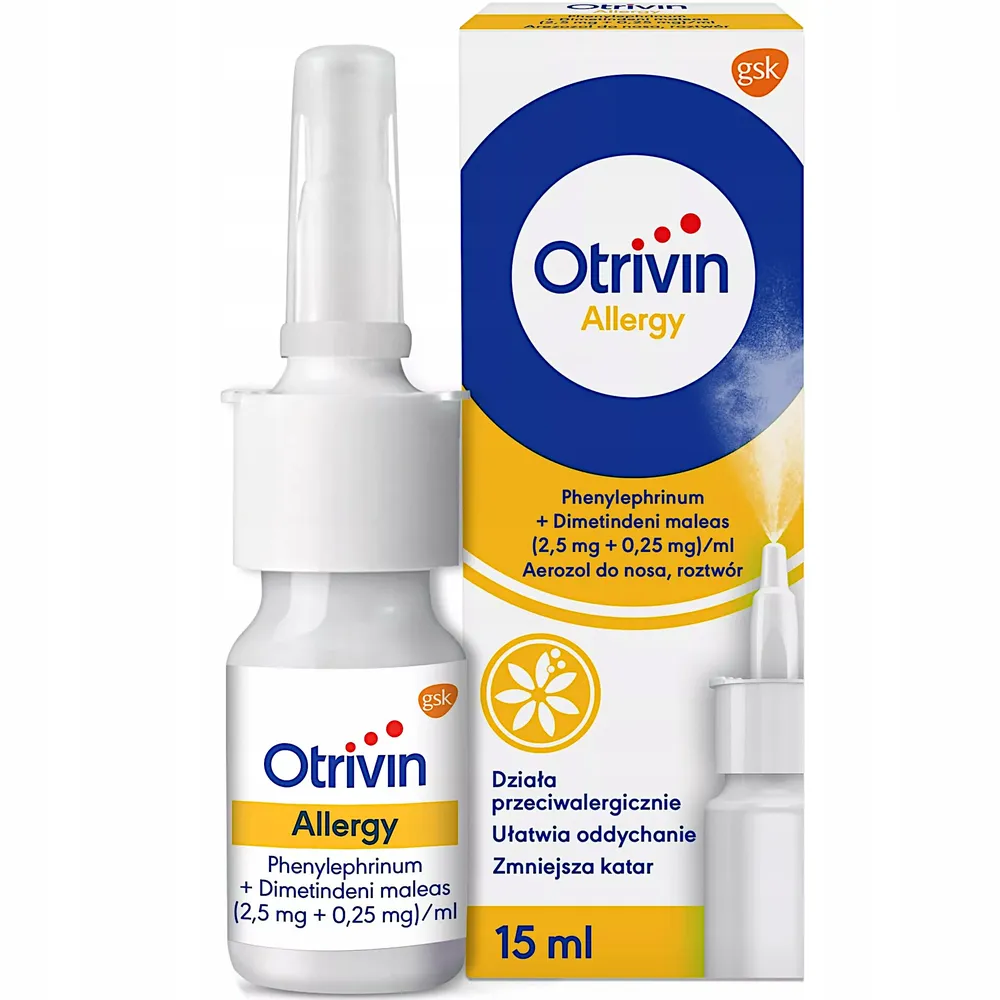
Table of Contents
Patient Information Leaflet
Otrivin Allergy
(2.5 mg + 0.25 mg)/ml, nasal spray, solution
Phenylephrinum + Dimetindeni maleas
Please read the entire leaflet carefully before using the medicine, as it contains
important information for the patient.
This medicine should always be used exactly as described in this patient leaflet or as directed by a
physician or pharmacist.
- Keep this leaflet for future reference.
- If you need advice or further information, consult your pharmacist.
- If you experience any adverse reactions, including any not listed in this leaflet, inform your doctor or pharmacist. See section 4.
- If there is no improvement after 7 days, or if symptoms worsen, consult your doctor.
Table of Contents
- What Otrivin Allergy is and what it is used for
- Important information before using Otrivin Allergy
- How to use Otrivin Allergy
- Possible side effects
- How to store Otrivin Allergy
- Contents of the pack and other information
1. What Otrivin Allergy is and what it is used for
Otrivin Allergy contains two active substances:
- phenylephrine – which reduces nasal mucosal congestion.
- dimetindene maleate – which inhibits the action of histamine responsible for allergic reactions.
The active substances in Otrivin Allergy help clear the nasal passages and reduce excessive nasal discharge (rhinorrhea), without impairing the function of the cilia in the nasal epithelium. Otrivin Allergy rapidly and effectively reduces nasal mucosal congestion, clears the nasal airway, and facilitates breathing. This medicine is intended for application to the nasal mucosa.
Therapeutic indications
Treatment of symptoms of the common cold, nasal mucosal congestion, acute and chronic rhinitis, seasonal (hay fever) and perennial allergic rhinitis, and vasomotor rhinitis. Supportive treatment in acute and chronic sinusitis, and in otitis media.
Pre- and post-operative care in nasal surgery.
If there is no improvement after 7 days, or if symptoms worsen, consult your doctor.
2. Important information before using Otrivin Allergy
When not to use Otrivin Allergy
- if the patient is allergic to phenylephrine, dexmedetomidine maleate, or any of the other ingredients of this medicine (listed in section 6),
- if the patient has atrophic rhinitis (chronic inflammation of the nasal mucosa with formation of crusts),
- if the patient is currently taking monoamine oxidase inhibitors (medicines used e.g. for depression) or has taken these medicines within the last 14 days. If in doubt whether the medicines being taken belong to the group of monoamine oxidase inhibitors, medical advice should be sought from a doctor or pharmacist before using Otrivin Allergy,
- if the patient has narrow-angle glaucoma,
- in children under 6 years of age.
Warnings and precautions
Before starting to use Otrivin Allergy, consult a doctor:
- if the patient has cardiovascular disease (e.g. coronary heart disease, hypertension);
- if the patient has hyperthyroidism;
- if the patient has diabetes;
- if the patient has benign prostatic hyperplasia, as urinary retention may occur;
- if the patient has epilepsy;
- if the patient is taking antidepressants or medicines used for hypertension (such as beta-blockers); see also section "Otrivin Allergy and other medicines";
- if the patient is hypersensitive to sympathomimetic agents (e.g. epinephrine, ephedrine), manifested by insomnia, dizziness, tremor, cardiac arrhythmias or increased blood pressure.
Consult a doctor before using Otrivin Allergy, even if
the above warnings refer to conditions that occurred in the past.
Otrivin Allergy should not be used for longer than 7 consecutive days. If symptoms persist,
consult a doctor. Prolonged use beyond the recommended period may lead to nasal mucosal hyperemia and recurrence or worsening of symptoms.
Do not use a higher dose than recommended. Overuse, especially in young children and elderly people (over 65 years of age), may lead to systemic adverse effects.
Use the lowest effective dose for the shortest possible duration.
Do not exceed the stated number of doses or recommended dosing frequency.
Children and adolescents
Otrivin Allergy is not recommended for use in children under 6 years of age.
For children aged 6 to 12 years, the medicine should be used under adult supervision.
Otrivin Allergy and other medicines
Inform your doctor or pharmacist about all medicines currently used, recently used, or planned to be used.
Before using Otrivin Allergy, consult a doctor if the patient is currently taking or has recently taken the following medicines:
- monoamine oxidase inhibitors (medicines used e.g. for depression); see section "When not to use Otrivin Allergy";
- tricyclic and tetracyclic antidepressants (such as imipramine, amitriptyline) or medicines used for hypertension (such as propranolol, atenolol, metoprolol); see section "Warnings and precautions".
Pregnancy and breastfeeding
If the patient is pregnant or breastfeeding, suspects she may be pregnant, or is planning to become pregnant, she should consult a doctor or pharmacist before using this medicine.
Do not use during pregnancy and breastfeeding.
Driving and operating machinery
This medicine does not affect the ability to drive or operate machinery.
Otrivin Allergy contains benzalkonium chloride
The medicine contains 0.1 mg of benzalkonium chloride per ml of solution. Benzalkonium chloride may cause irritation or swelling inside the nose, especially if used for prolonged periods.
Otrivin Allergy contains fragrance from lavender oil (geraniol, linalool,
coumarin, and limonene)
May cause allergic reactions.
3. How to use Otrivin Allergy
This medicine should always be used exactly as described in this patient information leaflet or as directed by a doctor. If in doubt, consult a doctor or pharmacist.
Otrivin Allergy is for nasal use only (including in cases of middle ear inflammation).
Otrivin Allergy should be used after thorough cleansing of the nasal passages.
For hygienic reasons, the medicine container should be used by only one patient.
Children under 6 years of age
Use of this medicine is not recommended.
Children aged 6 to 12 years (under adult supervision)
1 to 2 doses into each nostril 3 to 4 times daily.
Adults and children over 12 years of age
1 to 2 doses into each nostril 3 to 4 times daily; the last dose should preferably be taken shortly before bedtime.
Otrivin Allergy should not be used for longer than 7 consecutive days. If symptoms persist, consult a doctor.
Otrivin Allergy must not be used in children under 6 years of age.
Instructions for use:
- Remove the protective cap.
- Before first use, press the pump several times until the spray functions. The spray is then ready for use.
- Take care to avoid spraying the medicine into the eyes.
- Insert the nozzle into the nostril, firmly press the pump, and then remove it from the nostril without releasing pressure. Optimal spray delivery occurs when administered during a gentle nasal inhalation.
- After use, clean the nozzle and immediately replace the protective cap.
- To minimize the potential spread of infection, the medicine container should be used by only one patient.
The bottle containing 10 or 15 ml of medicine is equipped with a metered-dose pump delivering a defined amount of active substances per dose, thus eliminating the risk of accidental overdose.
Use in children
Otrivin Allergy is not recommended for use in children under 6 years of age.
In children aged 6 to 12 years, Otrivin Allergy should be used under adult supervision.
Overdose of Otrivin Allergy
If more medicine has been used than recommended, contact a doctor immediately.
The following symptoms may occur: fatigue, abdominal pain, increased heart rate, elevated blood pressure, restlessness, insomnia, pallor, nausea, vomiting, tremors, dizziness.
Gastric lavage is usually not necessary. In children aged 6 years, activated charcoal and laxatives should be administered; in older children and adults, administration of large amounts of fluids is usually sufficient.
Further management should follow clinical guidelines or recommendations from a poison control center.
Missed dose of Otrivin Allergy
Do not use a double dose to make up for a missed dose.
If you have any further questions about the use of this medicine, consult a doctor or pharmacist.
4. Possible adverse effects
Like any medicine, Otrivin Allergy can cause adverse effects, although they do not occur in everyone.
Adverse effects occur rarely ( less frequently than in 1 out of 1,000 people using the medicine ):
nasal discomfort, dryness of the nose, nosebleeds, burning sensation at the application site.
Reporting of adverse effects
If any adverse effects occur, including those not listed in this leaflet, tell your doctor or pharmacist. Adverse effects can be reported directly to the Department of Monitoring Adverse Drug Reactions at the Office for Registration of Medicinal Products, Medical Devices and Biocidal Products,
Al. Jerozolimskie 181C, 02-222 Warsaw
tel: + 48 22 49 21 301
fax: + 48 22 49 21 309
Website: https://smz.ezdrowie.gov.pl
Adverse effects may also be reported to the marketing authorization holder.
Reporting adverse effects helps to provide more information on the safety of the medicine.
5. How to store Otrivin Allergy
Bottle made of LDPE containing 10 ml of solution:
Store below 30°C. Protect from light.
Bottle made of HDPE containing 15 ml of solution:
Store below 25°C. Protect from light.
Shelf life after first opening: 6 months.
Keep the medicine out of the sight and reach of children.
Do not use this medicine after the expiry date stated on the packaging. The expiry date refers to the last day of the stated month.
Medicines must not be disposed of via the sewage system or household waste. Ask your pharmacist how to dispose of medicines no longer required. This will help protect the environment.
6. Contents of the pack and other information
What Otrivin Allergy contains
- The active substances in this medicine are phenylephrine and dimetindene maleate. One ml of solution contains 2.5 mg of phenylephrine and 0.25 mg of dimetindene maleate. One dose contains 0.3536 mg of phenylephrine and 0.0354 mg of dimetindene maleate.
- The other ingredients are: benzalkonium chloride, anhydrous sodium hydrogen phosphate, citric acid monohydrate, sorbitol, de-terpenated lavender oil (containing, among others, geraniol, linalool, coumarin, limonene), purified water.
What Otrivin Allergy looks like and contents of the pack
Otrivin Allergy is an aerosol nasal spray.
The pack contains 10 ml or 15 ml of solution.
Marketing Authorisation Holder:
Haleon Poland Sp. z o.o.
ul. Rzymowskiego 53
02-697 Warsaw
tel. 800 702 849
Importer:
Haleon Germany GmbH
Barthstrasse 4
80339 Munich
Germany