Otinum
Poland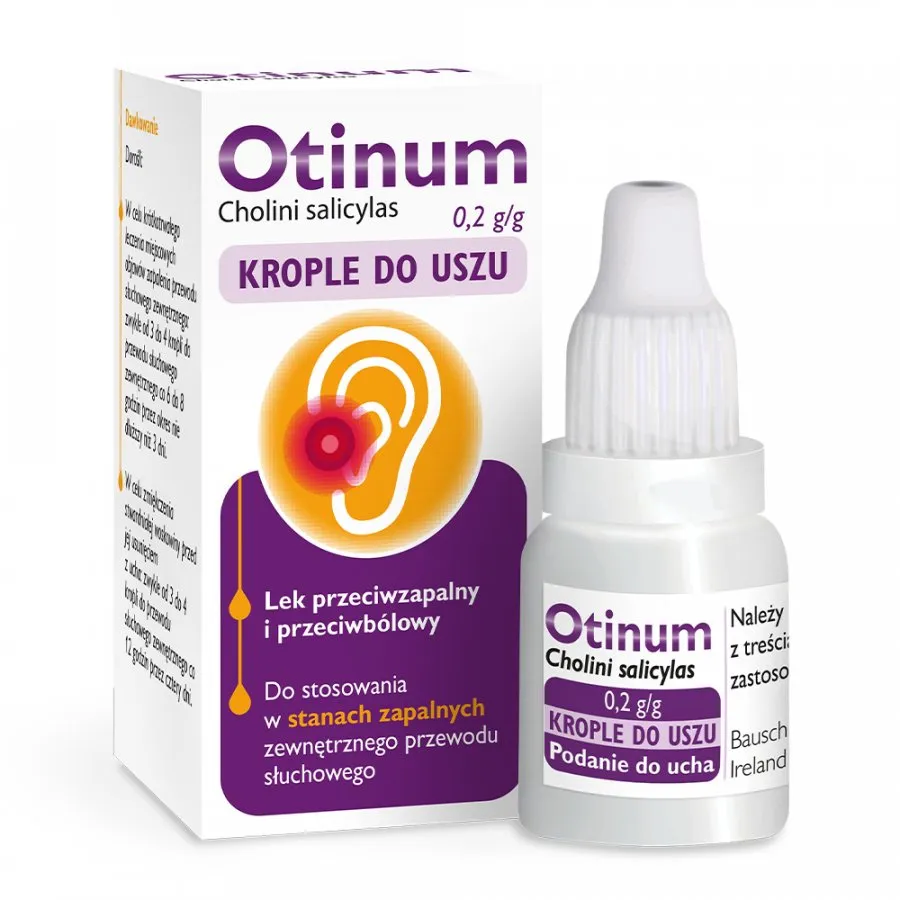
Table of Contents
Patient Information Leaflet: Information for the User
Warning! Keep this leaflet! Information on the immediate packaging in a foreign language.
Otinum
0.2 g/g (200 mg/g), ear drops, solution
Choline salicylate
Please read this leaflet carefully before using this medicine, as it contains important
information for you.
- This medicine should always be used exactly as described in this patient leaflet or as directed by your doctor.
- Keep this leaflet so that you can read it again if necessary.
- If you need advice or further information, please consult your pharmacist.
- If you experience any adverse reactions, including any possible side effects not listed in this leaflet, inform your doctor or pharmacist. See section 4.
- If there is no improvement after 3 days of treatment, or if you feel worse, consult your doctor.
Table of contents:
- What Otinum is and what it is used for
- Important information before using Otinum
- How to use Otinum
- Possible side effects
- How to store Otinum
- Contents of the pack and other information
1. What Otinum is and what it is used for
Otinum is a medicine indicated for short-term use in inflammatory conditions of the external
auditory canal associated with pain, itching, and redness.
It is also recommended for softening earwax prior to irrigation of the external auditory canal.
The active substance in Otinum ear drops is choline salicylate, a derivative of salicylic acid.
When applied locally, choline salicylate has analgesic and anti-inflammatory properties. Therefore, it reduces pain and inflammation associated with external otitis.
Glycerol contained in the medicine softens earwax, facilitating its removal.
When administered locally into the ear, the medicine does not produce systemic effects.
2. Important information before using Otinum
When not to use Otinum
- if the patient is allergic (hypersensitive) to the active substance (choline salicylate), other salicylates (e.g. acetylsalicylic acid/aspirin), or to any of the other ingredients of this medicine (listed in section 6);
- if the patient has bleeding or discharge from the ear;
- if the patient experiences severe ear pain accompanied by hearing loss;
- if the patient has previously been diagnosed with a perforated eardrum (rupture or discontinuity of the eardrum);
- in individuals under 18 years of age.
Signs suggestive of eardrum perforation include: acute ear pain (gradually decreasing), tinnitus (which may indicate damage to deeper ear structures), hearing loss, vertigo, and/or ear discharge. Causes of eardrum damage (perforation) include: infections, trauma (e.g. due to improper ear cleaning with cotton swabs), and medical procedures (e.g. improper ear irrigation due to cerumen impaction).
Warnings and precautions
Any ear pain should prompt consultation with a physician.
Otinum may be used temporarily, without prior medical consultation, for the treatment of external auditory canal inflammation, but not for longer than 3 days. If there is no improvement or if symptoms worsen despite using Otinum at the recommended doses for 3 days, medical advice should be sought.
If additional symptoms appear, indicating a developing disease (e.g. fever, malaise, fatigue, vertigo, ear discharge), the patient should contact a physician.
In case of recurrent episodes, the decision to use Otinum should be made by a physician.
Otinum may mask symptoms of other ear diseases and may hinder or delay their correct diagnosis.
The physician should be informed about the use of this medicine.
Otinum contains a preservative – chlorobutanol.
Otinum must not be used contrary to the indications listed in the leaflet or by alternative routes of administration (e.g. orally, on open wounds, especially within the auricle, or into the eyes).
Otinum and other medicines
Inform the physician or pharmacist about all medicines currently used or recently used, as well as any medicines the patient plans to use, including those available without a prescription.
Otinum is applied topically and does not exhibit systemic effects.
Concomitant use with non-steroidal anti-inflammatory drugs (e.g. aspirin, ibuprofen) may enhance local effects.
Pregnancy and breastfeeding
If the patient is pregnant or breastfeeding, suspects she may be pregnant, or is planning to become pregnant, she should consult a physician or pharmacist before using this medicine.
Driving and operating machinery
Otinum does not affect the ability to drive motor vehicles or operate machinery.
3. How to use Otinum
This medicine should always be used exactly as described in this patient leaflet or as directed by a doctor or pharmacist. If in doubt, consult a doctor or pharmacist.
Otinum is for topical use in the ear only.
Otinum is intended for use in adults only.
If you feel that the effect of Otinum is too strong or too weak, consult your doctor.
Recommended dosage:
- For short-term treatment of local symptoms of acute external otitis: usually 3 to 4 drops into the external ear canal every 6 to 8 hours. Otinum should not be used for longer than 3 days without medical advice.
- To soften hardened earwax prior to its removal: usually 3 to 4 drops into the external ear canal every 12 hours for four days.
Elderly patients: No dosage adjustment is necessary.
Patients with hepatic and/or renal impairment:
No dosage adjustment is necessary.
Instructions for administering Otinum:
- Wash your hands and then unscrew the cap from the bottle.
- Tilt your head or lie on your side so that the affected ear faces upward.
- Gently pull the earlobe (the lower part of the auricle) away from the neck.
- Turn the opened Otinum bottle upside down and, by gently squeezing it on both sides, instill 3–4 drops of the medicine into the affected ear.
- Keep your head tilted for several minutes to allow the drops to flow into the ear canal.
- Wipe away any excess liquid with a clean tissue.
- Screw the cap back onto the Otinum bottle.
Additional tips for administering Otinum:
- Having another person assist with instilling the drops or using a mirror may make administration easier.
- Take care to avoid getting water into the ear that has already been treated with the medicine.
- Do not share Otinum with other people.
Use of a higher than recommended dose of Otinum
Overdose is not possible when the medicine is administered into the ear.
Symptoms of overdose that may occur after accidental oral ingestion include:
confusion, dizziness, excessive sweating, vomiting, tinnitus, and abnormally rapid breathing (hyperventilation). Following ingestion of very large oral doses, disturbances of the central nervous system may occur, leading to respiratory and circulatory disturbances.
In case of accidental oral ingestion, seek immediate medical attention.
Missed dose of Otinum
If you miss a dose at the scheduled time, use it as soon as possible.
However, if it is almost time for the next dose, skip the missed dose.
Do not use a double dose to make up for a missed dose.
4. Possible adverse effects
Like all medicines, this medicine can cause adverse effects, although they do not occur in everyone.
The frequency of occurrence of the adverse effects listed below is unknown (cannot be determined
from the available data).
Local hypersensitivity reactions (skin redness and itching).
In individuals with perforation of the tympanic membrane, use of this medicine may lead to hearing damage.
Reporting of adverse effects
If any adverse effects occur, including any adverse effects not listed in this leaflet, inform a doctor or pharmacist. Adverse effects can be reported directly to the Department of Monitoring Adverse Drug Reactions of the Office for Registration of Medicinal Products, Medical Devices and Biocidal Products, Al. Jerozolimskie 181C, 02-222 Warsaw, phone: +48 22 49 21 301, fax: +48 22 49 21 309, website: https://smz.ezdrowie.gov.pl.
Reporting adverse effects allows further information on the safety of the medicine to be collected.
5. How to store Otinum
Keep this medicine out of sight and reach of children.
Store below 25°C.
Do not use this medicine after the expiry date stated on the immediate packaging and
the cardboard box. The expiry date refers to the last day of the stated month.
Medicines must not be disposed of via wastewater or household waste. Ask your
pharmacist how to dispose of medicines no longer required. This will help protect
the environment.
6. Contents of the package and other information
What Otinum contains
- The active substance is choline salicylate. 1 g of drops contains 200 mg of choline salicylate.
- The other ingredients are: glycerol, 96% ethanol, chlorobutanol, purified water.
What Otinum looks like and contents of the pack
The medicine is packed in a polyethylene bottle with a dropper, with a capacity of 10 g, placed in a cardboard box. The package contains 10 g of medicine.
For further detailed information, please contact the responsible party or the parallel importer.
Responsible entity in Latvia, country of export:
SIA Meda Pharma
Mūkusalas 101
Riga LV-1004
Latvia
Manufacturer:
ICN Polfa Rzeszów S.A.
Przemysłowa 2 Street
35-959 Rzeszów
Poland
Parallel importer:
InPharm Sp. z o.o.
Strumykowa 28/11 Street
03-138 Warsaw
Repackaged in:
InPharm Sp. z o.o. Services sp. k.
Chełmżyńska 249 Street
04-458 Warsaw
Marketing authorization number in Latvia, country of export: 96-0162
Parallel import authorization number: 228/17