Ostenil 70
Poland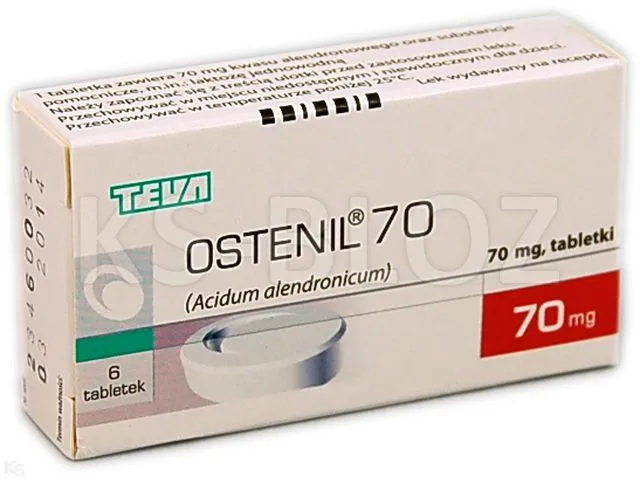
Table of Contents
Patient Information
OSTENIL 70, 70 mg, tablets
(Acidum alendronicum)
Please read this leaflet carefully before taking the medicine, as it contains important information for the patient.
- Keep this leaflet so that you can read it again if necessary.
- If you have any doubts, please consult your doctor, pharmacist, or nurse. This medicine has been prescribed for a specific individual. Do not give it to others.
- The medicine may harm another person, even if their symptoms are the same as yours.
- If you experience any adverse reactions, including any possible adverse reactions not listed in this leaflet, inform your doctor or pharmacist. See section 4.
Table of contents of the leaflet:
- What is Ostenil 70 and what is it used for
- Important information before taking Ostenil 70
- How to take Ostenil 70
- Possible side effects
- How to store Ostenil 70
- Contents of the pack and other information
1. WHAT IS OSTENIL 70 AND WHAT IS IT USED FOR
Ostenil 70 tablets contain alendronic acid as the active substance, 70 mg.
Alendronic acid is an aminobisphosphonate that strongly inhibits the resorption of bone tissue by osteoclasts (bone-resorbing cells). The effect of this action is a gradual increase in bone mass and a reduction in fracture risk.
Alendronate is indicated for the treatment of osteoporosis in postmenopausal women to reduce the risk of vertebral and hip fractures, and for the treatment of osteoporosis in men to reduce the risk of fractures in the spine and hip.
2. IMPORTANT INFORMATION BEFORE USING OSTENIL 70
When not to use Ostenil 70
- if the patient is allergic (hypersensitive) to the active substance or to any of the other ingredients of Ostenil 70
- if the patient has esophageal disorders causing delayed emptying, such as strictures, ulcers, or pyloric spasm
- in patients unable to maintain an upright position (standing or sitting) for at least 30 minutes
- in patients with low serum calcium levels.
Warnings and precautions
Before starting treatment with Ostenil 70, discuss this with your doctor or pharmacist.
Alendronate may cause local irritation of the upper gastrointestinal mucosa. Caution should be exercised when administering the drug to patients with swallowing difficulties, esophageal disorders, gastritis and/or duodenitis, peptic ulcers, or in individuals who have had serious gastrointestinal diseases within the past year, such as gastric and/or duodenal ulcer, active gastrointestinal bleeding, or upper gastrointestinal surgery other than pyloroplasty, as these conditions may worsen adverse effects.
Esophageal adverse events, including esophagitis, ulcers, and erosions, have been reported in patients taking alendronate; esophageal strictures have been reported rarely. Some of these adverse events have been severe and required hospitalization. Therefore, the physician should carefully monitor the patient for possible esophageal adverse effects. If symptoms of esophageal irritation occur, such as dysphagia (difficulty swallowing), pain on swallowing, or retrosternal pain, or if heartburn develops or worsens, the patient should consult a doctor, who will decide whether to discontinue the medication. Failure to follow medical advice may increase the risk of esophageal disorders.
It is important to inform the doctor before using this medicine if the patient has been diagnosed with Barrett’s esophagus (a condition involving changes in the cells lining the lower part of the esophagus).
The drug is not recommended in patients with severe renal impairment (creatinine clearance < 35 ml/min).
Before starting treatment, disturbances in calcium metabolism and vitamin D deficiency should be corrected.
During treatment of postmenopausal osteoporosis with this medicine, bone density measurements are recommended every 1–2 years to assess treatment efficacy, and serum calcium levels should be monitored every 6–12 months (this value should increase during treatment).
A slight, asymptomatic decrease in serum calcium and phosphate levels may occur, particularly in patients taking glucocorticosteroids, in whom calcium absorption may be impaired.
Ensuring adequate intake of calcium and vitamin D is especially important in patients receiving glucocorticosteroids.
The medicine should not be given to children due to lack of data on the use of sodium alendronate in pediatric patients.
Bone, joint, and/or muscle pain has been observed in patients taking bisphosphonates.
Symptoms may appear as early as the first day of treatment and/or several months after starting treatment. In most patients, symptoms resolved after discontinuation of treatment. Recurrence of symptoms may occur upon re-exposure to the same drug or after using another bisphosphonate.
Rare cases of severe skin reactions, including Stevens-Johnson syndrome and toxic epidermal necrolysis, have been reported after the drug was placed on the market.
Osteonecrosis of the jaw, usually associated with tooth extraction and/or local infection (including osteomyelitis), has been reported in cancer patients receiving intravenous bisphosphonate regimens. Many of these patients were also receiving chemotherapy and corticosteroids. Osteonecrosis of the jaw has also been reported in osteoporosis patients taking oral bisphosphonates.
In patients with concomitant risk factors (e.g. cancer, chemotherapy, radiotherapy, corticosteroid treatment, poor oral hygiene), the physician should consider performing dental examinations and appropriate dental prophylaxis before initiating bisphosphonate therapy.
If possible, such patients should avoid invasive dental procedures during treatment. The physician’s clinical assessment should be based on an individualized evaluation of the risk-benefit ratio for each patient.
Ostenil 70 and other medicines
Inform your doctor about all medicines you are currently taking or have recently taken, including those available without a prescription.
Medicines that neutralize gastric acid reduce the absorption and effectiveness of alendronate. Therefore, after taking alendronate, the patient should wait at least 30 minutes before taking any other oral medication.
Alendronate has a high affinity for calcium and other divalent and trivalent cations.
- Binding with these ions reduces the absorption and effectiveness of the drug. Concurrent use of alendronate with acetylsalicylic acid and other salicylates (including mesalazine and benorylate) increases the risk of damage to the upper gastrointestinal tract, particularly gastric ulceration. When alendronate is used concomitantly with hormone replacement therapy (medicines containing estrogen or a combination of estrogen with progestogen derivatives), a significant increase in bone mass and a reduction in bone turnover have been observed compared to monotherapy with either treatment alone. It has also been found that the safety and tolerability of combined therapy are comparable to monotherapy. Based on the assessment of the effect of sodium alendronate on protein binding, renal excretion, and metabolism of other drugs, no other clinically significant interactions are expected.
Since the use of NSAIDs is associated with irritation of the gastrointestinal mucosa, caution should be exercised when using them concomitantly with Ostenil 70.
Using Ostenil 70 with food and drink
Food and beverages (including mineral water, and especially those containing caffeine) reduce the absorption and effectiveness of alendronate.
Use of Ostenil 70 in patients with kidney function disorders
The drug is not recommended in patients with severe renal impairment (creatinine clearance < 35 ml/min).
Children and adolescents
Ostenil 70 should not be given to children and adolescents.
Pregnancy and breastfeeding
If the patient is pregnant, breastfeeding, suspects she may be pregnant, or is planning to have a child, she should consult her doctor before using the medicine.
Pregnancy
Ostenil 70 should not be given to pregnant women.
Breastfeeding
Ostenil 70 should not be used in women who are breastfeeding.
Driving and operating machinery
Some adverse effects caused by Ostenil 70 (including blurred vision, dizziness, bone, muscle, or joint pain) may affect the patient’s ability to drive or operate machinery. Individual patient response to Ostenil 70 may vary (see section 4 Possible side effects).
Important information about certain ingredients of Ostenil 70
If the patient has previously been diagnosed with intolerance to certain sugars, the patient should consult a doctor before taking the medicine.
3. HOW TO USE OSTENIL 70
Ostenil 70 should always be used exactly as directed by the physician. If in doubt, consult your doctor or pharmacist again.
The recommended dose for postmenopausal osteoporosis in women is 70 mg (1 tablet) once weekly. Choose one day of the week and always take the medicine on that same day each week.
Ostenil 70 should be taken orally, half an hour before the first meal, drink, or intake of other medications, with a full glass of boiled water. Other beverages (including mineral water), food, and medications may reduce the absorption of the drug.
To facilitate the passage of the tablet into the stomach and to reduce the risk of local irritation in the esophagus and other adverse effects, the following instructions should be observed:
- Swallow Ostenil 70 in the morning, after getting up from bed, with a full glass of boiled water (not less than 200 ml). Do not use mineral water, coffee, or tea.
- The tablet should be taken before the first meal.
- The tablet must be swallowed whole. Do not crush, chew, or allow the tablet to dissolve in the mouth, due to the risk of oral ulceration.
- After swallowing the tablet, the patient should not lie down until after taking the first meal, which should be consumed no earlier than 30 minutes after swallowing the tablet.
- The patient should remain in an upright position for at least 30 minutes after taking the medicine.
- Ostenil 70 should not be taken immediately before going to bed or right after waking up in the morning before getting out of bed.
- After swallowing the tablet, the patient should avoid lying down for at least 30 minutes.
Patients with osteoporosis should ensure adequate dietary intake of calcium and vitamin D.
In elderly patients (over 65 years of age), in patients with mild to moderate renal impairment (creatinine clearance from 35 to 60 ml/min), and in patients with hepatic dysfunction, dosage adjustment is not required.
Patients should be informed that if a dose is missed, it should be taken the following morning. Do not take a double dose on the same day to make up for a missed dose. Return to the regular dosing schedule of Ostenil 70 and take only one dose.
Studies on the use of Ostenil 70 in patients with glucocorticoid-induced osteoporosis have not been conducted.
Overdose of Ostenil 70
Overdose may lead to decreased serum calcium levels, decreased serum phosphate levels, and disturbances in the upper gastrointestinal tract (esophagitis, gastritis, or gastric mucosal ulceration with associated burning pain, nausea, vomiting, and a feeling of fullness in the epigastrium).
Milk or calcium-containing antacids should be administered to bind alendronate. Due to the risk of esophageal irritation, vomiting should not be induced, and the patient should remain in an upright position.
Missed dose of Ostenil 70
If a dose of Ostenil 70 is missed, the missed tablet should be taken the following morning. Then continue with the regular weekly dosing schedule, taking one tablet on the previously chosen day of the week. Do not take a double dose to make up for the missed dose.
If you have any doubts regarding the use of this medicine, consult your doctor or pharmacist.
4. POSSIBLE ADVERSE REACTIONS
Like all medicines, Ostenil 70 may cause adverse reactions, although not everyone experiences them.
In clinical trials, the drug was well tolerated. Adverse effects were usually mild in nature and did not lead to the need to discontinue treatment.
Frequency scale of adverse reactions:
- Very common – more than 1 in 10 patients
- Common – 1 to 10 in 100 patients
- Uncommon – 1 to 10 in 1,000 patients
- Rare – 1 to 10 in 10,000 patients
- Very rare – less than 1 in 10,000 patients
- Not known – frequency cannot be estimated from available data
If any of the following adverse symptoms occur, stop using Ostenil 70 and contact your doctor as quickly as possible:
- Difficulty or pain when swallowing
- New onset or worsening of heartburn
- Retrosternal pain
Very common
- Muscle, bone or joint pain, sometimes severe
Common
- Stomach pain or discomfort, indigestion, constipation, diarrhoea, bloating with gas passage, oesophageal ulceration, difficulty swallowing, feeling of fullness or bloating in the stomach
- Headache, dizziness
- Joint swelling, swelling of hands and feet
- Itching, hair loss
- Fatigue
Uncommon
- Irritation and ulceration of the oesophagus, nausea or vomiting, tarry and (or) bloody stools
- Skin rash, skin reactions, itching and redness of the skin
- Changes in taste perception
- Eye inflammation (usually painful)
- Transient symptoms (muscle pain, malaise and rarely fever) at the beginning of treatment
Rare
- Allergic reactions which may include (pinkish, itchy swellings on the skin, also known as urticaria or rash; swelling of the face, lips, mouth, tongue or throat, which may cause difficulty in swallowing or breathing)
- Rash that worsens with exposure to sunlight, hair loss
- Transient influenza-like symptoms (muscle weakness, malaise and rarely fever), usually occurring at the beginning of treatment
- Oesophageal stricture, symptoms resembling peptic ulcer disease, sometimes severe, including bleeding
- Ulceration of the oral and (or) pharyngeal mucosa occurred when tablets were chewed or sucked
- Jaw bone necrosis (osteonecrosis)
- Severe bone, muscle or joint pain
Very rare
- Severe skin reactions known as Stevens-Johnson syndrome and toxic epidermal necrolysis. These are serious conditions characterized by blistering of the skin, lips, oral mucosa, eyes, genital areas and anus.
- If a patient experiences ear pain, ear discharge and (or) ear infection, they should inform their doctor. These may be symptoms of bone tissue damage in the ear.
After marketing authorization, the following adverse reactions have been reported with unknown frequency:
- Nervous system: dizziness, changes in taste perception
- Muscles and bones: joint swelling
- General disorders: fatigue, swelling of hands and feet
In rare cases, atypical femoral fractures may occur, particularly in patients on long-term treatment for osteoporosis. Patients should consult their doctor if they experience pain, weakness or discomfort in the thigh, hip or groin area, as this may be an early sign of an impending femoral fracture.
Ostenil 70 may affect blood calcium and phosphate levels. To monitor these, your doctor may recommend regular blood count tests during treatment.
In rare cases, atypical femoral fractures may occur, particularly in patients on long-term treatment for osteoporosis. Patients should consult their doctor if they experience pain, weakness or discomfort in the thigh, hip or groin area, as this may be an early sign of an impending femoral fracture.
If any of the adverse effects worsen or if any adverse effects not listed in this leaflet occur, inform your doctor or pharmacist.
Reporting of adverse reactions
If any adverse reactions occur, including those not listed in this leaflet, inform your doctor or pharmacist. Adverse reactions can be reported directly to the Department of Monitoring Adverse Drug Reactions, Office for Registration of Medicinal Products, Medical Devices and Biocidal Products
Al. Jerozolimskie 181C, 02-222 Warsaw
Tel.: +48 22 49 21 301
Fax: +48 22 49 21 309
Website: https://smz.ezdrowie.gov.pl
Adverse reactions can also be reported to the marketing authorization holder.
Reporting adverse reactions helps provide more information on the safety of the medicine.
5. HOW TO STORE OSTENIL 70
Store below 25°C.
Keep out of the reach and sight of children.
Do not use the medicine after the expiry date stated on the packaging. The expiry date refers to the last day of the specified month.
Medicines must not be disposed of via wastewater or household waste. Ask your pharmacist what to do with medicines no longer required. This will help protect the environment.
6. CONTENTS OF THE PACKAGE AND OTHER INFORMATION
What Ostenil 70 contains
- The active substance is alendronic acid.
- The other ingredients are microcrystalline cellulose, lactose monohydrate, colloidal silicon dioxide anhydrous, magnesium stearate.
What Ostenil 70 looks like and contents of the pack
Tablets.
1 blister containing 4 tablets (4 tablets) in a cardboard box;
1 blister containing 6 tablets (6 tablets) in a cardboard box.
Marketing Authorisation Holder and Manufacturer
Marketing Authorisation Holder
Teva Pharmaceuticals Polska Sp. z o.o.
ul. Emilii Plater 53
00-113 Warszawa
Poland
Tel: (022) 345 93 00
Manufacturer
Teva Operations Poland Sp. z o.o.
ul. Mogilska 80
31-546 Kraków
Poland