Orofar max
Poland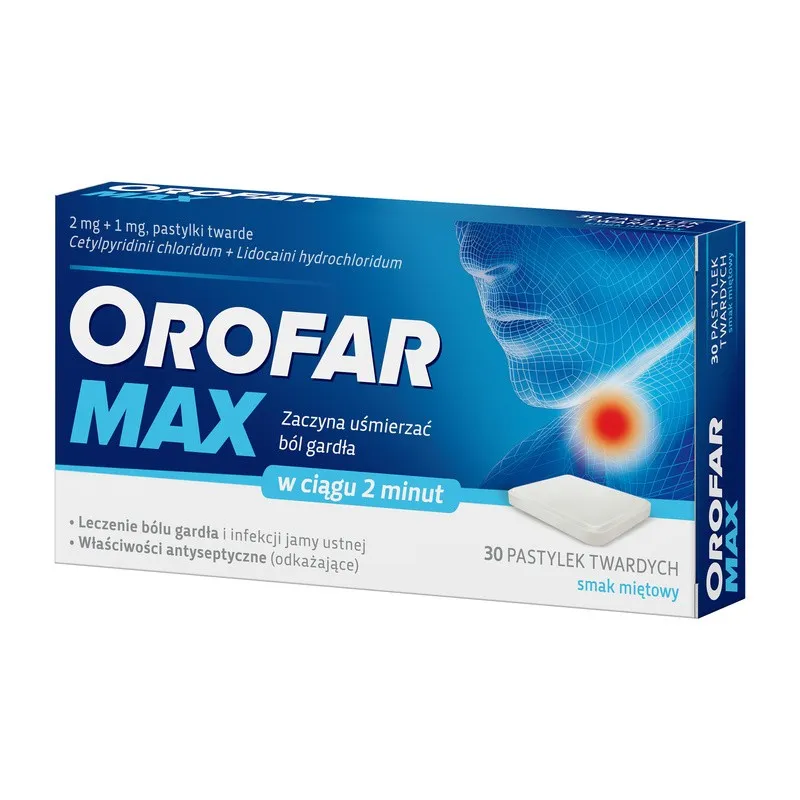
Table of Contents
Package leaflet: Information for the user
Orofar MAX, 2 mg + 1 mg, hard pastilles
Cetylpyridinium chloride + Lidocaine hydrochloride
Please read all of this leaflet carefully before taking this medicine, because it contains
important information for you.
This medicine should always be taken exactly as described in this patient leaflet or as directed by
your doctor or pharmacist.
- Keep this leaflet, so that you can read it again if necessary.
- If you need advice or further information, please consult your pharmacist.
- If you experience any adverse reactions, including any adverse reactions not listed in this leaflet, inform your doctor or pharmacist. See section 4.
- If there is no improvement after 5 days, or if you feel worse, you should contact your doctor.
Contents of the leaflet:
- What Orofar MAX is and what it is used for
- Important information before using Orofar MAX
- How to take Orofar MAX
- Possible side effects
- How to store Orofar MAX
- Contents of the pack and other information
1. What Orofar MAX is and what it is used for
Orofar MAX contains two active substances:
- Cetylpyridinium chloride – an antiseptic agent with bactericidal, antifungal and antiviral properties.
- Lidocaine hydrochloride – an anaesthetic agent that relieves pain.
Orofar MAX is used locally to treat sore throat and inflammatory conditions of the oral cavity.
The medicine has antiseptic properties and relieves pain and irritation associated with these conditions.
Pain-relieving action begins within two minutes after taking Orofar MAX.
2. Information before using Orofar MAX
When not to use Orofar MAX
- if the patient is allergic to cetylpyridinium chloride, lidocaine hydrochloride, other local anaesthetics from the amide group, or to any of the other ingredients of this medicine (listed in section 6).
Warnings and precautions
Before starting to use Orofar MAX, consult a doctor or
pharmacist if:
- sore throat persists for several days and the patient has fever
- sore throat persists after 5 days of treatment or is accompanied by high fever, dizziness, or vomiting.
Local anaesthetics may cause temporary swallowing difficulties and increase the
risk of choking.
Use the lowest effective dose for the shortest possible duration.
Do not exceed the recommended dose or dosing frequency.
Do not use together with other antiseptic agents.
Orofar MAX is intended for short-term use only, for a maximum of 5 consecutive days.
Exercise caution and consult a doctor or pharmacist if the patient has injuries or lesions in the oral cavity or throat, such as abrasions, wounds, or actively bleeding sores.
Keep the medicine out of sight and reach of children.
Children
Orofar MAX should not be used in children under 6 years of age.
Orofar MAX and other medicines
Inform the doctor or pharmacist about all medicines currently taken or recently used, as well as any medicines the patient intends to use.
Orofar MAX with food, drink, and alcohol
Orofar MAX should not be taken during or immediately before eating or drinking. The medicine may cause temporary swallowing difficulties and increase the risk of choking. Avoid eating or drinking until the numbness has subsided.
Avoid consuming alcohol simultaneously, as it increases the absorption of cetylpyridinium chloride, which may lead to overdose.
Some ingredients in toothpastes may reduce the effectiveness of cetylpyridinium chloride. Therefore, do not use this medicine immediately before or after brushing teeth.
Pregnancy and breastfeeding
If the patient is pregnant or breastfeeding, suspects she may be pregnant, or is planning to become pregnant, she should consult a doctor before using this medicine.
During pregnancy, Orofar MAX should be used only under medical supervision.
Use of Orofar MAX is not recommended during breastfeeding.
Driving and operating machinery
Orofar MAX has no effect or has a negligible effect on the ability to drive and operate machinery.
Orofar Max contains sorbitol
The medicine contains 1.107 g of sorbitol per hard lozenge.
Sorbitol is a source of fructose. If the patient (or their child) has previously been diagnosed with intolerance to certain sugars or hereditary fructose intolerance, a rare genetic disorder in which the body cannot break down fructose, the patient should consult a doctor before taking the medicine or giving it to a child.
Sorbitol may cause gastrointestinal discomfort and may have a mild laxative effect.
Orofar Max contains peppermint oil
The medicine contains a flavouring agent (peppermint oil) with limonene, which may cause allergic reactions.
3. How to use Orofar MAX
This medicine should always be used exactly as described in this patient leaflet or as directed by a
physician or pharmacist. If you have any doubts regarding the use of Orofar MAX, consult your
physician or pharmacist.
Children aged 6 to 12 years:
1 tablet every 3 to 4 hours depending on the severity of pain; do not use more than 3 tablets per day.
Adults and children over 12 years of age:
Acute inflammation of the mouth and throat: 1 tablet every 1 or 2 hours depending on the severity of pain.
Milder inflammation of the mouth and throat: 1 tablet every 2 to 3 hours depending on the severity of pain.
Do not use more than 6 tablets per day.
Use the lowest effective dose for the shortest possible duration.
Do not exceed the recommended dose or dosing frequency.
Orofar MAX is indicated for short-term use only.
If symptoms persist for more than 5 days or are accompanied by high fever, dizziness, or vomiting,
consult a physician.
Children under 6 years of age:
Orofar MAX should not be used in children under 6 years of age.
Method of administration
The tablet should be slowly sucked in the mouth. Do not chew or swallow it.
Orofar Max should not be taken during or immediately before eating or drinking.
Overdose of Orofar MAX
If more tablets than recommended have been taken, consult a physician or pharmacist immediately.
Due to the low concentration of lidocaine hydrochloride in Orofar Max, poisoning following oral
administration may occur only after ingestion of large quantities of the product.
Accidental ingestion of a large amount of Orofar MAX may cause nausea and vomiting,
dyspnea, cyanosis, asphyxia (oxygen deficiency) due to paralysis of respiratory muscles,
central nervous system depression, hypotension, and coma.
In case of accidental or intentional ingestion of large quantities of Orofar MAX, contact a physician
immediately or go to the nearest hospital for medical assistance.
Treatment should be symptomatic and supportive. Further management should follow clinical
guidelines or recommendations from a poison treatment center.
Missed dose of Orofar MAX
Do not take a double dose to make up for a missed dose.
If you have any further doubts about the use of this medicine, consult your physician or pharmacist.
4. Possible adverse reactions
Like all medicines, this medicine can cause adverse reactions, although not everybody gets them.
You should stop taking this medicine and consult a doctor immediately if any of the following occur:
- allergic reactions, including skin rash or urticaria (itchy, raised rash), swelling of the tongue, lips or oral cavity.
The following adverse reactions may occur during use of this medicine:
Rare (may occur in fewer than 1 in 1,000 people):
- nausea
- irritation of the oral cavity
- irritation of the throat
- allergic reactions, including skin rash or urticaria (itchy, raised rash), swelling of the tongue, lips or oral cavity.
Reporting of adverse reactions
If any adverse effects occur, including any adverse effects not listed in this leaflet, inform your doctor or pharmacist. Adverse reactions can be reported directly to the Department of Monitoring Adverse Drug Reactions of the Office for Registration of Medicinal Products, Medical Devices and Biocidal Products:
Al. Jerozolimskie 181C, 02-222 Warsaw, tel: + 48 22 49 21 301, fax: + 48 22 49 21 309,
Website: https://smz.ezdrowie.gov.pl
Adverse reactions can also be reported directly to the marketing authorization holder.
Reporting adverse reactions helps provide more information on the safety of this medicine.
5. How to store Orofar Max
Keep the medicine out of sight and reach of children.
Do not use Orofar Max after the expiry date stated on the packaging.
The expiry date refers to the last day of the stated month.
Store below 30°C in the original packaging.
Medicines must not be disposed of via wastewater or household waste. Ask your pharmacist how to dispose of medicines no longer required. This helps protect the environment.
6. Contents of the packaging and other information
What Orofar MAX contains
- The active substances in the medicine are cetylpyridinium chloride and lidocaine hydrochloride. Each Orofar MAX tablet contains 2 mg of cetylpyridinium chloride and 1 mg of lidocaine hydrochloride.
- The other ingredients are: peppermint oil from Mentha piperita leaves, Schimmel mint oil (containing, among others, limonene), levomenthol, potassium acesulfame, maize starch, citric acid monohydrate, macrogol 6000, microcrystalline cellulose, magnesium stearate, sorbitol.
What Orofar MAX looks like and contents of the pack
Orofar MAX is available as tablets (white, rectangular tablets) in blisters made of a three-layer foil composed of polyvinyl chloride (PVC)/polyethylene (PE)/polyvinylidene chloride.
The blister is placed in a cardboard box.
Pack sizes: 10, 20 or 30 hard tablets.
Marketing Authorisation Holder
STADA Arzneimittel AG
Stadastrasse 2-18
61118 Bad Vilbel
Germany
Manufacturer/Importer
STADA Arzneimittel AG
Stadastrasse 2-18
61118 Bad Vilbel
Germany
Lusomedicamenta Sociedade Técnica Farmacêutica S.A.
Estrada Consiglieri Pedroso 69-B, Queluz de Baixo
2730-055 Barcarena
Portugal