Orabloc
Poland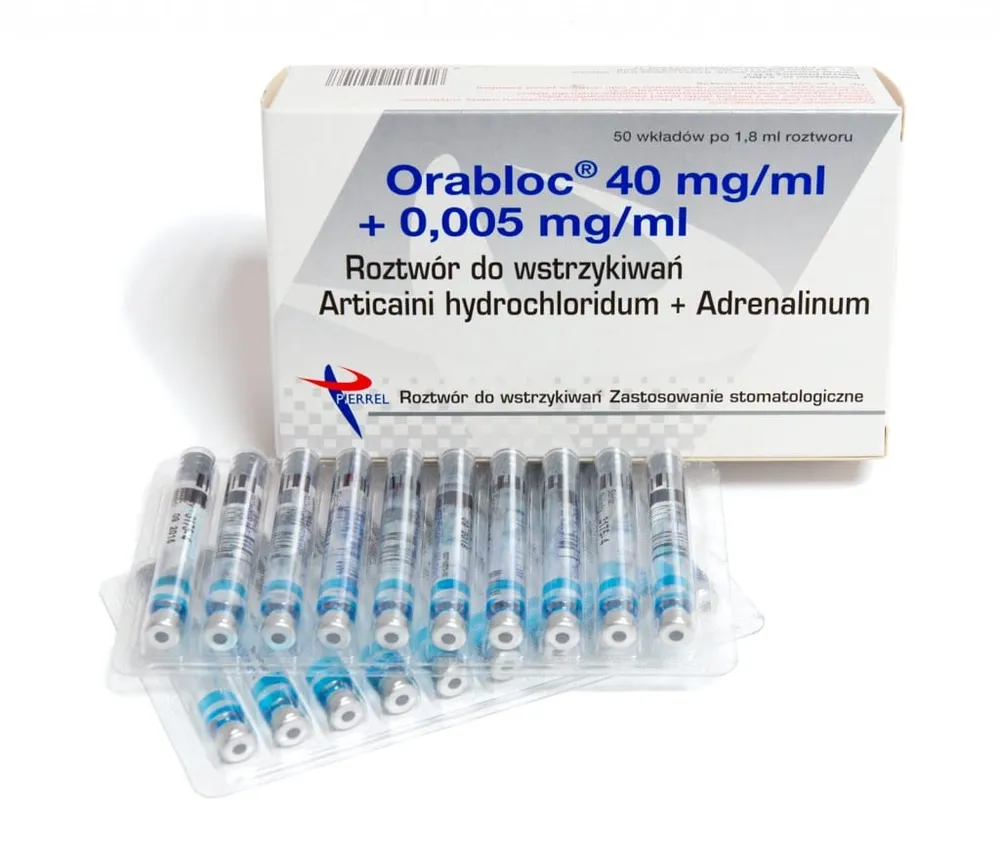
Table of Contents
Package leaflet: Information for the patient
Orabloc, (40 mg + 0.005 mg)/ml, solution for injection
Articaini hydrochloridum + Adrenalinum
Please read all of this leaflet carefully before use, as it contains important information for the patient.
- Keep this leaflet, so that you can read it again if necessary.
- If you have any questions, please consult your doctor, pharmacist, or nurse.
- This medicine has been prescribed for a specific individual. Do not pass it on to others. The medicine may harm another person, even if their symptoms are the same.
- If you experience any adverse reactions, including any not listed in this leaflet, inform your doctor, pharmacist, or nurse. See section 4.
Table of contents
- What Orabloc is and what it is used for
- Important information before using Orabloc
- How to use Orabloc
- Possible side effects
- How to store Orabloc
- Contents of the pack and other information
1. What Orabloc is and what it is used for
Orabloc is a medicine used in dentistry for local anaesthesia.
It contains articaine (a local anaesthetic agent) and adrenaline. Adrenaline
constricts blood vessels, thereby reducing blood flow at the injection site (local ischaemia). This reduces bleeding during the procedure and enhances the local anaesthetic effect.
Orabloc is used for local anaesthesia during dental procedures in adults, adolescents, and children over 4 years of age:
- Simple single or multiple tooth extractions,
- Removal of supragingival and subgingival calculus,
- Crown preparation.
2. Important information before using Orabloc
When not to use Orabloc
- if the patient is allergic to articaine or other local anaesthetics of the amide group, adrenaline, or any of the other ingredients of this medicine (listed in section 6),
- in patients with severe cardiac arrhythmias (e.g. second- or third-degree atrioventricular block),
- if the patient has a very slow heart rate,
- if the patient has acute heart failure (e.g. following a recent myocardial infarction),
- if the patient has very low blood pressure,
- in patients with bronchial asthma and sulfite sensitivity (asthma attacks triggered by sulfites),
- in children under 4 years of age.
Due to its adrenaline content, Orabloc should not be used in the following cases:
- anaesthesia of an area supplied by a single arterial branch only,
- increased intraocular pressure (glaucoma),
- hyperthyroidism,
- paroxysmal tachycardia,
- atrial fibrillation with rapid ventricular response,
- myocardial infarction within the last 3 to 6 months,
- coronary artery bypass grafting within the last 3 months,
- concomitant use of certain beta-blockers such as propranolol; there is a risk of hypertensive crisis or severe bradycardia,
- pheochromocytoma (adrenaline-producing tumour of the adrenal medulla),
- severe arterial hypertension,
- concomitant use of certain medications used in the treatment of depression or Parkinson's disease (tricyclic antidepressants, MAO inhibitors). These drugs may potentiate the effects of adrenaline on the heart and blood vessels. This interaction may persist for up to 14 days after discontinuation of MAO inhibitors.
Orabloc must not be administered intravenously.
Warnings and precautions
Before using Orabloc, inform your dentist:
- if you have a deficiency of certain enzymes (cholinesterase deficiency); the effect of Orabloc may be prolonged or intensified.
- if there is inflammation or infection at the site of injection; the effect of Orabloc may be reduced due to increased systemic absorption.
Orabloc may be used only after thorough medical evaluation if:
- the patient has blood coagulation disorders,
- the patient has severe renal or hepatic impairment (e.g. in case of nephritis or liver cirrhosis),
- the patient is concurrently treated with halogenated inhalational anaesthetics (see Orabloc and other medicines),
- the patient has epilepsy (see section 4).
In any of the following conditions, Orabloc should be administered only after thorough medical evaluation:
- cardiovascular diseases, e.g.:
- angina pectoris (chest pain and pressure caused by myocardial ischaemia)
- atherosclerosis (narrowing of arteries due to deposits, e.g. blood lipids)
- heart failure
- coronary artery disease (narrowing of the coronary arteries)
- previous myocardial infarction
- cardiac arrhythmias (irregular pulse)
- arterial hypertension
- impaired cerebral blood flow
- previous stroke
- chronic bronchitis, pulmonary emphysema
- diabetes mellitus
- severe anxiety disorders.
To avoid adverse effects, the dentist should:
- review the patient's medical history and concomitant medications,
- perform a test injection if there is a risk of allergy to the medicine,
- use the lowest possible dose,
- carefully check before injection whether a blood vessel has been accidentally punctured.
After administration of Orabloc, prolonged numbness in the anaesthetized area may occur:
in small children, care should be taken to avoid self-biting, which could cause injury to soft tissues.
Orabloc and other medicines
Inform your dentist about all medicines currently or recently taken, as well as any medicines planned for future use.
If other local anaesthetics are used concomitantly, their effects on the cardiovascular and nervous systems may be enhanced.
Orabloc contains adrenaline, which constricts blood vessels and increases blood pressure. The effect of adrenaline may be increased by certain medicines used in the treatment of depression and Parkinson's disease (concomitant use of tricyclic antidepressants and MAO inhibitors should be avoided). (See section 2. Important information before using Orabloc).
See also section "When not to use Orabloc" regarding concomitant use of beta-blockers (e.g. propranolol).
Epinephrine (adrenaline) may inhibit insulin release from the pancreas, thereby reducing the effectiveness of oral antidiabetic drugs.
Concomitant use of Orabloc and certain inhalational anaesthetics (e.g. halothane) may cause cardiac arrhythmias.
Phenothiazines may influence the blood pressure increase caused by epinephrine (adrenaline). Therefore, concomitant use of these drugs should be avoided. If concomitant use is necessary, patients should remain under continuous monitoring.
Warning: in patients taking anticoagulant drugs ("blood thinners" such as heparin or acetylsalicylic acid), accidental intravascular injection during local anaesthesia may lead to serious bleeding and increased bleeding tendency.
Orabloc with food and drink
After administration of Orabloc, patients should refrain from eating until the anaesthesia wears off.
Pregnancy and breastfeeding
In pregnant women, the dentist should use Orabloc only after careful assessment of benefit versus risk.
There is limited experience with the use of articaine in pregnant women, except during labour. Animal studies have shown that epinephrine (adrenaline) at doses higher than the maximum recommended dose in dentistry has toxic effects on offspring. Accidental intravascular administration in the mother may reduce uterine blood flow.
The active substances of Orabloc are rapidly metabolized in the patient's body. This means that active substances posing a risk to breastfed infants do not pass into breast milk. In case of short-term use of Orabloc, interruption of breastfeeding is usually not necessary.
Driving and operating machinery
The dentist should decide when the patient may resume driving or operating machinery after the procedure. No clinically relevant impairment of ability to drive vehicles has been observed after anaesthesia with articaine.
Orabloc contains sodium metabisulfite (E223) and sodium chloride
Sodium metabisulfite (E223) may in rare cases cause severe allergic reactions and bronchospasm.
This medicine contains less than 1 mmol of sodium chloride (23 mg) per dose, i.e. the medicine is considered "sodium-free".
3. How to use Orabloc
The dentist determines the dose and method of administration of Orabloc. For this purpose, the following recommendations are usually followed:
Dosage
An injection of 1.8 ml of Orabloc per tooth is usually sufficient for simple removal of upper teeth not affected by inflammation. In some cases, an additional injection of 1 – 1.8 ml may be necessary to achieve complete anaesthesia.
Usually, not every tooth requires full-dose anaesthesia with Orabloc. In certain cases, an adjacent tooth can be removed without an additional injection.
If incision or suturing of the palate is required, a dose of approximately 0.1 ml per puncture is sufficient. During procedures involving removal of mandibular molars without inflammation, a dose of 1.8 ml per tooth is usually adequate. If sufficient anaesthetic effect is not achieved, the dentist may administer an additional injection of 1 – 1.8 ml. If complete anaesthesia is not obtained after the second dose, the dentist may perform a mandibular nerve block.
Depending on the duration of the procedure, a dose of 0.5 – 1.8 ml of Orabloc 40 mg/ml + 0.005 mg/ml injection solution is sufficient for caries removal and tooth filling, as well as for tooth crown polishing. However, this does not apply to lower molar teeth.
Adults may receive up to 7 mg of articaine per kg of body weight during a procedure. Doses up to 500 mg (corresponding to 12.5 ml of injection solution) are well tolerated.
Elderly patients and patients with severe hepatic or renal impairment
In elderly patients and in patients with severe impairment of liver or kidney function (e.g. in cases of nephritis or liver cirrhosis), blood concentrations of articaine may be higher. Dentists should exercise particular caution in these patient groups and use the smallest possible dose required to achieve adequate anaesthesia.
Use in children and adolescents
When using Orabloc in children and adolescents, the smallest effective dose should be used to achieve adequate anaesthesia. The injection dose should be individually adjusted according to the child's age and body weight. The maximum recommended dose of 5 mg of articaine per kg of body weight must not be exceeded.
This medicinal product has not been studied in children under one year of age.
Method of administration
Orabloc is intended for intraoral administration (dental use). To prevent infections (e.g. transmission of hepatitis virus), disposable syringes and needles must be used for each injection.
For single use only. Any unused portions of the solution must be discarded.
Do not use the medicinal product if it is discoloured or cloudy.
Use of a higher than recommended dose of Orabloc
If a higher than recommended dose of Orabloc is administered, the following nervous system disorders may occur:
- headache,
- dizziness,
- nausea,
- disturbances of consciousness,
- episodes of dyspnoea and respiratory disturbances.
Cardiovascular disorders may also occur, such as decreased or increased arterial blood pressure. Such disorders require observation and appropriate management by the dentist.
If you have any further questions concerning the use of this medicinal product, consult your dentist.
4. Possible adverse reactions
Like all medicines, this medicine can cause adverse reactions, although not everyone will experience them.
Common (may affect up to 1 in 10 patients):
Nausea, vomiting, disturbances in tooth sensation (numbness), reduced sensation in the mouth and facial area (hypoesthesia); headache, probably caused by epinephrine.
Uncommon (may affect up to 1 in 100 patients):
Very fast heartbeat (tachycardia), dizziness.
Frequency not known (frequency cannot be estimated from available data):
- Heart rhythm disorders, increased blood pressure, decreased blood pressure, slow heart rate (bradycardia), heart failure, and shock (may be life-threatening).
- Depending on the dose (particularly in cases of overdose or accidental intravascular injection), nervous system disturbances may occur, such as:
- nervousness, restlessness,
- dizziness sometimes progressing to loss of consciousness, coma,
- breathing disturbances leading to respiratory arrest,
- muscle tremors, muscle spasms, and even seizures.
- During or shortly after injection of local anaesthetics in the head area, transient visual disturbances may occur (blurred vision, loss of vision, double vision).
- Nerve damage (e.g. facial nerve paralysis) and reduced taste sensitivity are not specific to articaine. However, such reactions may occur during dental procedures due to the anatomical course of nerves in the injection area or incorrect injection technique.
- Accidental intravascular injection may occasionally lead to areas of ischemia at the injection site, and sometimes even tissue necrosis.
- Hypersensitivity reactions (allergy or allergic-type reactions). These may manifest as swelling or inflammation at the injection site. Hypersensitivity reactions may occur independently of the injection site and present as:
- skin redness,
- itching,
- connective tissue inflammation,
- cold-like symptoms,
- facial swelling (angioedema) with swelling of the upper and/or lower lip and/or cheeks,
- laryngeal edema with throat tightness and difficulty swallowing,
- urticaria,
- breathing difficulties, and even anaphylactic shock.
- Due to the presence of sodium metabisulfite, this medicine may cause hypersensitivity reactions, particularly in patients with bronchial asthma. These reactions may present as vomiting, diarrhoea, wheezing, acute asthma attacks, disturbances in consciousness, or shock.
- Breathing disorders (rapid breathing, slowed breathing), which may lead to respiratory arrest.
Additional adverse reactions in children
In young children, unlike adults, prolonged numbness of the oral region after a dental procedure may lead to a risk of self-biting, which may cause trauma to the soft tissues of the oral cavity.
If any sudden or worsening adverse reaction occurs, inform a doctor immediately. This is very important because some adverse reactions (e.g. low blood pressure or breathing disturbances) may be life-threatening.
Reporting of adverse reactions
If any adverse effects occur, including any not listed in this leaflet, tell your doctor, pharmacist, or nurse. Adverse reactions can be reported directly to the Department of Monitoring Adverse Drug Reactions, Office for Registration of Medicinal Products, Medical Devices and Biocidal Products, Al. Jerozolimskie 181 C, 02-222 Warsaw, Tel.: +48 22 49 21 301, Fax: +48 22 49 21 309, Website: https://smz.ezdrowie.gov.pl
Adverse reactions can also be reported to the marketing authorisation holder.
Reporting adverse reactions helps to provide more information on the safety of this medicine.
5. How to store Orabloc
Keep out of the sight and reach of children.
Do not use this medicine after the expiry date stated on the blister pack and carton after:
Expiry date (EXP). The expiry date refers to the last day of the stated month.
Store below 25 °C. Store in the original packaging to protect from light.
Medicines must not be disposed of via wastewater or household waste. Ask your pharmacist how to dispose of medicines no longer required. Such measures will help protect the environment.
6. Contents of the pack and other information
What Orabloc contains
- The active substances in this medicine are articaine hydrochloride and adrenaline. 1 ml of injection solution contains 40 mg of articaine hydrochloride and 0.005 mg of adrenaline (epinephrine) as adrenaline bitartrate.
- One cartridge containing 1.8 ml of injection solution contains 72 mg of articaine hydrochloride and 0.009 mg of adrenaline (epinephrine) as adrenaline bitartrate.
- Other components are: sodium metabisulfite (E 223), sodium chloride, hydrochloric acid 2% (for pH adjustment), water for injections.
What Orabloc looks like and contents of the pack
Orabloc is a sterile, clear and colourless injection solution in cartridges made of colourless
glass type I, sealed at both ends with a bromobutyl rubber stopper (one of which acts as a
plunger) and an aluminium seal.
Cartridges are packed in PVC blisters (10 cartridges/blisters). Blisters are packed into cardboard boxes
containing 5 x 10 or 10 x 10 cartridges.
Not all pack sizes may be marketed.
Marketing Authorisation Holder
PIERREL S.p.A. Strada Statale Appia 7 BIS 46/48, 81043 Capua (CE), Italy
tel: +39 0823 626 111
fax: +39 0823 626 228
Manufacturer
PIERREL S.p.A. Strada Statale Appia 7 BIS 46/48, 81043 Capua (CE), Italy
tel: +39 0823 626 111
fax: +39 0823 626 228
e-mail: [email protected]
This medicinal product is authorised in the European Economic Area and in the United Kingdom (Northern Ireland) under the following names:
Austria: Orabloc 40 mg/ml + 5 Microgram/ml Injektionslösung
Germany: Orabloc 40 mg/ml + 0.005 mg/ml Injektionslösung
France: Orabloc 40 mg/ml adrénalinée au 1/200 000, solution injectable
Greece: Orabloc (40+0.005) mg/ml ενέσιμο διάλυμα
Poland: Orabloc
Romania: Orabloc 1:200.000 40 mg/ml + 0.005 mg/ml soluție injectabilă
Slovakia: Orabloc, 40 mg/ml + 0.005 mg/ml injekčný roztok
United Kingdom (Northern Ireland): Orabloc 1:200,000