Opokan-keto
Poland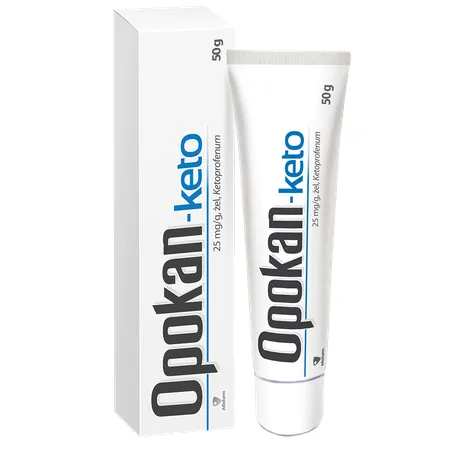
Table of Contents
Package leaflet: Information for the patient
Opokan-keto, 25 mg/g, gel
Ketoprofenum
Please read the entire leaflet carefully before using the medicine, as it contains
important information for the patient.
- Keep this leaflet, as you may need to read it again.
- If you have any questions, consult your doctor or pharmacist.
- This medicine has been prescribed for a specific individual. Do not pass it on to others. The medicine may harm someone else, even if their symptoms are the same.
- If the patient experiences any adverse reactions, including any adverse reactions not listed in this leaflet, inform the doctor or pharmacist. See section 4.
Table of contents
- What Opokan-keto is and what it is used for
- Important information before using Opokan-keto
- How to use Opokan-keto
- Possible side effects
- How to store Opokan-keto
- Contents of the package and other information
1. What Opokan-keto is and what it is used for
Opokan-keto is a gel medicine with anti-inflammatory and analgesic properties. The active substance, ketoprofen, is a non-steroidal anti-inflammatory drug (NSAID).
Opokan-keto is indicated in adults for:
- Traumatic pain of muscles and joints;
- Inflammation of muscles and tendons;
- Rheumatic pain;
- Adjunctive treatment of inflammatory conditions in degenerative joint disease of peripheral joints.
2. Important information before using Opokan-keto
When not to use Opokan-keto
-
if the patient is allergic to ketoprofen (the active substance in this medicine) or to any of the other ingredients of this medicine (listed in section 6), or to acetylsalicylic acid or other non-steroidal anti-inflammatory drugs (for example: ibuprofen, diclofenac, metamizole, butadione, and others), tiaprofenic acid, fenofibrate, UV filters, perfumes. Symptoms of allergy may include: runny nose, urticaria, breathing difficulties, swelling of the lips, face, throat or tongue;
-
if the patient has previously experienced allergic reactions during treatment with acetylsalicylic acid or other medicines from the NSAID group, manifesting as runny nose, urticaria or asthma (shortness of breath);
-
treatment must be stopped immediately if skin reactions occur, including skin reactions after simultaneous use of products containing octocrylene (octocrylene is one of the excipients used in various cosmetics and hygiene products such as shampoo, after-shave lotions, shower gels and bath products, skin creams, lipsticks, anti-wrinkle creams, make-up removers, hair lacquers to delay degradation under light exposure). The treated skin area must not be exposed to sunlight (even when the sky is overcast) or UV radiation in solariums during treatment and for 2 weeks after discontinuation of the medicine;
-
if the patient is in the last 3 months of pregnancy;
-
on damaged or diseased skin (e.g. eczema, acne, open wound);
-
in children and adolescents under 15 years of age.
Warnings and precautions
Before starting treatment with Opokan-keto, consult a doctor or pharmacist:
- if the patient has circulatory failure;
- if the patient has impaired kidney or liver function.
Do not apply the gel to areas of skin beyond the painful site.
Exposure to sunlight (even when the sky is overcast) or UVA radiation on areas of skin where Opokan-keto has been applied may cause serious skin reactions (photosensitivity).
Therefore, it is necessary to:
- protect treated skin areas by wearing clothing during treatment and for two weeks after stopping the medicine to avoid the risk of photosensitivity;
- thoroughly wash hands after each application of Opokan-keto;
- use protective gloves during prolonged use;
- do not cover the areas where Opokan-keto has been applied with a dressing;
- if any skin reactions occur, immediately discontinue use of the medicine and consult a doctor;
- do not apply the medicine near or into the eyes or on mucous membranes;
- to avoid skin photosensitivity reactions during treatment and for 2 weeks after treatment ends, avoid direct sunlight (including solariums);
- patients with asthma, chronic inflammation of the nasal mucosa, chronic sinusitis and/or nasal polyps have a higher risk of allergic reactions to aspirin and/or NSAIDs than the general population.
Do not exceed the recommended duration of treatment due to the increasing risk of contact dermatitis and photosensitivity reactions over time.
Children and adolescents
Do not use in children and adolescents under 15 years of age.
Opokan-keto and other medicines
Inform your doctor or pharmacist about all medicines currently used or recently used, as well as any medicines you plan to use.
In particular, inform your doctor if you are using medicines containing prednisolone or methotrexate.
No interactions have been described between topically applied ketoprofen and other medicines.
Pregnancy and breastfeeding
If the patient is pregnant or breastfeeding, suspects she may be pregnant, or is planning to become pregnant, she should consult a doctor or pharmacist before using this medicine.
Do not use Opokan-keto if the patient is in the last 3 months of pregnancy. During the first 6 months of pregnancy, Opokan-keto should not be used unless the doctor considers its use absolutely necessary. If treatment is required during this period, the lowest possible dose for the shortest possible duration is recommended.
Oral forms (e.g. tablets) of ketoprofen may cause adverse effects in the unborn child. It is not known whether the same risk applies when Opokan-keto is applied to the skin.
Use of Opokan-keto during breastfeeding is not recommended, as the medicine passes into breast milk.
Driving and operating machinery
No negative effects of the medicine on the ability to drive or operate machinery have been reported.
Opokan-keto contains ethanol
This medicine contains 285.6 mg of alcohol (ethanol) in each gram of gel.
May cause stinging on damaged skin.
The medicine is flammable. Do not use near open flames, lit cigarettes or certain devices (e.g. hair dryers).
3. How to use Opokan-keto
This medicine should always be used as directed by a physician. If in doubt, consult a doctor or pharmacist.
Topical gel for application to the skin. Do not swallow the medicine.
The dosage and duration of treatment are determined by the physician.
Recommended dose
Adults and adolescents over 15 years of age: Apply a small amount of gel 2–3 times daily to the affected area of skin, gently massaging it into the skin. The gel should be applied to the smallest possible area of skin. The skin at the site of application should be intact. The amount of gel used depends on the size of the painful area.
The daily dose should not exceed 15 g (7.5 g corresponds to approximately 14 cm of gel).
Treatment should last for the shortest possible time, but no longer than 7 days.
Do not cover the treated area with a dressing. Clothing may be worn over the skin treated with the gel.
After each use, the tube should be tightly closed and hands should be washed, unless the hands are the area being treated.
Use in children
The efficacy and safety of ketoprofen in children under 15 years of age have not been established.
Use of a higher than recommended dose of Opokan-keto
Overdose with topically applied ketoprofen is unlikely.
If the gel is ingested, symptoms such as drowsiness, nausea, and vomiting may occur.
In case of accidental ingestion, seek immediate medical advice. Bring the Opokan-keto packaging with you so the doctor knows which medicine has been taken.
Missed dose of Opokan-keto
Do not use a double dose to make up for a missed dose.
If you have any further questions about the use of this medicine, consult your doctor or pharmacist.
4. Possible adverse reactions
Like all medicines, this medicine can cause adverse reactions, although not everybody gets them.
You should stop taking the medicine and immediately contact a doctor or go to the nearest hospital
if any of the following occur:
- Angioedema (a severe allergic reaction – sudden swelling of the face, limbs or joints without itching or pain). Swelling in the head and neck area may cause difficulty in swallowing and breathing;
- Skin rash, for example in the form of blisters or red spots;
- Severe skin reactions caused by sunlight or ultraviolet light (photosensitivity). This is an acute, life-threatening allergic reaction.
The following adverse reactions may occur
Uncommon (occur in 1 to 10 out of 1,000 people):
- Local skin reactions such as: redness, itching, rash (itchy, red, burning rash), burning sensation.
Rare (occur in 1 to 10 out of 10,000 people):
- Severe skin reactions such as bullous or acneiform eruptions, which may spread or become generalized;
- Severe skin reactions during exposure to sunlight, bullous dermatitis, urticaria, photosensitivity.
Very rare (occur in less than 1 out of 10,000 people):
- Worsening of chronic renal failure.
Adverse reactions with unknown frequency (frequency cannot be estimated from available data):
- Local skin reactions which may spread beyond the site of application;
- Asthma attack in patients hypersensitive to acetylsalicylic acid or other NSAIDs;
- Severe hypersensitivity reactions (anaphylactic reactions);
- Swelling of the face, lips, tongue, throat or trachea, causing difficulty in breathing or swallowing (angioedema).
Reporting of adverse reactions
If any adverse reactions occur, including any adverse reactions not listed in this leaflet, inform your doctor or pharmacist.
Adverse reactions can be reported directly to the Department of Monitoring Adverse Drug Reactions at the Office for Registration of Medicinal Products, Medical Devices and Biocidal Products:
Al. Jerozolimskie 181C, 02-222 Warsaw
Tel.: +48 22 4921301
Fax: +48 22 4921309
Website: https://smz.ezdrowie.gov.pl
Adverse reactions may also be reported to the marketing authorization holder.
Reporting adverse reactions helps to provide more information on the safety of the medicine.
5. How to store Opokan-keto
Keep the medicine out of the sight and reach of children.
Do not use this medicine after the expiry date stated on the packaging. The expiry date refers to the last day of the stated month.
Store below 25°C and transport in covered vehicles.
Medicines must not be disposed of via the sewage system or in household waste. Ask your pharmacist how to dispose of medicines no longer required. Such measures help protect the environment.
6. Contents of the pack and other information
What Opokan-keto contains
- The active substance is ketoprofen. 1 g of gel contains 25 mg of ketoprofen.
- The other ingredients are: ethanol 96%, levomenthol, purified water, tromethamine, carbomer (Carbopol 980 NF).
What Opokan-keto looks like and contents of the pack
Opokan-keto is a colourless to slightly yellow gel, possibly with slight opalescence.
The product package contains: an aluminium tube with 50 g or 100 g of gel, placed in a cardboard box.
Marketing authorisation holder and manufacturer
Aflofarm Farmacja Polska Sp. z o.o.
ul. Partyzancka 133/151
95-200 Pabianice
tel. (42) 22-53-100