Onko bcg 100
Poland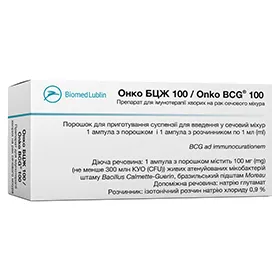
Table of Contents
- Package leaflet: Information for the user
- 1. What Onko BCG 50, Onko BCG 100 is and what it is used for
- 2. Important information before using Onko BCG 50, Onko BCG 100
- 3. How to use Onko BCG 50, Onko BCG 100
- 4. Possible adverse reactions
- 5. How to store Onko BCG 50, Onko BCG 100
- 6. Contents of the packaging and other information
Package leaflet: Information for the user
Onko BCG 50
Onko BCG 100
Powder and solvent for preparation of suspension for intravesical administration
Please read this leaflet carefully before using the medicine, as it contains important information for the patient.
- Keep this leaflet, as you may need to read it again.
- If you have any further questions, please ask your doctor, pharmacist, or nurse.
- This medicine has been prescribed for a specific individual. Do not pass it on to others. The medicine may harm another person, even if their symptoms are the same.
- If you experience any adverse reactions, including any not listed in this leaflet, inform your doctor, pharmacist, or nurse. See section 4.
Table of contents
- What Onko BCG 50, Onko BCG 100 is and what it is used for
- Important information before using Onko BCG 50, Onko BCG 100
- How to use Onko BCG 50, Onko BCG 100
- Possible side effects
- How to store Onko BCG 50, Onko BCG 100
- Contents of the pack and other information
1. What Onko BCG 50, Onko BCG 100 is and what it is used for
One ampoule or one vial of the medicine contains live, attenuated (i.e. non-virulent) BCG bacilli –
(Bacillus Calmette-Guérin), Brazilian Moreau strain, in a 5% sodium glutamate solution,
lyophilized under high vacuum.
One ampoule or one vial of Onko BCG 50 contains at least 150 million live BCG bacilli.
One ampoule or one vial of Onko BCG 100 contains at least 300 million live BCG bacilli.
The medicine does not contain any preservatives.
The medicine is used in the treatment of superficial, non-invasive urothelial tumours of the bladder
(carcinoma urotheliale T, T, T).
The medicine should not be used in invasive bladder cancer, as the chances of cure are negligible.
The 50 mg dose may be used in cases of recurrent adverse reactions (dysuria, elevated body temperature) or an enhanced tuberculin reaction.
BCG bacilli have been used as a non-specific immunostimulatory agent in the treatment of certain types of tumours.
Intravesical administration of BCG aims to destroy the primary tumour or to delay or prevent its recurrence. The exact mechanism of action of BCG is not fully understood. It is believed that the effect of the medicine is due to stimulation of an inflammatory process within the bladder wall, which protects the body against disease progression and activates the patient's immune system.
2. Important information before using Onko BCG 50, Onko BCG 100
When not to use Onko BCG 50, Onko BCG 100:
- if the patient is allergic to the active substance or to any of the other ingredients of this medicine (listed in section 6), and in the following cases:
- congenital or acquired immune system defects,
- immunosuppressive treatment (e.g. corticosteroids, cytostatic agents, or radiotherapy),
- urinary tract infection, until sterile urine culture is obtained,
- significant bleeding from the urinary bladder,
- active tuberculosis or other diseases treated with antituberculosis drugs,
- within 2–3 weeks after transurethral resection (TUR),
- bladder perforation.
Warnings and precautions
Before starting treatment with Onko BCG 50, Onko BCG 100, discuss this with your doctor.
Exacerbation of latent BCG infection (including delayed diagnosis)
After administration of the medicinal product, BCG bacilli may survive in the patient's body for several years. This latent BCG infection may reactivate years after the initial infection, particularly presenting as granulomatous pneumonia, abscesses, or infections within an aneurysm, implant, transplant, or surrounding tissue. The patient must be informed about the possibility of late reactivation of latent BCG infections and advised on the actions to take if symptoms such as unexplained fever and weight loss occur. In case of suspected reactivation of latent BCG infection, consult a physician specialized in infectious diseases.
Onko BCG 50, Onko BCG 100 and other medicines
Inform your doctor about all medicines currently taken or recently used, as well as any medicines the patient plans to take.
This medicine should not be used in patients receiving concomitant systemic cytostatic agents and systemic corticosteroids. Topically administered corticosteroids do not constitute a contraindication to therapy with this medicine.
During BCG treatment, the use of antibiotics with bactericidal activity against mycobacteria should be limited, as well as the use of acetylsalicylic acid derivatives (e.g. Aspirin) and certain anticoagulant drugs.
Pregnancy and breastfeeding
This medicine should not be used in pregnant women or during breastfeeding.
Driving and operating machinery
The influence of Onko BCG 50 and Onko BCG 100 on the ability to drive and operate machinery has not been studied.
3. How to use Onko BCG 50, Onko BCG 100
This medicine should always be used as directed by the physician. If in doubt, consult your doctor or pharmacist.
One dose of Onko BCG 50, corresponding to one dose used for one intravesical instillation, consists of the contents of one ampoule or vial (50 mg) reconstituted in 1 ml of isotonic sodium chloride solution.
One dose of Onko BCG 100, corresponding to one dose used for one intravesical instillation, consists of the contents of one ampoule or vial (100 mg) reconstituted in 1 ml of isotonic sodium chloride solution.
The medicine is prepared and administered by qualified medical personnel in the following manner:
To the ampoule or vial containing the powder, add 1 ml of solvent (sterile isotonic sodium chloride solution) using a 2 ml or 5 ml sterile syringe. Gently aspirate and re-expel the contents of the ampoule or vial three times to obtain a uniform suspension (avoid shaking or foaming the suspension). Then transfer the suspension from the ampoule or vial into a sterile 50 ml syringe and add it to a container containing 49 ml of solvent (sterile isotonic sodium chloride solution).
Empty the urinary bladder of urine using a catheter inserted via the urethra. Then slowly instill the entire volume (50 ml) of the BCG suspension through the catheter using a sterile 50 ml syringe. To ensure complete delivery of the BCG suspension from the catheter, after instillation administer an additional 5 ml of sterile isotonic sodium chloride solution.
The patient should not drink fluids for 3–4 hours before and 2 hours after administration of the product.
After instillation via the catheter, the catheter should be removed.
The instilled BCG suspension must remain in the urinary bladder for 2 hours. During this time, the patient should change body position every 15 minutes (lying on abdomen, back, and sides). After 2 hours, the patient should empty the bladder.
Intravesical administration should not be performed earlier than 14 days after biopsy of the tumor or bladder mucosa or after transurethral resection of the tumor (TUR).
The procedure should be performed once weekly for six consecutive weeks, followed by maintenance therapy every 3 months, consisting of one weekly instillation for three consecutive weeks.
If tumor recurrence is detected, a new 6-week course of treatment should be initiated.
Before starting treatment, the patient should undergo an intradermal tuberculin test (PT, PPD) to assess the patient's immunological reactivity. If the skin reaction is very pronounced or exceeds 1 cm in diameter (a reaction exceeding 6 mm in diameter is considered positive), immunotherapy with this medicine should be discontinued. After completion of the 6-week treatment course, the intradermal tuberculin test should be repeated to evaluate the impact of treatment on the patient's overall immunological reactivity. In some patients, this reactivity markedly increases.
Urination procedure
Two hours after administration of the medicine, the patient should be instructed to urinate. If difficulties occur in completely emptying the bladder (urinary retention after voiding), medical personnel should insert a catheter to drain residual urine from the bladder.
The toilet should be disinfected with standard disinfectants after urination.
Important information
Unless otherwise advised by the physician, fluid intake should be increased for 24 hours after the first urination. During this time, at least 12 glasses of fluids should be consumed. Urinate regularly.
Sexual abstinence is recommended for 48 hours after instillation. Condoms should be used for at least 1 week following instillation.
This medicine must not be administered intravenously, subcutaneously, or intramuscularly.
Lubricants used during catheterization must not contain tuberculostatic agents.
The BCG bacillus suspension for intravesical administration must be prepared immediately before the procedure.
Precautions should be taken when managing complications related to tuberculostatic and allergic reactions.
Administration of a higher than recommended dose of Onko BCG 50, Onko BCG 100
In case of overdose or prolonged retention of the medicine in the bladder, the urinary bladder should be repeatedly irrigated with sterile physiological saline solution. Residual urine in the bladder (in patients with urinary retention) should be removed using a catheter. In case of septic symptoms, tuberculostatic agents should be administered.
These procedures are performed by qualified medical personnel.
Missed dose of Onko BCG 50, Onko BCG 100
If a recommended dose is missed, inform the physician immediately.
4. Possible adverse reactions
Like any medicine, this medicinal product can cause adverse reactions, although not everyone experiences them.
Intravesical treatment of non-invasive bladder cancer with Onko BCG 50 or Onko BCG 100 is well tolerated by most patients, but both local and systemic adverse symptoms may occur.
Tuberculoid granulomatous lesions in the lungs have been observed.
The most common complication is symptoms of cystitis (cistitis acuta), usually occurring after the second or third instillation. Frequency of urination, haematuria, and painful micturition occurring on the day of administration typically resolve within a few hours.
More serious adverse effects of therapy are also known, such as tuberculoid inflammation of deeper layers of the bladder wall, prostatitis and/or epididymo-orchitis with caseous necrosis foci formation.
In patients with tuberculous prostatitis or persistent low-grade fever, a six-week treatment regimen should be applied using two drugs daily: 600 mg rifampicin and 5 mg/kg body weight isoniazid.
In patients with severe septic symptoms and/or arthritis, a 4-month treatment regimen used for urinary tuberculosis may be applied:
administering
- three drugs daily for 2 months: 600 mg rifampicin, 5 mg/kg body weight isoniazid, and 25 mg/kg body weight ethambutol (or 1500 mg pyrazinamide), followed by
- two drugs three times weekly for the next 2 months: 600 mg rifampicin and 10 mg/kg body weight isoniazid.
Corticosteroids may sometimes be necessary in cases of arthritic symptoms.
Treatment with the product must be absolutely discontinued in patients presenting the above-mentioned symptoms of generalized infection.
In addition to local reactions, systemic reactions may occur, such as malaise, transient increase in body temperature (38°C–39°C), chills, nausea, myalgia, arthralgia, diarrhoea, and pain in the genital area.
Systemic symptoms usually last 1–3 days. Very rarely, the above-mentioned symptoms necessitate discontinuation of therapy and initiation of antituberculous treatment.
Tuberculoid granulomatous lesions in the liver have also been observed.
All more serious adverse effects following intravesical administration of the product usually resolve after four months of antituberculous chemotherapy.
Immediately contact a doctor or go to the nearest hospital if any of the following symptoms occur:
- allergic reaction, which may manifest as difficulty breathing, coughing, rash, or facial swelling,
- tuberculosis infection, which may manifest as cough, high fever lasting longer than 12 hours (temperature above 39.5°C), or fever lasting longer than 2 days (temperature above 38.5°C).
Contact a doctor as soon as possible if any of the following symptoms are noticed:
- yellowing of the eyes or skin,
- pale or clay-coloured stools,
- fever (temperature below 38.5°C) with chills, headache, muscle or joint pain lasting more than 2 days,
- significant pain during urination or excessive urination,
- ocular inflammation,
- blood in the urine (haematuria).
BCG infection after completion of immunotherapy
In isolated cases, BCG infection may manifest after completion of therapy (see section 2). Diagnosis may be difficult because physicians usually do not suspect a causal relationship between symptoms and prior BCG therapy. Early diagnosis and appropriate therapy are crucial for treatment outcome, especially in elderly patients or those with compromised immunity, to avoid severe complications. A patient warning card focusing on this issue has been developed and should be provided to the patient after drug administration.
To alleviate the experience of side effects, patients should:
- stop smoking (if the patient is a tobacco smoker),
- rest when feeling fatigued,
- avoid alcohol consumption,
- follow all medical advice and take medications as prescribed by the physician.
The frequency of adverse reactions has been classified as: very common (≥1/10), common (≥1/100 to <1/10), uncommon (≥1/1000 to <1/100), rare (≥1/10,000 to <1/1000), very rare (<1/10,000), including single cases, frequency unknown.
Infections and parasitic infections
frequency unknown – tuberculoid inflammation of deeper layers of the bladder wall, tuberculosis infection (cough, high fever lasting longer than 12 hours (above 39.5°C) or fever lasting longer than 2 days (temperature above 38.5°C)), prostatitis and/or epididymo-orchitis with formation of caseous necrosis foci
Immune system disorders
frequency unknown – allergic reaction (difficulty breathing, cough, rash, facial swelling)
Eye disorders
frequency unknown – ocular inflammation, yellowing of the eyes
Respiratory, thoracic and mediastinal disorders
frequency unknown – tuberculoid granulomatous lesions in the lungs
Gastrointestinal disorders
frequency unknown – diarrhoea, nausea, pale or clay-coloured stools
Hepatobiliary disorders
frequency unknown – tuberculoid granulomatous lesions in the liver
Skin and subcutaneous tissue disorders
frequency unknown – yellowing of the skin
Musculoskeletal and connective tissue disorders
frequency unknown – myalgia, arthralgia, arthritis
Renal and urinary disorders
frequency unknown – painful micturition on the day of administration, frequency of urination, haematuria, excessive urination, significant pain during urination, cystitis
Reproductive system and breast disorders
frequency unknown – pain in the genital area
General disorders and administration site conditions
frequency unknown – chills, fever (below 38.5°C) with chills, headache, muscle or joint pain lasting longer than 2 days, transient increase in body temperature (38°C–39°C), malaise
Reporting of adverse reactions
If any adverse reactions occur, including any not listed in this leaflet, inform your doctor, pharmacist, or nurse. Adverse reactions can be reported directly to the Department of Monitoring Adverse Drug Reactions of the Office for Registration of Medicinal Products, Medical Devices and Biocidal Products: Al. Jerozolimskie 181C, 02-222 Warsaw, tel.: +48 22 49-21-301, fax: +48 22 49-21-309, website: https://smz.ezdrowie.gov.pl.
Adverse reactions can also be reported to the marketing authorization holder.
Reporting adverse reactions helps provide more information on the safety of the medicine.
5. How to store Onko BCG 50, Onko BCG 100
Store in a refrigerator (2°C - 8°C).
To protect from light, keep ampoules or vials in the outer packaging.
After reconstitution, use immediately.
Keep the medicine out of the sight and reach of children.
Do not use this medicine after the expiry date stated on the packaging.
The expiry date refers to the last day of the stated month.
After completion of the procedure, equipment and materials should be destroyed according to regulations for hazardous waste.
Batch number (Lot)
Expiry date (EXP)
6. Contents of the packaging and other information
What Onko BCG 50, Onko BCG 100 contains
- The active substance is BCG bacilli (Bacillus Calmette-Guerin), Brazilian Moreau strain
- The excipient is: sodium glutamate
Onko BCG 50
One vial or ampoule of powder contains:
BCG bacilli – 50 mg
Onko BCG 100
One vial or ampoule of powder contains:
BCG bacilli – 100 mg
1 ampoule of solvent contains: isotonic sodium chloride solution – 1 ml
What Onko BCG 50, Onko BCG 100 looks like and contents of the pack
A dry, amorphous powder, white or light cream in colour.
Packaging
1 ampoule containing 50 mg powder and 1 ampoule containing 1 ml solvent
1 vial containing 50 mg powder and 1 ampoule containing 1 ml solvent
5 ampoules containing 50 mg powder and 5 ampoules containing 1 ml solvent
5 vials containing 50 mg powder and 5 ampoules containing 1 ml solvent
1 ampoule containing 100 mg powder and 1 ampoule containing 1 ml solvent
1 vial containing 100 mg powder and 1 ampoule containing 1 ml solvent
5 ampoules containing 100 mg powder and 5 ampoules containing 1 ml solvent
5 vials containing 100 mg powder and 5 ampoules containing 1 ml solvent
Marketing Authorisation Holder and Manufacturer
Synthaverse S.A.
Uniwersytecka 10, 20-029 Lublin
Phone: 81 533 82 21
Fax: 81 533 80 60
Email: [email protected]