Ondansetron kalceks
PolandTable of Contents
- Package leaflet: Information for the user
- 1. What ONDANSETRON KALCEKS is and what it is used for
- 2. Important information before using ONDANSETRON KALCEKS
- 3. How to use ONDANSETRON KALCEKS
- 4. Possible adverse reactions
- 5. How to store ONDANSETRON KALCEKS
- 6. Contents of the pack and other information
Package leaflet: Information for the user
ONDANSETRON KALCEKS, 2 mg/ml, solution for injection/infusion
Ondansetronum
Please read all of this leaflet carefully before using this medicine because it contains important information for you.
- Keep this leaflet. You may need to read it again.
- If you have any further questions, please ask your doctor, nurse or pharmacist.
- This medicine has been prescribed for you personally. Do not pass it on to others. It may harm them even if their symptoms are the same as yours.
- If you experience any side effects, including any not listed in this leaflet, tell your doctor, nurse or pharmacist. See section 4.
Contents of the leaflet
- What ONDANSETRON KALCEKS is and what it is used for
- Important information before using ONDANSETRON KALCEKS
- How to use ONDANSETRON KALCEKS
- Possible side effects
- How to store ONDANSETRON KALCEKS
- Contents of the pack and other information
1. What ONDANSETRON KALCEKS is and what it is used for
ONDANSETRON KALCEKS contains an active substance called ondansetron. It belongs to a group of medicines known as antiemetics, which help relieve nausea and vomiting.
Adults
Ondansetron is used to prevent and control nausea and vomiting caused by chemotherapy and radiotherapy, as well as to prevent and treat nausea and vomiting following surgical operations.
Children and adolescents
Ondansetron is used to prevent and control nausea and vomiting caused by chemotherapy in children over 6 months of age and adolescents.
Ondansetron is also used to prevent and treat nausea and vomiting in the postoperative period in children over 1 month of age and adolescents.
2. Important information before using ONDANSETRON KALCEKS
When not to use ONDANSETRON KALCEKS:
- if the patient is allergic to ondansetron or any of the other ingredients of this medicine (listed in section 6);
- if the patient is taking apomorphine (used in the treatment of Parkinson's disease).
The patient will not be given ONDANSETRON KALCEKS if any of the above apply.
If the patient is unsure whether any of the above apply, talk to a
doctor or nurse before using this medicine.
Warnings and precautions
Before starting treatment with ONDANSETRON KALCEKS, discuss with the doctor or
nurse if:
- the patient experiences symptoms of an allergic reaction, such as itching, difficulty breathing, or swelling of the face, lips, throat, or tongue;
- the patient has ever had an allergic reaction to other anti-nausea and anti-vomiting medicines (e.g. granisetron or palonosetron);
- the patient has heart problems; a temporary change in the electrocardiogram (ECG) may occur;
- the patient is taking medicines used for heart rhythm disorders (antiarrhythmics) or medicines that lower blood pressure and resting heart rate (beta-blockers);
- the patient has constipation or a bowel condition that may lead to constipation;
- the patient has liver problems or is taking any medicines that may be harmful to the liver (hepatotoxic medicines used in chemotherapy). In such cases, liver function will be closely monitored, especially in children and adolescents;
- a blood test has been performed to check liver function (ondansetron may affect the results);
- the patient has problems with blood levels of minerals such as potassium and magnesium;
- the patient is scheduled for tonsillectomy. In such a case, the patient must be closely monitored.
If the patient is unsure whether any of the above apply, talk to
a doctor or nurse before using this medicine.
ONDANSETRON KALCEKS and other medicines
Tell the doctor or nurse about all medicines the patient is currently taking or has recently taken, as well as any medicines the patient plans to take.
In particular, tell the doctor or nurse if the patient is taking any of the following medicines:
- apomorphine (see "When not to use ONDANSETRON KALCEKS");
- carbamazepine or phenytoin (used in the treatment of epilepsy);
- rifampicin (used in the treatment of infections such as tuberculosis);
- tramadol (a painkiller);
- medicines used to treat depression and (or) anxiety disorders:
- selective serotonin reuptake inhibitors (SSRIs) such as fluoxetine, paroxetine, sertraline, fluvoxamine, citalopram, escitalopram;
- serotonin-norepinephrine reuptake inhibitors (SNRIs) such as venlafaxine and duloxetine.
When administered concomitantly with medicines for certain heart conditions, changes in the ECG pattern may occur. Concurrent use of medicines that damage the heart (e.g. anthracyclines (such as doxorubicin, daunorubicin) or trastuzumab), antibiotics (such as erythromycin), antifungal medicines (such as ketoconazole), antiarrhythmics (such as amiodarone), and beta-blockers (such as atenolol or timolol) may increase the risk of heart rhythm disturbances.
Pregnancy, breastfeeding, and effects on fertility
If the patient is pregnant or breastfeeding, suspects she may be pregnant, or is planning to have a child, she should consult a doctor before using this medicine.
Pregnancy
ONDANSETRON KALCEKS should not be used during the first trimester of pregnancy. This is because ONDANSETRON KALCEKS may slightly increase the risk of giving birth to a child with cleft lip and (or) cleft palate (an opening or split in the upper lip and (or) palate).
If the patient is pregnant, suspects she may be pregnant, or is planning to have a child, she should consult a doctor or pharmacist before using this medicine.
Women of childbearing age
Women of childbearing age may be advised to use effective contraception.
Breastfeeding
Breastfeeding must be discontinued before starting treatment with ondansetron.
Fertility
Ondansetron has no effect on fertility.
Driving and operating machinery
Ondansetron has no effect or has a negligible effect on the ability to drive and operate machinery.
ONDANSETRON KALCEKS contains sodium
This medicine contains 3.52 mg of sodium (the main component of table salt) per ml of solution. This corresponds to 0.18% of the maximum recommended daily dietary intake of sodium for adults.
3. How to use ONDANSETRON KALCEKS
Ondansetron is administered by a doctor or nurse as a slow intravenous injection or infusion, or as an intramuscular injection.
Ondansetron is also available in other pharmaceutical forms suitable for rectal and/or oral administration, allowing individual dose adjustment.
However, ONDANSETRON KALCEKS is intended for intravenous or intramuscular administration only.
Adults
Prevention of nausea and vomiting induced by chemotherapy or radiotherapy
- On the day of chemotherapy or radiotherapy: Ondansetron is given just before chemotherapy or radiotherapy. The usual dose in adults is 8 mg, administered as a slow intravenous or intramuscular injection, or as a slow intravenous infusion.
- In the following days: After initial treatment, your doctor may recommend that ondansetron be taken orally or rectally. If needed, follow the instructions provided in the package leaflet for the respective formulation. Always take ondansetron exactly as prescribed by your doctor.
The dose may be increased, if necessary, up to 32 mg per day.
Prevention and treatment of postoperative nausea and vomiting
The usual dose in adults is 4 mg given by slow intravenous or intramuscular injection.
Children and adolescents
Prevention of nausea and vomiting induced by chemotherapy in children over 6 months of age and adolescents
In children, this medicine is administered slowly into a vein (intravenously) just before chemotherapy (recommended dose: 5 mg/m² or 0.15 mg/kg). The intravenous dose must not exceed 8 mg. Oral administration may be started 12 hours later. This treatment may be continued for up to 5 days after chemotherapy. The oral dose should be calculated based on body weight or body surface area. The total daily dose must not exceed the adult dose of 32 mg.
Prevention and treatment of postoperative nausea and vomiting in children over 1 month of age and adolescents
In children, the dose is calculated based on body weight or body surface area. The total daily dose must not exceed the adult dose of 32 mg. The dose is given as a slow intravenous injection before, during, or after induction of anesthesia.
Elderly patients (over 65 years of age)
Ondansetron is well tolerated in patients over 65 years of age.
Nausea and vomiting induced by chemotherapy and radiotherapy
In patients aged 65 years or older, all intravenous doses should be diluted and administered as an infusion lasting at least 15 minutes. If multiple dosing is required, doses should be administered at intervals of at least 4 hours.
In patients aged 65 to 74 years, the initial dose is 8 mg or 16 mg. In patients over 75 years of age, the initial dose should not exceed 8 mg.
Prevention and treatment of postoperative nausea and vomiting
Data on use in elderly patients are limited.
Patients with hepatic impairment
In patients with moderate or severe hepatic impairment, the total daily dose should not exceed 8 mg.
Patients with renal impairment
No dosage adjustment is required regarding dose, frequency, or route of administration.
Use of a higher than recommended dose of ONDANSETRON KALCEKS
A doctor or nurse will administer ONDANSETRON KALCEKS injection to an adult or child, so it is unlikely that an overdose will occur. If it is suspected that an adult or child has received too high a dose, or if a dose has been missed, inform the doctor or nurse immediately.
The following symptoms may occur: visual disturbances, severe constipation, low blood pressure, and slowed heart rate.
If you have any further questions about the use of this medicine, consult your doctor, pharmacist, or nurse.
4. Possible adverse reactions
Like any medicine, this medicine can cause adverse reactions, although not everyone will experience them.
Adverse reactions in children and adolescents are similar to those in adults.
Severe allergic reactions. These occur rarely in people using ondansetron. Symptoms include:
- Raised, itchy skin rash (urticaria)
- Swelling, sometimes of the face or lips (angioedema), with difficulty breathing
- Brief loss of consciousness
If any of the above symptoms occur in a patient, contact a doctor immediately. The medicine should be discontinued.
Very common adverse reactions (may occur in more than 1 in 10 patients)
- Headache
Common adverse reactions (may occur in less than 1 in 10 patients)
- Feeling of warmth or skin flushing
- Constipation
- Redness
- Irritation at the injection site (after intravenous administration)
Uncommon adverse reactions (may occur in less than 1 in 100 patients)
- Seizures
- Involuntary movements or muscle twitching
- Irregular or slow heartbeat
- Chest pain
- Low blood pressure
- Hiccups
- Increased liver enzyme activity
Rare adverse reactions (may occur in less than 1 in 1,000 patients)
- Heart rhythm disorders (which sometimes lead to sudden loss of consciousness)
- Dizziness
- Transient blurred vision or visual disturbances
Very rare adverse reactions (may occur in less than 1 in 10,000 patients)
- Extensive blistering rash with peeling of the skin, affecting a large part of the body (toxic epidermal necrolysis)
- Transient loss of vision
Frequency not known (cannot be estimated from available data)
- Dryness of the mouth
- Myocardial ischaemia (symptoms include sudden chest pain or chest tightness)
Reporting of adverse reactions
If any adverse reactions occur, including any adverse reactions not listed in this leaflet, inform your doctor, pharmacist or nurse.
Adverse reactions can be reported directly to the Department of Monitoring Adverse Drug Reactions, Office for Registration of Medicinal Products, Medical Devices and Biocidal Products
Al. Jerozolimskie 181C
02-222 Warsaw
Tel.: + 48 22 49 21 301
Fax: + 48 22 49 21 309
Website: https://smz.ezdrowie.gov.pl
Adverse reactions can also be reported to the marketing authorization holder.
Reporting adverse reactions helps to provide more information on the safety of the medicine.
5. How to store ONDANSETRON KALCEKS
The medicine should be stored out of the sight and reach of children.
There are no special recommendations regarding storage temperature.
Store the ampoules in the outer packaging to protect from light.
After opening the ampoule
After opening, the medicine should be used immediately.
In-use stability
Chemical and physical in-use stability has been demonstrated for 7 days at a temperature of
25 °C and 2-8 °C.
From a microbiological point of view, the diluted solution should be used immediately. If the solution
is not used immediately, the user is responsible for the storage conditions and duration prior to use,
which should generally not exceed 24 hours at 2-8°C, provided that dilution took place under controlled
and validated aseptic conditions.
Do not use this medicine after the expiry date stated on the ampoule label after: “EXP”
and on the cardboard box after: “Expiry date (EXP)”. The expiry date refers to the last day of the
stated month.
Medicines must not be disposed of via wastewater or household waste. Ask your pharmacist how to
dispose of medicines no longer required. Such measures will help protect the environment.
6. Contents of the pack and other information
What ONDANSETRON KALCEKS contains
- The active substance is ondansetron. Each ml of solution contains ondansetron hydrochloride dihydrate equivalent to 2 mg of ondansetron. Each 2 ml ampoule contains ondansetron hydrochloride dihydrate equivalent to 4 mg of ondansetron. Each 4 ml ampoule contains ondansetron hydrochloride dihydrate equivalent to 8 mg of ondansetron.
- The other ingredients are: sodium chloride, citric acid monohydrate, disodium citrate dihydrate, water for injections.
What ONDANSETRON KALCEKS looks like and contents of the pack
A clear, colourless solution free from visible particles.
2 ml or 4 ml of solution in ampoules made of colourless type I glass with an OPC score mark and a coloured ring.
The ampoules are packed in a protective sleeve. The sleeve is packed in a cardboard box.
Pack sizes:
5, 10 or 25 ampoules
Not all pack sizes may be marketed.
Marketing Authorisation Holder and Manufacturer
AS KALCEKS
Krustpils iela 71E
LV-1057 Rīga
Latvia
Tel.: +371 67083320
E-mail: [email protected]
This medicinal product is authorised in the European Economic Area and the United Kingdom (Northern Ireland) under the following names:
Latvia Ondansetron Kalceks 2 mg/ml šķīdums injekcijām/infūzijām
Austria, Bulgaria, Croatia, Czech Republic, Denmark, Estonia, Finland, Germany, Hungary, Iceland, Lithuania, Norway, Slovakia, Sweden: Ondansetron Kalceks
Belgium Ondansetron Kalceks 2 mg/ml, solution injectable/pour perfusion / Ondansetron Kalceks 2 mg/ml, oplossing voor injectie/infusie / Ondansetron Kalceks 2 mg/ml, Injektions-/Infusionslösung
Greece ONDANSETRON/KALCEKS
Ireland, United Kingdom (Northern Ireland): Ondansetron 2 mg/ml solution for injection/infusion
Italy Ondansetrone Kalceks
Netherlands Ondansetron Kalceks 2 mg/ml, oplossing voor injectie/infusie
Poland ONDANSETRON KALCEKS
Romania Ondansetron Kalceks 2 mg/ml soluţie injectabilă/perfuzabilă
Slovenia Ondansetron Kalceks 2 mg/ml raztopina za injiciranje/infundiranje
Spain Ondansetron Kalceks 2 mg/ml soluciόn inyectable y para perfusiόn
------------------------------------------------------------------------------------------------------------------------
Information intended exclusively for medical professionals:
Further information about this medicinal product is available in the Summary of Product Characteristics (SmPC).
Overdose
Symptoms and signs
Experience with ondansetron overdose is limited, but in case of accidental overdose the following signs of poisoning may be expected: visual disturbances, severe constipation, hypotension and a vasovagal episode with transient second-degree atrioventricular block. In all reported cases, symptoms resolved completely. Ondansetron prolongs the QT interval in a dose-dependent manner.
Children and adolescents
Following accidental oral overdose of ondansetron (exceeding estimated intake of 4 mg/kg) in infants and children aged 12 months to 2 years, paediatric cases indicating serotonin syndrome have been reported.
Management
There is no specific antidote for ondansetron. In case of suspected overdose, appropriate symptomatic and supportive treatment should be administered. ECG monitoring is recommended. Further management should follow clinical indications or recommendations from the national poison control centre, if available.
The use of ipecacuanha is not recommended for treatment of overdose, as patients are unlikely to respond due to the antiemetic effect of ondansetron itself.
Incompatibilities
ONDANSETRON KALCEKS solution for injection/infusion must not be administered in the same syringe or infusion set as any other medicinal product.
Do not mix this medicinal product with other medicinal products except those listed below.
Special precautions for disposal and preparation of the medicinal product prior to administration
For single use only.
The medicinal product should be visually inspected before use. Do not use the medicinal product if any signs of degradation are visible (e.g. particles or change in colour).
ONDANSETRON KALCEKS medicinal product must not be sterilised in an autoclave.
The product may be diluted with the following intravenous infusion solutions:
- 9 mg/ml (0.9%) sodium chloride solution;
- 50 mg/ml (5%) glucose solution;
- 100 mg/ml (10%) mannitol solution;
- Ringer's solution;
- 3 mg/ml (0.3%) potassium chloride and 9 mg/ml (0.9%) sodium chloride solution;
- 3 mg/ml (0.3%) potassium chloride and 50 mg/ml (5%) glucose solution;
- Ringer's lactate solution.
It has been demonstrated that ONDANSETRON KALCEKS is compatible with polypropylene (PP) syringes, type I glass bottles, polyethylene (PE), polyvinyl chloride (PVC) and ethylene vinyl acetate (EVA) infusion bags, and PVC and PE administration sets, when diluted with the infusion solutions listed above. Undiluted ONDANSETRON KALCEKS solution for injection/infusion has been shown to be compatible with PP syringes.
Compatibility with other medicines
Ondansetron may be administered by intravenous infusion (1 mg per hour). The following medicinal products may be administered via the Y-site of the administration set used for ondansetron at ondansetron concentrations between 16 and 160 µg/ml (e.g. 8 mg/500 ml and 8 mg/50 ml, respectively):
- Cisplatin
- 5-Fluorouracil
- Carboplatin
- Etoposide
- Ceftazidime
- Cyclophosphamide
- Doxorubicin
- Dexamethasone
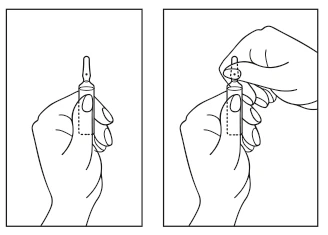
Instructions for opening the ampoule
- Turn the ampoule with the coloured mark facing upwards. If solution is present in the upper part of the ampoule, gently tap the ampoule with a finger to move all the solution to the lower part.
- Use both hands to open the ampoule; hold the lower part of the ampoule in one hand and snap off the top part away from the coloured mark (see illustration below).
Any unused medicinal product or waste material should be disposed of in accordance with local regulations.