Ondansetron baxter
Poland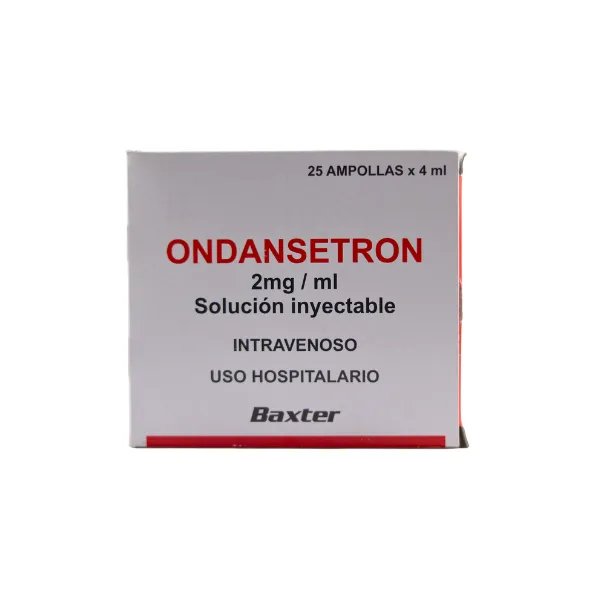
Table of Contents
Package leaflet: Information for the user
Ondansetron Baxter, 2 mg/ml, solution for injection
Ondansetronum (as dihydrochloride dihydrate)
The full name of this medicine is Ondansetron Baxter, 2 mg/ml, solution for injection, but in
this leaflet it will also be referred to as Ondansetron Baxter or Ondansetron.
Please read all of this leaflet carefully before using this medicine, because it contains
important information for the patient.
- Keep this leaflet so that you can read it again if necessary.
- If you have any further questions, please consult your doctor, pharmacist, or nurse.
- This medicine has been prescribed for a specific individual. Do not pass it on to others. It may harm someone else, even if their symptoms are the same.
- If the patient experiences any adverse reactions, including any adverse reactions not listed in this leaflet, inform your doctor, pharmacist, or nurse. See section 4.
Leaflet contents:
- What Ondansetron Baxter is and what it is used for
- What you need to know before using Ondansetron Baxter
- How to use Ondansetron Baxter
- Possible side effects
- How to store Ondansetron Baxter
- Contents of the pack and other information
1. What Ondansetron Baxter is and what it is used for
Ondansetron Baxter is a clear solution containing ondansetron as the active substance.
Ondansetron belongs to a group of medicines called antiemetics (medicines that prevent nausea and vomiting).
Ondansetron Baxter is used:
- to prevent nausea and vomiting caused by chemotherapy (in adults and children) and by radiotherapy for tumours (in adults only),
- to prevent nausea and vomiting after surgery.
2. Important information before using Ondansetron Baxter
When not to use Ondansetron Baxter:
- if the patient is taking apomorphine (used to treat Parkinson's disease)
- if the patient has known hypersensitivity (allergy) to ondansetron or to any other selective 5HT3 receptor antagonists (e.g. granisetron, dolasetron), or to any of the other ingredients of Ondansetron Baxter (listed in section 6). If in doubt, consult a doctor, nurse or pharmacist before using Ondansetron Baxter.
Warnings and precautions:
Before starting treatment with Ondansetron Baxter, discuss with your doctor, pharmacist or nurse:
- if the patient has ever had heart problems (e.g. congestive heart failure causing shortness of breath and swollen ankles),
- if the patient has an irregular heartbeat (arrhythmia),
- if the patient is allergic to medicines similar to ondansetron, such as granisetron or palonosetron,
- if the patient has liver problems,
- if the patient has intestinal obstruction,
- if the patient has electrolyte imbalances such as low levels of potassium, sodium or magnesium in the blood.
If the patient is unsure whether any of the above apply, they should consult a doctor, nurse or pharmacist before using Ondansetron Baxter.
Ondansetron Baxter and other medicines
Tell your doctor or nurse about all medicines the patient is currently taking, has recently taken or plans to take, including those available without prescription and herbal medicines. This is important because Ondansetron Baxter may affect the action of certain medicines, and some other medicines may affect the action of Ondansetron Baxter.
In particular, inform the doctor, nurse or pharmacist if the patient is taking any of the following medicines:
- carbamazepine or phenytoin, used to treat epilepsy;
- rifampicin, used to treat infections such as tuberculosis;
- antibiotics such as erythromycin or ketoconazole;
- antiarrhythmic medicines used to treat irregular heartbeat;
- beta-blockers used to treat certain heart conditions, eye conditions, anxiety, or to prevent migraine;
- tramadol, a painkiller;
- medicines affecting the heart (such as haloperidol or methadone);
- medicines used to treat cancer (especially anthracyclines and trastuzumab);
- selective serotonin reuptake inhibitors (SSRIs) used to treat depression and/or anxiety disorders, including fluoxetine, paroxetine, sertraline, fluvoxamine, citalopram, escitalopram;
- serotonin-norepinephrine reuptake inhibitors (SNRIs) used to treat depression and/or anxiety disorders, including venlafaxine and duloxetine.
If the patient is unsure whether any of the above apply, they should consult a doctor, nurse or pharmacist before using Ondansetron Baxter.
Ondansetron Baxter injection solution must not be administered in the same syringe or infusion line with any other medicines.
Pregnancy, breastfeeding and fertility
Ondansetron Baxter should not be used during the first trimester of pregnancy. This is because Ondansetron Baxter may slightly increase the risk of cleft lip and/or cleft palate [a gap or split in the upper lip and/or roof of the mouth]. If the patient is pregnant, suspects she may be pregnant, or is planning to become pregnant, she should consult a doctor, pharmacist or nurse before using Ondansetron Baxter. If the patient is a woman of childbearing potential, effective contraception may be recommended.
Breastfeeding must be discontinued during treatment with Ondansetron Baxter. The medicine passes into breast milk in small amounts. If in doubt, consult a doctor or midwife.
Driving and operating machinery
Ondansetron Baxter has no effect on the ability to drive or operate machinery.
Ondansetron Baxter contains sodium:
Ondansetron Baxter contains sodium citrate and sodium chloride.
It contains 3.6 mg/ml of sodium. The maximum daily dose of Ondansetron Baxter contains 2.52 mmol (57.6 mg) of sodium. If the patient is on a controlled sodium diet, they should consult their doctor before using this medicine.
3. How to use Ondansetron Baxter
Ondansetron Baxter is usually administered by a doctor or nurse. The prescribed dose will depend on the type of treatment the patient is receiving.
Prevention of nausea and vomiting caused by chemotherapy and radiotherapy in adults
On the day of chemotherapy or radiotherapy
- the usual dose for adults is 8 mg given by slow intravenous or intramuscular injection just before treatment, followed by another 8 mg twelve hours later. After chemotherapy, the medicine is usually given orally in the form of syrup or tablets.
In the following days
- the recommended dose for adults is one 8 mg tablet or 10 ml (8 mg) of syrup twice daily,
- this dose may be given for up to 5 days. If chemotherapy or radiotherapy causes severe nausea and vomiting, the patient may receive a higher than usual dose of Ondansetron Baxter. This will be decided by the doctor.
Prevention of nausea and vomiting caused by chemotherapy in children over 6 months of age and adolescents
The doctor will determine the dose according to the child's size (body surface area) or body weight. More information can be found on the label.
On the day of chemotherapy
- the first dose is administered by intravenous injection just before the procedure in the child. After chemotherapy, the medicine is usually given orally twelve hours later in the form of syrup or tablets.
In the following days
- small children and children with body weight of 10 kg or less receive a dose of 2.5 ml (2 mg) of syrup twice daily,
- older children and children with body weight above 10 kg receive a 4 mg tablet or 5 ml (4 mg) of syrup twice daily,
- adolescents and children with large body surface area receive two 4 mg tablets or 10 ml (8 mg) of syrup twice daily,
- these doses may be given for up to 5 days.
Prevention and treatment of postoperative nausea and vomiting
Adults
- the recommended dose for adults is 4 mg given by slow intravenous or intramuscular injection. To prevent nausea and vomiting, it will be administered just before surgery.
Children
For children over 1 month of age and adolescents, the dose will be determined by the doctor. The maximum dose is 4 mg, given as a slow intravenous injection. To prevent nausea and vomiting, it will be administered just before surgery.
Patients with moderate or severe liver disease
In all patients with liver disease, the maximum daily dose is 8 mg.
If nausea and vomiting continue
Ondansetron Baxter should start working shortly after the injection dose is administered. If nausea or vomiting does not subside, consult a doctor or nurse.
Use of a higher than recommended dose of Ondansetron Baxter
Ondansetron Baxter injection will be administered to an adult or child by a doctor or nurse. Therefore, it is unlikely that the patient will receive too high a dose. If you suspect that an adult or child has been given too high a dose or a dose has been missed, inform the doctor or nurse immediately.
4. Possible adverse reactions
Like all medicines, this medicine can cause adverse reactions, although not everyone will experience them.
Serious adverse reactions
If any of the following adverse reactions occur, contact a doctor immediately
- Chest pain
The following adverse reactions have been reported:
Allergic reactions
If the patient experiences an allergic reaction, treatment with this medicine should be discontinued and immediate contact should be made with a doctor or other healthcare professional. Symptoms may include:
- sudden wheezing, pain or tightness in the chest,
- swelling of the eyelids, face, lips, mouth or tongue,
- rash – red spots or patches under the skin on the body (urticaria),
- fainting.
Myocardial ischaemia
Symptoms include:
- sudden chest pain or
- chest tightness
Other adverse reactions:
Very common (occurs in more than 1 in 10 patients)
- headache.
Common (occurs in no more than 1 in 10 patients)
- sensation of warmth or skin flushing,
- constipation,
- changes in liver function test results (if the patient is receiving Ondansetron Baxter injections with a medicine called cisplatin; otherwise, this adverse reaction occurs uncommonly),
- irritation and redness at the injection site.
Uncommon (occurs in no more than 1 in 100 patients)
- hiccups,
- low blood pressure, which may cause fainting or dizziness,
- heart rhythm disturbances,
- chest pain,
- seizures,
- unusual body movements or tremors.
Rare (occurs in no more than 1 in 1,000 patients)
- dizziness or feeling of emptiness in the head,
- blurred vision,
- heart rhythm disturbances (sometimes leading to sudden loss of consciousness).
Very rare (occurs in no more than 1 in 10,000 patients)
- visual weakness or transient loss of vision, which usually resolves within 20 minutes.
Reporting of adverse reactions
If any adverse reactions occur, including any not listed in this leaflet, inform a doctor, pharmacist or nurse. Adverse reactions can be reported directly to the Department of Monitoring Adverse Drug Reactions of the Office for Registration of Medicinal Products, Medical Devices and Biocidal Products:
Al. Jerozolimskie 181C, 02-222 Warsaw
Tel.: +48 22 49 21 301
Faks: +48 22 49 21 309
e-mail: https://smz.ezdrowie.gov.pl
Adverse reactions can also be reported to the marketing authorization holder.
Reporting adverse reactions helps to provide more information on the safety of the medicine.
5. How to store Ondansetron Baxter
- Keep this medicine out of the sight and reach of children.
- Both the physician and pharmacist know how to store Ondansetron Baxter.
- This medicine does not require special storage temperature conditions. Ampoules should be kept in the cardboard packaging to protect the medicine from light.
- Do not use Ondansetron Baxter after the expiry date stated on the packaging after the word "Exp". The expiry date refers to the last day of the stated month.
- Use only ampoules containing a clear solution free from particles. Do not use the medicine if the ampoule is damaged.
- Medicines must not be disposed of via wastewater or household waste. Ask your pharmacist what to do with medicines no longer required. This will help protect the environment.
6. Contents of the pack and other information
What Ondansetron Baxter contains
The active substance in Ondansetron Baxter is ondansetron (as hydrochloride dihydrate).
Each 1 ml of solution contains 2 mg of ondansetron (as hydrochloride dihydrate).
Each 2 ml glass ampoule contains 4 mg of ondansetron (as hydrochloride dihydrate).
Each 5 ml glass ampoule (containing 4 ml of solution) contains 8 mg of ondansetron (as hydrochloride dihydrate).
The other ingredients are: citric acid monohydrate, sodium citrate, sodium chloride, and water for injections.
What Ondansetron Baxter looks like and contents of the pack
Ondansetron Baxter is a colourless, clear solution supplied in colourless glass ampoules with a volume of 2 ml containing 2 ml of solution, and ampoules with a volume of 5 ml containing 4 ml of solution.
The 2 ml ampoule contains 4 mg/2 ml solution.
The 5 ml ampoule contains 8 mg/4 ml solution.
Each pack contains 25 glass ampoules of 2 ml or 5 ml.
Each pack contains 5 glass ampoules of 2 ml or 5 ml.
Not all pack sizes may be marketed.
Marketing Authorisation Holder:
Baxter Holding B.V.
Kobaltweg 49
3542CE Utrecht, The Netherlands
Importer:
Baxter
Boulevard René Branquart 80,
7860 Lessines
Belgium
Bieffe Medital S.p.A.
Via Nuova Provinciale 23034 Grossotto (SO), Italy