Oncotice
Poland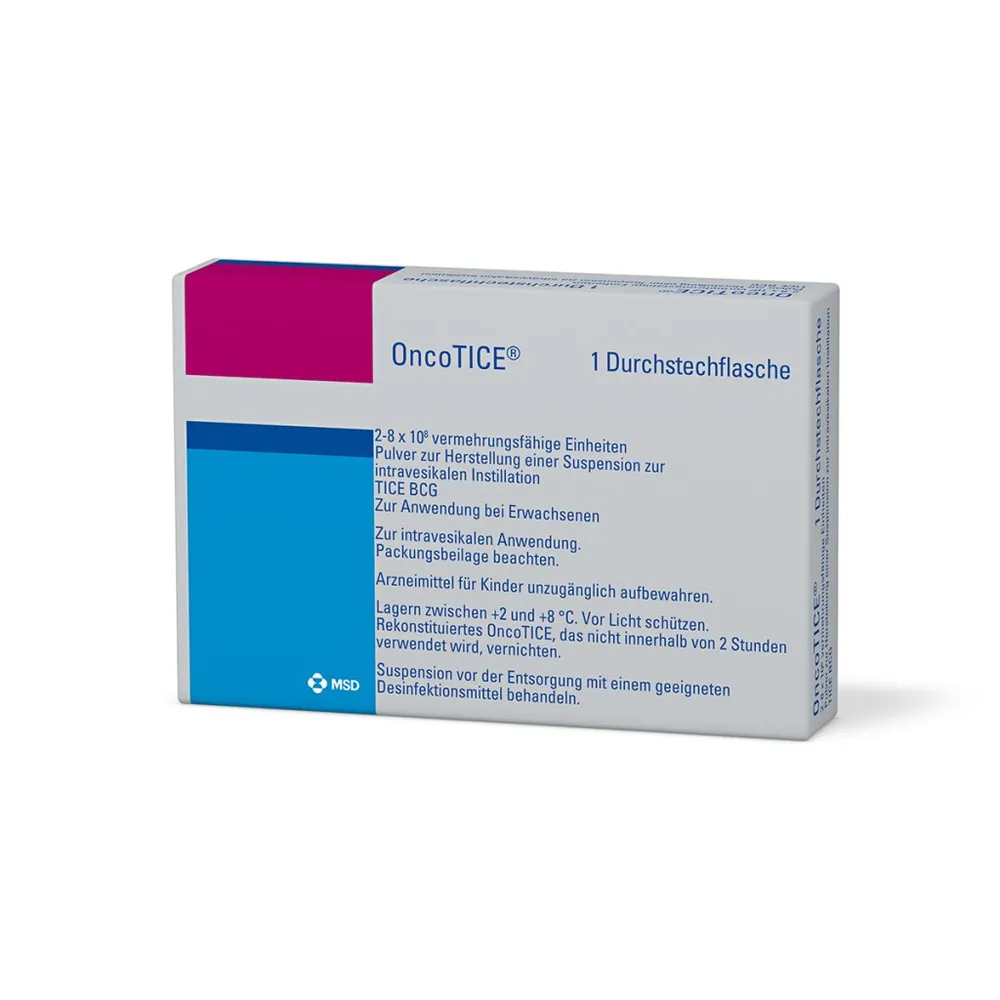
Table of Contents
Patient Information Leaflet
OncoTICE, ( BCG ad immunocurationem ), BCG immunotherapy,
2-8 x 10 CFU live, attenuated BCG (Bacillus Calmette-Guerin) organisms, TICE strain,
powder for suspension for intravesical administration
Please read this leaflet carefully before using this medicine, as it contains important information for you.
- Keep this leaflet, as you may need to read it again.
- If you have any further questions, ask your doctor or pharmacist.
- This medicine has been prescribed for a specific individual. Do not pass it on to others. It may harm them, even if their symptoms are the same.
- If you experience any adverse reactions, including any not listed in this leaflet, inform your doctor or pharmacist. See section 4.
Leaflet Contents
- What OncoTICE is and what it is used for
- Important information before using OncoTICE
- How to use OncoTICE
- Possible side effects
- How to store OncoTICE
- Contents of the pack and other information
1. What OncoTICE is and what it is used for
OncoTICE belongs to a group of medicines called immunostimulants. These medicines stimulate the immune system.
OncoTICE is a powder used to prepare a suspension, which after reconstitution is administered through a catheter into the urinary bladder.
OncoTICE is used in the treatment of superficial bladder cancer. It is also used to prevent recurrence of the disease following surgical intervention on the bladder.
2. Important information before using OncoTICE
When not to use OncoTICE
- If the patient is allergic to the active substance or to any of the other components of this medicine (listed in section 6).
- If there is a urinary tract infection. In case of cystitis, antibiotic treatment should be administered first before starting therapy with OncoTICE. OncoTICE may be administered after completion of antibiotic therapy.
- If there is blood in the urine.
- If there is active tuberculosis infection. The physician may recommend performing a skin test (Mantoux).
- If the patient is taking anti-tuberculosis medications.
- If there are disorders of immune system function (reduced immunity to infectious diseases), regardless of the cause of this impaired immunity.
- If there is HIV infection.
- During pregnancy or breastfeeding.
Warnings and precautions
Before starting treatment with OncoTICE, discuss this with your doctor.
- Prior to the first intravesical administration of OncoTICE, the physician may perform a skin test (Mantoux) to rule out active tuberculosis infection.
- In case of injury to the bladder or ureter walls during catheterization, treatment with OncoTICE should be postponed until the damaged areas have healed.
- It is very important to exclude HIV infection. Blood sampling for HIV testing may be necessary. The physician may also ask about risk factors such as unprotected sexual intercourse, use of used needles, drug use, or blood transfusions.
- For the safety of the partner, abstinence from sexual intercourse is recommended for one week after completion of OncoTICE therapy. If a condom is used correctly and is undamaged, abstinence from sexual intercourse is not necessary.
- The result of a skin test (Mantoux test) performed after OncoTICE therapy may be positive.
- If the patient experiences symptoms such as fever and unexplained weight loss, he or she should contact the physician, as these symptoms may indicate late-onset BCG infection. These symptoms may appear months or even years after the last dose of OncoTICE.
OncoTICE and other medicines
Tell your doctor or pharmacist about all medicines the patient is currently taking,
has recently taken, or plans to take.
The following medicines or treatments may reduce the effectiveness of OncoTICE:
- Antibiotics
- Immunosuppressive drugs
- Drugs inhibiting bone marrow cell production
- Radiotherapy
If any of these medicines or treatments are being used, the physician may decide to delay
administration of OncoTICE until completion of the ongoing treatment.
Pregnancy and breastfeeding
If the patient is pregnant or breastfeeding, suspects she may be pregnant, or is planning to become
pregnant, she should consult her doctor before using this medicine.
Use of OncoTICE is contraindicated during pregnancy and breastfeeding.
Driving and operating machinery
OncoTICE has no effect or has negligible effect on the ability to drive
and operate machinery.
3. How to use OncoTICE
This medicine should always be used exactly as directed by the physician. If in doubt, consult
your doctor.
The physician determines the dosage of OncoTICE.
OncoTICE is usually administered intravesically once a week for 6 weeks. Subsequently, the
medicine is administered once a week for 3 consecutive weeks at months 3, 6, and 12 after the start
of treatment.
If necessary, the 3-week treatment course may be repeated every 6 months.
Method of administration
OncoTICE should be administered into the bladder by a physician or nurse
The contents of one vial should be reconstituted in 50 ml of physiological saline solution. Before
administration, the urinary bladder should be emptied via a catheter, through which OncoTICE will
then be instilled into the bladder. It is important not to drink any fluids within 4 hours before
administration of the medicine. To achieve optimal treatment results, the OncoTICE suspension
should remain in the bladder for 2 hours. The medicine should have adequate contact with the
entire mucosal surface of the bladder; therefore, the patient should move periodically during this
time. Urination should not occur during these 2 hours.
It is important to urinate while sitting down for 6 hours after completion of administration. Each
time, before flushing the toilet, two cups of bleach should be poured into it and left for 15 minutes
before flushing.
Administration of a higher than recommended dose of OncoTICE
Medical personnel prepare the OncoTICE suspension from the contents of one vial, so overdose is
unlikely. However, if such a situation occurs, the physician will check for signs of BCG infection
and, if necessary, prescribe antituberculosis medications.
Missed dose of OncoTICE
Not applicable.
4. Possible side effects
Like all medicines, this medicine can cause side effects, although not everyone gets them.
Very common side effects (may affect more than 1 in 10 people):
- inflammation of the urinary bladder
- pain when passing urine, passing urine frequently, and blood in the urine. These symptoms usually resolve within 2 days.
- flu-like symptoms such as fever, fatigue, and malaise (feeling unwell). These symptoms usually appear within 4 hours after administration of the medicine and last for 24 to 48 hours.
Common side effects (may affect up to 1 in 10 people):
- joint pain
- joint inflammation
- muscle pain
- nausea and vomiting
- abdominal pain
- diarrhoea
- lung inflammation
- anaemia
- urinary incontinence
- urinary tract infection
- urgent need to pass urine
- abnormal urine laboratory test results
- fever with chills
Uncommon side effects (may affect up to 1 in 100 people):
- skin rash
- hepatitis with jaundice (yellowing of the skin and/or eyes)
- abnormal liver function test results
- reduction in red blood cells or platelets, which may present as fatigue and/or bruising
- reduction in white blood cells
- pus in the urine
- difficulty passing urine
- bladder constriction and blocked urine flow
- BCG infection in the body (tuberculosis-type infection) with possible delayed onset of symptoms. Symptoms may appear months or even years after the last dose
Rare side effects (may affect up to 1 in 1,000 people):
- cough
- epididymitis
Very rare side effects (may affect up to 1 in 10,000 people):
- hair loss
- excessive sweating
- dizziness (spinning sensation)
- headache
- increased muscle tension
- unusual sensations of pricking, burning, tingling, or itching
- conjunctivitis
- loss of appetite
- indigestion and bloating
- disorientation
- drowsiness
- weight loss
- low blood pressure
- bronchitis
- shortness of breath
- sore throat
- runny nose
- swollen lymph glands
- kidney dysfunction
- granuloma (nodule in an organ)
- balanitis
- orchitis
- Reiter's syndrome (inflammation of eyes, joints, and urinary/genital system)
- lupus vulgaris (cutaneous tuberculosis)
- prostatitis
- increased prostate-specific antigen (PSA) levels (laboratory test for prostate disorders)
- burning, itching, and pain in the female genital area
- back pain
- chest pain
- fluid retention in limbs
Side effects with unknown frequency (frequency cannot be estimated from available data):
- vasculitis, including inflammation of blood vessels in the brain (cerebral vasculitis)
- eye inflammation (infectious endophthalmitis)
- haemophagocytic lymphohistiocytosis – a condition in which the immune system produces excessive amounts of infection-fighting cells called histiocytes and lymphocytes. Symptoms may include fever, skin rash, swollen lymph nodes, breathing problems, and easy bruising.
Other observed side effects include:
- allergic reactions
- BCG bacterial blood infection (sepsis)
- abnormal widening of an artery due to bacterial infection (bacterial aneurysm)
If any of these side effects occur, or any new or worsening symptoms develop, contact your doctor or pharmacist immediately.
Reporting of side effects
If you experience any side effects, including any not listed in this leaflet, tell your doctor, pharmacist, or nurse. Side effects can be reported directly to the Department of Monitoring Adverse Drug Reactions at the Office for Registration of Medicinal Products, Medical Devices and Biocidal Products:
Al. Jerozolimskie 181C, 02-222 Warsaw, Tel.: +48 22 49 21 301, Fax: +48 22 49 21 309, Website: https://smz.ezdrowie.gov.pl
Side effects can also be reported to the marketing authorisation holder.
Reporting side effects helps provide more information on the safety of this medicine.
5. How to store OncoTICE
Keep this medicine out of the sight and reach of children.
OncoTICE should be stored in a hospital pharmacy according to the recommendations provided on the packaging.
Store in a refrigerator (2°C - 8°C). Keep in the original packaging to protect from light.
Do not use this medicine after the expiry date (EXP) stated on the packaging. The expiry date refers to the last day of the stated month.
Medicines must not be disposed of via wastewater or household waste. Ask your pharmacist how to dispose of medicines no longer required. Such measures help protect the environment.
6. Contents of the pack and other information
What OncoTICE contains
- The active substance in OncoTICE is 2-8 x 10 CFU - live Bacillus Calmette-Guérin (BCG), TICE strain. These are attenuated (avirulent) bacilli.
- The other ingredients are: lactose monohydrate, asparagine monohydrate, citric acid monohydrate, dipotassium phosphate, magnesium sulfate heptahydrate, ammonium iron citrate, glycerol, ammonium hydroxide, zinc formate.
What OncoTICE looks like and contents of the pack
The pack contains 1 or 3 vials.
Marketing Authorisation Holder and Manufacturer
Marketing Authorisation Holder
MSD Polska Sp. z o.o.
ul. Chłodna 51
00-867 Warsaw
Tel.: +48 22 549 51 00
[email protected]
Manufacturer
N.V. Organon, Kloosterstraat 6, 5349 AB Oss, The Netherlands
Merck Sharp & Dohme B.V., Waarderweg 39, 2031 BN Haarlem, The Netherlands