Omegaven
Poland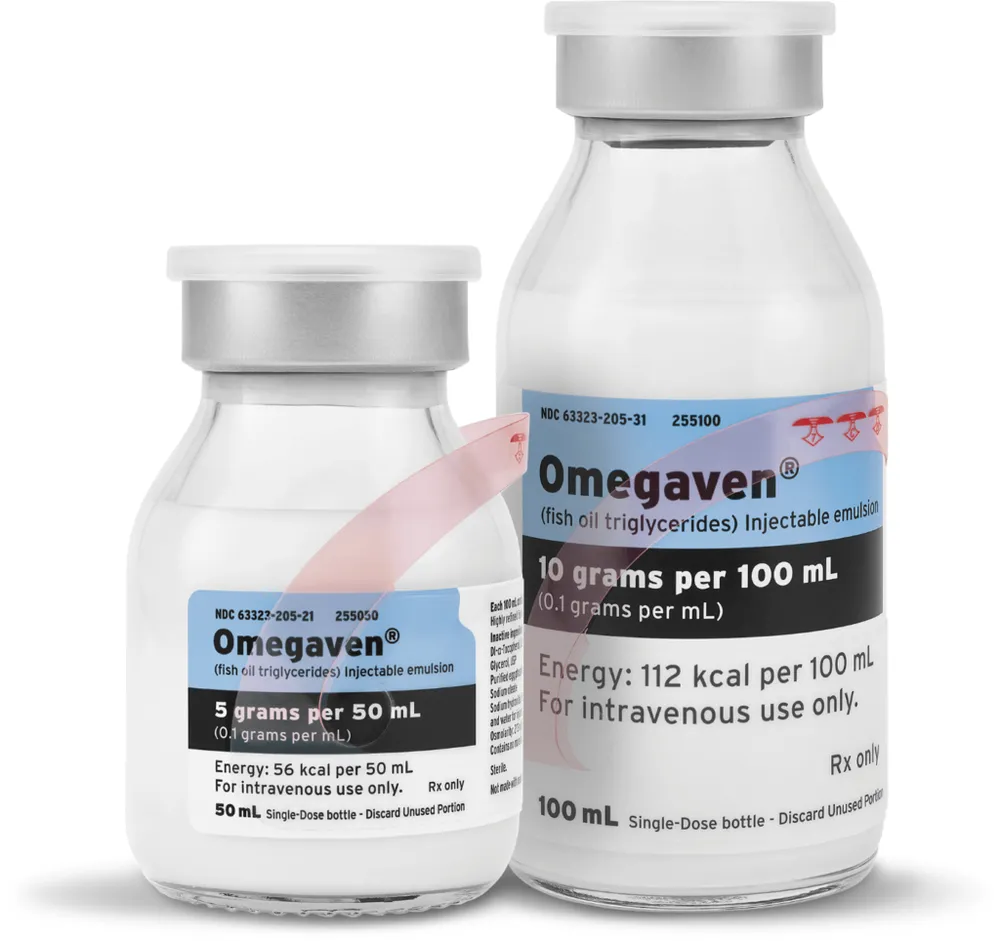
Table of Contents
- Package leaflet: Information for the user
- 1. What Omegaven is and what it is used for
- 2. Important information before using Omegaven
- 3. How to use Omegaven
- 4. Possible adverse reactions
- 5. How to store Omegaven
- 6. Contents of the pack and other information
- Information intended exclusively for medical professionals:
Package leaflet: Information for the user
Omegaven
Emulsion for infusion
Please read all of this leaflet carefully before using this medicine, because it contains
important information for you.
- Keep this leaflet, as you may need to read it again.
- If you have any further questions, ask your doctor, pharmacist, or nurse.
- This medicine has been prescribed for a specific individual. Do not pass it on to others. It may harm them, even if their symptoms are the same.
- If you experience any side effects, including any not listed in this leaflet, tell your doctor, pharmacist, or nurse. See section 4.
Contents of the leaflet
- What Omegaven is and what it is used for
- Important information before using Omegaven
- How to use Omegaven
- Possible side effects
- How to store Omegaven
- Contents of the pack and other information
1. What Omegaven is and what it is used for
Omegaven is a fat emulsion intended for parenteral nutrition. The medicine contains highly purified fish oil, which provides the body with omega-3 fatty acids necessary for energy production and normal metabolic processes.
The medicine is administered by intravenous infusion.
Indications:
Omegaven is indicated for use in parenteral nutrition as a source of long-chain omega-3 fatty acids (particularly eicosapentaenoic acid and docosahexaenoic acid), when oral or enteral nutrition is impossible, inadequate, or contraindicated.
2. Important information before using Omegaven
When not to use Omegaven
Do not use this medicine:
- if the patient is allergic to the active substances or to any of the other ingredients of this medicine (listed in section 6);
- if the patient has severe coagulation disorders;
- if the patient is allergic to fish or egg protein;
- if the patient is in collapse or in shock (a syndrome of symptoms caused by insufficient oxygenation of vital organs);
- if the patient has recently suffered a myocardial infarction;
- if the patient has had a stroke;
- if the patient has an embolism (sudden blockage of an artery, e.g. by a blood clot);
- if the patient is in coma of unknown origin;
- if the patient has severe liver or kidney failure;
- if the patient has hypokalemia (reduced potassium levels in the blood);
- if the patient is overhydrated (excess water in the body);
- if the patient has hypotonic dehydration (deficiency of water and sodium in the body);
- if the patient has metabolic disturbances (unstable metabolism);
- if the patient has acidosis (accumulation in the blood of excessive amounts of acidic substances or reduced concentration of alkaline substances);
- in premature infants, newborns, infants, and children.
Warnings and precautions
This medicine should be used with caution in patients with lipid metabolism disorders and in patients with uncontrolled diabetes (large fluctuations in blood glucose levels).
During administration of Omegaven, the doctor will order regular blood tests (daily measurement of triglyceride levels – simple fats, and systematic monitoring of glucose and electrolyte levels), fluid balance monitoring (amount of fluids taken in and excreted from the body), and monitoring of acid-base balance (appropriate ratio of acidic and alkaline substances in the body).
In patients receiving anticoagulant medicines (to prevent blood clots), the doctor will also order monitoring of platelet count and bleeding time.
Children
Omegaven must not be used in premature infants, newborns, infants, and children.
Omegaven and other medicines
Inform the doctor about all medicines currently or recently taken by the patient, as well as any medicines the patient plans to use.
Omegaven may prolong bleeding time and inhibit platelet aggregation (clumping together of platelets). Inform the doctor if the patient is taking medicines that prevent blood clotting (anticoagulants).
Pregnancy and breastfeeding
If the patient is pregnant or breastfeeding, suspects she may be pregnant, or is planning to have a child, she should consult a doctor before using this medicine.
The doctor will decide whether this medicine should be used during pregnancy or while breastfeeding.
Driving and operating machinery
Not applicable.
3. How to use Omegaven
This medicine is administered only by medical personnel. Self-administration of this medicine is not allowed.
If in doubt, consult a doctor.
The dosage is determined individually by the doctor for each patient, depending on body weight and health status.
Medical personnel may monitor the patient's health condition during treatment.
The duration of administration should not exceed 4 weeks.
Use of a higher than recommended dose of Omegaven
It is unlikely that a patient would receive an excessive dose of Omegaven, as this medicine is administered by trained medical personnel.
In the event of overdose, there is a risk of receiving too much fat. This may lead to a condition known as "fat overload syndrome." For detailed information, see section 4. If the patient experiences the above symptoms or believes they have received a higher than recommended dose of Omegaven, they should immediately inform their doctor or nurse.
If there are any further doubts regarding the use of this medicine, consult a doctor or nurse.
4. Possible adverse reactions
Like all medicines, this medicine can cause adverse reactions, although not everyone will experience them.
Adverse reactions observed during administration of Omegaven:
Uncommon adverse reactions (occurring in fewer than 1 in 1,000 patients, but more than
1 in 10,000 patients):
- prolonged bleeding time and inhibition of platelet aggregation (clumping together of platelets);
- fishy taste in the mouth.
Adverse reactions observed during administration of fat emulsions:
Uncommon adverse reactions (occurring in fewer than 1 in 100 patients, but more than
1 in 1,000 patients):
- abdominal pain;
- nausea;
- vomiting;
- increased body temperature;
- chills;
- tremors;
- feeling of fatigue;
- hypertriglyceridemia (increased blood triglyceride levels);
- headache.
Very rare adverse reactions (occurring in fewer than 1 in 10,000 patients):
- thrombocytopenia (reduced number of platelets, manifesting as petechiae, easy bruising, or haematomas);
- haemolysis (breakdown of red blood cells);
- reticulocytosis (increased number of immature red blood cells);
- hypersensitivity reaction, presenting as skin rash, swelling (especially of the lips, face, eyelids, tongue, and throat), shortness of breath, or fainting. In such cases, immediate contact with a physician is required.
- transient increase in liver enzyme activity;
- priapism (prolonged, painful penile erection);
- skin rash;
- urticaria (skin swelling with redness and itching);
- increased or decreased blood pressure.
During long-term treatment:
- thrombocytopenia has been reported in infants;
- transient increase in liver enzyme activity has been reported, with or without use of Omegaven.
Metabolic overload
Metabolic overload occurs when the body has difficulty metabolizing fats due to genetic factors (individual differences in metabolism) or due to underlying diseases. The following symptoms may occur:
- enlargement of the liver, with or without jaundice (yellowing of the skin and whites of the eyes);
- changes or reduction in certain coagulation parameters in blood tests (e.g. bleeding time, clotting time, prothrombin time, platelet count);
- enlargement of the spleen;
- reduction in the number of red blood cells, white blood cells, and platelets (anaemia, leukopenia, thrombocytopenia);
- bleeding or increased tendency to bleeding;
- abnormal liver enzyme activity test results;
- fever;
- hyperlipidemia (markedly elevated blood fat levels);
- headache;
- stomach pain;
- feeling of exhaustion;
- hyperglycemia (increased blood glucose levels).
Fat overload syndrome
Fat overload syndrome occurs when the body has difficulty metabolizing fats due to receiving an excessive amount of Omegaven. It may also occur due to a sudden change in the patient's health status (e.g. kidney problems or infection). Possible symptoms include fever, increased levels of fat in the blood, cells, and tissues, dysfunction of multiple organs, and coma. All these symptoms usually resolve after infusion is stopped.
Reporting of adverse reactions
If any adverse reactions occur, including any not listed in this leaflet, inform your doctor, pharmacist, or nurse. Adverse reactions can be reported directly to the Department of Monitoring Adverse Drug Reactions at the Office for Registration of Medicinal Products, Medical Devices and Biocidal Products
Al. Jerozolimskie 181C
02-222 Warsaw
Phone: +48 22 49 21 301
Fax: +48 22 49 21 309
Website: https://smz.ezdrowie.gov.pl
Adverse reactions can also be reported to the marketing authorization holder.
Reporting adverse reactions helps to gather further information on the safety of the medicine.
5. How to store Omegaven
Keep this medicine out of the sight and reach of children.
Store below 25°C. Do not freeze.
Do not use this medicine after the expiry date stated on the container. The expiry date refers to the last day of the stated month.
6. Contents of the pack and other information
What Omegaven contains
- The active substances are: highly purified fish oil, glycerol, and purified egg phospholipids.
100 ml of emulsion contains:
highly purified fish oil containing: 10.0 g
eicosapentaenoic acid (EPA) 1.25–2.82 g
docosahexaenoic acid (DHA) 1.44–3.09 g
dl-α-tocopherol (as antioxidant) 0.015–0.0296 g
glycerol 2.5 g
purified egg phospholipids 1.2 g
- Other components (excipients) are: sodium oleate, sodium hydroxide (for pH adjustment), water for injections.
Total energy: 470 kJ/100 ml = 112 kcal/100 ml
pH: 7.5 to 8.7
Acidity: <1 mmol HCl/l
Osmolality: 308–376 mOsm/kg water
What Omegaven looks like and contents of the pack
The medicine is a white, homogeneous emulsion.
The container is a clear type II glass bottle, closed with a bromobutyl rubber stopper and sealed with an aluminium cap.
Pack sizes: 50 ml in 1 bottle, 100 ml in 1 bottle.
Not all pack sizes may be marketed.
Marketing Authorisation Holder
Fresenius Kabi Deutschland GmbH
D-61346 Bad Homburg v.d.H.
Germany
Manufacturer
Fresenius Kabi Austria GmbH
Hafnerstrasse 36
A-8055 Graz
Austria
For further information, please contact the representative of the Marketing Authorisation Holder:
Fresenius Kabi Polska Sp. z o.o.
Al. Jerozolimskie 134
02-305 Warsaw
tel.: +48 22 345 67 89
Information intended exclusively for medical professionals:
Special warnings and precautions for use
Omegaven should be administered with caution to patients with lipid metabolism disorders and uncontrolled diabetes.
Serum triglyceride levels should be monitored daily. Blood glucose levels, acid-base balance, serum electrolyte levels, fluid balance, as well as blood cell counts and bleeding time should be regularly monitored, especially in patients receiving anticoagulant therapy. During fat emulsion infusion, serum triglyceride concentration should not exceed 3 mmol/l.
Dosage and method of administration
Dosage
Daily dose:
1 ml up to a maximum of 2 ml of Omegaven per kg body weight
= 0.1 g up to a maximum of 0.2 g of fish oil per kg body weight
= 70 ml up to a maximum of 140 ml of Omegaven for a patient weighing 70 kg
Maximum infusion rate:
The infusion rate should not exceed 0.5 ml of Omegaven per kg body weight per hour, corresponding to 0.05 g of fish oil per kg body weight per hour.
The recommended maximum infusion rate must be strictly observed; failure to comply may result in a significant increase in serum triglyceride levels.
Omegaven should be administered concomitantly with other fat emulsions. According to recommendations for total daily fat intake of 1–2 g per kg body weight, the fish oil contained in Omegaven should constitute 10–20% of this total dose.
Method of administration
For intravenous infusion via central or peripheral vein.
Shake the container well before use.
If Omegaven is administered together with other infusion solutions (e.g. amino acid solutions, carbohydrate solutions) through a common infusion line (by-pass, Y-connection), compatibility of the solutions and/or emulsions used must be ensured.
Duration of administration
The duration of administration should not exceed 4 weeks.
Overdose
Overdose leading to fat overload syndrome may occur when serum triglyceride levels exceed 3 mmol/l during fat emulsion infusion. This may result either from infusion rates exceeding the recommended rate or from administration at recommended rates in the presence of sudden clinical deterioration, such as impaired renal function or infection.
Overdose may lead to adverse reactions (see section 4.8 of the Product Characteristics).
In such cases, fat emulsion infusion should be discontinued or, if necessary, continued at a reduced dose. Fat administration should also be interrupted if a marked increase in blood glucose concentration occurs during Omegaven infusion. Acute overdose due to administration of Omegaven without concomitant carbohydrate infusion may lead to metabolic acidosis.
Preparation of the medicinal product for use
Shake the container well before use.
Use only if the emulsion is white and homogeneous and the container is undamaged.
Use, whenever possible, equipment free of phthalate compounds.
Unused contents of vials and residual mixtures remaining after infusion should be discarded.
Omegaven may be mixed aseptically with other fat emulsions and with fat-soluble vitamins. If Omegaven is administered simultaneously with other fat emulsions or diluted with other fat emulsions prior to administration, the fish oil contained in Omegaven should constitute 10–20% of the total daily fat intake.
Data on compatibility of Omegaven with other medicinal products are available upon request from the responsible entity's representative.
Pharmaceutical incompatibilities
Incompatibilities may occur upon addition of multivalent cations, such as calcium, particularly in combination with heparin.
Interactions with other medicinal products
Omegaven infusion may prolong bleeding time and inhibit platelet aggregation. Therefore, Omegaven should be used with caution in patients requiring anticoagulant therapy, even if dose reduction of anticoagulants has been considered.
Storage conditions
Store below 25°C. Do not freeze.
After dilution or mixing
Chemical and physical stability of mixtures containing Omegaven has been demonstrated for 24 hours at 25°C; data are available upon request from the responsible entity's representative.
From a microbiological standpoint, mixtures containing fat emulsion or fat emulsions containing fat-soluble vitamins should be used immediately. If not used immediately, the person administering the product is responsible for in-use storage conditions and duration. In-use storage conditions may be based on manufacturer's stability data only if mixing was performed under controlled and validated aseptic conditions. From a microbiological standpoint, mixtures prepared under uncontrolled and non-validated conditions should be used within 24 hours, taking into account infusion time (further information – see section 6.6 of the Product Characteristics).
Disposal of unused medicinal product or waste
Any unused residues of the medicinal product or waste material should be disposed of in accordance with local regulations.