Olopeg
Poland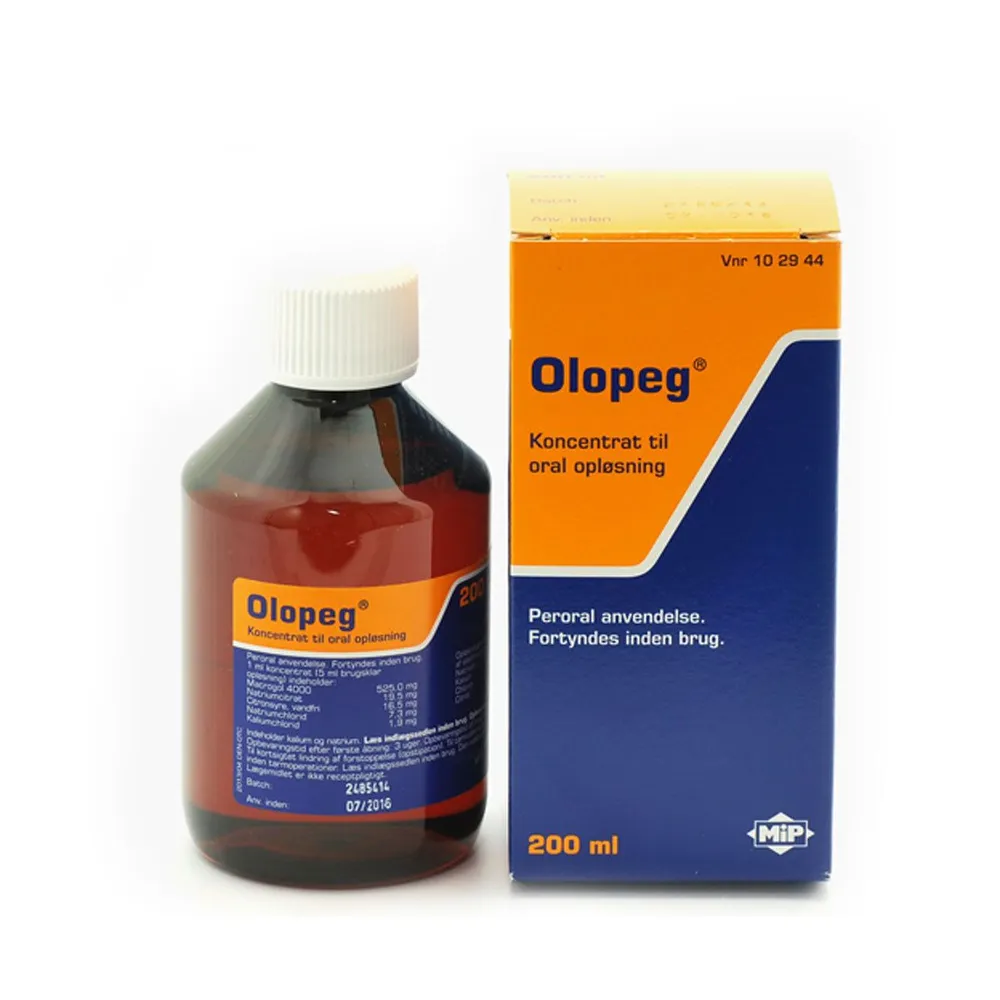
Table of Contents
Package leaflet: Information for the patient
Olopeg, 52.5 g/100 ml (13.125 g/25 ml), concentrate for solution for oral use
Macrogolum
- Please read this leaflet carefully before taking the medicine, as it contains important information for the patient.
- Keep this leaflet so that you can read it again if necessary.
- If you have any questions, please consult your doctor or pharmacist.
- This medicine has been prescribed for a specific individual. Do not pass it on to others. This medicine may harm other people, even if their symptoms are the same.
- If you experience any adverse reactions, including any not listed in this leaflet, inform your doctor or pharmacist. See section 4.
Table of contents
- What Olopeg is and what it is used for
- Important information before taking Olopeg
- How to take Olopeg
- Possible side effects
- How to store Olopeg
- Contents of the pack and other information
1. What Olopeg is and what it is used for
Olopeg is an osmotic laxative.
Indications:
- Symptomatic treatment of constipation
- Bowel cleansing prior to diagnostic procedures (e.g. colonoscopy) and prior to intestinal surgery
Treatment of constipation with this medicine only supports the patient's healthy lifestyle and diet (increased fluid and dietary fibre intake, appropriate physical activity, and restoration of the defecation reflex).
2. Important information before using Olopeg
When not to use Olopeg
- if the patient is allergic to macrogol (polyethylene glycol) or any of the other ingredients of this medicine (listed in section 6),
- if the patient has abdominal pain of unknown cause,
- if the patient has intestinal obstruction or suspected intestinal obstruction,
- if the patient has narrowing, perforation, or risk of perforation in the gastrointestinal tract,
- in patients with a tendency to gastric emptying disorders,
- in patients with acute peptic ulcer disease of the gastrointestinal tract,
- in patients with severe inflammatory bowel disease (Crohn's disease, Colitis ulcerosa, toxic megacolon, toxic or rapidly progressive colitis),
- if the patient has cardiac or circulatory failure or renal functional disorders (renal failure) or liver disease,
- in unconscious patients or patients with impaired consciousness,
- in patients with a tendency to aspiration or regurgitation of gastric contents, or with swallowing or pharyngeal reflex disorders,
- in patients with severe dehydration.
Warnings and precautions
If, during administration of Olopeg for bowel cleansing, the patient experiences sudden abdominal pain or rectal bleeding, medical advice must be sought immediately or urgent medical assistance obtained.
In patients with disturbances in water-electrolyte balance (with symptoms such as oedema, shortness of breath, increasing fatigue, dehydration, or cardiac weakness), administration of Olopeg must be stopped immediately, electrolyte levels should be measured, and appropriate measures taken if necessary.
The product contains potassium. Warning regarding dosing in patients with impaired renal function or on a low-potassium diet: The medicine contains 1.26 mmol (or 49 mg) of potassium per dose (125 ml of ready-to-drink solution), which should be taken into account in patients with reduced renal function and in patients monitoring potassium intake in their diet.
The product contains sodium. Warning regarding dosing in patients on a low-sodium diet: The medicine contains 186 mg of sodium (main component of table salt) in each dosage unit (125 ml of ready-to-drink solution). This corresponds to 9.3% of the maximum recommended daily sodium intake in the diet of adults.
In patients with diabetes, there is no need to add extra carbohydrate servings.
Olopeg may be used in patients prone to disturbances in water-electrolyte balance (e.g. elderly patients, patients with liver or kidney dysfunction, patients taking diuretics) only on explicit medical advice and with special caution. In case of diarrhoea in these patients, monitoring of water and electrolyte balance is recommended.
Elderly patients should use Olopeg with particular caution, as they are generally more susceptible to adverse drug reactions. This should be especially borne in mind in case of diarrhoea and disturbances in water-electrolyte balance.
Olopeg may be used in patients with reflux oesophagitis or cardiac rhythm disorders (conduction disturbances between the heart's sinoatrial node and atrium, sick sinus syndrome) only under medical supervision.
Children
Insufficient data are available from studies on the use of this medicine in children and adolescents; therefore, Olopeg should not be used in children and adolescents under 18 years of age.
Pregnancy and breastfeeding
If the patient is pregnant or breastfeeding, suspects she may be pregnant, or is planning to have a child, she should consult a doctor or pharmacist before using this medicine.
Insufficient data are available from studies on the use of this medicine during pregnancy; therefore, Olopeg should be used in pregnant women only if clearly necessary.
Insufficient data are available from studies on the use of this medicine during breastfeeding; therefore, Olopeg should be used in breastfeeding women only if clearly necessary.
Driving and operating machinery
The medicine has no effect or negligible effect on the ability to drive and operate machinery.
The solution does not contain sodium sulphate or sugar.
Interaction of Olopeg with other medicines
Inform your doctor about all medicines currently or recently taken, as well as any medicines the patient intends to take.
During diagnostic enzymatic tests (e.g. ELISA) of intestinal fluid clearance, interactions may occur between polyethylene glycol and enzymes.
Interactions of Olopeg with other medicines used in the treatment of constipation
There are no clinical reports of interactions with other medicines. However, macrogol increases the solubility of substances soluble in alcohol and poorly soluble in water. Therefore, there is a theoretical possibility that the absorption of such medicines may be transiently reduced. It is therefore recommended to maintain at least a two-hour interval between administration of Olopeg and other medicines.
Interactions of Olopeg with other medicines used during bowel cleansing
If the patient has taken other medicines several hours before or during administration of Olopeg, these may be flushed out from the stomach and intestines, or their absorption may be reduced or completely blocked. This particularly applies to medicines with delayed release of the active substance. If another life-sustaining medicine must be administered shortly before or during administration of Olopeg, oral administration of that medicine should be discontinued if necessary, and intravenous or intramuscular administration used instead.
3. How to use Olopeg medicine
This medicine should always be used according to the doctor's or pharmacist's instructions. If in doubt,
consult a doctor or pharmacist.
Before drinking, Olopeg medicine must be diluted in water according to the scheme below.
Symptomatic treatment of constipation
The medicine is used as an adjunct, while maintaining an appropriate lifestyle and diet.
Adults
25 ml of Olopeg medicine 2–3 times daily, diluted in 100 ml of water (totaling 125 ml of solution per dose), then drink.
Elderly persons
Initially, once daily 25 ml of Olopeg medicine diluted in 100 ml of water (yielding 125 ml of solution), then drink.
As with all laxatives, prolonged use of Olopeg medicine is not recommended. Olopeg medicine should not be used for longer than 2 weeks. It may be used again if necessary.
Gut cleansing prior to diagnostic examination
To prepare one liter of solution, add 800 ml of water to 200 ml of Olopeg medicine.
To completely empty the intestines, 3 to 4 liters of the solution should be consumed.
The solution should be drunk in portions of 200–300 ml every 10 minutes until the stool becomes clear or until the patient has consumed 3 liters (or up to a maximum of 4 liters) of the solution.
The bowel-cleansing solution is usually taken about 4 hours before the examination begins.
The patient may also drink the required amount the previous evening, or part of the solution the previous evening and the remainder on the morning of the examination.
From 2–3 hours before taking Olopeg medicine until the examination is performed, solid food should not be consumed.
If gastrointestinal discomfort occurs, drink the solution prepared from Olopeg medicine more slowly or discontinue administration until symptoms resolve.
Use of a higher than recommended dose of Olopeg medicine
Consult a doctor if symptoms of overdose occur: severe pain, bloating, or severe diarrhea.
Missed administration of Olopeg medicine
If the amount of solution consumed is clearly less than the recommended dose, bowel cleansing may be insufficient, which could prevent the planned examination from being performed. The dosing regimen recommended by the doctor or instructions provided in the patient leaflet should be strictly followed.
4. Possible adverse reactions
Like any medicinal product, this medicine can cause adverse reactions, although not everybody experiences them.
In the event of severe adverse reactions, including allergic reactions to the medicine (see below), the medicine should be discontinued and you should immediately contact your doctor or the Emergency Department of the nearest hospital.
Adverse reactions relate to treatment with macrogol 3350 and macrogol 4000.
Adverse reactions in the treatment of chronic constipation
Common: diarrhoea
Uncommon: abdominal pain, bloating, borborygmi (rumbling stomach), nausea, sudden urge to defecate, faecal incontinence.
Very rare: allergic reactions, hypersensitivity reactions (itching, rash, facial swelling, Quincke's oedema, anaphylactic shock (acute, sometimes life-threatening, generalized allergic reaction of the body).
Adverse reactions in bowel cleansing
Common: nausea, feeling of fullness, bloating.
Uncommon: sudden urge to defecate, faecal incontinence.
Rare: vomiting, stomach cramps, irritation of the anus. These adverse reactions are caused by drinking a relatively large volume of fluid in a short period of time.
Very rare: cardiac arrhythmias, tachycardia, pulmonary oedema. In patients at high risk, water and electrolyte balance should be closely monitored.
Frequency not known: decreased serum calcium ion concentration, electrolyte disturbances (too low levels of calcium or potassium in blood), rash, urticaria, oedema, watery nasal discharge, skin inflammation most likely of allergic origin, malaise, insomnia.
In the literature, isolated cases of Mallory-Weiss syndrome (longitudinal tears in the gastric mucosa at the oesophago-gastric junction) have been documented as a result of vomiting following administration of a bowel cleansing solution containing polyethylene glycol.
If any adverse reactions occur, including any not listed in this leaflet, inform your doctor or pharmacist. Adverse reactions can be reported directly to the Department of Monitoring of Adverse Drug Reactions of the Office for Registration of Medicinal Products, Medical Devices and Biocidal Products, Al. Jerozolimskie 181C, 02-222 Warsaw, tel.: +48 22 49 21 301, fax: +48 22 49 21 309, Website: https://smz.ezdrowie.gov.pl
Reporting of adverse reactions enables further collection of information on the safety of the medicine.
5. How to store the medicine Olopeg
The medicine should be stored in a place inaccessible and out of sight of children.
Store below 25°C.
Do not use this medicine after the expiry date stated on the blister and carton:
Expiry date. The expiry date refers to the last day of the stated month.
Shelf life: 3 years
After first opening the bottle: 3 weeks
Prepared solution: 48 hours
Medicines must not be disposed of via wastewater or household waste. Ask your pharmacist how to dispose of medicines no longer in use. This will help protect the environment.
6. Contents of the pack and other information
What Olopeg contains
- The active substance is macrogol 4000.
- Other ingredients are: disodium citrate dihydrate, anhydrous citric acid, sodium chloride, potassium chloride, raspberry flavour (H + R No.203580), potassium acesulfame, purified water.
What Olopeg looks like and contents of the pack
Olopeg is a concentrate for solution for oral use.
It is supplied in plastic bottles packed in cardboard boxes.
The pack contains 100 ml, 200 ml, 500 ml or 1000 ml of syrup. A measuring cup is provided with the pack.
Not all pack sizes may be marketed.
Marketing Authorisation Holder and Manufacturer
Marketing Authorisation Holder
MIP Pharma Polska Sp. z o.o.
ul. Orzechowa 5
80-175 Gdańsk
Poland
Tel.: 58 303 93 62
Fax: 58 322 16 13
e-mail: [email protected]
Manufacturer
Chephasaar, Chemisch-pharmazeutische Fabrik GmbH
Mühlstrasse 50
D-66386 St. Ingbert
Germany