Olfen patch
Poland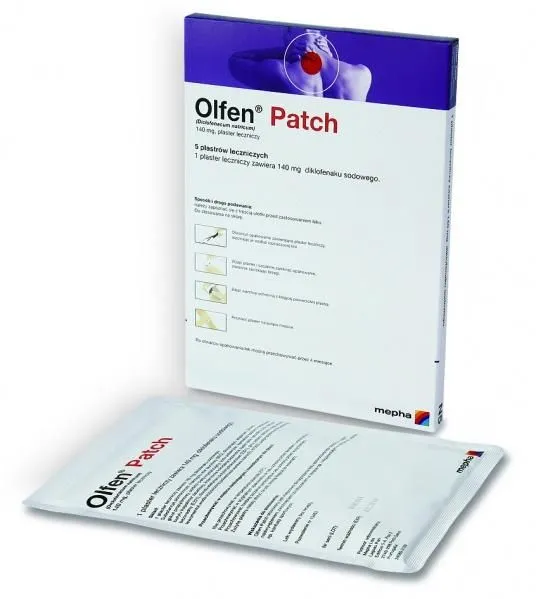
Table of Contents
Warning! Keep the leaflet. Information on the immediate packaging in a foreign language.
Olfen Patch (Olfen)
140 mg, medicinal patch
Diclofenacum natricum
Olfen Patch and Olfen are different trade names of the same medicine.
Please read the entire leaflet carefully before using the medicine, as it contains
important information for the patient.
This medicine should always be used exactly as described in the patient leaflet or according to
the instructions of a doctor or pharmacist.
- Keep this leaflet, so that it can be read again if necessary
- Consult a pharmacist if advice or additional information is needed
- If any adverse reactions occur in the patient, including any possible adverse reactions not listed in this leaflet, inform a doctor, pharmacist, or nurse. See section 4. If there is no improvement after 3 days, or if the patient feels worse, contact a doctor.
Leaflet Contents:
- What Olfen Patch is and what it is used for
- Important information before using Olfen Patch
- How to use Olfen Patch
- Possible side effects
- How to store Olfen Patch
- Contents of the pack and other information
1. What Olfen Patch is and what it is used for
Olfen Patch is an analgesic medicine. It belongs to the group of non-steroidal anti-inflammatory drugs (NSAIDs).
Olfen Patch is used locally in short-term treatment to relieve pain associated with sudden strains, sprains, or contusions of the arms and legs resulting from blunt trauma.
2. Important information before using Olfen Patch
When not to use Olfen Patch
- if the patient is allergic to diclofenac, propylene glycol, butylhydroxytoluene, or any of the other ingredients of this medicine (listed in section 6),
- if the patient is allergic to any other non-steroidal anti-inflammatory drug (NSAID), e.g. acetylsalicylic acid, ibuprofen,
- if taking acetylsalicylic acid or another NSAID has previously caused asthma attacks, skin swelling, or swelling and irritation inside the nose,
- if the patient has active gastric or duodenal ulcer disease,
- on wounds or open skin lesions (e.g. abrasions, cuts, burns), in case of skin infections or eczema,
- during the last three months of pregnancy.
Warnings and precautions
Before starting treatment with Olfen Patch, discuss with your doctor or pharmacist:
- if the patient has or has had asthma or allergies, as bronchospasm with breathing difficulties may occur,
- if a rash appears; in such case, remove the patch immediately and discontinue treatment,
- if the patient has impaired kidney, heart or liver function, or has a tendency to gastrointestinal ulcers, intestinal inflammation or bleeding.
Adverse effects can be minimized by using the lowest possible dose for the shortest necessary duration.
Important warnings:
- If symptoms do not improve after 3 days, consult a doctor.
- Do not apply the medicinal patch near the eyes or on mucous membranes. Avoid contact with eyes and mucous membranes.
The patch should be applied only to intact, undamaged skin. It should not be worn
while bathing.
After removing the patch, avoid exposing the treated areas to direct sunlight or solarium for approximately one day following removal of the Olfen Patch to reduce the risk of photosensitivity.
Do not simultaneously use topical or systemic medications containing diclofenac or other NSAIDs.
Olfen Patch and other medicines
Inform your doctor or pharmacist about all medicines the patient is currently taking or has recently taken, as well as any medicines planned for future use. When Olfen Patch is used correctly, only a very small amount of diclofenac is absorbed into the body, so drug interactions that may occur with oral administration of diclofenac are unlikely.
Pregnancy, breastfeeding and fertility
If the patient is pregnant or breastfeeding, suspects she may be pregnant, or is planning to become pregnant, she should consult her doctor or pharmacist before using this medicine.
Pregnancy
During the first six months of pregnancy, Olfen Patch should only be used after consultation with a doctor.
Olfen Patch must not be used during the last three months of pregnancy due to increased risk of complications for both mother and child (see "When not to use Olfen Patch").
Fertility
Olfen Patch should not be used in women who are planning pregnancy, have difficulty conceiving, or are undergoing fertility investigations.
Breastfeeding
Before using any medicine, consult your doctor or pharmacist.
Only small amounts of diclofenac pass into breast milk. Short-term use of Olfen Patch patches does not require discontinuation of breastfeeding, as no adverse effects in the infant have been observed.
However, Olfen Patch patches should not be applied to areas near the breasts.
Driving and operating machinery
Olfen Patch has no or negligible influence on the ability to drive or operate machinery.
Olfen Patch contains propylene glycol and butylhydroxytoluene (E 321)
This medicine contains 1400 mg of propylene glycol per patch. Propylene glycol may cause skin irritation.
Butylhydroxytoluene may cause local skin reactions (e.g. contact dermatitis) or irritation of the eyes and mucous membranes.
3. How to use Olfen Patch
This medicine should always be used as prescribed by a doctor. If in doubt, consult a doctor or pharmacist.
Recommended dose:
Apply one medicated patch to the painful area twice daily, in the morning and evening. No more than two medicated patches should be used per day, even if injuries occur in several areas. Only one patch should be applied at a time to a single painful site.
Olfen Patch should only be applied to intact, healthy skin without pathological changes.
Elderly patients
Elderly patients should use Olfen Patch with particular caution, as they are more susceptible to adverse effects.
Patients with kidney, heart, or liver disorders
Olfen Patch should be used with particular caution in patients with kidney, heart, or liver disorders.
Children and adolescents under 16 years of age
There is insufficient data on the efficacy and safety of use in children and adolescents under 16 years of age.
Method of application:
For external use only. Do not swallow.
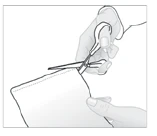
- Open the pouch containing the medicated patch by tearing along the marked line.
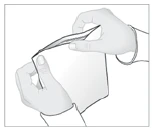
- Remove the patch and tightly reseal the pouch by pressing the edges together firmly.
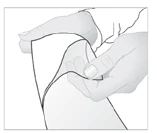
- Remove the protective liner from the adhesive surface of the patch.
- Apply the patch to the painful area.
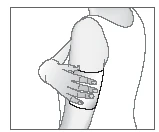
If necessary, a tubular bandage may be used to secure the patch in place.
Do not use the medicated patch under an occlusive dressing (i.e., one that does not allow air passage).
Do not cut the patch into parts.
Used patches should be folded in half with the adhesive side inward.
Duration of treatment
Due to limited data, short-term therapy is recommended.
Do not use Olfen Patch for longer than 3 days without consulting a doctor.
Therapeutic benefits of using the patch for longer than 7 days have not been confirmed.
In adolescents aged 16 years and adults, if it is necessary to use the product for longer than 7 days to relieve pain or if symptoms worsen, patients or parents should consult a doctor.
Overdose of Olfen Patch
If severe adverse symptoms occur due to accidental overdose (e.g., in children) or improper use of Olfen Patch medicated patches, contact a doctor immediately. Based on the assessment of the degree of intoxication, the doctor will decide what corrective actions are necessary.
Missed dose of Olfen Patch
Do not apply a double dose to make up for a missed dose.
If you have any further doubts regarding the use of this medicine, consult your doctor or pharmacist.
4. Possible adverse effects
Like all medicines, Olfen Patch may cause adverse effects, although not everyone experiences them.
You should stop using the patch and consult a doctor immediately if you notice any of the following symptoms:
sudden itchy rash (urticaria), swelling of the hands, feet, ankles, face, lips, mouth or throat, difficulty breathing, sudden drop in blood pressure or feeling weak.
The following adverse effects may occur:
Common (may affect up to 1 in 10 patients)
Reactions at the application site, rash, eczema, redness, skin inflammation (including allergic and contact dermatitis), skin swelling, itching, burning sensation.
Uncommon (may affect up to 1 in 100 patients)
Generalized skin rash, allergic reactions (including urticaria), swelling of the skin and mucous membranes, anaphylactic reactions, photosensitivity.
Rare (may affect up to 1 in 1,000 patients)
Skin blisters, dry skin.
Very rare (may affect up to 1 in 10,000 patients)
Asthma attack, severe rash, pustular rash, ulcerative rash.
Frequency not known (cannot be estimated from available data)
Bruising at the application site.
Absorption of diclofenac after topical application is very low, resulting in very low plasma concentrations of diclofenac compared to oral administration. Therefore, the likelihood of systemic adverse effects (such as gastrointestinal disorders, liver or kidney function disturbances, bronchospasm) is considerably lower than with oral diclofenac. However, if diclofenac is used for too long on large areas of skin, systemic adverse effects may occur.
If any adverse effect worsens or if any adverse effects not listed in this leaflet occur, inform your doctor or pharmacist.
Reporting of adverse effects
If any adverse effects occur, including those not listed in this leaflet, inform your doctor, pharmacist or nurse. Adverse effects can be reported directly to the Department of Monitoring Adverse Drug Reactions of the Office for Registration of Medicinal Products, Medical Devices and Biocidal Products
Al. Jerozolimskie 181C
02-222 Warsaw
Phone: +48 (22) 49 21 301
Fax: +48 (22) 49 21 309
Website: https://smz.ezdrowie.gov.pl
Reporting adverse effects helps to provide more information on the safety of the medicine.
5. How to store Olfen Patch
Keep this medicine out of the sight and reach of children.
Do not use this medicine after the expiry date stated on the packaging.
The expiry date refers to the last day of the stated month.
Store below 25°C. Keep in the original packaging to protect from light and drying out.
Keep the sachet tightly closed to prevent drying.
Shelf life after opening the sachet: 4 months.
Medicines must not be disposed of via wastewater or household waste. Ask your pharmacist how to dispose of medicines no longer required. These measures will help protect the environment.
6. Contents of the pack and other information
What Olfen Patch contains
The active substance is: sodium diclofenac. Each medicated patch contains 140 mg of sodium diclofenac.
Other ingredients include: macrogol lauryl ether, diisopropyl adipate, glycerol, propylene glycol, crystallizing liquid sorbitol (E 420), sodium polyacrylate, sodium carmellose, basic butyl methacrylate copolymer, anhydrous colloidal silica, light natural kaolin, sodium sulfite (E 221), disodium edetate, butylhydroxytoluene (E 321), alum, tartaric acid, levomenthol, purified water, polyester support layer, polypropylene protective film.
What Olfen Patch looks like and contents of the pack
Olfen Patch is a medicated patch measuring 10 cm x 14 cm, with a uniform adhesive layer applied on a dressing, ranging in colour from white to light brown, protected by a backing layer.
Olfen Patch is available in packs containing 5 medicated patches in 1 sachet or 10 medicated patches in 2 resealable sachets (5 patches per sachet).
For further information, please contact the marketing authorisation holder or the parallel importer.
Marketing Authorisation Holder in Portugal, country of export:
Mepha – Investigação, Desenvolvimento e Fabricação Farmacêutica, Lda.
Lagoas Park, Edifício 5-A, Piso 2, 2740-245 Porto Salvo
Portugal
Manufacturer:
Merckle GmbH
Ludwig-Merckle-Straße 3
89143 Blaubeuren
Germany
Teva Operations Poland Sp. z o.o.
ul. Mogilska 80
31-546 Kraków
Poland
Sofarimex – Indústria Química e Farmacêutica, S.A.
Avenida das Indústrias, Alto de Colaride – Agualva
2735-213 Cacém
Portugal
GlaxoSmithKline Santé Grand Public
23 rue Francois Jacob
92500 Rueil Malmaison
France
Parallel Importer:
Delfarma Sp. z o.o.
ul. Św. Teresy od Dzieciątka Jezus 111, 91-222 Łódź
Repackaged in:
Delfarma Sp. z o.o.
ul. Św. Teresy od Dzieciątka Jezus 111, 91-222 Łódź
Marketing Authorisation Number in Portugal, country of export: 5128723
Parallel Import Authorisation Number: 75/23
This medicinal product is authorised for sale in the European Economic Area under the following names:
France: VoltarenPlast 1%
Germany: Olfen Patch
Poland: Olfen Patch
Portugal: Olfen