Oftasteril
Poland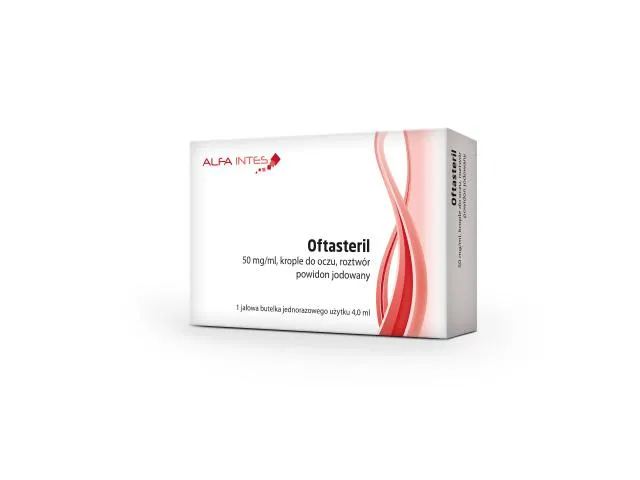
Table of Contents
- Package leaflet: Information for the patient
- 1. What Oftasteril is and what it is used for
- 2. Important information before using Oftasteril
- 3. How to use Oftasteril
- 4. Possible adverse reactions
- 5. How to store Oftasteril
- 6. Contents of the pack and other information
- Information intended exclusively for healthcare professionals:
Package leaflet: Information for the patient
Oftasteril, 50 mg/ml, eye drops, solution
povidone iodine
Please read all of this leaflet carefully before using the medicine, because it contains important information for you.
- Keep this leaflet, as you may need to read it again.
- Ask your doctor, pharmacist, or nurse if you have any questions.
- This medicine has been prescribed for a specific individual. Do not pass it on to others. The medicine may harm another person, even if their symptoms are the same.
- If you experience any side effects, including any not listed in this leaflet, inform your doctor, pharmacist, or nurse. This includes any possible side effects not mentioned in the leaflet. See section 4.
Leaflet contents:
- What Oftasteril is and what it is used for
- What you need to know before using Oftasteril
- How to use Oftasteril
- Possible side effects
- How to store Oftasteril
- Contents of the pack and other information
1. What Oftasteril is and what it is used for
Oftasteril contains the active substance povidone iodine, which belongs to a group of medicines called antimicrobial and antiseptic agents that work by killing bacteria, spores, fungi, and viruses. This medicine is used as a solution for antisepsis of the eyelids, eyelashes, cheeks, and ocular surface (including the eyebrow margin) prior to eye surgery or intravitreal injection.
2. Important information before using Oftasteril
When not to use Oftasteril
- if the patient is allergic to povidone-iodine or any of the other ingredients of this medicine (listed in section 6);
- in premature newborns, especially in newborns with a birth weight lower than 1500 g (very low birth weight) and newborns small for gestational age;
- for administration by injection directly into the eye or into areas around the eye (retrobulbar or peribulbar) – this medicine is intended for external use only.
Warnings and precautions
This medicine will be administered by a doctor or trained medical personnel.
Before starting treatment with Oftasteril, discuss it with your doctor, pharmacist or nurse.
Exercise caution when using this medicine:
- if the patient is using ophthalmic medicines containing mercury-based preservatives;
- in patients with thyroid problems or in elderly patients (due to the possibility of iodine absorption).
Children
The dose intended for adults may be used in infants, children and adolescents.
This medicine should not be used in premature newborns, particularly newborns with a birth weight below 1500 g (very low birth weight) and newborns small for gestational age.
In children undergoing strabismus surgery under general anaesthesia, cases of breathing problems (apnoea or respiratory arrest) have been reported after administration of eye drops containing 5% povidone-iodine. Healthcare professionals should be aware of such reactions.
Oftasteril with other medicines
Inform your doctor, pharmacist or nurse about all medicines the patient is currently using, has recently used, or plans to use.
Avoid using Oftasteril together with other antiseptic medicines or detergents.
Do not use Oftasteril together with other medicines containing mercury-based preservatives.
Pregnancy and breastfeeding
If the patient is pregnant or breastfeeding, suspects she may be pregnant, or is planning to become pregnant, she should consult a doctor, pharmacist or nurse before using this medicine.
Do not use Oftasteril during pregnancy except when strictly necessary and always under direct medical supervision. If its use is absolutely necessary, only small amounts should be used.
Use of this medicine in breastfeeding women may cause adverse effects in the infant. Breastfeeding should be discontinued for 24 hours after administration of povidone-iodine.
Driving and operating machinery
Oftasteril has no effect on the ability to drive or operate machinery.
Oftasteril contains phosphates
This medicine contains 1.5 mg of phosphates in each millilitre.
In patients with severe corneal epithelial damage, phosphates may in rare cases lead to the occurrence of corneal opacities due to calcium deposition during treatment.
3. How to use Oftasteril
This medicine will be administered by a doctor or other healthcare professional. If you have any doubts, consult your doctor or pharmacist.
Use of a higher than recommended dose of Oftasteril
This medicine will be administered by a doctor or other healthcare professional; therefore, overdose is unlikely. If the patient believes that an excessive dose has been administered, or if accidental ingestion or inhalation of the medicine occurs, inform the doctor immediately so that appropriate precautionary measures can be taken.
4. Possible adverse reactions
Like all medicines, this product may cause adverse reactions, although not everyone will experience them.
The most serious adverse reaction that may occur with the use of Oftasteril is hypersensitivity reaction.
Adverse reactions have been categorized according to their frequency of occurrence as follows:
- Very common (≥1/10)
- Common (≥1/100 to <1/10)
- Uncommon (≥1/1,000 to <1/100)
- Rare (≥1/10,000 to <1/1,000)
- Very rare (<1/10,000)
- Not known (frequency cannot be estimated from available data)
Immune system disorders:
Frequency not known: Hypersensitivity, anaphylactic reactions (allergic reactions, including difficulty breathing or swallowing; swelling of the face, lips, throat or tongue; skin rash with irritation and urticaria – red, raised, itchy bumps); sudden swelling of the skin, mucous membranes and submucosal tissues (angioedema).
Endocrine disorders:
Frequency not known: Regular and prolonged use may result in toxic iodine levels, which can cause thyroid dysfunction, especially in premature newborns and infants. Isolated cases of hypothyroidism (a condition in which the thyroid gland does not produce enough thyroid hormones to meet the body's needs) have been reported.
Eye disorders:
Very rare: In very rare cases, some patients with serious damage to the transparent layer at the front of the eye (cornea) developed corneal clouding due to calcium deposits during treatment.
Frequency not known: Conjunctival hyperaemia (redness of the whites of the eyes), superficial punctate keratitis and superficial punctate epitheliopathy (superficial punctate inflammatory conditions of the eye surface), eye irritation, dry keratoconjunctivitis (dry eye syndrome), residual yellowish discoloration of the conjunctiva.
Skin and subcutaneous tissue disorders:
Frequency not known: Contact dermatitis (with symptoms such as erythema, blisters, itching), angioedema (a reaction similar to urticaria affecting deeper skin layers), cases of reversible, transient brownish skin discoloration.
Reporting of adverse reactions
If any adverse reactions occur, including any not listed in this leaflet, inform your doctor, pharmacist or nurse. This includes any possible adverse reactions not mentioned in this leaflet. Adverse reactions can also be reported directly to the Department of Monitoring of Adverse Drug Reactions, Office for Registration of Medicinal Products, Medical Devices and Biocidal Products
Al. Jerozolimskie 181C
02-222 Warsaw
Phone: +48 22 49 21 301
Fax: +48 22 49 21 309
Website: https://smz.ezdrowie.gov.pl
Adverse reactions may also be reported to the marketing authorization holder.
Reporting adverse reactions helps provide more information on the safety of this medicine.
5. How to store Oftasteril
Keep this medicine out of sight and reach of children.
Do not use this medicine after the expiry date stated on the cardboard box, sachet, and bottle under "Expiry date (EXP)".
The expiry date refers to the last day of the stated month.
Do not store above 25°C. Do not store in the refrigerator or freeze.
Dispose of the bottle after use, even if there are leftovers of the medicine.
Medicines should not be disposed of via wastewater or household waste. Ask your pharmacist what to do with medicines no longer required. This will help protect the environment.
6. Contents of the pack and other information
What Oftasteril contains
- The active substance is povidone-iodine. 100 ml of solution contains 5 g of povidone-iodine.
- The other ingredients are: glycerol (E 422), citric acid monohydrate (E 330), polysorbate 20 (E 432), disodium phosphate dodecahydrate (E 339), sodium chloride, potassium iodate, sodium hydroxide (for pH adjustment) (E 524), purified water.
Oftasteril is a clear, reddish-brown solution.
What Oftasteril looks like and contents of the pack
The pack contains one 4.0 ml bottle with eye drops, solution.
The bottle is placed in a double sterile sachet.
Marketing Authorisation Holder
Alfa Intes Industria Terapeutica Splendore S.r.l.
Via Fratelli Bandiera 26 - 80026 Casoria (NA) - Italy - Tel.: +39 081 584 60 60
Manufacturer
Alfa Intes Industria Terapeutica Splendore S.r.l.
Via Fratelli Bandiera 26 - 80026 Casoria (NA) - Italy
Representative of the Marketing Authorisation Holder
Solinea Sp. z o.o.
Elizówka, ul. Szafranowa 6
21-003 Ciecierzyn, Poland
Tel.: +48 81 463 48 82
This medicinal product is authorised in the European Economic Area countries under the following names:
Netherlands: Povidon Jodium Alfa Intes 50 mg/ml oogdruppels, oplossing
Belgium: Povidone Iodine Alfa Intes 50 mg/ml Augentropfen, Lösung
Germany: Oftasteril 50 mg/ml Augentropfen, Lösung
Spain: Oftasteril 50 mg/ml colirio en solución
Portugal: Ophthajod 50 mg/ml colírio, solução
Package leaflet: information for the physician
Oftasteril, 50 mg/ml, eye drops, solution
povidone-iodine
Information intended exclusively for healthcare professionals:
Dosage and administration
Transfer the product to the operating room using aseptic technique with the double pouch and use as described.
Soak sterile gauze with the solution from the bottle and begin cleaning eyelashes and eyelid margins.
Repeat for eyelids, cheeks, and forehead (including eyebrow ridge), using circular motions until the entire surgical field is thoroughly cleaned. Repeat three times.
Insert an eyelid speculum and rinse the cornea, conjunctiva, and conjunctival fornices with the product.
Wait two minutes, then remove Oftasteril from the ocular surface by irrigating the cornea, conjunctiva, and conjunctival fornices with sterile physiological saline solution.
Discard the bottle after use, even if only partially used.
Overdose
In case of overdose during ocular administration, thoroughly rinse the eye with sterile physiological saline solution.
Accidental ingestion or inhalation of certain disinfectants may lead to serious consequences and, in some cases, death.
Known acute signs and symptoms following accidental ingestion include: abdominal pain, anuria, collapse, pulmonary edema, and metabolic disturbances.
In cases of recent accidental ingestion of a significant amount of Oftasteril, gastric lavage should be performed; in other cases, supportive treatment should be applied.
Interactions with other medicinal products and other types of interactions
Concomitant or subsequent use with other antiseptic agents should be avoided due to possible interference (antagonistic or inactivating effects).
Particular caution is required due to incompatibility with iodine.
In particular, mercury-based compounds must not be used simultaneously: combining iodine with mercury-based preservatives should be avoided due to the risk of forming corrosive compounds.
Special attention should be paid to mercury-based preservatives present in many ophthalmic preparations.
When used in volumes exceeding those resulting from a single ocular administration, povidone-iodine may interfere with thyroid function test results.
Further information is available in the Summary of Product Characteristics.