Oftaquix
Poland
Table of Contents
Patient Information Leaflet
Keep this leaflet! Information on the immediate packaging in a foreign language.
Oftaquix
5 mg/ml, eye drops, solution
Levofloxacinum
Please read this leaflet carefully before using this medicine, because it contains
important information for you.
- Keep this leaflet to be able to read it again if needed.
- If you have any questions, please consult your doctor, pharmacist, or nurse.
- This medicine has been prescribed for a specific individual. Do not pass it on to others. The medicine may harm another person, even if their symptoms are the same.
- If you experience any adverse effects, including any not listed in this leaflet, inform your doctor, pharmacist, or nurse. See section 4.
Table of contents:
- What Oftaquix is and what it is used for
- Important information before using Oftaquix
- How to use Oftaquix
- Possible side effects
- How to store Oftaquix
- Contents of the pack and other information
1. What Oftaquix is and what it is used for
Levofloxacin is an antibiotic belonging to a group called fluorochinolones (sometimes abbreviated as quinolones). The medicine works by killing certain types of bacteria that may cause infections.
Levofloxacin eye drops are used in children over 1 year of age, adolescents, and adults for the treatment of bacterial infections affecting the front part of the eye.
One such infection is bacterial conjunctivitis, which is an infection of the outer membrane of the eye (conjunctiva).
Oftaquix is not recommended for use in children under 1 year of age.
If there is no improvement after 5 days of treatment, or if the patient feels worse, consult a doctor.
2. Information before using Oftaquix
When not to use Oftaquix:
- If the patient is allergic to levofloxacin or other quinolones, or to any of the other ingredients of this medicine (listed in section 6).
If in doubt, consult a doctor or pharmacist.
Warnings and precautions
Before starting treatment with Oftaquix, discuss this with your doctor, pharmacist, or nurse.
- If allergic reactions occur, even after a single dose, discontinue use of the medicine immediately.
- If during treatment the patient notices worsening of eye-related symptoms, they should contact a doctor immediately.
- If after the treatment period prescribed by the doctor there are no signs of improvement, the patient should contact a doctor immediately.
- Generally, contact lenses of any type should not be worn during an eye infection.
- Oftaquix contains a preservative – benzalkonium chloride, which may cause eye irritation (additional information is provided below).
Tendon swelling and rupture have been reported in patients taking oral or intravenous fluoroquinolones, particularly in elderly patients and in patients receiving concomitant corticosteroid therapy. Treatment with Oftaquix should be discontinued if pain or swelling of the tendon occurs (tendonitis).
Children and adolescents
Special warnings and precautions for use are the same for adults, adolescents, and children aged one year and above.
Oftaquix and other medicines
Tell your doctor or pharmacist about all medicines the patient is currently taking, has recently taken, or plans to take. In particular, inform your doctor or pharmacist about the use of any other eye drops or eye ointments before starting treatment with Oftaquix.
If the patient is using other eye drops, wait at least 15 minutes between administration of Oftaquix and other eye drops.
Pregnancy, breastfeeding, and fertility
If the patient is pregnant or breastfeeding, suspects she may be pregnant, or is planning to have a baby, she should consult her doctor or pharmacist before using this medicine.
Oftaquix may be used during pregnancy only if the expected benefit justifies the potential risk to the fetus.
Levofloxacin passes into the bloodstream and breast milk in very small amounts after administration of eye drops; the likelihood of causing harm to the developing child is therefore very low.
The doctor, being aware of the potential risks, will advise the patient whether Oftaquix should be used in such circumstances.
Oftaquix may be used during breastfeeding only if the expected benefit justifies the potential risk to the breastfed child.
When used according to instructions, Oftaquix does not impair fertility (the ability to conceive or father a child).
Driving and operating machinery
Oftaquix has negligible influence on the ability to drive or operate machinery.
If the eye drops cause blurred vision, the patient should wait until full visual acuity is restored before driving or operating machinery.
Oftaquix contains benzalkonium chloride
This medicine contains approximately 0.002 mg of benzalkonium chloride per drop, equivalent to 0.05 mg/ml.
Benzalkonium chloride may be absorbed by soft contact lenses and may change their color. Contact lenses should be removed before instillation and at least 15 minutes should be waited before reinserting them.
Benzalkonium chloride may also cause eye irritation, especially in patients with dry eye syndrome or corneal disorders (the transparent layer at the front of the eye). If abnormal sensations occur in the eye, such as stinging or eye pain after using the medicine, contact a doctor.
3. How to use Oftaquix
This medicine should always be used exactly as directed by a doctor or pharmacist. If in doubt,
consult a doctor or pharmacist.
Oftaquix is intended for ophthalmic use and must be applied to the external surface of the eye.
For patients over one year of age, the recommended dosage is:
DAYS 1–2
- one or two drops into the conjunctival sac of the infected eye(s) every two hours,
- up to eight times per day.
DAYS 3–5
- one or two drops into the conjunctival sac of the infected eye(s),
- up to four times per day.
Dose adjustment is not necessary in elderly patients.
Treatment usually lasts five days. The doctor will inform the patient how long the drops should be used.
If the patient is using any other eye medication, at least 15 minutes should be left between the
administration of different types of eye drops.
Use in children and adolescents
There is no need to adjust the dose in children over one year of age and adolescents.
Oftaquix is not recommended for use in children under one year of age.
Before administering the drops:
If possible, ask another person to administer the drops. Before giving the drops to the patient,
ask these individuals to read these instructions in the patient's presence.
- Wash your hands.
- Open the bottle. Take special care not to touch the dropper tip to the eyelid, surrounding eye areas, or fingers.
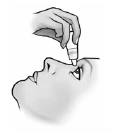
- Tilt the head backward and hold the bottle upside down over the eye.
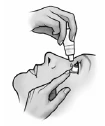
- Gently pull down the lower eyelid and look upward. Squeeze the container gently so that a single drop falls into the space between the lower eyelid and the eye.
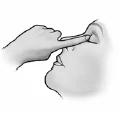
- Close the eye and press with a finger on the inner corner of the eye for about one minute. This helps prevent the drop from draining through the tear duct.
- Wipe away any excess solution from the skin around the eyes.
- Replace the cap and close the bottle.
If an additional drop is needed, or if treatment involves both eyes, repeat the steps described in steps 3 to 7.
Oftaquix must not be injected into the interior of the eyeball.
Use of more than the recommended dose of Oftaquix
If more than the recommended dose is used, rinse the eye(s) with clean water and
inform a doctor or pharmacist.
Missed dose of Oftaquix
If a dose of eye drops is missed, apply the next dose as soon as remembered. Do not use a double
dose to make up for a missed dose.
Accidental swallowing of Oftaquix
The amount of levofloxacin contained in the bottle is too small to cause adverse effects. However,
if in doubt, consult a doctor or pharmacist, who will advise on necessary measures.
Stopping treatment with Oftaquix earlier than advised by the doctor may prolong the healing process.
If there are any further questions about the use of this medicine, consult a doctor, pharmacist, or nurse.
4. Possible adverse reactions
Like any medicine, this medicine can cause adverse reactions, although not everyone will experience them.
They occur in approximately one in ten people using the medicine Oftaquix. Most of these
adverse reactions affect only the eye and may not last long. If a patient experiences any
severe or persistent adverse reactions, use of the medicine Oftaquix should be discontinued and
urgent medical advice should be sought.
There is a possibility of developing an allergic reaction to this medicine.
The following allergic reactions may rarely occur (may affect up to 1 in 1,000 people):
- worsening of redness and itching of the eyes
- sudden onset or worsening of eyelid swelling.
The following allergic reactions may very rarely occur (may affect up to 1 in 10,000 people):
- swelling or tightness in the throat
- difficulty breathing. The above symptoms may occur even after a single dose of Oftaquix.
If any of the above adverse reactions occur, use of the medicine Oftaquix should be discontinued and immediate contact should be made with a doctor or the nearest hospital Emergency Department.
In addition, the following may occur:
Common adverse reactions (may affect up to 1 in 10 people)
- burning sensation in the eye
- blurred vision or mucous discharge in the conjunctival sac.
Uncommon adverse reactions (may affect up to 1 in 100 people):
- headache
- burning or irritation of the eyes
- swelling or redness (bloodshot eyes) of the conjunctiva (the front layer covering the eye)
- skin rash around the eyes
- itching of the eyes
- eye pain
- dryness or soreness of the eyes
- sensitivity to light
- sticking together of eyelids
- nasal congestion or cold-like symptoms.
Rare adverse reactions (may affect up to 1 in 1,000 people):
- allergic reactions such as skin rash.
Additional adverse reactions in children and adolescents
The frequency, type, and severity of adverse reactions in children and adolescents are expected to be the same as in adults.
Reporting of adverse reactions
If any adverse reactions occur, including any adverse reactions not listed in this leaflet, inform a doctor, pharmacist, or nurse. Adverse reactions can be reported directly to the Department of Monitoring Adverse Reactions of Medicinal Products, Office for Registration of Medicinal Products, Medical Devices and Biocidal Products, Al. Jerozolimskie 181C, 02-222 Warsaw, tel.: +48 22 49 21 301, fax: +48 22 49 21 309, website: https://smz.ezdrowie.gov.pl.
Reporting adverse reactions helps to provide more information on the safety of the medicine.
5. How to store the medicine Oftaquix
Keep the medicine out of the sight and reach of children.
Do not store above 25°C.
Keep the bottle tightly closed.
Do not use this medicine after the expiry date stated on the packaging. The expiry date refers to the last day of the stated month.
Do not use this medicine if, in a new bottle, the plastic seal around the nozzle and dropper is missing or damaged.
To prevent contamination of the drops, the bottle must be discarded 4 weeks after first opening and a new bottle used.
Medicines should not be disposed of via wastewater or household waste. Ask your pharmacist how to dispose of medicines no longer required. These measures help protect the environment.
6. Contents of the pack and other information
What Oftaquix contains
- The active substance is levofloxacin. 1 ml contains 5 mg of levofloxacin (as 5.12 mg of levofloxacin hemihydrate).
- The other components are: benzalkonium chloride, sodium chloride, hydrochloric acid diluted, sodium hydroxide diluted, water for injections.
What Oftaquix looks like and contents of the pack
- Oftaquix is a clear solution, pale yellow to pale greenish-yellow in colour, free from visible particles of solid matter.
- The pack contains a white bottle with 5 ml of solution. The plastic bottle is closed with a screw cap.
For more detailed information, please contact the responsible party or the parallel importer.
Responsible party in Bulgaria, country of export:
Santen Oy, Niittyhaankatu 20, 33720 Tampere, Finland
Manufacturer:
Santen Oy, Kelloportinkatu 1, 33100 Tampere, Finland
Parallel importer:
InPharm Sp. z o.o., Strumykowa 28/11, 03-138 Warsaw, Poland
Repackaged in:
InPharm Sp. z o.o. Services sp. k., Chełmżyńska 249, 04-458 Warsaw, Poland
Marketing authorisation number in Bulgaria, country of export: 20040266
Parallel import authorisation number: 403/15
This medicinal product is authorised in the European Economic Area countries under the following names:
This medicinal product is authorised under the name Oftaquix in the following European Economic Area member states:
Austria, Czech Republic, Denmark, Estonia, Finland, Germany, Hungary, Iceland, Italy, Latvia, Lithuania, Luxembourg, Poland, Portugal, Romania, Slovakia, Sweden, United Kingdom