Oculosan
Poland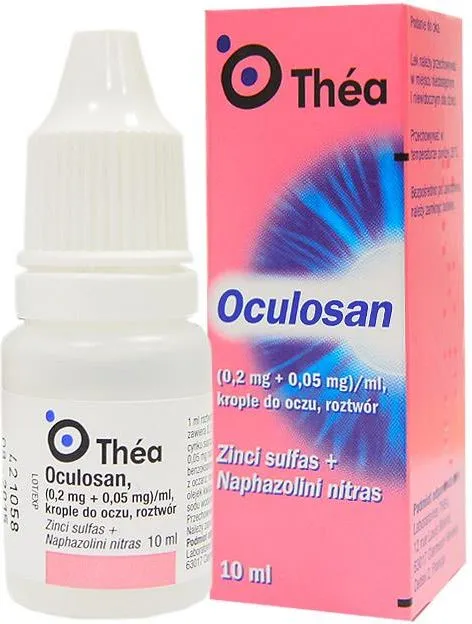
Table of Contents
Package leaflet: Information for the patient
Oculosan, (0.2 mg + 0.05 mg)/ml, eye drops, solution
Zinci sulfas + Naphazolini nitras
Please read all of this leaflet carefully before using this medicine, because it contains
important information for the patient.
This medicine should always be used exactly as described in this patient leaflet or as directed
by the doctor or pharmacist.
- Keep this leaflet so that you can read it again if necessary.
- If you need advice or further information, consult your pharmacist.
- If you experience any adverse reactions, including any possible adverse reactions not listed in this leaflet, inform your doctor or pharmacist.
- If there is no improvement within 2 days, or if your condition worsens, consult your doctor.
Contents of the leaflet
- What Oculosan is and what it is used for
- Important information before using Oculosan
- How to use Oculosan
- Possible side effects
- How to store Oculosan
- Contents of the package and other information
1. What Oculosan is and what it is used for
Oculosan contains two active substances: zinc sulfate and naphazoline nitrate.
It is used for the short-term treatment of redness and nonspecific eye irritation.
This medicine should not be used for longer than 3 days without medical supervision.
2. Important information before using Oculosan
When not to use Oculosan
- if the patient is allergic to the active substances or to any of the other ingredients of the medicine (listed in section 6);
- if the patient has dry eye syndrome, especially dry keratoconjunctivitis (Sjögren's syndrome);
- if the patient has narrow-angle glaucoma;
- in patients taking MAO inhibitors (used in neurology and psychiatry);
- in children;
- in pregnant and breastfeeding women.
Patients should inform their doctor about all concomitant medical conditions. This will help determine whether
treatment with Oculosan is possible.
Warnings and precautions
Do not use the medicine while wearing contact lenses. Contact lenses should not be worn in case of eye irritation.
- Patients should not use Oculosan for prolonged periods without medical advice. If eye irritation persists beyond 2 days of use, the medicine should be discontinued and the patient should contact
their doctor, who will initiate alternative treatment. If eye pain or visual disturbances occur, the use of the medicine must be stopped immediately.
Caution is advised in patients with predisposition to glaucoma, as well as in those with hypertension,
heart disorders, pheochromocytoma, aneurysm, hyperglycemia, or hyperthyroidism.
Prolonged use may lead to rebound hyperemia.
Children
Oculosan should not be used in children.
Oculosan with other medicines
Tell your doctor or pharmacist about all medicines currently used or recently used, as well as any medicines you plan to take.
If other ophthalmic medicines are used together with Oculosan, consult your doctor or pharmacist to determine the optimal timing for administration of each medicine.
When using other ophthalmic medicines simultaneously, an interval of at least 5 minutes should be maintained between administrations.
Patients treated with MAO inhibitors should not use medicines containing naphazoline, and should avoid such medicines for 10 days after the last dose of an MAO inhibitor.
Concomitant use of naphazoline with tricyclic antidepressants may enhance their effects.
Pregnancy and breastfeeding
If the patient is pregnant or breastfeeding, suspects she may be pregnant, or is planning to have a child, she should consult her doctor or pharmacist before using any medicine.
The use of Oculosan in pregnant and breastfeeding women is contraindicated.
Driving and operating machinery
After using Oculosan, limited ability to drive and operate machinery may rarely occur, caused by pupil dilation or blurred vision.
Oculosan contains benzalkonium chloride. Soft contact lenses should not be worn during instillation of the medicine. Lenses may be reinserted at least 15 minutes after instilling Oculosan.
3. How to use Oculosan
This medicine should always be used exactly as described in this patient information leaflet or as directed by a physician. If in doubt, consult a doctor or pharmacist.
The recommended dose of Oculosan in adult patients is 1 drop into the conjunctival sac 3 to 4 times daily.
Instructions for use:
- Wash your hands;
- Gently pull down the lower eyelid with one hand;
- Tilt your head backward;
- Hold the open bottle in the other hand by its lower part and position it above the eye;
- Carefully squeeze the bottle to instill 1 drop into the corner of the eye;
- Do not touch the eye or any other surface with the dropper tip, as this may contaminate the solution in the bottle;
- After instillation, it is recommended to gently press with the fingertip on the inner corner of the closed eyelid for 1 to 2 minutes. This may help prevent the drop from draining through the tear ducts into the nose and reduce the risk of systemic adverse effects.
Use of a higher than recommended dose of Oculosan
Following accidental oral ingestion, the following symptoms may occur: dizziness, headache, nausea, nervousness, weakness, cardiac arrhythmias, pallor, sweating, pupil dilation, increased blood pressure, drowsiness, and decreased body temperature. In infants, bradycardia or even coma may occur.
Seek immediate medical attention.
If you have any further questions about the use of this medicine, consult your doctor or pharmacist.
4. Possible adverse effects
Like all medicines, this medicine can cause adverse effects, although not everyone will experience them.
Local adverse effects
Blurred vision.
Very rare: pupil dilation with slight increase in intraocular pressure.
Immediately after instillation of the medicine, mild burning may occur, which does not affect the treatment outcome.
Long-term use may exceptionally cause redness of the eyes (this is a transient effect).
With prolonged use, the following may occur: conjunctival hyperaemia, dryness of the mucous membrane, burning sensation of the ocular mucous membrane.
Systemic adverse effects
In rare cases, systemic circulatory disturbances (hypertension, cardiac disorders) may occur. In some patients, fatigue, hyperactivity (palpitations, tremor, weakness, sweating), angina-like symptoms and headache have been observed.
Reporting of adverse effects
If any adverse effects occur, including any adverse effects not listed in this leaflet, inform your doctor or pharmacist. Adverse effects can be reported directly to the Department of Monitoring Adverse Drug Reactions of the Office for Registration of Medicinal Products, Medical Devices and Biocidal Products:
Al. Jerozolimskie 181C, 02-222 Warsaw
Tel.: + 48 22 49 21 301
Faks: + 48 22 49 21 309
e-mail: [email protected]
Adverse effects can also be reported to the marketing authorization holder.
By reporting adverse effects, additional information on the safety of the medicine can be collected.
5. How to store Oculosan
Keep the medicine out of sight and reach of children.
Store below 25°C.
After each instillation, close the bottle immediately.
After first opening, the medicine remains stable for 28 days.
Do not use this medicine after the expiry date stated on the container.
Medicines must not be disposed of via wastewater or household waste. Ask your pharmacist how to properly dispose of medicines no longer in use. This will help protect the environment.
6. Contents of the packaging and other information
What Oculosan contains
- The active substances in this medicine are zinc sulfate and naphazoline nitrate. 1 ml of solution contains 0.2 mg of zinc sulfate and 0.05 mg of naphazoline nitrate.
- Other ingredients are: benzalkonium chloride (preservative), purified water, eyebright tincture, 95% ethanol, orange flower oil, lavender oil, sodium chloride, sodium hydroxide, water for injections.
What Oculosan looks like and contents of the pack
Oculosan is a sterile aqueous solution used as eye drops.
It is packaged in a transparent polyethylene bottle with a dropper and a cardboard box. The bottle contains 10 ml of solution.
Marketing Authorisation Holder and Manufacturer
Marketing Authorisation Holder:
Laboratoires THEA
12 rue Louis Blériot
63017 Clermont-Ferrand Cedex 2
France
Manufacturers:
EXCELVISION
27 rue de la Lombardière
ZI la Lombardière
07100 Annonay
France
Laboratoires THEA
12 rue Louis Blériot
63017 Clermont-Ferrand Cedex 2
France
For further information, please contact the representative of the Marketing Authorisation Holder:
Thea Polska Sp. z o.o.
ul. Cicha 7
00-353 Warsaw
tel.: +48 22 642 87 77