Octenisept
Poland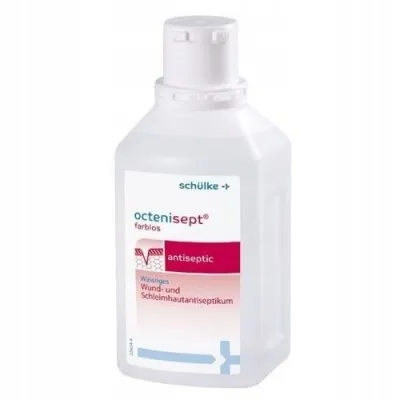
Table of Contents
Package leaflet: information for the patient
Warning! Keep this leaflet! The information on the immediate packaging is in a foreign language.
Octenisept, (0.10 g + 2.00 g)/100 g, solution for skin application
Octenidini dihydrochloridum + Phenoxyethanolum
Please read this leaflet carefully before using the medicine, as it contains important information for the patient.
This medicine should always be used exactly as described in this patient leaflet or as directed by a doctor or pharmacist.
- Keep this leaflet so that you can read it again if necessary.
- If you need advice or further information, please consult your pharmacist.
- If any adverse reactions occur, including any possible adverse reactions not listed in this leaflet, inform your doctor or pharmacist. See section 4.
- If there is no improvement or if the patient feels worse, consult a doctor.
Table of contents of the leaflet:
- What Octenisept is and what it is used for
- Important information before using Octenisept
- How to use Octenisept
- Possible side effects
- How to store Octenisept
- Contents of the pack and other information
1. What Octenisept is and what it is used for
Octenisept is a disinfectant solution containing the active substances: octenidine dihydrochloride, phenoxyethanol. Octenisept has bactericidal, fungicidal and virucidal properties. The microbiological efficacy of the medicine has been widely documented in both laboratory and clinical studies. The effectiveness of the solution in destroying microorganisms or inactivating viruses occurs within 1 minute of application. Even under laboratory conditions with additional protein load from mucous membranes, the medicine exerts a destructive effect on bacteria (including Chlamydia and Mycoplasma), fungi, yeasts, protozoa (Trichomonas), and viruses (Herpes simplex, inactivates HBV and HIV). The effect of the medicine lasts for one hour, thereby ensuring safety during diagnostic, therapeutic or surgical procedures. Octenidine dihydrochloride belongs to cationic-active compounds, has two active centers, and acts on the surface of wounds and skin. Phenoxyethanol complements the spectrum of activity of octenidine dihydrochloride by acting in deeper layers of the skin and mucous membranes.
Octenisept is intended for:
- disinfection and supportive treatment of minor, superficial wounds, and skin disinfection prior to non-surgical procedures
- supportive antiseptic management of closed skin surfaces after procedures – e.g. post-procedural sutures
- repeated, short-term antiseptic treatment of mucous membranes and adjacent tissues before and after diagnostic procedures in the oral cavity, genital organs and anus, including vagina, vulva and glans penis, as well as prior to urinary bladder catheterization
- use in paediatrics (e.g. for umbilical stump care)
- disinfection of the oral cavity (e.g. aphthae, irritations caused by orthodontic appliances or dental prostheses)
- short-term, supportive antiseptic treatment of interdigital mycosis
- use in the genital organs, e.g. in inflammatory conditions of the vagina, as well as on the glans penis in males.
Octenisept is intended for use in adults and children of all ages.
2. Important information before using Octenisept
When not to use Octenisept
Do not use this medicine if the patient is allergic to octenidine dihydrochloride, phenoxyethanol, or any of the other ingredients of this medicine (listed in section 6).
Octenisept must not be used for peritoneal lavage.
Warnings and precautions
Talk to your doctor or pharmacist before using Octenisept.
This medicine is for topical use only.
Caution! To avoid tissue damage and local swelling, the medicine must not be injected or introduced under pressure into tissues. In all cases, adequate drainage from body cavities or wounds must be ensured (e.g. by drainage or suction).
Use with caution in newborns, especially premature infants. Octenisept may cause severe skin reactions. Excess product should be removed, and care must be taken to ensure that the solution does not remain in contact with the skin longer than necessary (this also applies to materials soaked with the solution that are in direct contact with the patient).
Octenisept must not be used in the eyes. If contact occurs, rinse the eyes immediately with a large amount of water.
Use of Octenisept inside the ear is not recommended, and ingestion must be avoided.
Octenidine dihydrochloride is more toxic when administered intravenously than orally; therefore, care should be taken to avoid significant systemic absorption, e.g. due to accidental injection. However, since octenidine dihydrochloride is present in Octenisept only at a concentration of 0.1%, the risk associated with this substance is unlikely.
Octenisept and other medicines
Inform your doctor or pharmacist about all medicines the patient is currently using or has recently used, as well as any medicines the patient intends to use.
Octenisept should not be used concomitantly with antiseptics based on PVP-iodine (iodine-povidone complex) on adjacent areas of the body, as this may result in strong brown or even violet discolorations.
As a cationic agent, Octenisept may form poorly soluble residues when combined with anionic surfactants or detergents.
Pregnancy, breastfeeding, and fertility
If the patient is pregnant or breastfeeding, suspects she might be pregnant, or is planning to become pregnant, she should consult her doctor or pharmacist before using this medicine.
Pregnancy
Octenisept should not be used during the first three months of pregnancy due to lack of clinical data and as a general precaution.
Octenisept may be used during the remainder of pregnancy only if considered necessary by the physician.
Breastfeeding
There is no data available on the use of Octenisept during breastfeeding. Octenisept should not be used without medical advice.
Octenisept should be removed from the breast area before breastfeeding to prevent the newborn from being exposed to the medicine.
Driving and operating machinery
No studies have been performed on the effects of Octenisept on the ability to drive or operate machinery.
3. How to use Octenisept
This medicine should always be used exactly as described in this patient information leaflet or as directed by a doctor or pharmacist. If in doubt, consult your doctor or pharmacist.
Octenisept is intended for use in its undiluted form.
Method of administration
Application to the skin
Octenisept should be applied at least once daily to the affected area by spraying, wiping with a sterile swab, or using a compress, ensuring complete moistening of the area.
Disinfection of skin and mucous membranes
Areas of skin and mucous membranes to be treated should be thoroughly moistened with a sterile swab soaked in Octenisept or by spraying the medicine directly onto accessible areas of skin and mucous membranes. The required contact time must be observed – a minimum of 1 minute, with extension up to 5 minutes recommended. Ensure even moistening of the entire surface. Leave in place for at least 1 minute. As supportive treatment in fungal skin infections between the toes, spray the affected areas morning and evening for 14 days.
Antiseptic treatment of superficial wounds
Spray the wound or wipe with a sterile swab soaked in Octenisept. Octenisept should always be used during each dressing change. In wounds with exudate, apply Octenisept as a compress, ensuring contact with the wound and maintaining moistening for at least 1 minute, with extension up to 5 minutes recommended.
Postoperative suture care
Spray the wound or wipe with a sterile swab soaked in Octenisept. Octenisept should always be used during each dressing change. Octenisept has antiseptic and local anesthetic effects. The area surrounding the wound should be disinfected using sterile swabs soaked in undiluted Octenisept, applied radially from the center of the wound outwards.
Antiseptic treatment of the vaginal mucous membrane
Moisten the vaginal mucous membrane with Octenisept, ensuring contact of the medicine with the mucous membrane for at least 1 minute. Numerous clinical studies have demonstrated that Octenisept effectively exerts bactericidal action against various bacteria, including Gram-positive and Gram-negative species.
Antiseptic treatment of the male glans penis
Moisten the mucous membrane of the glans penis with Octenisept, ensuring contact of the medicine with the mucous membrane for at least 1 minute.
Disinfection of the oral cavity
Rinse the mouth thoroughly with 20 ml of Octenisept for 20 seconds.
Umbilical stump care
For umbilical stump care, use a gauze pad soaked in Octenisept. After 1 minute, gently dry the stump and surrounding skin. The infant's umbilical stump should be kept clean and dry.
Use of a higher than recommended dose of Octenisept
If more medicine is used than recommended or if the medicine is ingested, contact a doctor immediately.
If you have any further questions about the use of this medicine, consult your doctor or pharmacist.
4. Possible adverse reactions
Like any medicinal product, this medicine may cause adverse reactions, although not everyone experiences them.
After moistening the vaginal mucosa, a sensation of warmth or burning may occur in rare cases. When rinsing the mouth, a bitter taste may persist for about 1 hour; this is related to the action of the medicine.
Reporting of adverse reactions
If any adverse reactions occur, including any adverse reactions not listed in this leaflet, inform your doctor or pharmacist. Adverse reactions can be reported directly to the Department of Monitoring Adverse Drug Reactions at the Office for Registration of Medicinal Products, Medical Devices and Biocidal Products, Al. Jerozolimskie 181C, 02-222 Warsaw, phone: +48 22 49 21 301, fax: +48 22 49 21 309; website: https://smz.ezdrowie.gov.pl.
Reporting adverse reactions enables better assessment of the medicine's safety profile.
5. How to store Octenisept
Store below 25°C.
Keep the medicine out of sight and reach of children.
Do not use this medicine after the expiry date stated on the packaging. The expiry date refers to the last day of the stated month.
Shelf life after first opening of the bottle: 3 years.
Medicines must not be disposed of via wastewater or household waste. Ask your pharmacist how to dispose of medicines no longer required. This will help protect the environment.
6. Package contents and other information
What Octenisept contains
The active substances in this medicinal product are: octenidine dihydrochloride and phenoxyethanol.
100 g of the skin solution contains 0.10 g of octenidine dihydrochloride and 2.00 g of phenoxyethanol.
The other ingredients are: cocamidopropyl dimethylammonium chloride, sodium D-gluconate,
glycerol 85%, sodium hydroxide, sodium chloride, purified water.
What Octenisept looks like and contents of the pack
Octenisept is a clear, colourless, almost odourless solution.
Packaging:
Plastic bottle with spray pump, containing 50 ml of solution, in a cardboard box.
For further information, please contact the responsible entity or the parallel importer.
Marketing Authorisation Holder in Austria, country of export:
Schülke & Mayr GmbH
Seidengasse 9
A-1070 Vienna
Austria
Manufacturer:
Schülke & Mayr GmbH
D-22840 Norderstedt
Germany
Parallel Importer:
InPharm Sp. z o.o.
Strumykowa 28/11
03-138 Warsaw
Poland
Repackaged by:
InPharm Sp. z o.o. Services sp. k.
Chełmżyńska 249
04-458 Warsaw
Poland
Marketing Authorisation Number in Austria, country of export: 1-20402
Marketing Authorisation Number for Parallel Import: 154/23