Octagam 10%
Poland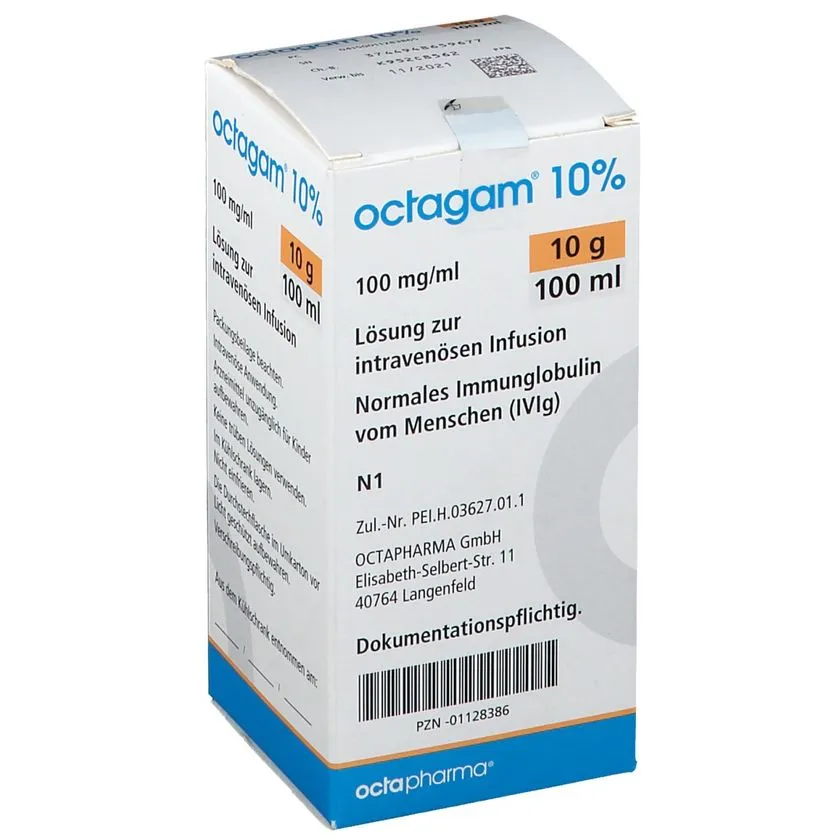
Table of Contents
Octagam 10% infusion solution
Human normal immunoglobulin (IVIg)
Please read this leaflet carefully before using the medicine, as it contains
important information for the patient.
Keep this leaflet, so that you can read it again if necessary.
If you have any further questions, please consult your doctor or pharmacist.
This medicine has been prescribed for a specific individual. Do not pass it on to others. The medicine may harm someone else, even if their symptoms are the same.
If any adverse reactions occur in the patient, including any not listed in this leaflet, inform your doctor or pharmacist. See section 4.
Contents of the leaflet
- What Octagam 10% is and what it is used for
- Important information before using Octagam 10%
- How to use Octagam 10%
- Possible side effects
- How to store Octagam 10%
- Contents of the package and other information
1. What Octagam 10% is and what it is used for
What Octagam 10% is
Octagam 10% is a solution of normal human immunoglobulin (IgG) (i.e. a solution of human antibodies) for intravenous administration (i.e. infusion into a vein). Immunoglobulins are normal components of the human body and support its immune system. Octagam 10% contains all IgG antibodies present in the normal human population. Appropriate doses of this medicinal product can restore abnormally low immunoglobulin levels to normal.
Octagam 10% provides a broad spectrum of antibodies against various infectious agents.
What Octagam 10% is used for
Octagam 10% is used for replacement therapy in children, adolescents (0–18 years) and adults in various patient groups:
- Patients with congenital antibody deficiency (primary immunodeficiency disorders), such as: congenital agammaglobulinaemia and hypogammaglobulinaemia, common variable immunodeficiency, severe combined immunodeficiency
- Patients with acquired antibody deficiency (secondary immunodeficiency) caused by certain diseases and/or treatments, who experience severe or recurrent infections
Octagam 10% may also be used for treatment of susceptible adults, children and adolescents (aged 0–18 years) who have been exposed to measles or are at risk of exposure to measles, and in whom active measles vaccination is contraindicated or not recommended.
Octagam 10% may additionally be used in the treatment of the following autoimmune diseases (immunomodulation):
- In patients with immune thrombocytopenia (ITP) — a disorder in which platelets are destroyed and their number reduced — who are at high risk of bleeding or require platelet count correction before surgery;
- In patients with Kawasaki disease — a condition leading to inflammation of various organs;
- In patients with Guillain-Barré syndrome — a disorder causing inflammation of certain parts of the nervous system;
- In patients with chronic inflammatory demyelinating polyradiculoneuropathy (CIDP) — a disease causing chronic inflammation in the peripheral nervous system, resulting in numbness or muscle weakness, primarily in the arms and legs;
- In patients with multifocal motor neuropathy (MMN) — a condition characterized by slowly progressive, asymmetric limb weakness without loss of sensation;
- In adult patients with active dermatomyositis (DM), a disease causing inflammation of muscles and skin lesions. Typical symptoms include progressive, symmetrical muscle weakness and characteristic skin rashes (e.g. on the eyelids, cheeks, nose, back, elbows, knuckles), as well as dry, scaly skin. Octagam 10% may be used in patients treated with immunosuppressive drugs such as corticosteroids, or when such drugs are contraindicated or poorly tolerated.
2. Important information before using Octagam 10%
When not to use Octagam 10%
- if the patient has a known hypersensitivity to human immunoglobulin or to any of the other components of Octagam 10% (listed in section 6),
- if the patient has immunoglobulin A deficiency (IgA deficiency) and has developed antibodies against IgA immunoglobulins.
Warnings and precautions
Before starting treatment with Octagam 10%, discuss this with your doctor or pharmacist. It is strongly recommended that the name and batch number of the product be recorded each time Octagam 10% is administered to a patient, in order to maintain traceability between the patient and the batch of product used.
Adverse reactions may occur more frequently:
- if the infusion rate is too high,
- in patients receiving Octagam 10% for the first time, or, in rare cases, after a long interval since the last infusion,
- if the patient has untreated infection or chronic inflammatory conditions.
If adverse reactions occur, the infusion rate should be reduced or the infusion stopped. The required management in the event of an adverse reaction will depend on the nature and severity of the reaction.
Circumstances and conditions increasing the risk of adverse reactions
-
In very rare cases, thromboembolic events such as myocardial infarction, stroke, and deep vein thrombosis (e.g. in the calf) or pulmonary blood vessel occlusion may occur after administration of Octagam 10%. These events occur more frequently, although still very rarely, in patients with risk factors such as obesity, advanced age, high blood pressure, diabetes, dermatomyositis, previous history of such events, prolonged immobilization, or use of certain hormones (e.g. oral contraceptives). In such cases, adequate fluid replacement should be ensured, and Octagam 10% should be administered at the lowest possible infusion rate.
-
If the patient has previously had kidney problems or has certain risk factors such as diabetes, overweight, or is over 65 years of age, Octagam 10% should be administered at the lowest possible infusion rate, as cases of acute kidney failure, although very rare, have been reported in patients with such risk factors. If any of the above conditions apply to the patient, even if they occurred in the past, inform the doctor.
-
Patients with blood group A, B, or AB, as well as patients with certain inflammatory conditions, are at increased risk of red blood cell destruction caused by administered immunoglobulins (a phenomenon known as haemolysis).
When might it be necessary to reduce the infusion rate or stop the infusion?
-
Rarely, severe headache and neck stiffness may occur within a few hours to 2 days after receiving Octagam 10%.
-
Allergic reactions are rare, but this medicine may cause anaphylactic shock, even in patients who previously tolerated it well. A sudden drop in blood pressure or shock may result from an anaphylactic reaction.
-
In very rare cases, acute transfusion-related lung injury (TRALI) may occur after administration of immunoglobulins, including Octagam 10%. TRALI leads to fluid accumulation in the lung air spaces unrelated to heart disease. Symptoms of TRALI include severe shortness of breath and elevated body temperature (fever), while heart function remains normal. Symptoms typically occur within 1 to 6 hours after administration of the medicine.
If the patient notices any of the above reactions during or after infusion of Octagam 10%, they should immediately inform the doctor or healthcare professional. The doctor or healthcare professional will decide whether to reduce the infusion rate or stop the infusion completely, and whether further actions are required.
- Occasionally, immunoglobulin solutions such as Octagam 10% may cause a decrease in white blood cell count. This condition usually resolves spontaneously within 1–2 weeks.
Viral safety
For medicines derived from human blood or plasma, precautions must be taken to prevent transmission of infectious diseases. Such precautions include:
- careful selection of blood and plasma donors to exclude carriers of infectious diseases,
- testing of individual donations and pooled plasma for the presence of virus/infection,
- virus inactivation or removal procedures used by manufacturers during blood or plasma processing.
Despite these measures, it is not possible to completely exclude the risk of transmitting infectious agents when administering medicines derived from human blood or plasma. This includes unknown or emerging viruses or other pathogens. Precautions taken help prevent transmission of enveloped viruses such as human immunodeficiency virus (HIV), hepatitis B virus, and hepatitis C virus.
Precautions taken may have limited effectiveness against non-enveloped viruses such as hepatitis A virus (HAV) and parvovirus B19. Immunoglobulins are not associated with hepatitis A or parvovirus B19 infections, likely due to protective antibodies present in the product against these infections.
Children and adolescents
There are no special or additional warnings or precautions for children and adolescents.
Octagam 10% and other medicines
Inform your doctor about all medicines the patient is currently taking or has recently taken, including those obtained without prescription, as well as any vaccinations administered within the last three months.
The infusion line may be flushed before and after administration of Octagam 10% with 0.9% sodium chloride solution or 5% dextrose solution.
Concomitant use of loop diuretics should be avoided.
Octagam 10% may reduce the effectiveness of vaccines containing live attenuated viruses, such as measles, mumps, rubella, and varicella vaccines.
Vaccination with live attenuated virus vaccines should be delayed by three months after administration of immunoglobulin. In the case of measles vaccine, effectiveness may be reduced for up to 1 year.
Effect on blood test results
Patients undergoing blood tests after receiving Octagam 10% should inform the person drawing blood or the doctor that they have received normal human immunoglobulin solution, as this may affect test results.
Blood glucose testing
Some types of blood glucose monitoring systems (so-called glucometers) may incorrectly identify maltose present in Octagam 10% as glucose. This may lead to falsely elevated glucose readings during infusion and for approximately 15 hours after infusion ends, potentially resulting in inappropriate insulin administration and life-threatening hypoglycaemia (low blood sugar). Also, in cases of true hypoglycaemia, treatment may not be administered due to falsely elevated glucose readings.
Therefore, during administration of Octagam 10% or other products containing maltose,
blood glucose levels should be measured using a glucose-specific testing system. Systems based on
pyrroloquinoline quinone glucose dehydrogenase (GDH-PQQ) or glucose oxidoreductase methods should not be used.
Carefully read the information provided with the glucose monitoring system, including test strips, to determine whether the system is suitable for use during concomitant administration of parenteral products containing maltose. If in doubt, contact the treating physician to confirm whether the glucose monitoring system is appropriate for use during concomitant administration of parenteral products containing maltose.
Octagam 10% with food, drink, and alcohol
No interactions have been observed. When administering Octagam 10%, adequate hydration should be ensured prior to infusion.
Pregnancy, breastfeeding, and fertility
If the patient is pregnant, breastfeeding, suspects she may be pregnant, or plans to become pregnant, she should consult her doctor or pharmacist before using this medicine.
The safety of this medicine in pregnant women has not been established in controlled clinical trials, and therefore it should be administered to pregnant women and breastfeeding mothers with particular caution. It has been shown that IVIg medicinal products cross the placenta, with increasing transfer during the third trimester. Clinical experience with immunoglobulin use suggests they do not have harmful effects on pregnancy, fetal development, or the newborn.
Immunoglobulins are excreted in human milk. No adverse effects on breastfed infants/children are expected.
Clinical experience with immunoglobulin use suggests no harmful effect on fertility is expected.
Driving and operating machinery
Octagam 10% has no effect or negligible effect on the ability to drive or operate machinery. However, patients who experience adverse reactions during treatment should not drive or operate machinery until these symptoms have resolved.
Octagam 10% contains sodium
100 ml of this medicine contains 69 mg of sodium (the main component of table salt), equivalent to 3.45% of the WHO recommended maximum daily sodium intake for adults (2 g). This should be taken into account in patients who are monitoring their dietary sodium intake.
3. How to use Octagam 10%
The need for treatment and the dose of Octagam 10% is determined by the doctor. Octagam 10% is administered as an intravenous infusion (a drip into a vein) by medical personnel. The dose and dosing regimen depend on the indication and require individual determination for each patient.
- If in doubt about how to use the medicine, consult your doctor or pharmacist.
Use in children and adolescents
Administration (intravenous) of Octagam 10% to children and adolescents (0–18 years) does not differ from administration to adults.
Accidental overdose of Octagam 10%
Overdose is very unlikely because Octagam 10% is usually administered under medical supervision. However, if the patient receives a higher dose than recommended, their blood may become too thick (excessively viscous), increasing the risk of blood clots. This may be particularly likely if the patient is in a risk group, for example, is elderly or has heart or kidney disease. Adequate hydration should be ensured. Inform the doctor if any health problems occur.
Missed dose of Octagam 10%
Discuss with your doctor how to proceed.
4. Possible adverse reactions
Like any medicine, this type of medicine may cause adverse reactions, although not everyone will experience them.
If any of the following adverse reactions occur, contact your doctor immediately (these adverse reactions are very rare
and may occur less frequently than 1 in 10,000 infusions).
In some cases, your doctor may need to stop the infusion, reduce the dose, or discontinue treatment:
- Swelling of the face, tongue, or windpipe causing significant breathing difficulties;
- Sudden allergic reaction with shortness of breath, rash, wheezing, and drop in blood pressure;
- Stroke causing weakness and/or loss of sensation on one side of the body;
- Heart attack causing chest pain;
- Blood clot causing pain and swelling in limbs;
- Blood clot in the lungs causing chest pain and shortness of breath;
- Anaemia causing shortness of breath or paleness;
- Severe kidney problems leading to inability to pass urine;
- Lung disease known as transfusion-related acute lung injury (TRALI), causing difficulty breathing, bluish skin discoloration, fever, and drop in blood pressure;
- Severe headache combined with any of the following symptoms: neck stiffness, drowsiness, fever, light sensitivity, nausea, vomiting (these may be signs of meningitis). If any of the above adverse reactions occur, contact your doctor immediately.
Additionally, the following adverse reactions have been reported during use of this medicine:
Common adverse reactions (may occur in up to 1 in 10 infusions):
- Hypersensitivity (allergic reaction);
- Headache;
- Nausea;
- Changes in blood pressure;
- Fever.
Uncommon adverse reactions (may occur in up to 1 in 100 infusions):
- Deficiency of various blood cells;
- Changes in heart rhythm;
- Vomiting;
- Stroke;
- Dizziness;
- Tingling or prickling sensation of the skin;
- Tremor;
- Blurred vision;
- Blood clots in blood vessels;
- Deep vein thrombosis;
- Pulmonary embolism;
- Back pain;
- Chest pain;
- Joint or muscle pain;
- Involuntary muscle contractions;
- Pain in arms or legs;
- Breathing difficulties;
- Chills;
- Feeling of fatigue, general malaise, or weakness;
- Fluid in limb tissues;
- Skin reactions at the injection site;
- Abnormal blood test results (related to liver function or red blood cells).
Other adverse reactions not observed in clinical trials but also reported include:
- Fluid overload;
- Low sodium levels in blood;
- Feeling of restlessness, anxiety, confusion, or nervousness;
- Migraine;
- Speech disorders;
- Loss of consciousness;
- Reduced sensation or touch perception;
- Light sensitivity;
- Visual impairment;
- Angina;
- Palpitations;
- Transient bluish discoloration of lips or other skin areas;
- Respiratory failure or shock;
- Phlebitis (vein inflammation);
- Pale skin;
- Cough;
- Pulmonary oedema (fluid accumulation in the lungs);
- Bronchospasm (difficulty breathing or wheezing);
- Respiratory failure;
- Lack of oxygen in blood;
- Diarrhoea, abdominal pain;
- Hives, skin itching;
- Skin redness;
- Skin rash;
- Skin peeling;
- Skin inflammation;
- Hair loss;
- Muscle weakness or stiffness;
- Severe and painful muscle cramps;
- Neck pain;
- Kidney pain;
- Skin swelling (oedema);
- Hot flushes, excessive sweating;
- Feeling of discomfort in the chest;
- Flu-like symptoms;
- Feeling of cold or heat;
- Drowsiness;
- Burning sensation;
- False readings of blood glucose levels.
Reporting of adverse reactions
If any adverse symptoms occur, including any adverse symptoms not listed in this leaflet, inform your doctor, pharmacist, or nurse.
Adverse reactions can be reported directly to the Department of Monitoring Adverse Drug Reactions, Office for Registration of Medicinal Products, Medical Devices and Biocidal Products
Al. Jerozolimskie 181C
02-222 Warsaw
Phone: +48 22 49 21 301
Fax: +48 22 49 21 309
Website: https://smz.ezdrowie.gov.pl
Adverse reactions can also be reported to the marketing authorisation holder.
Reporting adverse reactions helps provide more information on the safety of the medicine.
5. How to store Octagam 10%
Keep this medicine out of the sight and reach of children.
Do not use Octagam 10% after the expiry date stated on the label and carton.
Store in a refrigerator (2°C – 8°C). Keep the container in the outer packaging to protect it from light. Do not freeze.
The medicine may be removed from the refrigerator once for a period of up to 9 months (without exceeding the expiry date) and may be stored at a temperature ≤ 25°C. At the end of this period, the medicine must not be returned to the refrigerator but should be discarded. The date of removal from the refrigerator should be recorded on the outer packaging.
Use immediately after first opening.
Do not use Octagam 10% if cloudiness, sediment or pronounced discoloration of the solution is visible.
Medicines must not be disposed of via wastewater or household waste. Ask your pharmacist how to dispose of medicines no longer required. These measures will help protect the environment.
6. Contents of the package and other information
What Octagam 10% contains
The active substance is normal human immunoglobulin (human antibodies), solution 10% (containing at least 95% immunoglobulin G).
The other components of the medicine are maltose and water for injections.
What Octagam 10% looks like and contents of the pack
Octagam 10% is a solution for infusion available in vials (2 g/20 ml) or bottles (5 g/50 ml, 6 g/60 ml, 10 g/100 ml, 20 g/200 ml, 30 g/300 ml).
Pack sizes:
2 g in 20 ml
5 g in 50 ml
6 g in 60 ml
10 g in 100 ml
20 g in 200 ml
3 x 10 g in 3 x 100 ml
3 x 20 g in 3 x 200 ml
30 g in 300 ml
Not all pack sizes may be marketed.
The solution is clear or slightly opalescent, colourless or slightly yellow.
Marketing Authorisation Holder and Manufacturer
Octapharma (IP) SPRL
Route de Lennik 451
1070 Anderlecht
Belgium
Manufacturer
Octapharma Pharmazeutika Produktionsges.m.b.H.
Oberlaaer Strasse 235, A-1100 Vienna, Austria
Octapharma AB
Lars Forssells gata 23
SE-112 75 Stockholm, Sweden
This medicine is authorised in the European Economic Area and the United Kingdom (Northern Ireland) under the following names:
Austria, Czech Republic, Denmark, Finland, France,
Latvia, Norway, Portugal, Slovenia, Sweden: Octagam 100 mg/ml
Hungary:
Belgium, Bulgaria, Cyprus, Estonia, Netherlands,
Iceland, Lithuania, Luxembourg, Malta, Germany,
Octagam 10%
Poland, Romania, Slovakia, and United Kingdom (Northern Ireland)
Italy: Gamten 100 mg/ml
Spain: Octagamocta 100 mg/ml
The following information is intended for healthcare professionals only:
- Warm the product to room temperature or body temperature before use.
- The solution should be clear to slightly opalescent and colorless to pale yellow.
- Do not use the solution if it is cloudy or contains precipitate.
- Any unused product or waste material must be disposed of in accordance with local regulations.
- This medicinal product must not be mixed with other medicinal products.
- To administer any residual medication remaining in the infusion tubing at the end of the infusion, the tubing may be flushed with 0.9% sodium chloride solution or 5% dextrose solution.