Obsidan
Poland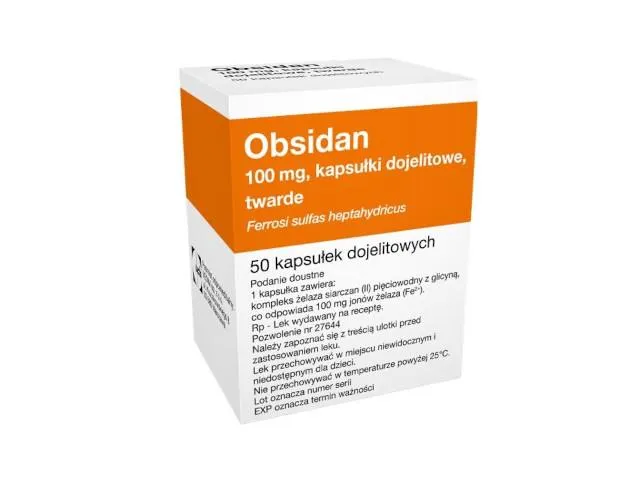
Table of Contents
Package leaflet: Information for the user
Obsidan, 100 mg, hard enteric-coated capsules
Ferrosi sulfas heptahydricus
Please read all of this leaflet carefully before taking this medicine, because it contains
important information for the patient.
- Keep this leaflet, as you may need to read it again.
- If you have any further questions, please ask your doctor or pharmacist.
- This medicine has been prescribed for a specific individual. Do not pass it on to others. This medicine may harm other people, even if their symptoms are the same.
- If you experience any adverse effects, including any not listed in this leaflet, inform your doctor or pharmacist. See section 4.
Table of contents
- What Obsidan is and what it is used for
- Important information before taking Obsidan
- How to take Obsidan
- Possible side effects
- How to store Obsidan
- Contents of the pack and other information
1. What Obsidan is and what it is used for
Obsidan is an iron preparation intended for oral administration, used in the treatment or prevention of iron deficiency. Iron is essential for oxygen transport and energy transfer in the body. These capsules are described as enteric-coated, because they do not release their contents in the stomach. Instead, they transport iron to the intestines, where it is absorbed.
Obsidan is used for the treatment of iron deficiency.
2. Important information before taking Obsidan
When not to take Obsidan
- if the patient is allergic to iron compounds or any of the other ingredients of this medicine (listed in section 6);
- if the patient has oesophageal stricture;
- if the patient suffers from an inherited disease caused by excessive accumulation of iron in the body (haemochromatosis);
- if the patient suffers from diseases caused by excess iron in the body (chronic haemolysis, thalassaemia, other haemoglobinopathies);
- if the patient suffers from iron metabolism disorders (e.g. sideroblastic anaemia, anaemia caused by lead poisoning);
- if the patient is receiving repeated blood transfusions.
Children
- Children under 6 years of age must not take Obsidan.
- Children aged 6 years and older with body weight below 20 kg must not take Obsidan.
Warnings and precautions
Before starting treatment with Obsidan, discuss it with your doctor or pharmacist.
While taking Obsidan, exercise particular caution:
- if the patient already suffers from gastrointestinal disorders, such as chronic inflammatory bowel diseases, oesophageal or intestinal strictures, diverticulosis, gastric mucosal inflammation, peptic ulcer disease of the stomach and/or intestines;
- if the patient suffers from chronic kidney disease requiring administration of erythropoietin; iron should be administered intravenously because orally administered iron is poorly absorbed in patients with uraemia;
- if the patient suffers from impaired liver function and/or alcoholism;
- if the patient is elderly and has blood or iron loss of unknown cause. In such cases, the cause of anaemia/bleeding source should be thoroughly investigated.
- The patient's teeth may become discoloured during treatment with Obsidan. (These discolourations may resolve after discontinuation of Obsidan. If they persist, they can be removed using a whitening toothpaste or professional dental cleaning.)
Children
Exercise particular caution when administering Obsidan to children, as overdose in children may lead to poisoning.
Obsidan and other medicines
Tell your doctor or pharmacist if you are taking, have recently taken or might take any other medicines.
Increased effectiveness and possible worsening of adverse effects
- Painkillers and anti-rheumatic drugs (e.g. salicylates and phenylbutazone): may intensify gastric mucosal irritation caused by Obsidan.
- Intravenous administration of iron together with oral iron-containing medicines may lead to hypotension (low blood pressure) or even shock due to rapid release of iron and possible overdose. This combination is not recommended.
Reduced effectiveness and possible worsening of adverse effects
- Certain antibiotics (tetracyclines) or drugs (bisphosphonates) used in the treatment of weakened bone structure (osteoporosis): if the patient is also taking Obsidan, absorption of both iron and tetracycline or bisphosphonates is reduced. This means that the effectiveness of these drugs will be diminished. Ask your doctor whether an increased dose of these drugs is necessary.
- Calcium-, magnesium- or aluminium-containing medicines, e.g. gastric acid neutralisers, calcium and magnesium salts used in substitution therapy: these medicines reduce or prevent absorption of iron from Obsidan. An increased dose of Obsidan may be necessary.
- Drugs used for arthritis, such as penicillamine and oral gold compounds, drugs used in Parkinson's disease, such as methyldopa and levodopa, and levothyroxine used in the treatment of hypothyroidism: these drugs are less well absorbed when taken simultaneously with iron-containing Obsidan. Ask your doctor whether an increased dose of these drugs is necessary.
- Antibiotics belonging to the group known as fluoroquinolones, for example ciprofloxacin, levofloxacin, norfloxacin and ofloxacin: iron significantly reduces absorption of these drugs. Before starting treatment with these drugs, the patient should inform the doctor that they are taking Obsidan.
The time interval between taking Obsidan and any of the above-mentioned medicines should be at least two hours.
The time interval between taking Obsidan and tetracycline (other than doxycycline) (see below) should be at least three hours.
- Doxycycline and Obsidan should not be taken together, as doxycycline may inhibit absorption and distribution of Obsidan.
Other possible adverse effects
- Obsidan may cause darkening of the stool, which does not indicate occult gastrointestinal bleeding.
- Obsidan contains vitamin C, which may cause false-negative results in routine faecal occult blood tests.
Obsidan with food and drink
Do not take Obsidan during meals. Substances present in plant-based products (e.g. cereals and vegetables) may form compounds with iron (e.g. phytates, oxalates and phosphates). These compounds impair iron absorption. Components of coffee, tea, milk and cola may also reduce iron absorption into the blood.
The time interval between consuming these foods and taking Obsidan should be at least two hours.
Pregnancy and breastfeeding
If the patient is pregnant or breastfeeding, suspects she may be pregnant, or is planning to have a child, she should consult her doctor or pharmacist before using this medicine.
There are no known risks associated with using Obsidan during pregnancy and breastfeeding.
Driving and using machines
It is unlikely that Obsidan affects the ability to drive or operate machinery.
Obsidan contains sodium
This medicine contains less than 1 mmol (23 mg) of sodium per capsule, i.e. the medicine is considered "sodium-free".
3. How to take Obsidan
This medicine should always be taken exactly as described in this leaflet or as directed by
your doctor or pharmacist. If in doubt, consult your doctor or pharmacist.
Do not take more than 5 mg of Obsidan per kilogram of body weight. For example,
if a patient weighs 60 kg, the maximum daily dose will be 5 x 60 = 300 mg (three
capsules).
Unless otherwise prescribed by a doctor, the usual dose is:
Children from 6 years of age (minimum body weight – 20 kg), adolescents and adults
| Body weight (kg) | Number of capsules per dose | Frequency of administration | Total dose of Fe2+ (mg) |
| ≥ 20 | 1 | once daily | 100 |
Adolescents from 15 years of age (minimum body weight – 50 kg) and adults
For adolescents from 15 years of age and adults with significant iron deficiency,
the following dosage is recommended at the beginning of treatment:
| Body weight (kg) | Number of capsules per dose | Frequency of administration | Total Fe2+ dose (mg) |
| 50 - < 60 | 1 | Twice daily | 200 |
| ≥ 60 | 1 | 2 - 3 times daily in divided doses | 200 - 300 |
Use in children and adolescents
Obsidan must not be used in children under 6 years of age (with body weight below 20 kg) (see section 2).
Children aged 6 years and older (with a minimum body weight of 20 kg) may be given 1 capsule per day.
Further information on dosing can be found in the table.
Method of administration
Obsidan capsules should be taken with an adequate amount of water. DO NOT chew the capsule. The capsules should be taken at an appropriate interval from meals (e.g. in the morning on an empty stomach or between two main meals), as food components may reduce absorption.
Note
If a patient is unable or unwilling to swallow the capsule, the capsule may be opened and its contents swallowed. To do this, gently pull the two halves of the capsule apart over a bowl. Carefully shake out the contents, remove them with a teaspoon, and swallow. After swallowing the capsule contents, drink some water.
Duration of treatment
The physician will decide how long Obsidan should be taken.
Treatment should be continued until normal blood iron levels are achieved, which usually takes 10 to 20 weeks or longer in cases of underlying chronic disease.
The duration of treatment for prevention of iron deficiency depends on the situation (pregnancy, blood donation, long-term hemodialysis, and planned autotransfusion – a blood transfusion procedure in which the recipient and donor are the same person).
Overdose of Obsidan
Following intentional or accidental overdose, symptoms described in section 4 "Possible undesirable effects" may occur and may be more severe.
If a patient takes too much Obsidan, a doctor should be contacted immediately.
Overdose may lead to poisoning, particularly in children.
Iron poisoning causes symptoms such as: restlessness, abdominal pain, nausea, vomiting, and diarrhea. Stools become tarry in appearance, and vomit may contain blood.
Shock, acidosis (disturbed acid-base balance, excess acid in the body), and coma may occur. After seizures, Cheyne-Stokes respiration (abnormal breathing pattern characterized by alternating periods of shallow and deep breathing), coma, and pulmonary edema, death may occur.
Missed dose of Obsidan
Do not take a double dose to make up for a missed dose. If a patient forgets one or more doses of Obsidan, treatment should be continued for a slightly longer period.
Discontinuation of Obsidan
No special precautions are required when stopping treatment with Obsidan.
If there are any further doubts regarding the use of this medicine, consult a doctor or pharmacist.
4. Possible adverse reactions
Like all medicines, this medicinal product may cause adverse reactions, although not everybody will experience them.
The medicine Obsidan may, in isolated cases (frequency cannot be estimated), cause a severe allergic reaction (anaphylactic). In case of severe rash, itching, and difficulty breathing, consult a doctor immediately.
Common adverse reactions (occur in 1 to 10 out of 100 patients):
- discomfort in the stomach or intestines (abdominal area);
- heartburn;
- vomiting;
- loose stools (diarrhea);
- nausea;
- constipation;
- stools (faeces) with dark discoloration.
Rare adverse reactions (occur in 1 to 10 out of 10,000 patients):
- tooth discoloration (see also special precautions during use of Obsidan in section 2);
- hypersensitivity (e.g. skin hypersensitivity symptoms, erythema, rash, urticaria).
Unknown frequency (cannot be estimated from available data):
- abdominal pain and epigastric pain;
- gastrointestinal bleeding;
- change in tongue coloration;
- change in coloration of the oral cavity.
Reporting of adverse reactions
If any adverse reactions occur, including any adverse reactions not listed in this leaflet, inform your doctor or pharmacist. Adverse reactions can be reported directly to the Department of Monitoring Adverse Drug Reactions at the Office for Registration of Medicinal Products, Medical Devices and Biocidal Products:
Al. Jerozolimskie 181C,
02-222 Warsaw,
Tel.: +48 22 4921301,
Fax: +48 22 4921309,
Website: https://smz.ezdrowie.gov.pl.
Reporting adverse reactions enables continuous monitoring of the benefit-risk balance of the medicinal product.
Adverse reactions may also be reported to the marketing authorization holder.
5. How to store Obsidan
Keep this medicine out of sight and reach of children.
Do not use this medicine after the expiry date stated on the outer packaging and blister.
The expiry date refers to the last day of the stated month.
Do not store above 25°C.
6. Contents of the packaging and other information
What the medicine Obsidan contains
- The active substance is iron(II) sulfate pentahydrate complex with glycine. One capsule contains: 567.7 mg of iron(II) sulfate pentahydrate complex with glycine, corresponding to 100 mg of iron ions (Fe2+).
- Other components are: Granules containing iron(II) sulfate pentahydrate complex with glycine: ascorbic acid, microcrystalline cellulose, hypromellose, hydroxypropylcellulose, methacrylic acid and ethyl acrylate copolymer (1:1), 30% dispersion (Eudragit L30 D 55) (containing methacrylic acid and ethyl acrylate copolymer (1:1), sodium lauryl sulfate, polysorbate 80), acetyltributyl citrate, talc. Capsule:
- body: gelatin, titanium dioxide (E 171), iron oxide red (E 172), iron oxide yellow (E 172);
- cap: gelatin, titanium dioxide (E 171), iron oxide red (E 172), iron oxide black (E 172).
What Obsidan looks like and contents of the pack
Obsidan is an enteric, hard gelatin capsule of approximately 21.7 mm x 7.5 mm in size, with an opaque chocolate-brown cap without imprint and an opaque orange body without imprint. It contains enteric-coated, greyish-brown granules.
Obsidan is available in packs containing 30, 50, 90, 100 or 500 enteric hard capsules.
Not all pack sizes may be marketed.
Marketing Authorisation Holder
VEDIM sp. z o.o.
ul. Kruczkowskiego 8
00-380 Warszawa
Tel.: + 48 22 696 99 20
Manufacturer
Aesica Pharmaceuticals GmbH
Alfred-Nobel-Str. 10
40789 Monheim am Rhein
Germany
This medicine is authorised in the European Economic Area under the following names:
Denmark: Niferex
Spain: Ferro Sanol
Greece: Ferro Sanol Duodenal
Italy: Niferex
Norway: Niferex
Poland: Obsidan
Sweden: Niferex