Nutriflex special
Poland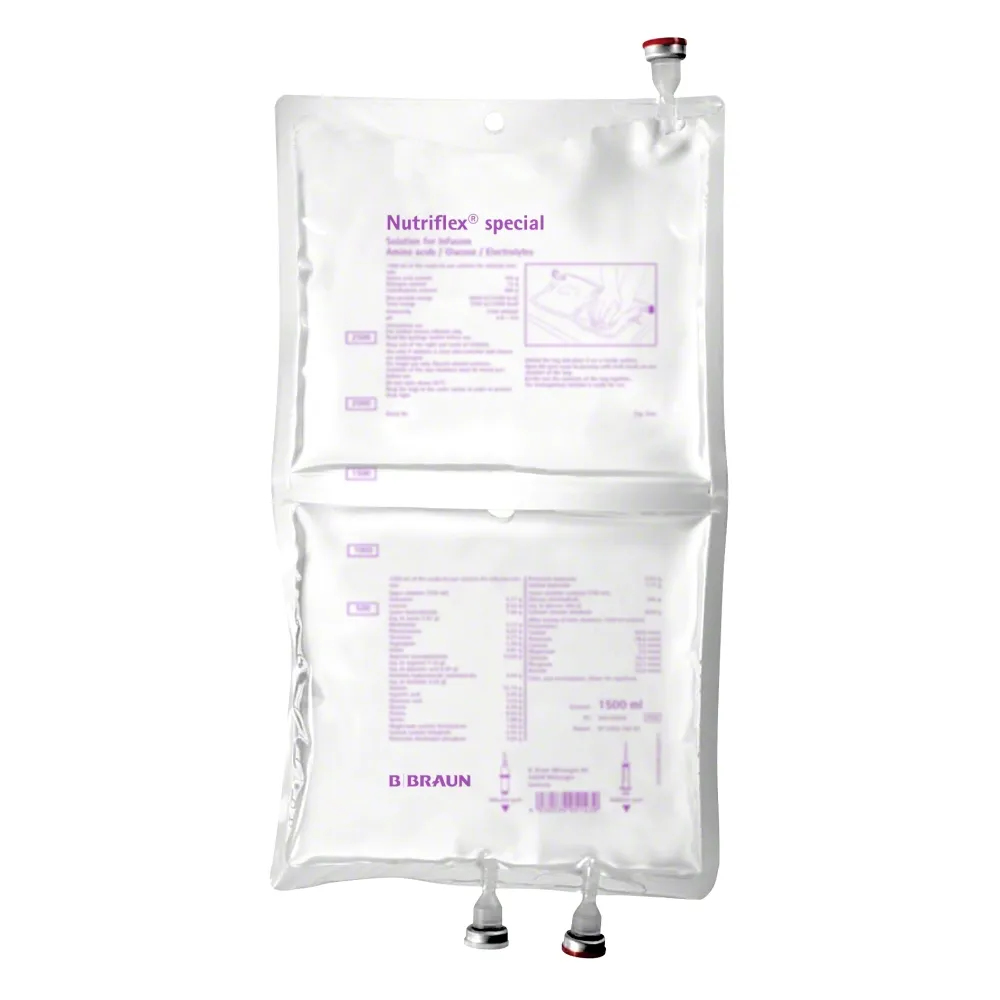
Table of Contents
- Patient Information Leaflet
- 1. What Nutriflex Special is and what it is used for
- 2. Before using Nutriflex Special
- 3. How to use Nutriflex Special
- 4. Possible adverse reactions
- 5. How to store Nutriflex Special
- 6. Contents of the pack and other information
- Information intended exclusively for medical professionals:
Patient Information Leaflet
Nutriflex Special dual-chamber bag for infusion solution
Amino acids / Glucose / Electrolytes
Please read this leaflet carefully before use, as it contains
important information for the patient.
- Keep this leaflet for future reference.
- If you have any questions, please consult your doctor, pharmacist, or nurse.
- This medicine has been prescribed for a specific individual. Do not share it with others. This medicine may harm others, even if their symptoms are the same.
- If the patient experiences any adverse reactions, including any not listed in this leaflet, inform your doctor, pharmacist, or nurse immediately. See section 4.
Contents:
- What Nutriflex Special is and what it is used for
- Before you are given Nutriflex Special
- How to use Nutriflex Special
- Possible side effects
- How to store Nutriflex Special
- Contents of the pack and other information
1. What Nutriflex Special is and what it is used for
This medicine contains fluids and substances called amino acids, salts (electrolytes), and carbohydrates (glucose), which are essential for body growth or recovery, as well as calories in the form of carbohydrates.
Since the patient is unable to eat normally or be fed through a feeding tube, this medicine will be administered directly into the vein (infusion).
Nutriflex Special is particularly indicated for adults and children and adolescents aged 2–17 years with moderate or severe catabolism, a condition in which the patient consumes energy and protein reserves faster than they can be replenished.
2. Before using Nutriflex Special
When not to use Nutriflex Special:
- if the patient is allergic to the active substances or any of the other ingredients of this medicine (listed in section 6);
- if the patient has inherited disorders of amino acid metabolism requiring a special protein diet;
- if the patient has high blood sugar levels requiring insulin administration at doses exceeding 6 units per hour;
- if the patient has increased levels of acidic substances in the blood (acidosis);
- if the patient has bleeding within the skull or spinal cord;
- if the patient has severe liver failure;
- if the patient has severe kidney failure without access to renal replacement therapy (hemofiltration or dialysis).
As with other medicines of this type, Nutriflex Special must not be used in the following conditions:
- acute phase of heart attack (myocardial infarction) or shock;
- any untreated or inadequately treated metabolic disorders, e.g. loss of consciousness (coma) of unknown origin, insufficient tissue oxygenation, or uncontrolled diabetes;
- life-threatening circulatory disorders such as those occurring during collapse or shock, fluid accumulation in the lungs (pulmonary edema), or disturbances in water balance.
Nutriflex Special must not be administered to newborns, infants, or children under 2 years of age.
Warnings and precautions
Before starting treatment with Nutriflex Special, discuss it with your doctor.
Inform your doctor if:
- the patient has heart or kidney disorders;
- the patient has fluid, electrolyte, or acid-base imbalances, for example, low levels of body fluids and electrolytes (hypotonic dehydration), or low levels of sodium or potassium in the blood;
- the patient has high blood sugar levels.
Dosage must be carefully adjusted and monitored in patients with kidney, liver, adrenal, heart, or lung impairment.
Your doctor will exercise particular caution in patients with impaired blood-brain barrier, as this medicine may increase intracranial or intraspinal pressure.
In patients with severe malnutrition, parenteral nutrition should be introduced gradually and with great caution. Adequate supply of electrolytes, especially potassium, magnesium, and phosphate, must be ensured.
This medicine contains glucose (a type of sugar), which may affect the patient's blood sugar level. Blood tests may be necessary to monitor this.
Sudden interruption of the infusion may lead to a rapid drop in blood sugar levels. Your doctor will take this into account, especially in patients with impaired glucose metabolism (e.g. diabetic patients) and in children under 3 years of age. Therefore, blood sugar levels should be closely monitored, particularly after stopping the infusion.
Electrolyte levels in the blood, fluid balance, acid-base balance, red blood cell count, coagulation factors, and liver function should also be monitored.
Your doctor will ensure appropriate fluid and electrolyte supply. To meet the patient's nutritional requirements, additional nutritional substances will be administered alongside Nutriflex Special.
As with all intravenous solutions, strict aseptic techniques must be observed during the infusion of Nutriflex Special.
Children and adolescents
Regarding rapid drop in blood sugar levels in children and adolescents following sudden interruption of infusion, see section "Warnings and precautions".
Nutriflex Special must not be administered to newborns, infants, or children under 2 years of age.
Nutriflex Special and other medicines
Tell your doctor about all medicines the patient is currently taking or has recently taken, as well as any medicines the patient plans to take.
Nutriflex Special may interact with certain other medicines. Inform your doctor if the patient is taking or receiving any of the following medicines:
- drugs used to treat inflammatory conditions (corticosteroids);
- hormonal preparations affecting fluid balance (adrenocorticotropic hormone [ACTH]);
- diuretics such as spironolactone, triamterene, or amiloride;
- drugs used to treat high blood pressure (ACE inhibitors) such as captopril and enalapril;
- drugs used to treat high blood pressure or heart conditions (angiotensin II receptor antagonists) such as losartan and valsartan;
- drugs used in organ transplantation, such as cyclosporine and tacrolimus.
Pregnancy, breastfeeding and fertility
If the patient is pregnant or breastfeeding, suspects she may be pregnant, or is planning to become pregnant, she should consult her doctor before using this medicine.
Pregnancy
If the patient is pregnant, she will receive this medicine only if the doctor considers it absolutely necessary for her recovery.
Breastfeeding
Breastfeeding is not recommended for mothers receiving parenteral nutrition.
Fertility
No data are available.
Driving and operating machinery
This medicine is usually administered to immobilized patients, e.g. in hospital or clinic settings, which excludes driving and operating machinery. However, the medicine itself does not affect the ability to drive or operate machinery.
3. How to use Nutriflex Special
This medicine is administered by intravenous infusion (drip infusion), meaning through a thin tube directly into a vein.
Before starting the infusion, the medicine should be warmed to room temperature.
Your doctor will decide how much of this medicine you need and how long you will require treatment with it.
The recommended dose for adult patients is up to 25 ml of infusion solution per kg of body weight.
Your doctor will determine the appropriate dose.
Use in children and adolescents
Dosage should be adjusted for children and adolescents aged 2 to 17 years. Your doctor knows the appropriate dosage for patients in this age group.
Administration of a higher than recommended dose of Nutriflex Special
If too high a dose of this medicine is administered, the patient may develop so-called overload syndrome and the following symptoms may occur:
- fluid overload (hypervolemia);
- increased urine production (polyuria);
- electrolyte imbalance;
- fluid in the lungs (pulmonary edema);
- loss of amino acids in urine and amino acid imbalance;
- accumulation of acidic substances in the blood (metabolic acidosis);
- vomiting, nausea, chills, headache;
- elevated blood glucose levels (hyperglycemia);
- glucose in the urine (glycosuria);
- fluid deficiency (dehydration);
- significantly higher blood osmolality than normal (hyperosmolality);
- impaired or lost consciousness due to extremely high blood glucose levels (hyperglycemic-hyperosmolar state).
If any of these symptoms occur, the infusion must be stopped immediately. The doctor will decide whether further treatment is necessary. Before resuming the infusion, any imbalances should be corrected.
If you have any doubts, consult your doctor, pharmacist, or nurse.
4. Possible adverse reactions
Like all medicines, this medicine can cause adverse reactions, although not everybody gets them.
Adverse reactions are usually the result of overdose or infusion administered too rapidly, and typically resolve after
stopping the infusion.
Rare (occurring in 1 out of 1,000 patients):
- Nausea, vomiting and loss of appetite;
- Excessive urine production (polyuria).
If adverse reactions occur, the infusion should be stopped or, if appropriate, continued at a reduced rate.
Reporting of adverse reactions
If any adverse effects occur, including any adverse effects not listed in this leaflet, inform your doctor or nurse.
Adverse reactions can be reported directly to the Department of Monitoring Adverse Drug Reactions of the Office for Registration of Medicinal Products, Medical Devices and Biocidal Products:
Al. Jerozolimskie 181C,
02-222 Warsaw,
tel.: 22 49-21-301,
fax: 22 49-21-309,
website: https://smz.ezdrowie.gov.pl
Adverse reactions can also be reported to the marketing authorization holder.
Reporting adverse reactions helps to provide more information on the safety of the medicine.
5. How to store Nutriflex Special
Keep the medicine out of the reach and sight of children.
Do not store above 25°C.
Store the bag in the outer packaging to protect from light.
Do not use the medicine after the expiry date stated on the packaging. The expiry date refers to the last day of the stated month.
6. Contents of the pack and other information
What Nutriflex Special contains
The active substances of the medicine are amino acids, glucose and electrolytes.
Each bag after mixing contains:
| 1000 ml | 1500 ml | |
| Isoleucine | 4.11 g | 6.17 g |
| Leucine | 5.48 g | 8.22 g |
| Lysine hydrochloride (as lysine) | 4.97 g 3.98 g | 7.46 g 5.97 g |
| Methionine | 3.42 g | 5.13 g |
| Phenylalanine | 6.15 g | 9.23 g |
| Threonine | 3.18 g | 4.77 g |
| Tryptophan | 1.00 g | 1.50 g |
| Valine | 4.54 g | 6.81 g |
| Arginine monoglutamate (as arginine) (as glutamic acid) | 8.72 g 4.73 g 3.99 g | 13.08 g 7.10 g 5.99 g |
| Histidine hydrochloride monohydrate (as histidine) | 2.96 g 2.19 g | 4.44 g 3.29 g |
| Alanine | 8.49 g | 12.74 g |
| Aspartic acid | 2.63 g | 3.95 g |
| Glutamic acid | 2.15 g | 3.23 g |
| Glycine | 2.89 g | 4.34 g |
| Proline | 5.95 g | 8.93 g |
| Serine | 5.25 g | 7.88 g |
| Magnesium acetate tetrahydrate | 1.08 g | 1.62 g |
| Sodium acetate trihydrate | 1.63 g | 2.45 g |
| Potassium dihydrogen phosphate | 2.00 g | 3.00 g |
| Potassium hydroxide | 0.62 g | 0.93 g |
| Sodium hydroxide | 1.14 g | 1.71 g |
| Glucose monohydrate (as glucose) | 264.0 g 240.0 g | 396.0 g 360.0 g |
| Calcium chloride dihydrate | 0.60 g | 0.90 g |
The other ingredients of the medicine are citric acid and water for injections.
| Electrolytes: | 1000 ml | 1500 ml |
| Sodium | 40.5 mmol | 60.8 mmol |
| Potassium | 25.7 mmol | 38.6 mmol |
| Calcium | 4.1 mmol | 6.2 mmol |
| Magnesium | 5.0 mmol | 7.5 mmol |
| Chloride | 49.5 mmol | 74.3 mmol |
| Phosphate | 14.7 mmol | 22.1 mmol |
| Acetate | 22.0 mmol | 33.0 mmol |
| 1000 ml | 1500 ml | |
| Amino acid content | 70 g | 105 g |
| Nitrogen content | 10 g | 15 g |
| Carbohydrate content | 240 g | 360 g |
| 1000 ml | 1500 ml | |
| Energy from amino acids [kJ (kcal)] | 1172 (280) | 1757 (420) |
| Energy from carbohydrates [kJ (kcal)] | 4017 (960) | 6025 (1440) |
| Total energy [kJ (kcal)] | 5198 (1240) | 7782 (1860) |
| Theoretical osmolarity [mOsm/L] | 2100 | 2100 |
| pH | 4.8 – 6.0 | 4.8 – 6.0 |
What Nutriflex Special looks like and contents of the pack
This medicine is a solution for infusion, i.e. it is administered through a thin tube directly into a vein.
Nutriflex Special is supplied in dual-chamber infusion bags. The lower chamber contains glucose,
and the upper chamber contains an amino acid solution. The glucose and amino acid solutions are clear, colourless or slightly yellowish.
The medicine is supplied in dual-chamber plastic bags containing:
- 1000 ml (500 ml amino acids + 500 ml glucose)
- 1500 ml (750 ml amino acids + 750 ml glucose)
Pack sizes: 5 × 1000 ml, 5 × 1500 ml
Not all pack sizes may be marketed.
Marketing Authorisation Holder and Manufacturer
B. Braun Melsungen AG
Carl-Braun-Straße 1
34212 Melsungen, Germany
Correspondence address
34209 Melsungen
Germany
Tel.: +49-5661-71-0
Fax: +49-5661-71-4567
__________________________________________________________________________
Information intended exclusively for medical professionals:
Before starting the infusion, the medicinal product should be warmed to room temperature.
Nutriflex Special may be used only if the solution is clear and the packaging is undamaged. Any unused portions of the solution must be discarded.
Preparation of the mixed solution:
The barrier between the chambers should be broken immediately before use, and the contents mixed under aseptic conditions.
Remove the bag from its protective packaging and proceed as follows:
- Open the bag and lay it flat on a stable surface.
- Open the breakable partition using both hands.
- Gently mix the contents of the chambers.
The additional port allows for the addition of other substances to Nutriflex Special.
When adding other solutions or fat emulsions to Nutriflex Special, aseptic techniques must be strictly observed. Fat emulsions can be easily added to the solution using a special infusion set.
Maximum infusion rates:
The maximum infusion rate for adult patients, children, and adolescents aged 2 to 17 years is 1.0 ml per kg of body weight per hour.
Storage after mixing the bag contents:
Nutriflex Special should be used immediately after mixing the contents of both chambers. If the medicinal product cannot be used immediately after mixing, it may be stored for up to 7 days at room temperature and up to 14 days at 2–8°C (including administration time). Partially used containers must not be reconnected.