Novo-helisen depot
Poland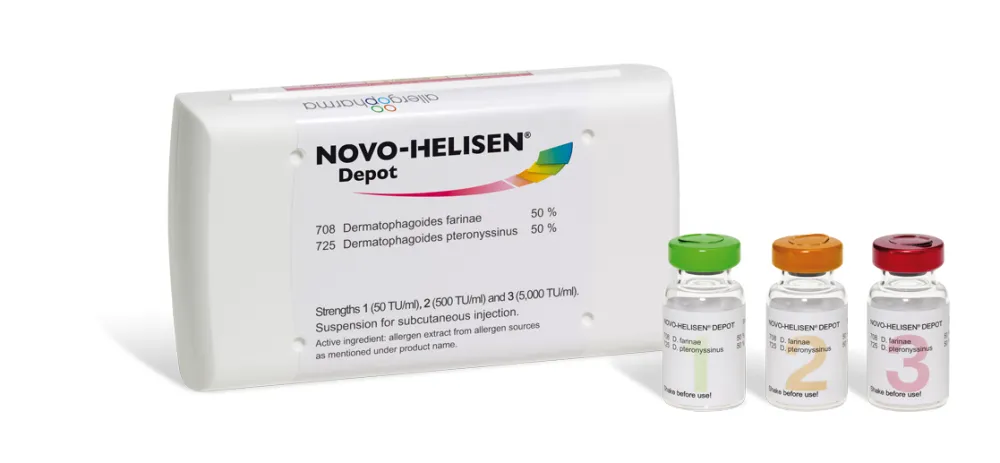
Table of Contents
- Package leaflet: Information for the user
- 1. What Novo-Helisen Depot is and what it is used for
- 2. Important information before using Novo-Helisen Depot
- 3. How to use Novo-Helisen Depot
- 4. Possible adverse reactions
- 5. How to store Novo-Helisen Depot
- 6. Contents of the pack and other information
- Information intended exclusively for healthcare professionals:
Package leaflet: Information for the user
Novo-Helisen Depot
Fungal allergen extracts
Suspension for injection
Please read all of this leaflet carefully before using this medicine, because it contains
important information for the patient.
- Keep this leaflet, as you may need to read it again.
- If you have any further questions, please ask your doctor.
- This medicine has been prescribed for a specific patient only. Do not pass it on to others. This medicine may harm other people, even if their symptoms are the same.
- If you experience any adverse reactions, including any not listed in this leaflet, tell your doctor or nurse. See section 4.
Contents of the leaflet:
- What Novo-Helisen Depot is and what it is used for
- Important information before using Novo-Helisen Depot
- How to use Novo-Helisen Depot
- Possible side effects
- How to store Novo-Helisen Depot
- Contents of the pack and other information
1. What Novo-Helisen Depot is and what it is used for
Novo-Helisen Depot is an allergen extract intended for desensitisation (specific immunotherapy).
During specific immunotherapy, increasing doses of a clinically relevant allergen causing an allergic reaction in the patient are administered by injection until reaching the individual maximum dose, which is then maintained as a maintenance dose.
The aim of this treatment is to alleviate clinical symptoms related to the specific allergen(s) and to reduce the need for symptomatic medications.
Novo-Helisen Depot is used in allergic diseases (IgE-mediated), such as allergic rhinitis, allergic conjunctivitis, allergic asthma, etc., caused by allergens that cannot be eliminated from the patient's environment.
Novo-Helisen Depot is used in adults, adolescents, and children above 5 years of age.
2. Important information before using Novo-Helisen Depot
When not to use Novo-Helisen Depot
- If the patient has hypersensitivity (allergy) to any of the excipients listed in section 6;
- If the patient has uncontrolled asthma, i.e. FEV1 is below 70% of predicted value despite appropriate pharmacotherapy;
- If the patient has permanent lung changes, e.g. pulmonary emphysema, bronchiectasis;
- If the patient has inflammatory or febrile diseases, severe acute or chronic conditions (e.g. neoplastic diseases, active tuberculosis);
- If clinically significant cardiovascular insufficiency has been diagnosed in the patient. In case of a severe allergic reaction after injection of Novo-Helisen Depot, adrenaline is used as emergency treatment. Patients with heart disease have an increased risk of adverse effects following adrenaline administration;
- If the patient has been diagnosed with immunological disorders (severe systemic autoimmune diseases, immune complex-induced immunopathies, immunodeficiencies, or multiple sclerosis, etc.);
- If the patient has previously experienced severe systemic reactions related to specific allergen immunotherapy;
- If the patient has severe psychiatric disorders.
Warnings and precautions
This medicinal product for subcutaneous allergen immunotherapy must be administered only by physicians, nurses, or medical personnel trained or experienced in allergy treatment.
Before starting treatment with Novo-Helisen Depot, discuss with your doctor if:
- The patient is being treated with ACE inhibitors for high blood pressure;
- The patient is being treated with beta-blockers (medicines used to treat high blood pressure or heart disease, or as eye drops for glaucoma treatment);
- The patient is pregnant;
- Acute symptoms of illness are present (e.g. allergic symptoms or cold);
- The patient has symptoms of bronchial asthma;
- The patient has received or has planned vaccination.
The patient should inform the doctor of any changes in health status, such as infectious diseases or pregnancy, and discuss further management. If indicated, lung function tests (e.g. peak expiratory flow measurement) may be performed before injection in patients with bronchial asthma.
The patient should inform the doctor whether the previous injection was well tolerated.
Before each injection, the doctor will determine the individual dose based on tolerance of the last administered dose and clinical history.
In case of severe allergic adverse reactions occurring after or during injection, the doctor may administer adrenaline as emergency treatment. It should be clarified in advance whether adrenaline treatment is possible for the patient.
On the day of injection, strenuous activities such as sports or heavy physical work should be avoided. Alcohol consumption, sauna visits, and hot showers should also be avoided.
In the case of planned vaccination against pathogens, an interval of at least 1 week should be maintained between the last injection of this medicine and the vaccination date. Treatment with this medicine is continued for 2 weeks after vaccination using the last administered dose. Vaccinations that are immediately necessary (e.g. tetanus vaccination after injury) may be given at any time.
Children and adolescents
Treatment with Novo-Helisen Depot is generally not recommended for children under 5 years of age.
Novo-Helisen Depot and other medicines
Inform the doctor about all medicines currently or recently taken or used by the patient, as well as any medicines the patient plans to take or use.
No studies on drug interactions have been conducted.
Please keep in mind the following recommendations and discuss them with your doctor:
- Beta-blockers (medicines used in the treatment of high blood pressure or heart disease, and also as eye drops for glaucoma treatment) may be taken concomitantly with Novo-Helisen Depot only after consultation with a doctor.
- ACE inhibitors (medicines used in the treatment of high blood pressure) may be taken concomitantly with Novo-Helisen Depot only after consultation with a doctor.
- Concomitant treatment with medicines used for allergy treatment (e.g. antihistamines, corticosteroids, mast cell stabilizers) or medicines that partially act similarly to antiallergic drugs (e.g. certain sedatives, antiemetics, antacids) may influence treatment with Novo-Helisen Depot. This may allow for better tolerance of higher doses of this medicine. If these medicines are discontinued, it may be necessary to reduce the dose of Novo-Helisen Depot.
During treatment with Novo-Helisen Depot, exposure to allergens causing allergy—especially mould fungi—should be avoided as much as possible, particularly on the day of administration. Other factors that may trigger allergic reactions should also be avoided.
Novo-Helisen Depot with food, drink, and alcohol
Alcohol should not be consumed on the day of injection.
Pregnancy, breastfeeding, and fertility
If the patient is pregnant or breastfeeding, suspects she may be pregnant, or is planning to become pregnant, she should consult her doctor or pharmacist before using this medicine.
There is insufficient experience with the use of mould allergen extracts in pregnant women.
Therefore, allergen immunotherapy is not recommended during pregnancy.
There are insufficient data available regarding breastfeeding mothers. Although it is unlikely that a breastfed infant would be exposed to risk, the doctor will need to weigh the benefits against the risks during breastfeeding.
There are insufficient data on the effect of Novo-Helisen Depot on fertility.
Driving and operating machinery
Novo-Helisen Depot has minor influence on the ability to drive and operate machinery, as dizziness may occur. This should be taken into account when driving, operating machinery, or working without secure support.
Novo-Helisen Depot contains sodium
This medicine contains less than 1 mmol (23 mg) of sodium per 1.0 mL of maximum dose (concentration 3), meaning the medicine is considered "sodium-free".
3. How to use Novo-Helisen Depot
Recommended dose
A doctor trained or experienced in the treatment of allergies will determine the most appropriate treatment schedule for the patient and will inform the patient about the intervals at which injections will be administered.
The doctor will also determine the appropriate dose. The individual dose depends, among other factors, on how well the patient tolerated the injection.
The maximum dose is 1.0 mL of concentration 3. The individual maximum dose may be lower.
Treatment consists of 2 different phases: initial treatment and maintenance treatment.
Initial treatment (dose escalation)
For seasonal mould allergens, treatment should be started outside the allergy season.
For perennial mould allergens, treatment should be started, whenever possible, during a symptom-free period.
The doctor may choose one of 2 different dose escalation schedules:
- standard dose escalation schedule (14 injections),
- dose escalation schedule for highly sensitive patients (23 injections).
During initial treatment, the doctor will determine the maximum dose tolerated by the patient, gradually increasing the dose up to the maximum recommended dose of the medicinal product.
Injections will be administered at regular intervals of 7 to 14 days until the individual maximum dose or the maximum recommended dose is reached.
If the interval between two injections is exceeded, the doctor may be unable to increase the dose according to the planned schedule. Therefore, it is important always to adhere to the scheduled injection dates and not interrupt initial treatment.
Maintenance treatment
After the doctor has established the individual maximum dose during initial treatment or after reaching the maximum recommended dose of the medicinal product, maintenance treatment begins.
For non-seasonal allergens, once the maximum dose is reached, the intervals between injections are gradually extended so that injections are ultimately administered every 4 to 6 weeks. If the intended 6-week interval is exceeded, the doctor must reduce the next dose. The dose is then increased again at shorter intervals.
It is also important always to adhere to the scheduled injection dates and not interrupt maintenance treatment.
When starting a new batch of Novo-Helisen Depot, the doctor will reduce the dose. The dose will then be increased again at intervals of 7 to 14 days.
Use in children and adolescents
Allergen-specific immunotherapy (desensitisation) is not usually performed in children under 5 years of age, as there is a higher likelihood of problems with acceptance and cooperation in this age group compared to adults.
In children and adolescents, the same initial and maintenance treatment schedules are used as in adults.
Method of administration
Novo-Helisen Depot is administered by subcutaneous injection by a doctor. The injection is given into the outer aspect of the upper arm, approximately one hand's width (of the patient) above the elbow. Doses of 0.5–1 mL may be divided and administered into both arms to improve tolerance. The doctor will shake the medicinal product well before use.
The patient must remain under medical supervision for at least 30 minutes after the injection. The doctor will ask the patient about their general condition. The observation period may be individually extended. In the event of adverse reactions, even after the observation period, the patient should contact the doctor immediately.
The doctor may use two different desensitising preparations. If both preparations are to be administered on the same day, at least a 30-minute interval between injections should be maintained. However, it is recommended that injections be given 2 to 3 days apart. Each preparation should be administered separately into the right and left arm.
Duration of treatment
The recommended duration of treatment is generally 3 years.
Use of a higher than recommended dose of Novo-Helisen Depot
Overdosing may lead to allergic reactions and even anaphylactic shock. In such cases, the doctor will take the necessary countermeasures. Typical symptoms are described in section 4, "Possible side effects".
Missed dose of Novo-Helisen Depot
Patients should always attend their scheduled appointments to ensure treatment success is not compromised. If a patient misses a scheduled appointment, the treatment schedule may need to be adjusted. The patient should contact their doctor, who will explain how to proceed.
Discontinuation of Novo-Helisen Depot treatment
This should be discussed with the doctor in advance. If treatment is discontinued prematurely, the therapeutic effect may be weakened.
If you have any doubts regarding the use of this medicinal product, consult your doctor.
4. Possible adverse reactions
Like all medicines, this medicine can cause adverse reactions, although not everyone experiences them.
After administration of this medicine, the patient will be monitored for at least 30 minutes.
The physician will ask the patient about their general condition. It should be remembered that adverse reactions may also occur
after this observation period. In case of any adverse symptoms, contact the physician immediately.
Significant adverse reactions and countermeasures
If intolerance symptoms occur during injection, the physician will immediately stop the injection.
Reactions at the injection site (e.g. redness, itching, swelling) as well as systemic reactions (e.g. shortness of breath, generalized itching, generalized redness) may occur.
Severe allergic reactions up to anaphylactic shock may occur. Anaphylactic reactions, including
anaphylactic shock, may occur within seconds to minutes after injection.
Typical warning symptoms include itching and feeling of warmth on and under the tongue and in the throat, shortness of breath, itching or burning of the palms and (or) soles of the feet, generalized urticaria, pruritus, drop in blood pressure, dizziness, malaise. The medical staff must be informed immediately if the patient notices any of these symptoms.
The physician must have an emergency anaphylaxis kit immediately available whenever this medicine is administered. If an allergic (anaphylactic) shock occurs, the patient must remain under medical supervision for 24 hours.
Post-marketing data
The list below provides an overview of adverse reactions reported spontaneously after marketing authorization for Novo-Helisen Depot containing fungal allergen extract. Due to the small number of reported cases, the frequency of adverse reactions cannot be estimated based on the available data.
At the injection site: redness, swelling, reaction at the injection site, swelling, urticaria, sensation of warmth
Other adverse reactions: anaphylactic reaction, dizziness, restlessness, rapid heartbeat (tachycardia), bluish discoloration of the skin and lips (cyanosis), redness, decreased blood pressure, chest discomfort, chills, malaise, feeling of cold, increased body temperature, depressive mood, rhinitis, allergic conjunctivitis, eye itching, asthma, cough, dyspnea, sneezing, difficulty swallowing, gastrointestinal disturbances, vomiting, loss of subcutaneous fat tissue (lipoatrophy), angioedema, facial swelling, redness, itching, rash, skin reaction, urticaria, joint pain, muscle weakness, spondyloarthropathy, swelling of hands and (or) feet (peripheral edema)
Children and adolescents
The safety profile in children and adolescents is comparable to that in adults.
No different adverse reactions are expected in these age groups.
Reporting of adverse reactions
If any adverse reactions occur, including any adverse reactions not listed in this leaflet, inform your physician, pharmacist, or nurse. Adverse reactions can be reported directly to the Department of Monitoring of Adverse Drug Reactions of the Office for Registration of Medicinal Products, Medical Devices and Biocidal Products:
Al. Jerozolimskie 181 C,
02-222 Warsaw,
tel.: 22 49-21-301,
fax: 22 49-21-309.
Website: https://smz.ezdrowie.gov.pl
Adverse reactions can also be reported to the responsible entity.
Reporting adverse reactions helps to collect more information on the safety of the medicine.
5. How to store Novo-Helisen Depot
Keep this medicine out of sight and reach of children.
Do not use this medicine after the expiry date stated on the packaging following "EXP".
Store in a refrigerator (2 **°**C–8 **°**C).
Do not freeze!
The shelf life after opening the vial is 12 months. However, the medicine must not be used after
the expiry date stated on the carton and vial.
Do not use this medicine if you notice any particles.
Ask your pharmacist how to dispose of medicines no longer required. Such disposal helps protect
the environment.
6. Contents of the pack and other information
What Novo-Helisen Depot contains
Novo-Helisen Depot contains allergen extracts of animal origin, house dust mites, and mould fungi.
The composition of the medicinal product is individually selected depending on the patient's sensitization profile and according to the attached list. The names of individual allergens and their percentage content are indicated on the packaging.
Standardization is performed in PNU (protein nitrogen units).
Concentration 1 contains 5 PNU/mL
Concentration 2 contains 50 PNU/mL
Concentration 3 contains 500 PNU/mL
Other components of the medicinal product are: aluminium hydroxide, sodium chloride, sodium bicarbonate, phenol, water for injections
What Novo-Helisen Depot looks like and contents of the pack
The medicinal product is a suspension which, after shaking, shows visible turbidity.
Depending on the starting material and concentration, suspensions may vary in appearance and are sometimes intensely coloured.
Pack sizes:
- Pack containing 1 vial of 4.5 mL of concentration 1, 1 vial of 4.5 mL of concentration 2, and 1 vial of 4.5 mL of concentration 3,
- Pack containing 1 vial of 4.5 mL of concentration 3,
- Pack containing 2 vials of 4.5 mL of concentration 3,
- Pack containing 1 vial of 9.5 mL of concentration 3.
Marketing Authorisation Holder and Manufacturer
Allergopharma GmbH & Co. KG
Hermann-Koerner-Str. 52-54
21465 Reinbek
Germany
Tel. +49 40 / 72765-0
Fax +49 40 / 7227713
e-mail: [email protected]
For further information, please contact the representative of the Marketing Authorisation Holder:
SUN-FARM Sp. z o.o.
ul. Dolna 21
05-092 Łomianki
Poland
Tel. 22 350 66 69
Fax 22 350 77 03
DOSING SCHEDULE
Before administration, read the patient leaflet carefully! Do not exceed the individual maximum dose!
Patient.....................................................................................................................................
Batch number........................................................................................................................
Initial treatment:
| Concentration | High sensitivity dose in mL | Standard dose in mL | Individual dose in mL | Date | Time of injection | End of observation time | Notes | |||||||
| 1 green label | 0.05 | |||||||||||||
| 0.1 | 0.1 | |||||||||||||
| 0.2 | 0.2 | |||||||||||||
| 0.4 | 0.4 | |||||||||||||
| 0.6 | ||||||||||||||
| 0.8 | 0.8 | |||||||||||||
| 2 orange label | 0.05 | |||||||||||||
| 0.1 | 0.1 | |||||||||||||
| 0.2 | 0.2 | |||||||||||||
| 0.4 | 0.4 | |||||||||||||
| 0.6 | ||||||||||||||
| 0.8 | 0.8 | |||||||||||||
| 3 red label | 0.05 | |||||||||||||
| 0.1 | 0.1 | |||||||||||||
| 0.2 | 0.2 | |||||||||||||
| 0.3 | ||||||||||||||
| 0.4 | 0.4 | |||||||||||||
| 0.5 | ||||||||||||||
| 0.6 | 0.6 | |||||||||||||
| 0.7 | ||||||||||||||
| 0.8 | 0.8 | |||||||||||||
| 0.9 | ||||||||||||||
| 1.0 | 1.0 | |||||||||||||
Maintenance treatment:
| Concentration | High sensitivity dose in mL | Standard dose in mL | Date | Injection time | End of observation time | Notes |
| 3 red label | ||||||
List of allergenic extracts that may be included in the Novo-Helisen Depot product
Fungal allergenic extracts:
400 Alternaria tenuis
401 Aspergillus fumigatus
402 Botrytis cinerea
405 Cladosporium herbarum
406 Curvularia lunata
407 Fusarium moniliforme
408 Helminthosporium halodes
410 Mucor mucedo
412 Penicillium notatum
413 Pullularia pullulans
414 Rhizopus nigricans
416 Serpula lacrymans
Information intended exclusively for healthcare professionals:
This medicinal product for subcutaneous allergen immunotherapy must be administered only by
physicians, nurses, and healthcare professionals trained or experienced in allergy treatment.
In the event of severe local or systemic reactions or anaphylaxis during treatment with Novo-Helisen Depot,
the treating physician must have access to an anaphylactic shock emergency kit. In case of anaphylactic
shock, patients must be monitored by a physician for 24 hours. National and international guidelines for
the management of anaphylaxis should be taken into account.
Special warnings and precautions for use
If adverse reactions occur during injection, administration of the product must be discontinued immediately.
Allergen immunotherapy products (desensitization) must be prescribed and used only by physicians,
nurses, and healthcare personnel trained or experienced in allergy treatment.
On the day of injection, the patient must not have acute symptoms of illness (such as allergic symptoms,
e.g., allergic rhinitis, allergic conjunctivitis, colds), and especially not asthmatic symptoms.
Before each injection, patients should be encouraged to inform the physician about any changes in their
health status, such as infectious diseases or pregnancy, and whether the last administered dose was well
tolerated. In patients with asthma, lung function should be assessed if necessary (e.g., by measuring peak
expiratory flow).
The dose for each injection must be individually determined based on previous tolerance and current
medical history.
Particular caution is advised
- in patients treated with angiotensin-converting enzyme (ACE) inhibitors (see also section 4.5 of SmPC),
- in patients treated with beta-blockers (local, systemic; see also section 4.5 of SmPC),
- during pregnancy (see section 4.6 of SmPC).
Since adrenaline is recommended for the treatment of severe allergic reactions, contraindications to
adrenaline use must be considered.
On the day of injection, strenuous activities (physical exertion, alcohol consumption, sauna, hot shower, etc.)
should be avoided, as they may exacerbate allergic reactions.
If vaccination is planned, a minimum interval of at least one week should be maintained between the last
injection of the allergen extract and the vaccination date. Vaccination should therefore be performed during
the maintenance phase of treatment. Vaccination for life-threatening indications (e.g., tetanus after injury)
may be administered independently of the phase of allergen immunotherapy. Desensitization continues
two weeks after vaccination with the last administered dose.
The medicinal product contains less than 1 mmol of sodium (23 mg) per 1 mL of maximum dose (concentration 3),
and is therefore considered "sodium-free".
Traceability
To improve traceability of biological medicinal products, the name and batch number of the administered
product should be clearly documented.
Method of administration
Precautions to be taken before use or administration of the medicinal product
Intravascular injection must be strictly avoided (aspirate before injection!).
Subcutaneous injection should be administered on the extensor side of the upper arm, approximately one
hand's width (of the patient) above the elbow.
After each injection, the patient must be observed for at least 30 minutes, after which their condition
should be evaluated by a physician. In individual cases, the observation period may be extended.
Adverse reactions may also occur after the observation period.
Patients should be instructed to contact their treating physician or medical staff immediately if adverse
symptoms occur, even after the observation period.
Doses of 0.5–1 mL may be divided and administered into both arms to improve tolerance.
When conducting concurrent therapy with two allergen immunotherapy products on the same day, a
minimum interval of 30 minutes must be maintained between injections. The second injection may only
be administered after it has been confirmed that the first injection did not cause an adverse reaction.
Concurrent therapy should be conducted only according to the standard dose escalation schedule
(Table 1) or the dose escalation schedule for highly sensitive patients (Table 2). To avoid cumulative
effects, it is recommended to maintain a 2–3 day interval between the two injections. Additionally, it is
recommended to administer each allergen extract into a separate arm.
Treatment outcome depends, among other factors, on achieving the individual maximum dose, which must
not be exceeded (see dosing).
When continuing treatment with a new package bearing a new batch number, the first dose must not
exceed 20% of the last administered dose. The dose may then be gradually increased again to the individual
maximum dose at intervals of 7 to 14 days, following the appropriate initial treatment schedule.
If the allergen composition is changed, therapy must be restarted from the lowest concentration. This also
applies if specific immunotherapy was previously conducted with another product (including oral or sublingual).
Instructions for preparation of the medicinal product before administration – see section 6.6 of SmPC.
The recommended duration of treatment is generally 3 years.
Dosage
Dosage must be individually adjusted; dosage recommendations provided in the schedules serve only as
guidelines. Dosing must be adapted to the individual course of therapy. The patient's individual sensitivity
level is determined based on a thorough medical history and diagnostic testing (skin test results).
Regular dose escalation must be ensured. The dose may be increased only if the last administered dose
was well tolerated. Otherwise, the last administered dose should be maintained or reduced.
In the event of a local or systemic reaction following administration of the medicinal product, the following
management is recommended:
- Intensified local reaction: repeat the last well-tolerated dose or reduce the last dose by one level.
- Mild systemic reaction: reduce the last dose by one level.
- Moderate systemic reaction: reduce the last dose by two levels or, if necessary, restart therapy with concentration 1 according to the standard dose escalation schedule (see Table 1) or the dose escalation schedule for highly sensitive patients (see Table 2).
- Severe systemic reaction: restart therapy with concentration 1 according to the standard dose escalation schedule (see Table 1) or the dose escalation schedule for highly sensitive patients (see Table 2).
The decision on continuing treatment must be based on the course and severity of allergic reactions!
Novo-Helisen Depot therapy consists of two phases: initial treatment and maintenance treatment.
Initial treatment (dose escalation)
For seasonal mould allergens, treatment should begin outside the allergy season.
For perennial mould allergens, treatment should begin during a period with the mildest possible symptom expression.
Initial treatment may be conducted according to one of two dose escalation schedules:
- standard dose escalation schedule (14 injections) (Table 1),
- dose escalation schedule for highly sensitive patients (23 injections) (Table 2).
Table 1 Standard dose escalation schedule
| Concentration | Dose (mL) |
|-------------------|---------------|
| 1 | 0.1 |
| Green label | 0.2 |
| | 0.4 |
| | 0.8 |
| 2 | 0.1 |
| Orange label | 0.2 |
| | 0.4 |
| | 0.8 |
| 3 | 0.1 |
| Red label | 0.2 |
| | 0.4 |
| | 0.6 |
| | 0.8 |
| | 1.0 |
Table 2 Dose escalation schedule for highly sensitive patients
| Concentration | Dose (mL) |
|-------------------|---------------|
| 1 | 0.05 |
| | 0.1 |
| Green label | 0.2 |
| | 0.4 |
| | 0.6 |
| | 0.8 |
| 2 | 0.05 |
| | 0.1 |
| | 0.2 |
| Orange label | 0.4 |
| | 0.6 |
| | 0.8 |
| 3 | 0.05 |
| | 0.1 |
| | 0.2 |
| | 0.3 |
| Red label | 0.4 |
| | 0.5 |
| | 0.6 |
| | 0.7 |
| | 0.8 |
| | 0.9 |
| | 1.0 |
Dose escalation, especially in highly sensitive patients, must be performed gradually until the individual
tolerance threshold is reached. This constitutes the individual maximum dose, which must not be exceeded.
The maximum dose is 1.0 mL of concentration 3. The individual maximum dose for a given patient may be lower.
During dose escalation, injections are administered at intervals of 7 to 14 days. If the recommended interval between doses is prolonged, treatment should be continued according to the following schedule (Table 3).
Table 3 Dose modification in case of prolonged interval during initial treatment
| Interval since last injection | Dose modification |
|----------------------------------|------------------------|
| >2 weeks | Reduce by one dose level in the applied schedule |
| >4 weeks | Restart initial treatment from the lowest dose according to the appropriate schedule |
Maintenance treatment
Maintenance treatment may be conducted continuously (year-round).
The first maintenance dose is administered 14 days after reaching the individual maximum dose (usually 1.0 mL of concentration 3) during initial treatment. Subsequent injection intervals are gradually extended to 4–6 weeks.
If the interval between maintenance doses is prolonged, treatment should be continued according to the following schedule (Table 4):
Table 4 Dose modification in case of prolonged interval during maintenance treatment
| Interval since last injection | Dose modification |
|----------------------------------|------------------------|
| >6 to 8 weeks | Reduce by one dose according to the appropriate schedule, then gradually increase back to the individual maximum dose at 7–14 day intervals |
| >8 weeks | 5% of the last tolerated dose, then gradually increase back to the individual maximum dose at 7–14 day intervals |
| 52 weeks | Restart dose escalation from the lowest dose according to the appropriate schedule |
Children and adolescents
Children under 5 years of age are generally not suitable candidates for immunotherapy (desensitization) due to a higher likelihood of compliance and acceptance issues in this age group compared to adults.
In children over 5 years of age and adolescents, clinical data are limited and insufficient to confirm efficacy and safety; however, safety data do not indicate a higher risk than in adults.
The same initial and maintenance treatment schedules as in adults should be used in children and adolescents.
Important patient information regarding dosage is provided in section 3 "How to use Novo-Helisen Depot".