Nodom
Poland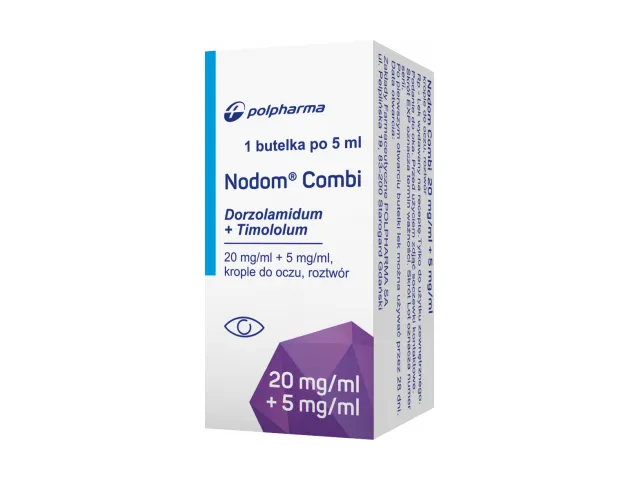
Table of Contents
NODOM, 20 mg/ml, eye drops, solution
Dorzolamide
Please read the following information carefully before using the medicine, as it contains
important information for the patient.
- Keep this leaflet for future reference.
- If you have any doubts, consult your doctor or pharmacist.
- This medicine has been prescribed for a specific individual. Do not share it with others. The medicine may harm another person, even if their symptoms are the same.
- If the patient experiences any adverse reactions, including those not listed in this leaflet, inform a doctor or pharmacist immediately. See section 4.
Table of contents
- What Nodom is and what it is used for
- Important information before using Nodom
- How to use Nodom
- Possible side effects
- How to store Nodom
- Contents of the package and other information
1. What Nodom is and what it is used for
Nodom contains dorzolamide, which belongs to a group of medicines known as "carbonic anhydrase inhibitors".
This medicine is indicated to reduce elevated intraocular pressure and for the treatment of glaucoma.
It may be used alone as an eye medicine or in combination with other medicines that lower intraocular pressure (called beta-adrenergic blocking agents).
2. Important information before using Nodom
When not to use Nodom:
- if the patient is allergic to dorzolamide hydrochloride or any of the other ingredients of this medicine (listed in section 6);
- if the patient has severe kidney function disorders or kidney problems, or has previously had kidney stones.
Warnings and precautions
Before starting to use Nodom, discuss this with your doctor or pharmacist.
Inform your doctor or pharmacist about all current or past medical conditions, including eye diseases or eye surgeries, as well as any allergies to any medicines.
Consult your doctor immediately if eye irritation occurs or any new eye problems develop during treatment, such as eye redness or eyelid swelling.
Stop using the medicine and consult your doctor immediately if the patient suspects that Nodom has caused an allergic reaction (for example: skin rash, severe skin reaction or itching).
Children
The effect of dorzolamide has been studied in infants and children under 6 years of age who have been diagnosed with increased intraocular pressure or glaucoma. For further information, please consult your doctor.
Elderly patients
Studies have shown similar effects of dorzolamide in elderly patients compared to younger individuals.
Use in patients with liver function disorders
Inform your doctor about any current or past liver problems.
Nodom with other medicines
Inform your doctor or pharmacist about all medicines (including eye drops) you are currently taking or plan to use. This is particularly important if you are taking other carbonic anhydrase inhibitors, such as acetazolamide, or sulfonamides.
Pregnancy, breastfeeding and fertility
If you are pregnant or breastfeeding, think you may be pregnant, or are planning to have a baby, consult your doctor or pharmacist before using this medicine.
Use during pregnancy
Do not use this medicine during pregnancy.
Inform your doctor if you are pregnant or planning a pregnancy.
Use during breastfeeding
If treatment with this medicine is necessary, breastfeeding must be discontinued.
Inform your doctor if you are breastfeeding or planning to breastfeed.
Effect on fertility
Animal studies do not indicate that treatment with dorzolamide affects fertility in males or females. There are no data available in humans.
Driving and operating machinery
No studies on the effect of dorzolamide on the ability to drive or operate machinery have been conducted.
Adverse effects associated with the use of Nodom, such as dizziness and visual disturbances, may affect the ability to drive or operate machinery. Do not drive or operate machinery until your well-being improves or visual disturbances resolve.
Nodom contains benzalkonium chloride
The medicine contains 0.075 mg of benzalkonium chloride per 1 ml of solution.
Benzalkonium chloride may be absorbed by soft contact lenses and may change their color. Remove contact lenses before instilling the drops and wait at least 15 minutes before reinserting them.
Benzalkonium chloride may also cause eye irritation, especially in patients with dry eye syndrome or corneal disorders (the transparent layer at the front of the eye). If abnormal sensations in the eye, stinging, or eye pain occur after using the medicine, contact your doctor.
3. How to use Nodom
This medicine should always be used exactly as prescribed by the doctor. In case of doubt, consult
your doctor or pharmacist.
The correct dosage and duration of treatment will be determined by the doctor.
If this medicine is used as the sole treatment, the recommended dose is one drop into the affected eye(s)
in the morning, afternoon, and evening.
If the doctor has prescribed concomitant use of this medicine with a beta-blocker eye drop intended
to reduce intraocular pressure, the recommended dose is one drop of Nodom into the affected eye(s)
in the morning and evening.
If the patient is using other eye medications together with Nodom, an interval of at least 10 minutes
should be maintained between administration of each medication. Ointments should be administered last.
Avoid contact between the dropper tip and the eye or surrounding areas. The dropper may become
contaminated with bacteria, which could lead to eye infections resulting in serious eye damage and
potentially loss of vision. To avoid possible contamination of the medicine, protect the dropper tip
from contact with any surface.
Instructions for use
- Wash your hands thoroughly before instilling the medicine.
- Unscrew the cap from the bottle.
- After removing the cap, if the tamper-evident ring is loose, remove it before using the medicine, as it may fall into the eye and cause injury.
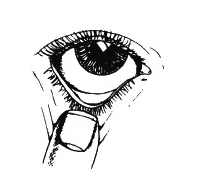
- Tilt your head backward and gently pull down the lower eyelid to create a pouch between the eyelid and the eyeball.
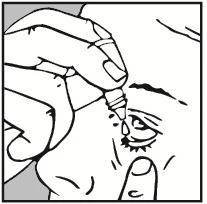
- Invert the bottle and gently press with your thumb or index finger on the side of the bottle until one drop of medicine is dispensed into the eye. DO NOT TOUCH THE EYE OR EYELIDS WITH THE DROPPER TIP. If the drop misses the eye, instill another drop.
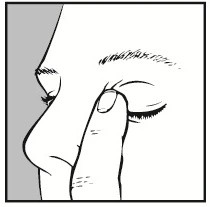
- Close the eye and press with a finger on the inner corner of the eye for about two minutes. This helps prevent the medicine from being absorbed into the rest of the body.
- Repeat steps 4–6 if the doctor has instructed instillation into the second eye.
- The dropper is designed to deliver drops accurately; therefore, DO NOT ENLARGE THE OPENING OF THE DROPPER.
- After instillation, replace the cap on the bottle. Do not overtighten.
Use of a higher than recommended dose of Nodom
If too many drops have been instilled into the eye or if the contents of the bottle have been swallowed,
contact a doctor immediately.
Missed dose of Nodom
It is important to use this medicine exactly as prescribed by the doctor.
If a dose is missed, instill the drop as soon as possible.
However, if it is almost time for the next dose, skip the missed dose and return to the regular dosing schedule.
Do not use a double dose to make up for a missed dose.
Stopping Nodom treatment
If the patient wishes to discontinue using the medicine, they should contact the doctor immediately.
In case of any further doubts regarding the use of this medicine, consult your doctor or pharmacist.
4. Possible adverse reactions
Like any medicine, this medicine can cause adverse reactions, although not everyone experiences them.
If the patient experiences allergic reactions, including hives, facial swelling, swelling of the lips, tongue, and (or)
throat, which may cause difficulty in breathing or swallowing, the use of the medicine must be stopped immediately
and medical advice should be sought.
During clinical trials or after marketing of dorzolamide, the following adverse reactions have been reported:
Very common adverse reactions (occurring in more than 1 in 10 people)
Burning and stinging of the eyes.
Common adverse reactions (occurring in 1 to 10 in 100 people)
Corneal disorders with eye pain and blurred vision (punctate epithelial keratitis), lacrimation, eye discharge with itching (conjunctivitis), eyelid irritation/inflammation, blurred vision, headache, nausea, bitter taste in the mouth, fatigue.
Uncommon adverse reactions (occurring in 1 to 10 in 1,000 people)
Iritis.
Rare adverse reactions (occurring in 1 to 10 in 10,000 people)
Tingling and (or) numbness of hands and (or) feet, transient myopia resolving after discontinuation of treatment, fluid accumulation under the retina (choroidal detachment after filtration surgery), eye pain, eyelid sticking together, low intraocular pressure, corneal edema (with symptoms of visual disturbance), eye irritation with redness, kidney stones, dizziness, nosebleeds, throat irritation, dryness of the mouth, local rash (contact dermatitis), severe skin reactions, allergic reactions such as urticaria, rash, itching. In rare cases, swelling of lips, eyes and mouth, dyspnea, and less frequently wheezing may occur.
Frequency not known (frequency cannot be estimated from the available data)
Dyspnea.
Foreign body sensation in the eye (feeling that something is in the eye).
Pounding heartbeats, which may be fast or irregular (palpitations).
Increased heart rate.
Increased blood pressure.
Reporting of adverse reactions
If any adverse reactions occur, including any adverse reactions not listed in this leaflet, the patient should inform their doctor or pharmacist. Adverse reactions can be reported directly to the Department of Monitoring Adverse Drug Reactions of the Office for Registration of Medicinal Products, Medical Devices and Biocidal Products
Al. Jerozolimskie 181C
02-222 Warsaw
Phone: +48 22 49 21 301
Fax: +48 22 49 21 309
Website: https://smz.ezdrowie.gov.pl
Adverse reactions can also be reported to the marketing authorization holder.
Reporting adverse reactions enables the collection of further information on the safety of the medicine.
5. How to store the medicine Nodom
Keep this medicine out of the sight and reach of children.
Store at a temperature below 25°C.
Do not use this medicine after the expiry date stated on the carton and on the bottle after:
EXP. The expiry date refers to the last day of the stated month.
The marking on the packaging following the abbreviation EXP indicates the expiry date, and following the abbreviation Lot indicates the batch number.
After first opening the bottle, do not use the medicine for longer than 28 days. After this period, the medicine must be discarded, even if it has not been completely used.
Medicines must not be disposed of via wastewater or household waste. Ask your pharmacist how to dispose of medicines no longer in use. This will help protect the environment.
6. Contents of the package and other information
What Nodom contains
- The active substance is dorzolamide. Each ml contains 20 mg of dorzolamide (equivalent to 22.26 mg of dorzolamide hydrochloride). Each bottle contains 5 ml (not less than 140 drops).
- Other ingredients are: hypromellose, mannitol, sodium citrate, benzalkonium chloride solution, sodium hydroxide, water for injections.
What Nodom looks like and contents of the pack
Nodom is a sterile, colourless, transparent, slightly viscous eye drop solution.
The medicine is available in polyethylene bottles with a dropper cap, containing 5 ml of solution.
Pack sizes:
1 bottle of 5 ml in a cardboard box
3 bottles of 5 ml in a cardboard box.
Not all pack sizes may be marketed.
Marketing Authorisation Holder
POLPHARMA S.A. Pharmaceutical Works
ul. Pelplińska 19, 83-200 Starogard Gdański
tel. +48 22 364 61 01
Manufacturer
Rafarm S.A.
Thesi Pousi Xatzi Agiou Louka
Paiania, 190 02
Greece