Nivalin
Poland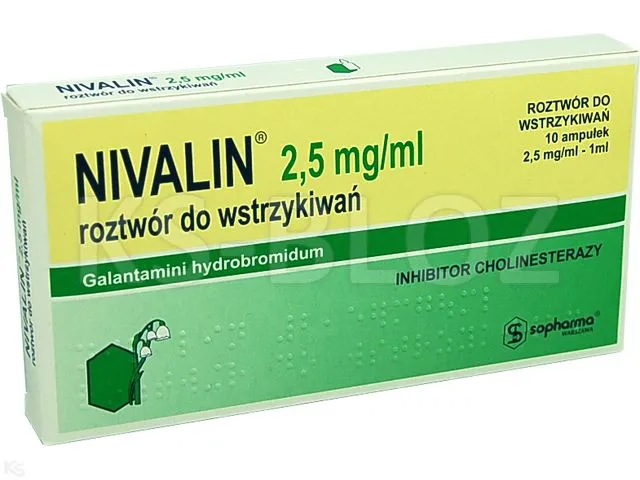
Table of Contents
Package leaflet: Information for the patient
Warning! Keep this leaflet! Information on the immediate packaging is in a foreign language.
Nivalin, 5 mg/ml, solution for injection
Galantamini hydrobromidum
Please read the following leaflet carefully before using this medicine, as it contains
important information for the patient.
- Keep this leaflet, so that you can read it again if necessary.
- If you have any doubts, consult your doctor or pharmacist.
- This medicine has been prescribed for a specific individual. Do not pass it on to others. The medicine may harm someone else, even if their symptoms are the same.
- If the patient experiences any adverse reactions, including any adverse reactions not listed in this leaflet, inform the doctor or nurse. See section 4.
Table of contents of the leaflet:
- What is Nivalin and what is it used for
- Important information before using Nivalin
- How to use Nivalin
- Possible adverse reactions
- How to store Nivalin
- Contents of the package and other information
1. What is Nivalin and what is it used for
Nivalin is a medicine containing galantamine – an alkaloid isolated from snowdrop bulbs.
Galantamine belongs to a group of medicines called acetylcholinesterase inhibitors.
It increases the concentration of a chemical substance called acetylcholine, which is involved in the transmission
of nerve impulses in the central and peripheral nervous system.
Nivalin is used in symptomatic supportive treatment of neurological neuromuscular and spinal cord disorders.
2. Important information before using Nivalin
When not to use Nivalin
- if the patient is allergic to the active substance or to any of the other ingredients of this medicine (listed in section 6),
- if the patient has bronchial asthma (breathing difficulties),
- if the patient has a slow heart rate (bradyarrhythmia) or conduction disorders (atrioventricular block),
- if the patient has ischaemic heart disease (inadequate blood supply to the heart muscle) or severe heart failure (impaired heart function),
- if the patient has epilepsy,
- if the patient has excessive motor activity,
- if the patient has severe renal or hepatic insufficiency.
Warnings and precautions
Before starting treatment with Nivalin, discuss with your doctor:
- if the patient has sick sinus syndrome (impaired generation of electrical impulses in the heart), prolonged QTc interval, or other conduction disorders of the heart;
- if the patient is taking other medicines that may slow the heart rate (digoxin, β-adrenergic receptor blockers);
- if the patient has been diagnosed with high or low blood potassium levels;
- if the patient shows symptoms of Parkinson's disease (tremor, rigidity, mask-like facial expression, slow movements, and shuffling gait);
- if the patient suffers from severe respiratory disease (chronic obstructive pulmonary disease);
- if the patient has moderate renal impairment or urinary tract obstruction, if the patient has recently undergone surgical treatment of the prostate or urinary bladder, or during surgical procedures under general anaesthesia. If excessive weight loss occurs during treatment with Nivalin, it should be monitored.
Nivalin and other medicines
Inform your doctor about all medicines the patient is currently taking, has recently taken, or plans to take.
Some medicines may increase the likelihood of adverse effects in patients taking Nivalin. These include: antiarrhythmic or antihypertensive drugs (quinidine, digoxin, β-adrenergic receptor blockers such as atenolol, propranolol); drugs affecting the QTc interval; antibiotics (gentamicin, amikacin, erythromycin); antidepressants (paroxetine, fluoxetine); ketoconazole (used to treat fungal infections); ritonavir (used in the treatment of AIDS).
Pregnancy and breastfeeding
If the patient is pregnant or breastfeeding, suspects she may be pregnant, or is planning to become pregnant, she should consult her doctor before using this medicine.
Driving and operating machinery
Nivalin may cause visual disturbances, dizziness, and drowsiness, which may affect the ability to drive or operate machinery.
Nivalin contains sodium
This medicine contains less than 1 mmol (23 mg) of sodium per 1 ml of solution, meaning the medicine is considered "sodium-free".
3. How to use Nivalin
Nivalin is available in doses of 2.5 mg/ml and 5 mg/ml.
Nivalin is administered by qualified medical personnel under medical supervision.
The dosage and duration of treatment are determined by the physician depending on the type and severity of the disease.
Nivalin injection solution is administered subcutaneously, intramuscularly, or intravenously. Unless otherwise directed by the physician, the following dosing is recommended:
Treatment of neurological disorders
Use in adults
The recommended initial dose is 2.5 mg. Every 3–4 days, the dose should be gradually increased by 2.5 mg in 2 or 3 divided doses. The maximum single dose in adults is 10 mg subcutaneously, and the maximum daily dose is 20 mg.
Use in children and adolescents
Nivalin is administered subcutaneously in doses prescribed by the physician, depending on the child's age. The drug is given subcutaneously in the following daily doses:
from 1 to 2 years 0.25–1.0 mg
from 3 to 5 years 0.50–5.0 mg
from 6 to 8 years 0.75–7.5 mg
from 9 to 11 years 1.0–10.0 mg
from 12 to 15 years 1.25–12.5 mg
above 15 years 1.25–15.0 mg
The duration of treatment depends on the nature and severity of the disease being treated. Most commonly, treatment lasts 40 to 60 days.
Treatment cycles may be repeated 2–3 times with an interval of 1–2 months between them.
Use of a higher than recommended dose of Nivalin
Since the drug is administered by qualified medical personnel, overdose is unlikely. Nevertheless, any suspicion of overdose should be reported to the physician.
In case of any doubts regarding the use of the medicine, consult your doctor.
4. Possible adverse reactions
Like all medicines, Nivalin can cause adverse reactions, although not everyone experiences them.
Nivalin may slow heart rate or cause cardiac arrhythmia, chest pain, palpitations, nausea, vomiting, diarrhoea, increased peristalsis, and abdominal pain. Sometimes, hypertension or hypotension may occur. Other symptoms include miosis, increased sweating and salivation, as well as excessive secretion from the nose, lacrimal glands, and bronchi, insomnia, muscle cramps, dizziness, headache, rapid breathing, and respiratory disturbances. Loss of appetite and weight loss have been reported. Some patients may experience allergic reactions, including itching, skin rash, urticaria, and rhinitis. In isolated cases, severe hypersensitivity reactions with loss of consciousness have been observed.
Reporting of adverse reactions
If any adverse symptoms occur, including any adverse symptoms not listed in this leaflet, inform your doctor or nurse.
Adverse reactions can be reported directly to the Department of Monitoring Adverse Drug Reactions of the Office for Registration of Medicinal Products, Medical Devices and Biocidal Products, Al. Jerozolimskie 181C, 02-222 Warsaw, tel.: +48 22 49 21 301, fax: +48 22 49 21 309, website: https://smz.ezdrowie.gov.pl.
Reporting adverse reactions helps to provide more information on the safety of the medicine.
5. How to store Nivalin
Keep this medicine out of the sight and reach of children.
Store below 25°C. Keep in the original packaging to protect from light. Do not freeze.
Do not use Nivalin after the expiry date stated on the container. The expiry date refers to the last day of the stated month.
Medicines must not be disposed of via wastewater or household waste. Ask your pharmacist how to dispose of medicines no longer required. This will help protect the environment.
6. Contents of the packaging and other information
What Nivalin contains
- The active substance is galantamine hydrobromide.
- The other components are: sodium chloride and water for injections.
What Nivalin looks like and contents of the pack
1 ampoule with a volume of 1 ml contains 5 mg of galantamine hydrobromide.
Nivalin solution for injection is a clear, colourless or slightly yellow liquid.
Packaging:
Colourless glass ampoules in a PVC blister.
1 blister pack contained in a cardboard box with a patient leaflet.
Pack size:
1 blister containing 10 ampoules, in a cardboard box.
For more detailed information, please contact the marketing authorisation holder or the parallel importer.
Marketing authorisation holder in Latvia, country of export:
Sopharma AD
16, Iliensko Shosse Str.
1220 Sofia
Bulgaria
Manufacturer:
Sopharma AD
16, Iliensko Shosse Str.
1220 Sofia
Bulgaria
Parallel importer:
InPharm Sp. z o.o.
ul. Strumykowa 28/11
03-138 Warsaw
Repackaged in:
InPharm Sp. z o.o. Services sp. k.
ul. Chełmżyńska 249
04-458 Warsaw
Marketing authorisation number in Latvia, country of export: 06-0145
Parallel import authorisation number: 91/18