Niquitin mini
Poland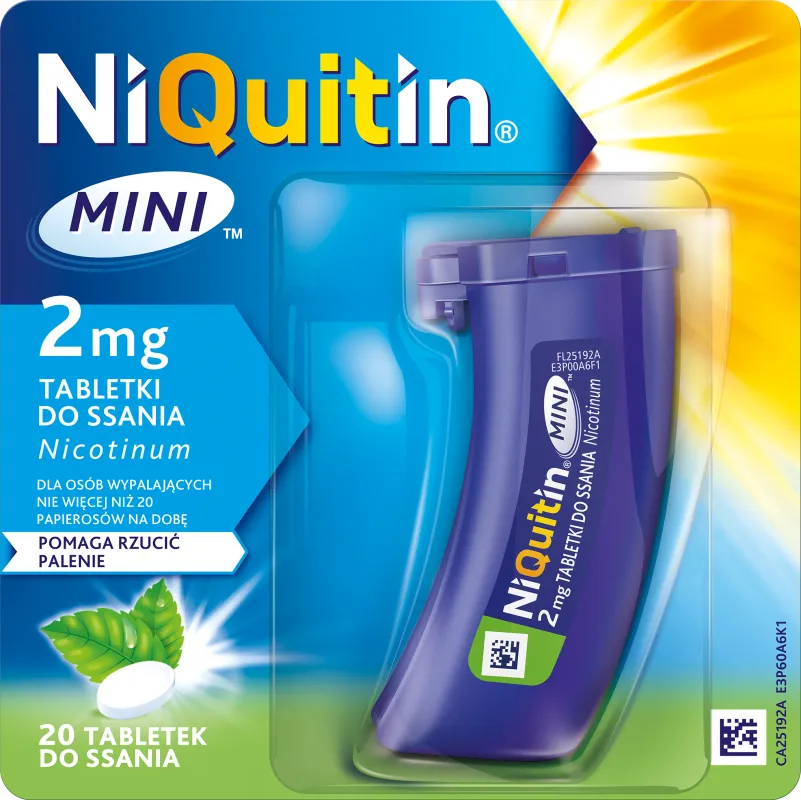
Table of Contents
Package leaflet: Information for the user
NiQuitin MINI, 2 mg, chewing tablets
Nicotinum
Please read all of this leaflet carefully before taking this medicine, because it contains
important information for you.
This medicine should always be used exactly as described in this patient leaflet or as directed by
a healthcare professional.
- Keep this leaflet so that you can read it again if necessary.
- If you need advice or further information, please contact a healthcare professional, such as your doctor, nurse, smoking cessation advisor, or pharmacist.
- If you experience any side effects, including any not listed in this leaflet, tell a healthcare professional. See section 4.
- If you are unable to reduce or stop smoking or using NiQuitin medicine, please consult your doctor. See section 3.
Contents of the leaflet
- What NiQuitin MINI is and what it is used for
- What you need to know before using NiQuitin MINI
- How to use NiQuitin MINI
- Possible side effects
- How to store NiQuitin MINI
- Contents of the pack and other information
1. What NiQuitin MINI is and what it is used for
NiQuitin MINI chewing tablets help you stop smoking. The use of this type of medicine is called Nicotine Replacement Therapy (NRT). NiQuitin MINI is indicated for use in adults and adolescents (aged 12–17 years, after seeking advice from a healthcare professional).
NiQuitin MINI 2 mg chewing tablets are suitable for people who smoke 20 or fewer cigarettes per day.
The ultimate goal of treatment is permanent smoking cessation. NiQuitin MINI chewing tablets may also be used during a gradual smoking cessation programme for individuals who do not wish or are unable to stop smoking abruptly. NiQuitin MINI chewing tablets should be used in conjunction with a behavioural support programme. See section 3: "How to use NiQuitin MINI".
- Nicotine in tobacco causes physical dependence on cigarette smoking. NiQuitin MINI chewing tablets help you quit smoking by replacing some of the nicotine obtained from cigarettes. The nicotine supplied helps relieve some of the unpleasant symptoms associated with smoking cessation, such as low mood and irritability. The supplied nicotine also reduces nicotine withdrawal symptoms and helps control the urge to smoke a cigarette.
NiQuitin MINI chewing tablets eliminate the health risks associated with tobacco smoking, as they do not contain tar, carbon monoxide, or other toxins found in tobacco smoke. Some individuals may be concerned about becoming dependent on nicotine tablets after stopping smoking. Such dependence is very rare, and even if it occurs, it is less harmful to health and easier to overcome than cigarette smoking.
Your chances of quitting successfully are increased if you participate in a support programme. For more information about such programmes, please contact a healthcare professional.
Smoking tobacco brings no health benefits. Therefore, quitting is clearly better for your health. Using Nicotine Replacement Therapy, such as NiQuitin MINI chewing tablets, can help you achieve this. Remember that the health risks associated with smoking tobacco are greater than any side effects that may occur during Nicotine Replacement Therapy.
2. Important information before using NiQuitin MINI
When not to use NiQuitin MINI
- if the patient is allergic (hypersensitive) to nicotine or any of the other ingredients of this medicine (listed in section 6),
- in children under 12 years of age,
- in non-smokers.
Warnings and precautions
Before starting to use NiQuitin MINI, discuss this with a healthcare professional:
- Smoking-dependent individuals who have recently suffered a myocardial infarction (heart attack) or stroke, or who have unstable or worsening angina pectoris (chest pain), rest angina, or severe cardiac arrhythmias, should try to quit smoking without using Nicotine Replacement Therapy (NRT), unless a doctor authorizes its use.
- If the patient is pregnant or breastfeeding.
During attempts to quit smoking, NiQuitin MINI lozenges should not be used interchangeably with nicotine-containing chewing gum.
Consult a healthcare professional in the following cases:
- heart or circulatory problems, including heart failure, stable angina pectoris, high blood pressure, or peripheral arterial occlusive disease,
- diabetes: patients with diabetes should monitor their blood glucose levels more frequently than usual while using NiQuitin MINI lozenges. Dosage recommendations for insulin or antidiabetic medications may need adjustment.
- history of allergic reactions, including swelling of the lips, face, and throat (angioedema) or itchy skin rash (urticaria). NRT may occasionally cause such reactions.
- severe or moderate liver or kidney impairment, due to an increased risk of adverse effects,
- uncontrolled hyperthyroidism or phaeochromocytoma (a tumour of the adrenal gland affecting blood pressure), due to the possibility of worsening symptoms, as advised by a physician,
- peptic ulcer of the stomach or duodenum or oesophagitis (inflammation of the oesophagus, the part of the digestive tract between the mouth and the stomach), because swallowed nicotine may worsen symptoms and may also cause oral ulcers. If symptoms worsen, consult a doctor. It may be necessary to switch from oral Nicotine Replacement Therapy to transdermal patches.
- history of seizures (epilepsy)
- any doubts regarding dependence on this medicinal product, or if the patient believes they have become dependent on this medicine.
Children and adolescents
This medicine must not be used in children under 12 years of age. The typical dose of nicotine used in adults may cause severe or even fatal poisoning in a child. Therefore, NiQuitin MINI must be stored out of sight and reach of children.
Adolescents (aged 12–17 years) should use NiQuitin MINI lozenges only after consultation with a healthcare professional. Adolescents should not use combination NRT when quitting smoking.
NiQuitin MINI and other medicines
Inform your healthcare professional about any medicines you are currently taking or have recently taken. Nicotine may potentially enhance certain effects of medications used for irregular or rapid heartbeat (adenosine), such as increased blood pressure and heart rate, and may also enhance pain response.
Stopping smoking may alter the effects of other medicines. If in doubt, consult a healthcare professional.
The following medicines may require dose adjustments after stopping smoking: asthma medications (theophylline), painkillers (pentazocine), antiarrhythmics (flecainide), antipsychotics (clozapine, olanzapine), dopamine agonists (ropinirole), and caffeine.
NiQuitin MINI with food or drink
Do not eat or drink while sucking a NiQuitin MINI lozenge.
Beverages such as coffee, fruit juices, and soft drinks may reduce the effectiveness of nicotine. Avoid these liquids for 15 minutes before taking a NiQuitin MINI lozenge.
Pregnancy and breastfeeding
If the patient is pregnant or breastfeeding, suspects she may be pregnant, or is planning to have a baby, she should consult a doctor or pharmacist before using this medicine. Combination NRT is not recommended during pregnancy or breastfeeding unless otherwise advised by a healthcare professional.
Pregnancy
Smoking during pregnancy is dangerous for the unborn child. It may cause delayed fetal growth, premature birth, or stillbirth. Quitting smoking is the only effective way to improve the health of both the mother and the baby. The sooner smoking is stopped, the better.
Pregnant women should try to quit smoking without using Nicotine Replacement Therapy. However, if this is not successful, a healthcare professional may recommend using NRT, as it is less harmful to the baby than continuing to smoke.
Breastfeeding
Tobacco smoke exposure in infants and children causes breathing difficulties and other health problems. Nicotine from smoking and from NRT passes into breast milk. Women who are breastfeeding should try to quit smoking without using Nicotine Replacement Therapy. However, if this attempt fails, a healthcare professional may recommend using NRT. When a breastfeeding woman needs to use Nicotine Replacement Therapy to quit smoking, the amount of nicotine to which the infant is exposed is small and significantly less harmful than passive smoking if the mother continued to smoke. It is also advisable to breastfeed before using Nicotine Replacement Therapy to minimize the infant's exposure to nicotine.
Driving and using machines
There is no data available on the effects of NiQuitin MINI lozenges on the ability to drive or operate machinery. However, it should be noted that quitting smoking may cause behavioural changes that could affect the ability to drive or operate machinery.
NiQuitin MINI contains sodium
This medicine contains less than 1 mmol of sodium (23 mg) per lozenge, meaning the medicine is considered "sodium-free".
3. How to use NiQuitin MINI
This medicine should always be used exactly as recommended by a healthcare professional. If in
doubt, consult a healthcare professional.
This product is intended for oral mucosal administration. This means that the nicotine contained
in the lozenge is slowly released into the oral cavity, from where it is absorbed into the body.
Place one NiQuitin MINI lozenge in the mouth and move it occasionally from one side of the mouth
to the other until it dissolves completely (approximately 10 minutes).
Do not chew or swallow the lozenge whole.
Further dosing recommendations depend on whether:
a) the patient intends to stop smoking immediately, or
b) the patient intends to gradually reduce smoking before completely stopping.
Adults (aged 18 years and over)
Monotherapy:
a) Immediate smoking cessation
- For up to 6 weeks, take one lozenge (using 8 to 12 lozenges per day) each time a strong urge to smoke occurs. Then gradually reduce the number of lozenges taken per day.
- When the number of lozenges used per day decreases to 1 or 2, completely discontinue use.
After quitting smoking, an occasional sudden urge to smoke may still occur. In such a case,
the lozenges may be used again.
b) Gradual smoking reduction
When a strong urge to smoke occurs, take a NiQuitin MINI lozenge instead of a cigarette.
Make every effort to reduce the number of cigarettes smoked daily. If it is not possible to reduce
the number of cigarettes smoked per day after 6 weeks, consult a healthcare professional.
The user should completely stop smoking as soon as they feel able. Then follow the instructions
given above under section "a) Immediate smoking cessation". This should be done as soon as possible.
If complete smoking cessation is not achieved within 6 months of starting NiQuitin MINI lozenge treatment,
consult a healthcare professional.
Do not exceed the recommended dose. Follow instructions carefully and do not use more than 15
lozenges in 24 hours.
If you feel the need to use NiQuitin MINI lozenges for more than 9 months in total, seek advice from a
healthcare professional.
Combination therapy:
Intended for individuals who have returned to smoking after using NRT, or for those in whom
using lozenges alone is insufficient to control nicotine cravings, or as first-line treatment for
heavily dependent smokers.
Patients may combine a transdermal system (patch) with oral forms of NRT (such as chewing gum,
lozenges, or other oral preparations). Combination therapy is more effective than using patches alone.
Combination therapy should begin with selecting the appropriate patch dose based on the
individual's previous smoking habits. The recommended number of NiQuitin MINI 2 mg lozenges
used in conjunction with patches is 5 to 6 lozenges per day.
The maximum daily dose is 15 lozenges. Only one type of oral NiQuitin formulation (lozenges or
chewing gum) should be used in combination with the transdermal system (patches).
Continue using the oral NiQuitin product for 2–3 months, then gradually reduce its use as nicotine
craving episodes decrease. When daily consumption decreases to 1–2 lozenges, treatment should be discontinued.
| Individuals smoking more than 10 cigarettes per day | ||
| Phase | Transdermal system (patches) | NiQuitin 2 mg, lozenges |
| For the first 6 weeks | Step 1, NiQuitin Clear 21 mg / 24 hours | 5 to 6 lozenges per day |
| Week 7 and 8 | Step 2, NiQuitin Clear 14 mg / 24 hours | Lozenges should continue to be used as needed |
| Week 9 and 10 | Step 3, NiQuitin Clear 7 mg / 24 hours | |
| After 10 weeks | Discontinue NiQuitin Clear patches | Gradually reduce the number of lozenges. Treatment should be stopped when the patient takes 1 to 2 lozenges per day. |
| Individuals smoking less than 10 cigarettes per day | ||
| Period | Transdermal system (patches) | NiQuitin 2 mg, lozenges |
| For the first 6 weeks | Step 2, NiQuitin Clear 14 mg / 24 hours | 5 to 6 lozenges per day |
| Week 7 and 8 | Step 3, NiQuitin Clear 7 mg / 24 hours | Lozenges should continue to be used as needed |
| After 8 weeks | Discontinue NiQuitin Clear patches | Gradually reduce the number of lozenges. Treatment should be stopped when the patient takes 1 to 2 lozenges per day. |
To obtain additional information, please read the package leaflet included with the
NiQuitin Transparent product.
Use in children and adolescents
Adolescents aged 12–17 years
The medicinal product may be administered to adolescents aged 12–17 years only upon recommendation by a healthcare professional.
Children under 12 years of age must not use NiQuitin MINI.
Consult a healthcare professional if the patient:
- is concerned about relapse into tobacco dependence
- or has difficulties discontinuing the use of the medicinal product
If tobacco use resumes, a healthcare professional will advise on the most effective way to use the next Nicotine Replacement Therapy.
Use of a higher than recommended dose of NiQuitin MINI
If too many NiQuitin MINI tablets are taken, nausea, dizziness, and malaise may occur. In such a case, stop using the medicinal product immediately and seek immediate medical advice from a doctor or go to a hospital emergency department. Bring the package leaflet or the medicinal product packaging along to show to the doctor.
This medicinal product is not intended for children under 12 years of age or for non-smokers. In case of accidental ingestion by a child or a non-smoker, symptoms of nicotine overdose may occur, such as headache, vomiting, abdominal pain, and diarrhoea. A child who has used or ingested the medicinal product must be taken immediately to a hospital emergency department or a doctor must be contacted. If possible, show the doctor the package leaflet or the medicinal product packaging.
4. Possible adverse reactions
Like all medicines, this product may cause adverse reactions, although not everyone experiences them.
Simply stopping smoking can cause symptoms such as dizziness, headache,
sleep disturbances, cough, and flu-like symptoms. Other symptoms (withdrawal symptoms), such as depression,
irritability, anxiety, restlessness, increased appetite, and insomnia, may also be caused by
stopping tobacco use.
If any of the following serious adverse reactions occur, you must stop using the NiQuitin product and immediately contact a doctor, as
they may be signs of a severe allergic reaction:
- Severe allergic reaction, symptoms of which include sudden onset of wheezing or chest tightness, rash, and feeling faint (frequency: very rare)
- Swelling of the skin or mucous membranes, face, tongue, and throat causing difficulty in breathing (frequency: not known)
Other possible adverse reactions:
Very common (may affect more than 1 in 10 users)
- Nausea, vomiting
- Sleep disturbances
Common (may affect up to 1 in 10 users)
- Nervousness, dizziness, headache
- Diarrhea
- Tremor
- Constipation
- Indigestion/heartburn
- Bloating
- Hiccups
- Sore throat
- Cough
- Breathing difficulties, shortness of breath
- Upper abdominal pain
- Dryness of the oral mucosa
- Oral ulcers
- Oral discomfort
- Fatigue (tiredness)
- Feeling of general discomfort
- Flu-like symptoms
- Lack of energy
Uncommon (may affect up to 1 in 100 users)
- Difficulty swallowing
- Palpitations (awareness of heartbeat)
- Increased heart rate
Rare (may affect up to 1 in 1,000 users)
- Hypersensitivity
Frequency not known (cannot be estimated from available data)
- Seizures
- Unusual dreams, depression, irritability, anxiety, disturbances/distortion of taste, rash
- Itching
- Skin redness
- Increased sweating
- Urticaria
- Tingling in the mouth, belching
- Excessive salivation
Reporting of adverse reactions
If any adverse symptoms occur, including any adverse effects not listed
in this leaflet, inform healthcare professionals. Adverse reactions
can be reported directly to the Department of Monitoring Adverse Drug Reactions of the Office for Registration of Medicinal Products, Medical Devices and Biocidal Products, Al. Jerozolimskie 181C, 02-222 Warsaw, Tel: 22 49-21-301, Fax: 22 49-21-309, website: https://smz.ezdrowie.gov.pl
Adverse reactions can also be reported to the marketing authorization holder.
Reporting adverse reactions helps to provide more information on the safety of the medicine.
5. How to store NiQuitin MINI
Keep this medicine out of sight and reach of children.
Do not use this medicine after the expiry date stated on the packaging, following "EXP".
The expiry date refers to the last day of the stated month.
Do not store above 25ºC.
Store in the original immediate packaging to protect from moisture.
The container should not be used for other purposes, as fine dust from the tablets may settle on its walls.
Medicines must not be disposed of via wastewater or household waste. Ask your pharmacist how to dispose of medicines no longer required. Such measures will help protect the environment.
6. Contents of the pack and other information
What NiQuitin MINI contains
- The active substance is nicotine in the form of nicotine cation-exchange resin equivalent to 2 mg of nicotine.
- Other ingredients (excipients) are: mannitol (E 421), sodium alginate (E 401), xanthan gum (E 415), potassium hydrogen carbonate (E 501), calcium polycarbophil, sodium carbonate (E 500), acesulfame potassium (E 950), peppermint flavour (D,L-menthol, peppermint oil, gum arabic, mint flavour), magnesium stearate (E 470b), sucralose.
What NiQuitin MINI looks like and contents of the pack
Approximate size to the nearest 1 mm: length: 10 mm × width: 5 mm
White or almost white, biconvex, oval lozenge for oral sucking, embossed with "NIC2" on one side.
Outer packaging may contain 1 (total 20 lozenges), 3 (total 60 lozenges), or 5 (total 100 lozenges) tablet containers.
Not all pack sizes may be marketed.
Marketing Authorisation Holder
Perrigo Poland Sp. z o.o.
ul. Domaniewska 48
02-672 Warsaw
Tel +48 (22) 852 55 51
Importer
Omega Pharma International NV
Venecoweg 26
9810 Nazareth
Belgium
Perrigo Supply Chain International DAC
The Sharp Building
10-12 Hogan Place
Dublin 2
Ireland
This medicinal product is authorised in the European Economic Area member states under the following names:
Sweden: NiQuitin 2 mg compressed lozenge
Belgium: NiQutin Minilozenge 2 mg zuigtabletten – comprimés à sucer – Lutschtabletten gepresst
Luxembourg: NiQuitin Minilozenge 2 mg
Netherlands: NiQuitin minizugtablet 2 mg, zuigtabletten
Poland: NiQuitin MINI
Portugal: Niquitin Menta 2 mg compressed lozenge
Spain: Niquitin 2 mg comprimidos para chupar sabor menta
Ireland: Niquitin Mini 2 mg Mint Lozenges
Czech Republic: Nicotine Omega
Greece: NiQuitim Mini Mint
Hungary: NiQuitin Minitab 2 mg préselt szopogató tabletta