Niquitin
Poland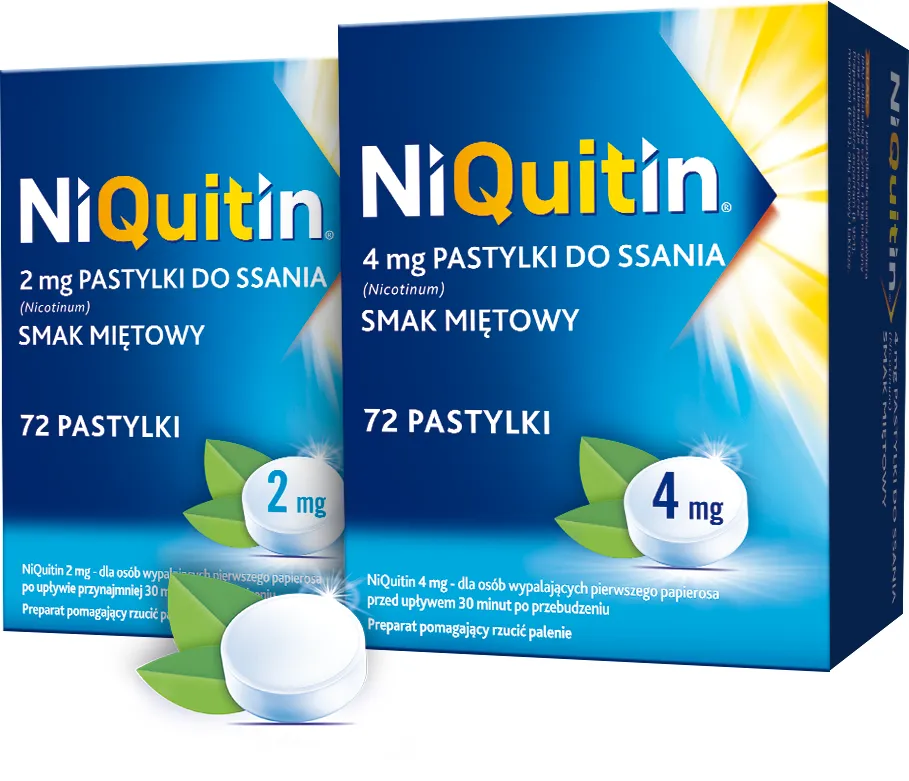
Table of Contents
Package leaflet: Information for the user
NiQuitin, 2 mg lozenges
Nicotinum
NiQuitin, 4 mg lozenges
Nicotinum
Please read all of this leaflet carefully before you start taking this medicine because it contains
important information for you.
Always use this medicine exactly as described in this patient leaflet or as your doctor,
pharmacist, or nurse has told you.
- Keep this leaflet. You may need to read it again.
- If you need advice or further information, please consult your pharmacist.
- If you experience any side effects, including any not listed in this leaflet, tell your doctor, pharmacist, or nurse. See section 4.
- If you do not get better or feel worse, talk to your doctor.
Contents of the leaflet
- What NiQuitin is and what it is used for
- What you need to know before you use NiQuitin
- How to use NiQuitin
- Possible side effects
- How to store NiQuitin
- Contents of the pack and other information
1. What NiQuitin is and what it is used for
NiQuitin lozenges are used in Nicotine Replacement Therapy (NRT) to reduce nicotine craving
and withdrawal symptoms in people dependent on nicotine, regardless of the method of nicotine use.
Nicotine dependence may result from smoking tobacco, inhaling vapour containing nicotine (vaping),
or absorption of nicotine through the cheek from oral products such as nicotine pouches or other nicotine-containing products.
The medicinal product NiQuitin lozenges is indicated as an aid in immediate smoking cessation or in gradually stopping nicotine use before completely giving up the habit, as well as enabling temporary abstinence, e.g. when the use of nicotine products is not permitted. The medicinal product NiQuitin lozenges may also be used to reduce the use of cigarettes and other nicotine products in people who do not plan to quit immediately.
In justified cases, NiQuitin patches and oral forms of the medicinal product may be used in combination. Whenever possible, NRT should be used together with a behavioural support programme, which increases the chance of successful nicotine cessation.
The aim of therapy is complete cessation of nicotine use.
2. Important information before using NiQuitin
When not to use NiQuitin
- if the patient is allergic to nicotine or to any of the other ingredients of this medicine (listed in section 6)
- in children and adolescents under 18 years of age;
- in non-smokers or people who do not use e-cigarettes or nicotine pouches;
- in individuals with hypersensitivity to peanuts or soya.
Warnings and precautions
Exercise particular caution in the following cases:
- uncontrolled hypertension,
- impaired kidney or liver function,
- phaeochromocytoma,
- hyperthyroidism,
- cardiovascular diseases (e.g. stable angina pectoris, heart failure, cerebrovascular disorders, conditions involving vasoconstriction, severe peripheral vascular disease),
- individuals who have ever experienced seizures should consult a doctor, pharmacist or nurse before using this medicine.
- gastric or duodenal ulcer or oesophagitis, as swallowed nicotine may worsen disease symptoms,
- if hospitalisation was due to myocardial infarction, severe cardiac arrhythmia or stroke, the patient should try to stop smoking, vaping or using nicotine products without using nicotine replacement therapy, unless otherwise advised by a doctor. After discharge from hospital, nicotine replacement therapy may be continued as before. If a clinically significant increase in blood pressure occurs or other nicotine-related side effects appear, the dose should be reduced or use of NiQuitin discontinued.
There is a risk of dependence during use of this medicine.
Patients with diabetes: patients should monitor their blood glucose levels more frequently than usual during treatment with this medicine, as requirements for insulin or other antidiabetic medications may change.
Patients with phenylketonuria: NiQuitin tablets contain a source of phenylalanine and may be harmful to people with phenylketonuria.
If a patient has previously been diagnosed with intolerance to certain sugars, the patient should consult a doctor before taking this medicine.
Keep out of the sight and reach of children.
NiQuitin with food and drink
Do not eat or drink while sucking the tablet.
Important information for patients on a low-sodium diet
1 NiQuitin tablet contains 15 mg of sodium. This should be taken into consideration in patients who are monitoring their sodium intake.
NiQuitin and other medicines
Inform your doctor or pharmacist about all medicines currently used, recently used, or which you plan to use.
Pregnancy, breastfeeding and fertility
Pregnant women, women trying to become pregnant, and breastfeeding women should try to stop smoking without using NiQuitin tablets. If quitting smoking is unsuccessful, these women should consult their doctor.
Driving and using machines
The effect of this medicine on the ability to drive and operate machinery is unknown.
3. How to take NiQuitin
This medicine should always be taken exactly as described in the patient information leaflet, or as directed by your doctor, pharmacist, or nurse. If in doubt, consult your doctor, pharmacist, or nurse.
Dosage:
Adults (aged 18 years and over)
NiQuitin 2 mg is suitable for smokers who smoke 20 or fewer cigarettes per day, users of e-cigarettes using liquids with a concentration of <12 mg/ml (1.2%), and users of nicotine pouches with a strength of <10 mg.
NiQuitin 4 mg is suitable for smokers who smoke more than 20 cigarettes per day, users of e-cigarettes using liquids with a concentration of >12 mg/ml (1.2%), and users of nicotine pouches with a strength of >10 mg.
Behavioural counselling and support usually improve the success rate of treatment.
Immediate cessation of smoking, nicotine vaping, or use of oral nicotine pouches (or other nicotine-containing products)
Individuals using NiQuitin should make every effort to completely stop smoking, vaping, or using nicotine pouches during treatment with this product.
The following treatment schedule should be followed:
| Step 1 | Step 2 Step 3 To help prevent Weeks 7 to 9. smoking, Weeks 10 to 12. vaping, or treatment period with treatment period with using nicotine pouches, dose reduction dose reduction for the next 12 weeks: 1 lozenge every 1 lozenge every use 1 or 2 lozenges per day 2-4 hours 4-8 hours only when experiencing strong cravings to smoke a cigarette, vape, or use nicotine pouches | ||
| Weeks 1 to 6. | |||
| initial treatment period | |||
| 1 lozenge every 1-2 hours | |||
From week 1 to week 6, it is recommended to use at least 9 tablets per day.
Do not use more than 15 tablets per day.
Treatment with nicotine tablets may last longer than 24 weeks if necessary to remain abstinent from smoking, vaping, or using nicotine pouches.
Patients using nicotine tablets for longer than 12 months should consult a healthcare professional.
Gradual cessation of smoking, nicotine vaping, or using nicotine pouches (or other products containing):
For smokers, vapers, or users of oral nicotine pouches and other nicotine-containing products who do not wish or are unable to quit immediately.
Take a nicotine tablet whenever a strong urge to smoke, vape, or use a nicotine pouch arises, in order to minimize the number of cigarettes smoked or the amount of nicotine consumed, and to extend the period of abstinence from smoking, vaping, or using nicotine pouches as long as possible.
The number of nicotine tablets used per day varies depending on individual needs. However, do not use more than 15 nicotine tablets per day.
If after 6 weeks of treatment the patient has not managed to reduce cigarette smoking or nicotine intake from vaping or nicotine pouches, they should consult a physician.
Reduced consumption should lead to complete cessation of smoking, vaping, or using nicotine pouches. This goal should be achieved as quickly as possible. Once the number of cigarettes smoked, frequency of vaping, or use of nicotine pouches has been reduced to a level at which the user feels ready to quit completely, they should begin the dosing regimen recommended for "immediate smoking cessation" described above.
If a complete cessation attempt has not been made within 6 months of starting treatment, consultation with a physician is recommended.
Reducing smoking, nicotine vaping, or use of nicotine pouches (or other nicotine-containing products):
For smokers, vapers, or users of oral nicotine pouches who wish to reduce their use of nicotine products without planning immediate cessation.
Take a nicotine tablet whenever a strong urge to smoke, vape, or use an oral nicotine pouch arises, in order to minimize the number of cigarettes smoked or the amount of nicotine consumed and to extend abstinence from smoking, vaping, or using nicotine pouches as long as possible. Users should be encouraged to achieve complete cessation of smoking, vaping, or using nicotine pouches as quickly as possible.
The number of nicotine tablets used per day varies depending on individual needs. However, do not use more than 15 nicotine tablets per day.
If after 6 months from the start of treatment the user still feels the need for regular use of nicotine tablets and has not been able to attempt permanent cessation, it is recommended to seek additional help and advice from a physician.
Temporary abstinence:
Take one tablet every 1–2 hours to control troublesome withdrawal symptoms, including nicotine cravings. Users should not take more than 15 nicotine tablets per day.
Users should be encouraged to achieve complete cessation of smoking, vaping, or using nicotine pouches as quickly as possible. If after 6 months from the start of treatment the user still feels the need for regular use of nicotine tablets and has not been able to attempt permanent cessation, it is recommended to seek additional help and advice from a physician.
Combined Nicotine Replacement Therapy (NRT):
In some cases, it may be beneficial to use more than one form of NRT simultaneously. Combined therapy may be used, for example, by smokers, vapers, or users of oral nicotine pouches who have previously relapsed while using a single NRT product, or if nicotine cravings persist despite NRT use, or if difficulties arise in controlling the urge to smoke or use another nicotine-containing product during monotherapy.
Smokers, vapers, or users of oral nicotine pouches may combine transdermal patches with oral nicotine products (chewing gum, lozenges, etc.). The combination of transdermal patches and oral nicotine is more effective than using transdermal patches alone.
Treatment should begin by establishing the patch dose used in combination with the oral nicotine dose.
Treatment with NiQuitin patches generally starts with the NiQuitin 21 mg dose, which should be reduced according to the following schedule:
Dose Duration
Step 1: NiQuitin 21 mg First 6 weeks
Step 2: NiQuitin 14 mg Next 2 weeks
Step 3: NiQuitin 7 mg Final 2 weeks
For moderate smokers (e.g., smoking fewer than 10 cigarettes per day), vapers using nicotine liquids with concentrations below 6 mg/ml (0.6%), and users of nicotine pouches with strength < 6 mg, it is recommended to start therapy at Step 2 (14 mg) for 6 weeks, then reduce the NiQuitin product dose to 7 mg during the final 2 weeks.
The recommended daily use of oral products in combination with patches is approximately 5–6 units. When using combined therapy, the maximum daily dose of 4 mg oral formulations is 10 units, and for 1.5 mg/2 mg oral formulations, it is 15 units.
Recommended dosing for combined therapy:
For heavier smokers (e.g., smoking more than 10 cigarettes per day, vapers using nicotine liquids with concentrations above 6 mg/ml (0.6%), and users of nicotine pouches with strength > 6 mg):
| Period | Patches* | Oral nicotine dose
chewing gum/lozenge 2 mg/4 mg
or mini lozenge 1.5 mg/2 mg/4 mg |
|------------|---------------|------------------------------------------------------------------------------------------------|
| Step 1: 6 weeks | nicotine 21 mg/24 hours | Average: 5–6 units/24 hours** |
| Step 2: 2 weeks | nicotine 14 mg/24 hours | Continue using oral formulations as needed** |
| Step 3: 2 weeks | nicotine 7 mg/24 hours | Continue using oral formulations as needed** |
| After 8–10 weeks | Discontinue patches | Gradually reduce the number of oral products used.
When daily intake is limited to 1–2 units, treatment should be discontinued. |
*Depending on the number of cigarettes smoked or amount of nicotine consumed per day (see above).
**Smokers consuming more than 20 cigarettes per day, vapers using nicotine liquids with concentration >12 mg/ml (1.2%), and users of nicotine pouches with strength >10 mg should use the 4 mg dose for the first 6 weeks. Afterwards, switch to a lower-dose oral product. The maximum daily dose of 4 mg oral formulations is 10 units, and for 1.5 mg/2 mg oral formulations, it is 15 units.
For lighter smokers (smoking 10 or fewer cigarettes per day, vapers using nicotine liquids with concentration below 6 mg/ml (0.6%), and users of nicotine pouches with strength < 6 mg):
| Period | Patches* | Oral nicotine dose
chewing gum/lozenge 2 mg
or mini lozenge 1.5 mg/2 mg |
|------------|---------------|----------------------------------------------------------------------------------------|
| Step 1: 6 weeks | nicotine 14 mg/24 hours | Average: 5–6 units/24 hours** |
| Step 2: 2 weeks | nicotine 7 mg/24 hours | Continue using oral formulations as needed** |
| After 8–10 weeks | Discontinue patches | Gradually reduce the number of oral products used.
When daily intake is limited to 1–2 units, treatment should be discontinued. |
*Depending on the number of cigarettes smoked or amount of nicotine consumed per day (see above).
**Maximum daily dose of 1.5 mg/2 mg oral formulations is 15 units.
The duration of treatment depends on individual needs. Generally, oral nicotine NRT products are used for 2–3 months, after which the dosage should be gradually reduced. Treatment should be discontinued when the patient is taking 1 to 2 lozenges per day.
Method of administration
Place one tablet in the mouth and allow it to dissolve completely. From time to time, move it from one side of the mouth to the other until fully dissolved (approximately 20–30 minutes). Do not chew or swallow the tablet whole.
Avoid eating or drinking while the tablet is in the mouth.
Use of a higher than recommended dose of NiQuitin
If too many NiQuitin tablets are taken, symptoms such as pallor, cold sweats, salivation, nausea, vomiting, abdominal pain, diarrhea, headache, dizziness, hearing and vision disturbances, tremor, confusion, and weakness may occur. Stop using the medication immediately and consult a doctor or pharmacist without delay.
Missed dose of NiQuitin
If a dose is missed, take the next tablet as soon as possible. Do not take two tablets at the same time to make up for the missed dose.
4. Possible adverse effects
Like all medicines, this medicine may cause adverse effects, although not everyone will experience them.
The adverse effects listed below have been grouped according to their frequency of occurrence:
Very common (occurring in more than 1 in 10 patients)
- nausea
Common (occurring in less than 1 in 10, but in more than 1 in 100 patients)
- vomiting, dyspepsia, abdominal pain, diarrhoea, dry mouth, constipation, hiccups, oral inflammation, flatulence, oral discomfort, heartburn, oral irritation or ulceration
- headache, dizziness
- insomnia, restlessness, increased appetite
- sore throat, cough, throat and larynx pain
Uncommon (occurring in no more than 1 in 100 people)
- peptic ulcer, gastroesophageal reflux, hiatus hernia, oesophagitis, dry throat, toothache
- local numbness, taste disturbances
- low mood, increased anxiety, nightmares, feeling of hunger, mood changes
- laryngospasm, asthma, lower respiratory tract infections, nasal or throat irritation, nasal congestion
- coagulation disorders and associated bleeding (bleeding from gums and nose)
- skin redness
- rash, itching, skin eruption, local skin reactions, excessive sweating
- jaw pain
- nocturnal enuresis
- overdose effect, leg pain, leg swelling
Very rare (occurring in less than 1 in 10,000 people)
- severe allergic reactions such as sudden shortness of breath or chest tightness, skin rash, and feeling faint
Adverse effects with unknown frequency
- palpitations, tachycardia (rapid heartbeat), fast and irregular heartbeat (atrial fibrillation)
- difficulty swallowing, belching, regurgitation (passive movement of stomach contents into the oesophagus), excessive salivation, ulcerative inflammation of the oral mucosa
- weakness, fatigue, malaise, influenza-like symptoms
- hypersensitivity, angioedema (breathing difficulty or swelling of lips, tongue, throat or face), urticaria
- tremor
- seizures
- nervousness
- dyspnoea
- unusual dreams
If any adverse effects occur, including any possible adverse effects not listed in this leaflet, consult a doctor, pharmacist or nurse.
Reporting of adverse effects
If any adverse effects occur, including any adverse effects not listed in this leaflet, inform your doctor, pharmacist or nurse. Adverse effects can also be reported directly to the Department of Monitoring Adverse Drug Reactions, Office for Registration of Medicinal Products, Medical Devices and Biocidal Products, Al. Jerozolimskie 181C, 02-222 Warsaw,
tel.: 22 49-21-301, fax: 22 49-21-309
website: https://smz.ezdrowie.gov.pl
Adverse effects can also be reported to the marketing authorization holder.
Reporting adverse effects helps to provide more information on the safety of the medicine.
5. How to store NiQuitin
Store below 25 °C in the original packaging. The medicine should be stored
in a place out of sight and reach of children.
Do not use this medicine after the expiry date stated on the packaging. The expiry date refers to
the last day of the stated month.
If you have any questions or doubts, consult your doctor or pharmacist.
Medicines must not be disposed of via wastewater or household waste. Ask your
pharmacist how to dispose of medicines you no longer use. This will help protect
the environment.
6. Contents of the pack and other information
What NiQuitin contains
The active substance is nicotine. Each tablet contains 2 mg or 4 mg of nicotine (in the form of
nicotine with cation exchange resin).
The other ingredients are: mannitol (E421), sodium alginate (E401), xanthan gum (E415),
potassium hydrogen carbonate (E501), anhydrous sodium carbonate, aspartame (E951), magnesium stearate, peppermint flavour (containing maltodextrin and modified starch).
What NiQuitin looks like and contents of the pack
NiQuitin is a white or almost white, round tablet presented in blisters. The carton contains 12, 24, 36 or 72 tablets in blisters.
Marketing Authorisation Holder and Importer:
Marketing Authorisation Holder:
Perrigo Poland Sp. z o.o.
ul. Domaniewska 48
02-672 Warsaw
tel. +48 (22) 852 55 51
Importer:
Perrigo Supply Chain International Designated Activity Company
The Sharp Building
Hogan Place
Dublin 2
Dublin, D02 TY74, Ireland