Nicerin
Poland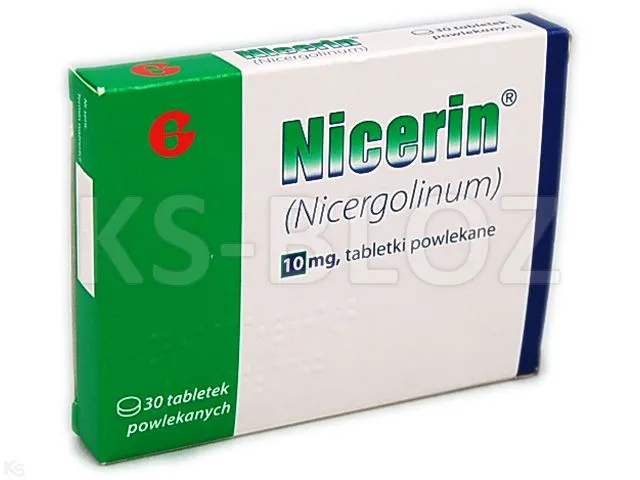
Table of Contents
Package leaflet: Information for the patient
Nicerin, 10 mg, coated tablets
Nicergolinum
Please read the entire leaflet carefully before using the medicine, as it contains important information for the patient.
- Keep this leaflet for future reference.
- If you have any doubts, consult your doctor or pharmacist.
- This medicine has been prescribed for a specific individual. Do not pass it on to others. This medicine may harm others, even if their symptoms are similar.
- If you experience any adverse reactions, including any not listed in this leaflet, inform your doctor or pharmacist. See section 4.
Table of contents
- What Nicerin is and what it is used for
- Important information before taking Nicerin
- How to take Nicerin
- Possible side effects
- How to store Nicerin
- Contents of the pack and other information
1. What Nicerin is and what it is used for
Nicerin belongs to a group of medicines that dilate peripheral blood vessels. Nicergoline, the active substance of this medicine, improves blood flow in the brain and has anti-aggregatory properties (prevents platelets from clumping together).
Nicerin is indicated for the treatment of patients with mild to moderate dementia.
2. Important information before using Nicerin
When not to use Nicerin:
- if the patient is allergic to nicergoline, other ergotamine derivatives, or any of the other ingredients of this medicine (listed in section 6);
- in patients with recent myocardial infarction;
- in case of haemorrhage;
- in case of severe bradycardia (slow heart rate);
- in patients with hypotension or a history of orthostatic hypotension (reduction in blood pressure associated with change in body position from lying to standing);
- when used concomitantly with alpha- or beta-mimetic drugs (e.g. drugs used in bronchial asthma and nasal mucosal inflammation).
Warnings and precautions
Before starting treatment with Nicerin, discuss with your doctor or pharmacist:
- if the patient has elevated levels of uric acid in the blood;
- if the patient has previously been diagnosed with gout;
- if the patient is taking medicines that may affect uric acid metabolism and excretion.
Nicergoline may reduce systolic blood pressure, and to a much lesser extent:
- diastolic blood pressure in patients with normal or elevated blood pressure.
Use of ergotamine derivatives may cause fibrotic reactions (e.g. in the lungs, heart, heart valves, retroperitoneal space).
If there are any doubts regarding the use of the medicine, consult your doctor or pharmacist.
In case of severe nausea, vomiting, diarrhoea, abdominal pain, or peripheral vasoconstriction, contact your doctor or pharmacist, as these symptoms may indicate ergotamine poisoning.
Nicerin with other medicines
Inform your doctor or pharmacist about all medicines currently used, recently used, or planned to be used.
Nicerin may enhance the effect of antihypertensive drugs.
Nicerin may interact with antiarrhythmic drugs, beta-adrenergic receptor blocking drugs used in the treatment of hypertension and certain heart diseases, and tricyclic drugs used in the treatment of depression. Nicerin may increase the negative chronotropic (heart function suppressing) effect of beta-adrenergic receptor blockers.
Concomitant use of Nicerin and antiplatelet drugs (including acetylsalicylic acid) or anticoagulants may prolong bleeding time.
Use of drugs affecting uric acid metabolism and excretion (e.g. those used in the treatment of gout) may alter uric acid metabolism and excretion.
Nicerin with food, drink and alcohol
See section 3.
As with other drugs acting on the nervous system, concomitant alcohol consumption may intensify adverse effects on the nervous system.
Pregnancy and breastfeeding
If the patient is pregnant or breastfeeding, suspects she may be pregnant, or is planning to become pregnant, she should consult her doctor or pharmacist before using this medicine.
Nicerin should not be used during pregnancy. If administration is absolutely necessary, it should be performed under direct medical supervision.
It is not known whether nicergoline passes into human milk. Nicerin should not be used during breastfeeding.
Driving and operating machinery
No studies have been conducted on the effect of the medicine on the ability to drive vehicles or operate machinery.
However, when driving vehicles or operating machinery, consider the possibility of dizziness or drowsiness occurring.
Nicerin contains 60 mg of monohydrate lactose
If the patient has previously been diagnosed with intolerance to certain sugars, the patient should consult a doctor before taking this medicine.
3. How to use Nicerin
This medicine should always be used exactly as prescribed by the physician. In case of doubt, consult
your doctor or pharmacist.
The doctor will determine the dose and duration of treatment.
Nicergoline should be administered in doses ranging from 10 mg to 60 mg per day. The medicine should be given in two
divided doses: during breakfast and lunch.
Nicerin coated tablets should be swallowed whole with water, during breakfast
and lunch. Tablets must not be chewed.
Long-term administration of Nicerin is recommended. After 6 months, the doctor will assess whether
treatment should be continued.
Elderly patients
Dosage adjustment is not required in elderly patients.
Patients with renal function impairment
In patients with impaired renal function, the doctor will reduce the dose.
Use of a higher than recommended dose of Nicerin
If a higher than recommended dose of Nicerin is taken and symptoms indicating a significant
decrease in blood pressure occur (dizziness, fainting), the doctor may recommend appropriate symptomatic treatment.
In acute poisoning, gastric lavage should be performed and activated charcoal administered.
If an overdose is taken, seek immediate medical advice from a doctor or pharmacist.
Missed dose of Nicerin
The missed dose should be taken as soon as possible, except when it is almost time for the next dose.
A double dose must not be taken to make up for a missed dose. In case of doubt, consult your doctor.
Discontinuation of Nicerin
Do not stop treatment without consulting your doctor.
4. Possible adverse reactions
Like all medicines, this medicine can cause adverse reactions, although not everybody will experience them.
The adverse reactions listed below are categorized according to system organ classes and frequency of occurrence.
Common adverse reactions (may occur in 1 to 10 out of 100 patients): abdominal discomfort.
Uncommon adverse reactions (may occur in 1 to 10 out of 1,000 patients):
agitation, confusion, insomnia, drowsiness, dizziness, headache, hypotension, facial flushing, constipation, diarrhoea, nausea, pruritus, increased blood uric acid concentration.
Frequency unknown (cannot be estimated from available data): feeling of warmth, rash, fibrosis (e.g. in lungs, heart, heart valves, retroperitoneal space).
Reporting of adverse reactions
If any adverse reactions occur, including any possible adverse reactions not listed in this leaflet, inform your doctor or pharmacist. Adverse reactions can be reported directly to the Department of Monitoring of Adverse Drug Reactions of the Office for Registration of Medicinal Products, Medical Devices and Biocidal Products
Al. Jerozolimskie 181C, 02-222 Warsaw, Phone: +48 22 49 21 301, Fax: +48 22 49 21 309,
Website: https://smz.ezdrowie.gov.pl
Adverse reactions can also be reported to the Marketing Authorization Holder.
Reporting adverse reactions helps provide more information on the safety of the medicine.
5. How to store Nicerin
Keep this medicine out of sight and reach of children.
Do not use this medicine after the expiry date stated on the outer carton after "EXP" and on the blister after the abbreviation "EXP". The expiry date refers to the last day of the stated month.
Store below 25°C. Keep in the original packaging to protect from moisture.
Medicines must not be disposed of via wastewater or household waste. Ask your pharmacist how to dispose of medicines no longer required. These measures will help protect the environment.
6. Contents of the pack and other information
What Nicerin contains
- The active substance is nicergoline. Each Nicerin tablet contains 10 mg of nicergoline.
- Other ingredients are:
Tablet core: monohydrate lactose, corn starch, microcrystalline cellulose PH-101, povidone K 25, crospovidone, magnesium stearate.
Tablet coating: hypromellose E5-LV, hypromellose E15-LV, eudragit E100, glycerol, propylene glycol, polysorbate 80, titanium dioxide (E 171).
What Nicerin looks like and contents of the pack
Nicerin 10 mg: white or almost white, round, biconvex coated tablets.
Pack sizes:
Nicerin 10 mg is packed in blisters placed in a cardboard box containing 30, 50 or 60 tablets.
Not all pack sizes may be marketed.
Marketing Authorisation Holder
neuraxpharm Arzneimittel GmbH
Elisabeth-Selbert Str. 23
40764 Langenfeld
Germany
Manufacturer
Glenmark Pharmaceuticals s.r.o.
Fibichova 143
566 17 Vysoké Mýto
Czech Republic
For further information, please contact the representative of the Marketing Authorisation Holder:
Neuraxpharm Polska Sp. z o.o.
ul. Domaniewska 37
02-672 Warsaw