Nebispes
Poland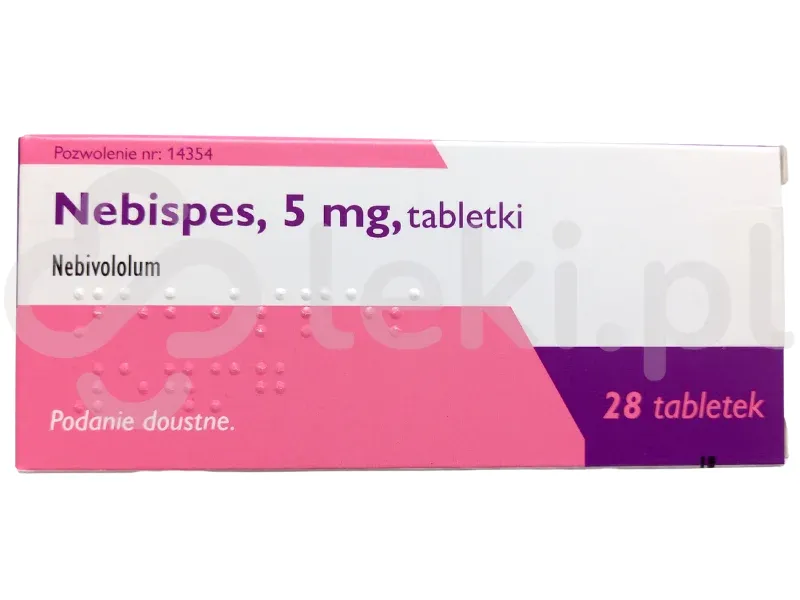
Table of Contents
Package leaflet: Information for the user
Nebispes, 5 mg, tablets
Nebivolol
Please read all of this leaflet carefully before taking this medicine, because it contains
important information for you.
- Keep this leaflet. You may need to read it again.
- If you have any further questions, ask your doctor or pharmacist.
- This medicine has been prescribed for a specific individual. Do not pass it on to others. It may harm them, even if their symptoms are the same.
- If you experience any side effects, including any not listed in this leaflet, tell your doctor or pharmacist. See section 4.
Leaflet contents:
- What Nebispes is and what it is used for
- What you need to know before taking Nebispes
- How to take Nebispes
- Possible side effects
- How to store Nebispes
- Contents of the pack and other information
1. What Nebispes is and what it is used for
Nebispes contains nebivolol, which is a selective beta-adrenergic blocking agent with vasodilating properties.
This medicine is used to treat high blood pressure (hypertension).
Nebispes is also used in the treatment of chronic heart failure in patients aged 70 years or older.
2. Important information before using Nebispes
When not to use Nebispes
- if the patient is allergic to nebivolol or any of the other ingredients of this medicine (listed in section 6),
- in case of low blood pressure (systolic or "upper" blood pressure lower than 90 mm Hg),
- in case of poor blood circulation in the arms or legs,
- in case of very slow heart rate (less than 60 beats per minute before starting this medicine),
- if the patient has been diagnosed with heart conduction disorders (such as sick sinus syndrome or atrioventricular block) and does not have a pacemaker implanted,
- in case of acute heart failure or intravenous treatment (via intravenous infusion) to support heart function,
- in case of severe breathing difficulties or wheezing,
- if the patient has untreated adrenal gland tumour called phaeochromocytoma,
- if the patient has severe liver disease or impaired liver function,
- in case of metabolic acidosis (as in diabetic patients when blood sugar becomes too high and blood pH becomes too acidic),
- if the patient is using medicines containing floctafenic or sultopride.
Warnings and precautions
Before starting treatment with Nebispes, discuss this with your doctor or pharmacist if:
- the patient has or develops any of the following conditions:
- heart failure (inability of the heart to pump enough blood to meet the body's needs),
- mild atrioventricular heart block (first-degree),
- chest pain caused by coronary artery spasm (so-called Prinzmetal's angina or nocturnal angina),
- poor circulation in the arms or legs, e.g. Raynaud's disease or Raynaud's phenomenon, muscle cramp-like pain during walking,
- long-term breathing problems,
- diabetes, because nebivolol may mask symptoms of low blood sugar (hypoglycaemia) and may increase the risk of severe hypoglycaemia when used together with certain types of antidiabetic medicines called sulfonylureas (such as glyquidone, gliclazide, glibenclamide, glipizide, glimepiride or tolbutamide),
- hyperthyroidism, because Nebispes may mask abnormally rapid heart rate associated with this condition,
- allergies, because allergic reactions may be more severe and may require larger doses of medicines for treatment,
- skin conditions known as psoriasis, because Nebispes may worsen symptoms,
- wearing contact lenses, because Nebispes may reduce tear production and cause dry eyes.
The use of Nebispes in children and adolescents under 18 years of age is not recommended.
In such cases, the doctor may adjust treatment or monitor the patient more frequently.
If surgery is planned and anaesthesia is required, it is important that the patient informs the surgeon or dentist about taking this medicine.
In case of kidney function impairment, this medicine should not be used for the treatment of heart failure. Inform your doctor about this.
Nebispes with other medicines
Tell your doctor or pharmacist about all medicines the patient is currently taking or has recently taken, as well as any medicines the patient plans to take.
Always inform your doctor or pharmacist if the patient is taking any of the following medicines together with Nebispes:
- diltiazem or verapamil (used to treat high blood pressure or other heart conditions); intravenous verapamil should not be administered during treatment with Nebispes,
- other medicines known as calcium antagonists used to treat high blood pressure or other heart conditions, such as amlodipine, felodipine, lacidipine, nifedipine, nicardipine, nimodipine, nitrendipine,
- other antihypertensive medicines or organic nitrates used to treat chest pain,
- clonidine, guanfacine, moxonidine, methyldopa, rilmenidine used to treat high blood pressure,
- medicines used to treat heart rhythm disorders (irregular heartbeat), such as quinidine, hydroquinidine, amiodarone, cibenzoline, flecainide, disopyramide, lidocaine, mexiletine, propafenone,
- tricyclic antidepressants (used to treat depression), phenothiazines (used to treat psychosis) or barbiturates (used to treat epilepsy),
- diabetes medicines such as insulin or oral antidiabetic medicines,
- digoxin or medicines known as digitalis glycosides (used to treat heart failure),
- non-steroidal anti-inflammatory drugs (NSAIDs) used for pain and inflammation – note that low daily doses of acetylsalicylic acid (e.g. 50 or 100 mg) used for antithrombotic purposes can be safely taken with Nebispes,
- medicines used to treat asthma, nasal congestion or certain eye disorders such as glaucoma (increased eye pressure) or pupil dilation,
- anaesthetics: always inform the anaesthesiologist that the patient is taking Nebispes before undergoing anaesthesia,
- cimetidine (used to treat stomach acidity) – Nebispes should be taken with food, and antacids should be taken between meals,
- medicines affecting nebivolol metabolism, i.e. terbinafine (used in fungal or candidiasis infections), bupropion (used to aid smoking cessation), chloroquine (used to treat malaria or rheumatoid arthritis), levomepromazine (used to treat psychosis), paroxetine, fluoxetine, thioridazine (used to treat depression),
- amifostine (a protective agent used during chemotherapy or radiotherapy),
- baclofen (a muscle relaxant),
- mefloquine (an antimalarial medicine).
Nebispes with food and drink
Nebispes can be taken before, during or after meals, or on an empty stomach. The tablet or its parts should be swallowed with water or another liquid.
Pregnancy and breastfeeding
Pregnancy
Do not use Nebispes during pregnancy unless your doctor decides otherwise.
Breastfeeding
Breastfeeding is not recommended while taking Nebispes.
If the patient is pregnant or breastfeeding, suspects she may be pregnant, or is planning to have a baby, she should consult her doctor or pharmacist before using this medicine.
Driving and using machines
No studies on the effect on the ability to drive or operate machinery have been conducted.
This medicine lowers blood pressure and may therefore cause dizziness or fainting. If these occur, DO NOT drive or operate machinery. These symptoms are more likely at the beginning of treatment or after dose increase (see also section 4).
Nebispes contains lactose
This medicine contains lactose. If the patient has been diagnosed with an intolerance to certain sugars, he or she should consult a doctor before taking this medicine.
3. How to use Nebispes
Nebispes must always be taken exactly as directed by the physician. If in doubt,
consult the doctor or pharmacist again.
Treatment of high blood pressure (hypertension)
- The usual dose is 1 tablet per day.
- For elderly patients and patients with impaired renal function, the initial dose is usually 1/2 tablet per day.
- It may take up to 4 weeks before the medicine starts to work fully.
Treatment of chronic heart failure
- Treatment will be initiated and monitored by an experienced physician.
- Treatment starts with an initial dose of 1/4 tablet per day. This dose may be increased after 1–2 weeks to 1/2 tablet per day, then to 1 tablet per day, and subsequently to 2 tablets per day, until the appropriate dose for the patient is reached.
- The maximum recommended dose is 10 mg (2 tablets per day).
- The patient must be observed by an experienced physician for 2 hours after starting treatment and each time the dose is increased.
- If necessary, the physician may reduce the dose of the medicine; treatment must not be stopped suddenly, as this could worsen heart failure.
- Patients with severe renal impairment should not take this medicine.
The medicine should be taken once daily, preferably at the same time each day.
The physician may decide to co-administer Nebispes tablets with another medicine indicated for the individual patient.
Nebispes is not recommended for use in children and adolescents.
Taking more Nebispes than recommended
If too many tablets are accidentally taken (overdose), the patient may experience: slow heart rate, low blood pressure, other heart-related disorders, breathing difficulties or wheezing. Immediate contact should be made with the nearest hospital emergency department, or a doctor or pharmacist should be informed.
Missing a dose of Nebispes
If the patient forgets to take the medicine but remembers shortly afterwards, the next tablet should be taken at approximately the usual time. However, if a significant delay has occurred (e.g. a full day), the missed dose should be skipped and the next dose taken at the usual time the following day. A double dose must not be taken to make up for a missed dose. Repeatedly missing doses should be avoided.
Stopping Nebispes treatment
Do not stop taking Nebispes without first consulting a doctor. Stopping the medicine suddenly may cause a dangerous worsening of symptoms.
If there are any further doubts about the use of this medicine, consult a doctor or pharmacist.
4. Possible adverse reactions
Like all medicines, this medicine can cause adverse reactions, although not everybody gets them.
If any of the following symptoms occur, stop taking Nebispes and
immediately inform your doctor or go to the nearest hospital emergency department:
- Feeling of tightness in the chest and breathing difficulties or wheezing (uncommon, may occur in no more than 1 in 100 people)
- Swelling of the face, lips, throat or tongue (angioedema), allergic reaction (hypersensitivity), itchy rash (urticaria) (frequency not known, cannot be estimated from available data)
Common adverse reactions (may occur in no more than 1 in 10 people) in the treatment
of high blood pressure:
- Headache
- Dizziness
- Fatigue
- Unusual itching or tingling sensation
- Diarrhea
- Constipation
- Nausea
- Shortness of breath
- Swelling of hands or feet
Common adverse reactions (may occur in no more than 1 in 10 people) in the treatment
of chronic heart failure:
- In a clinical study on chronic heart failure, the following adverse reactions were observed: slow heart rate, dizziness
Uncommon adverse reactions (may occur in no more than 1 in 100 people) in the treatment
of high blood pressure:
- Slow heart rate or other heart-related disorders
- Low blood pressure
- Onset or worsening of pain in the feet/legs while walking due to narrowing of arteries and inadequate blood circulation (intermittent claudication)
- Vision abnormalities
- Impotence (difficulty achieving erection)
- Feeling of depression
- Indigestion, stomach or intestinal gas
- Vomiting
- Skin rash
- Itching
- Nightmares
Uncommon adverse reactions (may occur in no more than 1 in 100 people) in the treatment
of chronic heart failure:
- In a clinical study on chronic heart failure, the following adverse reactions were observed: worsening of heart failure, low blood pressure (e.g. feeling faint when standing up quickly), drug intolerance, irregular heartbeat, swelling (e.g. swelling around the ankles).
Very rare adverse reactions (may occur in no more than 1 in 10,000 people):
- Fainting
- Worsening of psoriasis
Reporting of adverse reactions
If any adverse reactions occur, including any adverse reactions not listed
in this leaflet, inform your doctor or pharmacist. Adverse reactions can be reported
directly to the Department of Monitoring Adverse Drug Reactions of the Office for Registration of Medicinal Products, Medical Devices and Biocidal Products
Al. Jerozolimskie 181C,
02-222 Warsaw
Tel.: + 48 22 49 21 301
Fax: + 48 22 49 21 309
Website: https://smz.ezdrowie.gov.pl
Reporting adverse reactions helps to provide more information on the safety of the medicine.
5. How to store Nebispes
Keep this medicine out of sight and reach of children.
Do not use this medicine after the expiry date stated on the outer and immediate packaging following "EXP". The expiry date refers to the last day of the specified month.
Do not store above 30°C.
Medicines must not be disposed of via wastewater or household waste. Ask your pharmacist how to dispose of medicines no longer in use. Such measures help protect the environment.
6. Contents of the pack and other information
What Nebispes contains
The active substance is nebivolol.
Each tablet contains 5 mg of nebivolol, equivalent to 5.45 mg of nebivolol hydrochloride.
The other ingredients are:
Monohydrate lactose
Crospovidone type A
Poloxamer 188
Povidone K-30
Microcrystalline cellulose
Magnesium stearate
What Nebispes looks like and contents of the pack
Nebispes tablets are white, round, biconvex, with crossed notches dividing the tablet on one side, approximately 9 mm in diameter.
The Nebispes tablet can be divided into four equal parts.
The tablets are packed in blisters made of PVC/PE/PVDC/Aluminium (containing 7, 10 or 14 tablets).
Pack sizes: 7, 10, 14, 20, 28, 30, 50, 56, 60, 90, 100 and 120 tablets.
Not all pack sizes may be marketed.
Marketing Authorisation Holder
Bausch Health Ireland Limited
3013 Lake Drive
Citywest Business Campus
Dublin 24, D24PPT3
Ireland
Manufacturer
PharmaPath S.A.
28is Octovriou 1
Agia Varvara
123 51 Greece
This medicinal product is authorised in the Member States of the European Economic Area under the following names:
DK: Nebispes 5 mg tabletter
HU: Nebispes 5 mg tabletta
PL: Nebispes, 5 mg, tabletki
SI: Nebispes 5 mg tablete
CZ: Nebispes 5 mg tablety
EE: Nebispes 5 mg tabletid
LT: Nebispes 5 mg tabletės